

A Canadian family driving south with a dog in the back seat faces less federal paperwork today than they would have in 2023. That is the good news, and it is also the reason this move trips people up: the rules got simpler in 2024, several guides never caught up, and “simpler” gets misread as “nothing to check.” A land border crossing with a pet is not a formality. It is a short, specific checklist, and the checklist is different from the one this site’s own guides to taking a dog to Thailand and taking a dog to Portugal describe, because a land border works nothing like an international flight.
Three separate authorities touch this move, not one. The United States federal government sets the entry rule. The destination state can layer its own requirement on top, independent of what the border officer checks. Canada runs its own, much lighter, process for a pet leaving the country. Several guides collapse those three into one undifferentiated list, or state a rabies-certificate requirement that stopped being federally required in August 2024.
What Changed in 2024, and Why Some Guides Still Get It Wrong
Before 1 August 2024, a dog entering the United States could face a chain of USDA and CDC paperwork depending on its vaccination history and origin. The CDC replaced that chain with a single form for the case that covers almost every Canada-based mover: a dog that has spent the six months before travel only in Canada, the US or Mexico. For that dog, the free CDC Dog Import Form, completed online before travel, is the only federal document required. No rabies vaccination certificate, no USDA endorsement, no separate CDC “rabies-free” certification. That last point is where several guides go wrong. One veterinary-clinic guide states that a dog needs to be “vaccinated against rabies at least 30 days before entering the US” to cross from Canada. That was accurate under the pre-2024 rule but is not the current federal requirement for a Canada-only dog. Rabies vaccination remains a good idea, for reasons covered below, but it is not what gets your dog across this specific border today.
You’re Actually Navigating Three Separate Rule Sets
Federal: what CDC actually requires at the border
A US border officer enforces this rule at every port of entry, land, air or sea. This federal rule is the only layer with real power to refuse your dog entry. CDC’s own guidance states it plainly: for dogs that have been only in dog-rabies-free or low-risk countries in the six months before entry, “the only required documentation… is the CDC Dog Import Form.” Canada is not on CDC’s high-risk list, so a Canada-only dog qualifies.
State: a layer the border agent does not enforce, but your new home does
Individual US states set their own animal-health law independent of the federal border rule. Several states require current proof of rabies vaccination for dogs, regardless of where the animal entered the country. They include Florida, Arizona, California and Texas, and Florida and Texas extend the rule to cats. A CBP officer at a land crossing is checking the CDC rule, not state law. State law becomes relevant the first time you register the pet with a local vet, boarding kennel, groomer or municipal licensing office at your destination. By then, “I did not need it to cross the border” is not a useful answer. Carry a current rabies certificate even though CDC does not ask for one, because your destination state almost certainly will.
Canada’s side: what CFIA requires before your dog leaves
CFIA’s own guidance on dogs travelling to the United States does not set a separate Canadian export health certificate for a personal pet leaving for the US. It confirms that CDC’s August 2024 requirements apply, and directs owners straight to CDC for the specifics. CFIA’s cats and ferrets guidance says the same thing more explicitly: it points owners to USDA APHIS and CDC for the actual requirements and confirms that CFIA endorsement is not required.
Our role is to plan every stage properly and manage it with experienced international coordination from departure through to arrival.
Your Dog’s Complete Checklist for the US Border
Age, microchip and health, the three baseline conditions
Underneath the CDC Dog Import Form sits a short set of physical conditions that apply to every dog entering the US from a low-risk country, Canada included, with no exceptions for a short trip or a service animal:
- At least 6 months old at the time of entry. This applies to a Canada-only dog exactly as it applies to a dog from anywhere else. A dog that turns 6 months old the week after your planned crossing date is not eligible the week before, and there is no accelerated path around it.
- Microchipped, and the chip must be readable with a universal scanner. CDC does not require an ISO-11784 or ISO-11785-specific chip for a Canada-only dog, unlike the EU-bound rules this site’s Portugal guide describes. Any brand works, provided a universal scanner can read it. The chip that fails this test at the counter has migrated, has failed, or was implanted with a non-standard reader in mind.
- Healthy on arrival. CDC does not define this with a checklist. The officer on duty can refer a visibly ill or injured animal for a closer look. That is why a current rabies certificate and basic vet records are worth carrying even though nothing federally requires them for a Canada-only dog.
The CDC Dog Import Form, what it actually is
You complete it online, it is free, and it produces a receipt you print or show on your phone at the border. A few mechanics catch first-time movers:
- One form per dog. A household moving with two dogs needs two separate submissions. A single receipt does not cover more than one animal.
- The person bringing the dog into the US completes it, listed as the importer, owner or shipper.
- The receipt is valid for six months from issue, and covers repeat entries within that window, provided the dog has not visited a high-risk country or a different low-risk country in the meantime.
- There is no minimum lead time. You can complete it the day of travel, though CDC itself recommends doing it a few days ahead simply to have it done, not because processing takes time.
If your dog has spent any part of the last six months in a country on CDC’s high-risk list for dog rabies, none of the above applies in the simple form described here. That situation needs additional CDC documentation. A foreign-vaccinated dog cannot use a land crossing at all. If your dog’s last six months include a stop anywhere other than Canada, the US or Mexico, check CDC’s current guidance for that specific country before you plan around this article’s simpler case.
Your Cat’s Checklist Is Genuinely Shorter, Not Just Under-Documented
USDA APHIS states directly that it “does not have any animal health requirements related to bringing (importing) a pet cat into the United States from a foreign country.” There is no federal Dog Import Form equivalent for cats, no age minimum, no federal microchip mandate. A cat is still visually inspected at the port of entry to confirm it is not visibly ill. None of that means travelling with no paperwork at all is the smart move. The same state-law layer described above applies to cats: several states require current rabies proof independent of any federal rule. A vet visit shortly before the move, with a written rabies record, costs little and closes that gap completely.
Land Border vs Flying: What Actually Changes
This site’s pet-transport content is built around flying, including our guides to moving pets from the USA to Thailand and from Canada to Thailand.
- There is no IATA crate standard to satisfy. The snub-nosed dog crate-sizing formula and ventilation rules that govern a cargo-hold flight are airline requirements, not border requirements. Driving your own dog across in your own vehicle, restrained for safety, satisfies CBP with no crate specification at all.
- There is no airline breed embargo to clear. Airlines refuse to carry certain brachycephalic breeds as cargo because of documented in-flight health risk, not because any government prohibits those breeds from entering the country. Driving removes that constraint. A French Bulldog or Pug that no airline will carry crosses a land border under exactly the same rule as any other dog.
- The Dog Import Form works at any port of entry. CDC’s own guidance is explicit that a dog meeting the low-risk-country conditions “can enter the U.S. at any airport, seaport, or land border crossing.” There is no land-specific version of the form.
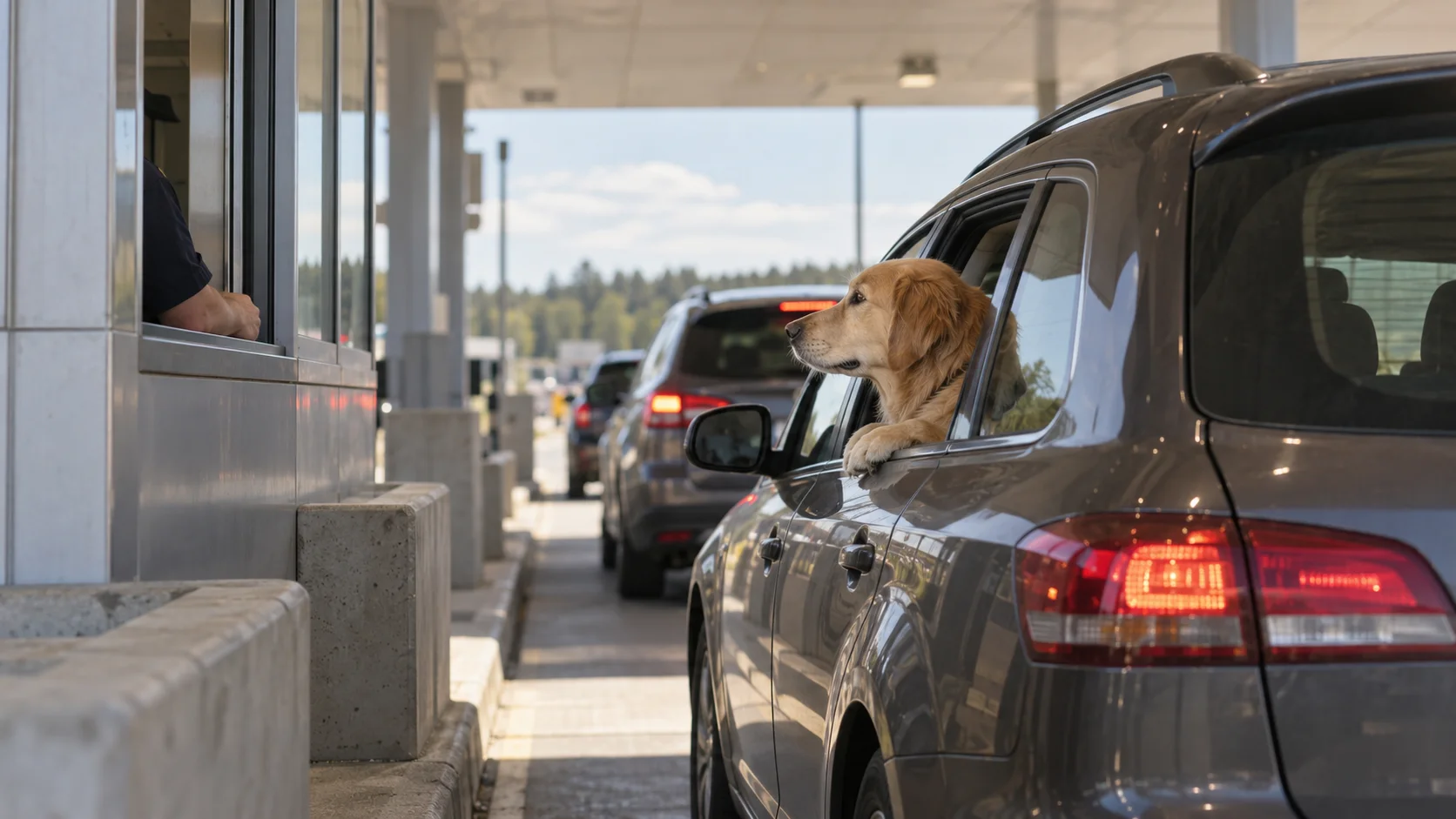
- Driving adds officer discretion in real time. A land crossing puts you face to face with a CBP officer who can ask questions, request the receipt, and refer the dog for secondary inspection if anything looks off. Budget extra time for this, particularly at a high-volume crossing, rather than planning to the minute.
Breed Restrictions: What’s Real and What Isn’t
There is no federal US breed restriction on a dog entering the country, by land, air or sea. USDA and CDC’s requirements above apply identically regardless of breed. Two separate things sometimes get confused with a border-level breed ban. The first is the airline embargo covered above, which is a carrier policy relevant only if you fly rather than drive. The second is breed-specific legislation at the municipal or condo-association level in your destination, unconnected to border entry. Some US cities and homeowners’ or condo associations still restrict certain breeds within their limits, though the trend in several states runs the other way. Florida, for one, passed a state law in 2023 that preempts most local breed-specific bans. That is why Miami-Dade’s long-standing pit bull restriction no longer applies county-wide. The rule that matters for your specific move is your destination city’s own ordinance and your building’s own pet policy, not a federal or border-level list.
The Sequence That Works
Your dog’s age is the one condition with a real waiting period, and this sequence keeps it from becoming the thing that delays the whole move.
- Confirm your dog will be 6 months or older on the planned crossing date. Do this first, before booking anything else. If your dog is younger, the move date moves, not the rule.
- Confirm the microchip is implanted and scannable. If your dog was chipped years ago at a different clinic, ask your vet to scan it with a universal reader before you travel, not at the border.
- Book a vet visit for a current rabies vaccination and a written record. Not federally required for a Canada-only dog, but the single most useful document for the state-law layer described above and for your new vet, groomer, or kennel.
- Complete the CDC Dog Import Form a few days before travel. Print the receipt and save a copy on your phone.
- Pack the paperwork where you can reach it without stopping the car. Keep the Dog Import Form receipt, the rabies certificate, and the microchip record together at the crossing, not in a box in the moving truck.
- Check your destination state’s rabies-registration rule and your new city’s or building’s pet policy before you finalise where you are living, not after.
What This Actually Costs: DIY vs a Relocation Service
Doing it yourself costs close to nothing in government fees. The CDC Dog Import Form is free. If your dog is not already current, a vet visit for a rabies vaccination and written record typically runs somewhere in the range of CAD $50 to $150 depending on your clinic and province, and that is the whole federal-and-state-facing cost for most Canada-only movers. The real cost of the DIY route is not money. It is the sequencing risk covered above: an under-age dog, an unscannable chip, or a missed state requirement discovered after you have already arrived. Hiring a pet relocation or cross-border pet-transport specialist buys certainty on that sequencing, plus someone else driving and handling the crossing itself. Industry-reported ranges for a domestic, ground-based pet move put shorter point-to-point trips at roughly CAD $200 to $600, rising toward CAD $1,000 to $3,500 for a longer cross-country run. Those figures sit well below the CAD $2,000 to $4,500-plus quoted for a full international air-freight relocation, because a land crossing is the lighter-weight job of the two. A first-time mover with a straightforward, healthy, adult dog and a flexible schedule can reasonably do this without help. On a fixed closing date, with an anxious or elderly pet, or juggling a household move and a pet move on the same week, the extra cost buys something real: one less variable that can go wrong on a day that already has too many of them. A quote for a Canada-to-US pet move costs nothing to request and gives you a real number to weigh against the DIY route before you commit to either.
What Actually Goes Wrong at the Border
- Owners run the age math on the day of booking, not the day of travel. A dog that turns 6 months old two weeks before the crossing is fine. A dog booked to cross two weeks before that birthday is not. Rebooking a move around a vet’s estimate of a birth date is an awkward late discovery.
- Movers complete the Dog Import Form for the wrong country of departure. A dog that took a side trip to a different low-risk country needs the receipt to name that country as the country of departure, not Canada re-used from a previous Canada-only trip.
Frequently Asked Questions
Do I need a rabies vaccination certificate to bring my dog into the US from Canada?
Not federally, provided your dog has spent the last six months only in Canada, the US or Mexico. CDC’s August 2024 rule replaced that requirement with the free Dog Import Form for exactly this case. Carry a current rabies certificate anyway: several US states require one independent of the federal border rule, and it is the single most useful document once you register with a vet at your destination.
How old does my dog need to be to cross into the US from Canada?
At least 6 months old at the time of entry, with no exception for Canada-only travel history. This is the one condition in the whole process with no way to compress it after the fact, so confirm it before booking the move.
Does my cat need any special paperwork to enter the US from Canada?
No federal document equivalent to the Dog Import Form exists for cats. USDA APHIS states directly that it has no animal health requirements for a pet cat entering the US from another country. A current rabies record is still worth carrying for the same state-law reasons that apply to dogs.
Can I cross at any land border crossing, or only certain ones?
CDC’s guidance states that a qualifying dog can enter at any airport, seaport, or land border crossing, with no separate list of approved land crossings. Budget extra time at a high-volume crossing, since a land border puts you in front of an officer who can refer any animal for a closer look.
Does my dog’s breed matter for crossing into the US?
Not at the federal border level. There is no US breed restriction on entry by land, air or sea. Airline breed embargoes are a carrier policy relevant only if you fly, and any local breed-specific rule in your destination city or building is a separate matter from border entry, worth checking with your new municipality directly.
Do I need a professional pet relocation service for a Canada-to-US move, or can I do this myself?
Most Canada-only movers with a healthy adult dog can complete this move themselves at close to zero government cost, since the CDC form is free. On a tighter timeline, with an anxious or elderly pet, or for a household already managing a full move on the same schedule, a relocation specialist earns its cost by taking on the sequencing risk rather than the paperwork itself.
What does Canada require before my dog leaves for the US?
Very little for a personal, non-commercial pet. CFIA’s own guidance confirms that CDC’s requirements govern this move and does not set a separate Canadian export health certificate. The administrative burden on the Canadian side of this specific corridor is close to zero.
Sources:
- CDC: Bringing a Dog into the U.S.
- CDC: Entry Requirements for Dogs from Dog-Rabies Free or Low-Risk Countries
- Canadian Food Inspection Agency: Dogs Travelling to the United States
- Canadian Food Inspection Agency: Exporting Cats and Ferrets to the United States
- USDA APHIS: Bring a Pet Cat (Domestic) into the United States
- U.S. Customs and Border Protection: Bringing Pets and Wildlife into the United States
A land border crossing is procedurally the lightest pet move this site covers, and that is exactly the condition under which small things get skipped. Swift Cargo’s pet relocation team handles the age and microchip checks, the CDC Dog Import Form, and the destination-state paperwork as one sequenced file, so a birthday or a failed chip scan gets caught weeks before the crossing date instead of at the booth. Start with a quote for your pet’s move and we will map the paperwork against your actual travel dates. If your move also involves household goods, our guide to Canada’s goods-to-follow export declarations covers that paperwork, and our guide to leaving Canada as an emigrant covers the CRA residency and CBSA export-reporting steps that apply regardless of which country you are heading to.