
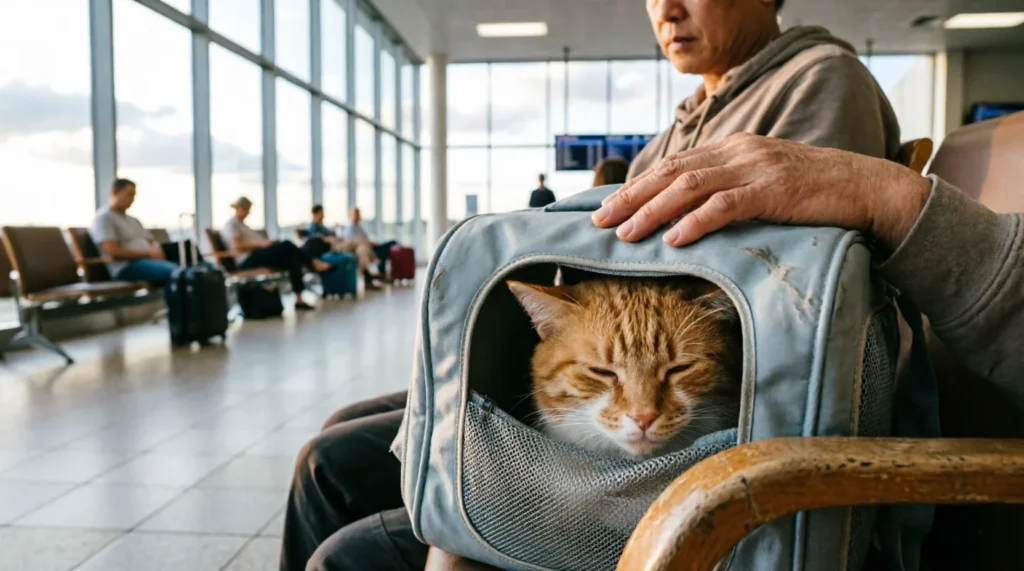
Not one of the airlines currently flying passengers between Australia and Thailand will let a dog or cat sit at your feet in the cabin. Qantas won’t. Thai Airways won’t. Singapore Airlines won’t. Jetstar, the only carrier flying direct between Australia and Phuket, doesn’t carry live animals in its hold at all, let alone in the cabin. That is the direct answer to the question this article’s title asks, and it’s worth stating plainly before anything else, because most of what gets written about “flying pets in cabin” online is written about routes where it’s actually possible, and quietly assumes the reader’s route works the same way. This one doesn’t.
What follows isn’t a dead end, though. It’s a more specific and more useful question than the one most owners start with: not “can my pet sit with me,” but “which of the remaining options actually gets my pet from Australia to Thailand, and what does each one require.” Airline policy on this shifts without much warning: a route gets added, a partnership changes, a trial program quietly expands. Everything below should be treated as where things stand today, confirmed directly with the airline before you commit to a booking, not as a permanent rule.
Why There Is No Universal Answer
Cabin-pet policy isn’t set once, industry-wide. It’s set per airline, and often per route within that airline’s own network. A carrier can allow small pets in cabin on its domestic short-haul network while banning them entirely on international widebody services, which is close to exactly what has happened with Jetstar’s own cabin-pet trial: real, but confined to a handful of short Australian domestic sectors, with no indication it extends to international flying. Asking “do airlines allow pets in cabin” is a bit like asking whether restaurants take reservations: the honest answer is that it depends entirely on which one, and the only way to know for certain is to ask that specific carrier about that specific route.
The Australian Departure Sector Matters More Than People Expect
Which Australian city you’re flying from changes the answer more than most owners assume going in. Thai Airways’ own pet policy explicitly excludes Sydney, Melbourne, Perth and Brisbane. The airline does not accept pets as checked baggage on flights to or from any of those four cities, which covers essentially every major Australian gateway Thai Airways serves. That’s not a cabin restriction specifically; it’s a full pet-travel restriction on the Australian end of the route, for an airline that does carry pets as checked baggage elsewhere in its network. Qantas and Thai Airways both operate direct flights between Australia and Bangkok, but only Qantas carries pets on this corridor at all, and only through Qantas Freight as manifest cargo, not as a passenger booking. Jetstar flies direct daily between Melbourne and Phuket, and between Perth and Phuket. Its aircraft cargo holds aren’t pressurized, so it carries no live animals in any class on those routes, and that includes the cabin: Jetstar’s cabin-pet trial stays confined to short domestic Australian services and doesn’t extend to this one.
Operating Carrier Versus Ticketing Airline
A detail that trips up more bookings than it should: the airline whose name is on your ticket is not always the airline actually operating the aircraft. Codeshare agreements mean a flight sold as “Thai Airways” or booked through a Qantas partnership can be operated by a different carrier’s aircraft and crew, and pet policy follows the operating carrier, not the name on your itinerary. An owner might check Thai Airways’ published pet policy, then book a codeshare flight actually operated by a regional partner with different rules. They can arrive at the airport with a booking that doesn’t match the policy they researched. Before assuming any pet policy applies, confirm the operating carrier for your specific flight number. Most booking confirmations list it in smaller print near the flight details, and it’s worth a direct check rather than an assumption.
Cabin-Route Feasibility: What Actually Applies Today
Laid out by carrier, this is what the current picture looks like for a pet travelling between Australia and Thailand:
| Airline | AU-Thailand routes flown | Cabin pets | Checked baggage / cargo pets | What this means practically |
|---|---|---|---|---|
| Qantas | Direct to Bangkok (Sydney, Melbourne) | Not offered on any route | Yes, but only as manifest cargo via Qantas Freight, using a professional pet shipper | Not a passenger-ticket option; arranged separately as freight |
| Thai Airways | Direct to Bangkok; connects on to Chiang Mai | Not offered | Checked baggage (AVIH) offered on some routes, but explicitly excluded on flights to/from Sydney, Melbourne, Perth and Brisbane | Effectively not usable for a pet departing the four major Australian cities Thai Airways serves |
| Singapore Airlines | Via Singapore (common connection, not direct) | Not offered | Yes, as checked baggage (AVIH), up to roughly 32kg combined weight | Usable, but adds a transit stop in Singapore with its own clearance rules (see below) |
| Jetstar | Direct to Phuket (Perth, Melbourne) | Trial limited to short domestic AU routes only, not international | Not offered; aircraft holds are unpressurized, no live animals carried in any class | The only direct AU-Phuket carrier currently carries no pets on that route at all |
| AirAsia | Regional connections via Kuala Lumpur | Not offered | Not offered; no pets accepted network-wide, any class | Not a viable option for pet travel under any circumstance |
Read plainly, that table has one consistent message: the passenger-ticket pathway (cabin or checked baggage, booked on your own reservation) is either unavailable or route-restricted on every carrier actually flying this corridor. The pathway that remains open is manifest air cargo, arranged through a freight forwarder or pet-transport specialist rather than through the airline’s own passenger booking system.
Carrier Size, Weight and Why the Numbers Rarely Apply Here
In-cabin pet travel isn’t currently offered on this route, but the numbers are still useful context for why the restriction exists. Where cabin travel is offered elsewhere, airlines typically cap combined pet-and-carrier weight around 9kg, with the carrier required to fit fully under the seat in front of the passenger. Checked-baggage and cargo ceilings run considerably higher; Singapore Airlines’ own published limit sits around 32kg combined. But a weight ceiling is only ever the second filter. The first is IATA’s container-sizing formula: internal length equal to nose-to-tail length plus half the leg height, width roughly double the shoulder width, height enough to stand and turn fully upright. Airlines can refuse a crate that fails that standard, regardless of what the scale reads.
Transit Rules: What Happens at the Connection
Most Australia-to-Thailand pet bookings that don’t route through Qantas Freight directly will touch a connection point, and Singapore is the most common one given Singapore Airlines’ network. Singapore’s Animal & Veterinary Service treats any transiting pet as subject to inspection by the Changi Animal & Plant Quarantine Station, and a connection longer than six hours means the ground handling agent transfers the pet out of the aircraft’s hold into its own holding area for the duration of the wait. That’s not a bad outcome, but it is a real one, with its own climate and handling standards that are separate from the airline’s. As of a 2026 rule change, owners can no longer clear a transiting pet themselves through Singapore; the process now requires an AVS-recognised pet agent to handle documentation and inspection on the owner’s behalf, which is one more reason a coordinated booking through a specialist tends to outperform a self-arranged multi-leg itinerary on this specific route.
Through-Ticket Versus Self-Transfer
A through-ticket means one booking, with one airline or codeshare partnership responsible for the pet across every leg. That keeps a single party accountable for the connection. Self-transfer means an owner books two separate tickets on two separate airlines and personally re-clears the pet between them. That removes accountability entirely: nobody is contractually responsible for what happens to the animal during the gap between flights, and the owner has to physically manage a live-animal re-clearance in an unfamiliar airport, on a schedule set by two airlines that don’t coordinate with each other. On a route where the passenger-ticket pathway is already this restricted, a self-transfer plan adds a second layer of risk on top of a corridor that’s already tight. A through-arranged cargo booking with a single accountable operator is the more defensible choice here, not just the more convenient one.
Thailand’s Entry Documents Don’t Change Based on Travel Method
Thailand’s own import requirements apply identically, whichever pathway gets a pet there: cargo, checked baggage on a route where it’s actually offered, or, in the rare case of a future policy change, cabin. The Department of Livestock Development’s R.1/1 application, R.6 approval and R.7 arrival clearance don’t have a different version for cargo versus checked baggage; the paperwork is the same regardless of which part of the aircraft the animal travelled in. Owners who haven’t yet worked through that process should read our full breakdown of Thailand’s pet import permit forms before locking in a flight date, since the permit’s validity window needs to be timed against the travel method actually booked.
Cabin Versus Direct Cargo: The Trade-off That Actually Exists
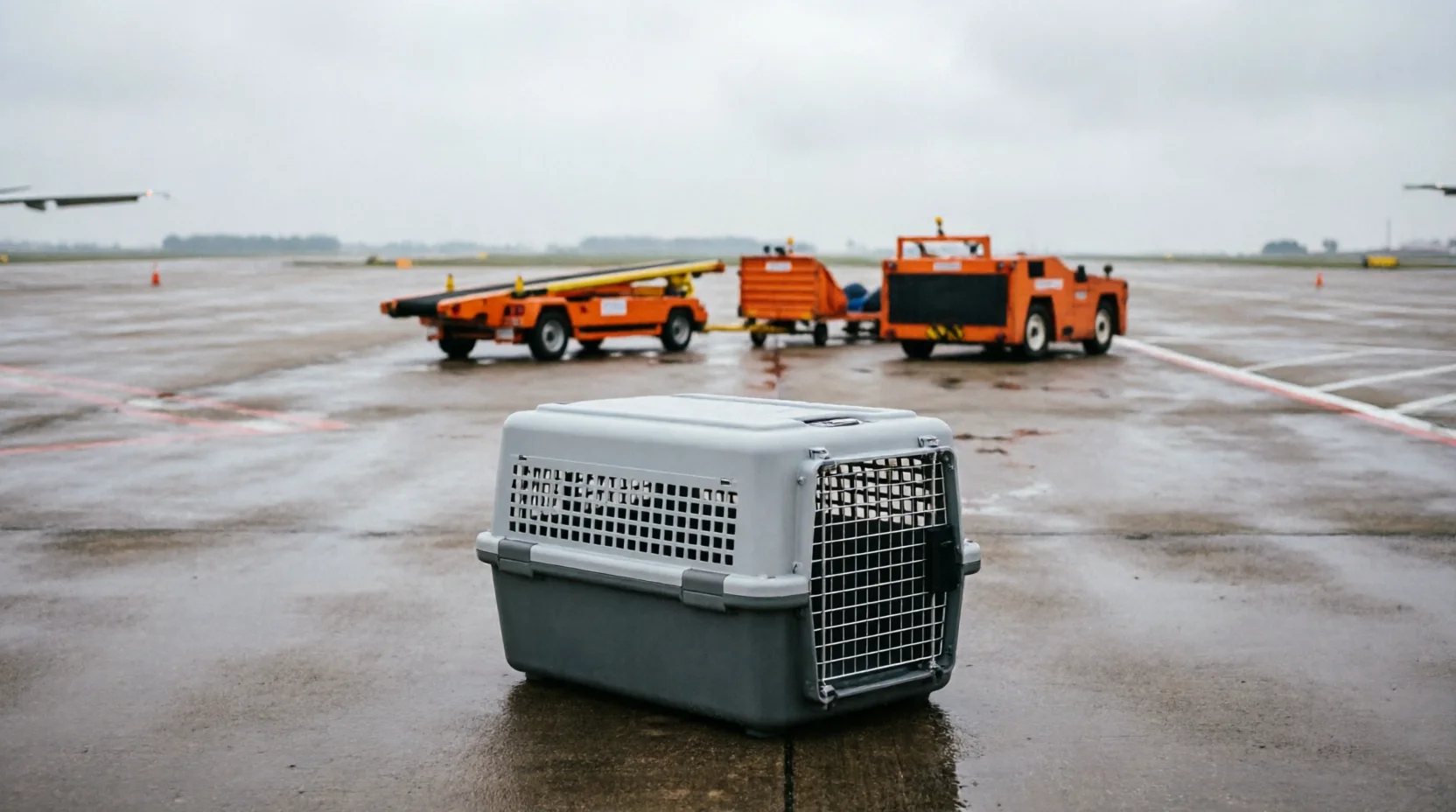
Since cabin isn’t genuinely on the table for this route today, the real decision an owner faces is between checked baggage on a route where it happens to be offered (currently just Singapore Airlines, with a Singapore transit) and manifest air cargo arranged directly (available via Qantas Freight or an independent pet-transport operator). Checked baggage keeps the pet nominally “with” the owner’s itinerary, but ties departure timing to a human passenger’s own schedule and adds the Singapore transit’s handling requirements. Manifest cargo can be scheduled independently of a passenger’s own flight. It also allows more control over routing, specifically over heat exposure and long connections, the two factors our guide to whether pet cargo travel is safe treats as the real safety drivers. And it’s the pathway that a dedicated pet-transport service is actually built around end to end, from crate sizing through Thai customs clearance.
Questions to Ask the Airline Before You Book Anything
- Does your airline carry live animals, in any class, on the specific flight number I’m booking, not just somewhere in your network?
- Who is the operating carrier for this flight number, and does their pet policy match what I’ve read on your site?
- Is my departure city on any excluded-route list for pet travel?
- If there’s a connection, which airline is responsible for my pet during that layover?
- Is this a checked-baggage (AVIH) booking on my own ticket, or manifest cargo booked separately, and which one are you actually describing to me?
- What happens to my booking if your airline’s pet policy changes between today and my travel date?
What to Get in Writing
- Written confirmation of the operating carrier and aircraft type for your specific flight number
- The airline’s current crate-size and weight requirements, in writing, before you buy a carrier
- Confirmation of which party is responsible for the pet during any connection or transit stop
- A clear statement of whether the booking is checked baggage on your ticket or a separate cargo booking
- The airline’s current heat-embargo and seasonal-restriction policy for your specific route
Verbal assurances from a call centre are not the same as a written confirmation attached to a booking reference, and this is a route where the gap between the two has real consequences.
Route Examples, Without Promising Availability
None of the following should be read as a guarantee. Airline capacity, seasonal embargoes and policy all shift, so treat this as a realistic picture of how the pieces currently fit together. A Sydney-based owner typically has the most workable options: Qantas Freight for manifest cargo on the direct Sydney-Bangkok route, or a Singapore Airlines checked-baggage booking via Singapore. A Perth or Melbourne-based owner with a preference for Phuket over Bangkok faces the narrowest field. Jetstar, the only direct carrier on that specific city pair, doesn’t carry pets in any class, which typically means routing the pet through Bangkok as cargo and arranging separate onward transport to Phuket, a logistics question our comparison of Australia-to-Thailand pet transport costs covers in full. A Brisbane-based owner loses the Thai Airways checked-baggage option outright under the current route exclusions, which narrows the realistic choice down to cargo from the outset. Whichever Australian city you’re departing from, the Thai airport your pet actually clears through is its own decision. See our comparison of Bangkok, Phuket and Chiang Mai as pet-entry points before locking in a routing.
Swift Cargo’s pet transport team builds the itinerary around whichever of these pathways is actually open for a specific departure city and destination, rather than starting from what would be most convenient and working backward. That’s the practical answer to a question that, honestly, doesn’t have a single universal one.
Related reading: Pet Transport from Perth to Thailand: Airline, Arrival and WA Rules
Frequently Asked Questions
Can dogs fly in cabin from Australia to Thailand?
Not on any of the airlines currently operating passenger flights on this route. Qantas does not carry pets in cabin on any route. Thai Airways does not offer in-cabin pet travel and additionally bans pets as checked baggage entirely on flights to and from Sydney, Melbourne, Perth and Brisbane. Singapore Airlines does not accept pets in cabin. Jetstar does not carry live animals in the cargo hold at all on its direct Perth-Phuket and Melbourne-Phuket services, and its cabin-pet trial is limited to short domestic Australian routes, not international ones.
Can cats fly in cabin on the same route?
The same restrictions apply to cats as to dogs. None of the carriers operating passenger services between Australia and Thailand currently accept any pet species in the cabin on that route. A cat’s smaller size and weight don’t change an airline’s cabin-pet policy, which is set at the route and carrier level, not by species.
Do any airlines allow pets in cabin between Australia and Thailand?
Not as of this writing, across the carriers that actually operate passenger services on this corridor. Airline policy changes without much notice, so this should be treated as a starting point for a call to the specific airline, not a permanent fact. The practical route today runs through manifest air cargo, not a cabin or checked-baggage booking on your own ticket.
What is the weight limit for a pet carrier on a Thailand flight?
In-cabin travel isn’t currently offered by any airline on Australia-Thailand routes, but where it’s offered elsewhere, a common combined pet-plus-carrier ceiling is around 9kg. For checked baggage or cargo travel, ceilings are typically far higher, commonly up to 32kg combined for a single animal and carrier. Airlines size and weigh the specific crate against IATA’s container formula, not just a single number.
What’s the difference between cargo and cabin for pet travel?
Cabin travel means the carrier rides under the seat in front of you on your own ticket, which is not currently offered by any Australia-Thailand carrier. Checked baggage (sometimes called AVIH) means the pet travels in the hold on your flight, booked alongside your own ticket. Manifest air cargo means the pet travels as freight, arranged separately through a cargo agent or pet shipper, sometimes on a different flight than the owner. On this specific route, manifest cargo is the option that is actually available in practice.
Do I still need Thailand import documents if my pet flies as cargo instead of cabin?
Yes, identically. Thailand’s import permit requirements (the R.1/1 application, the R.6 approval, and the R.7 clearance issued on arrival) apply the same way regardless of whether the pet travelled in cabin, as checked baggage, or as manifest cargo. The travel method changes which door of the airport the animal goes through; it does not change what Thai authorities require on paper.
