
The 1974 Martin D-28 left Rotterdam in a hard case inside a plywood crate, buried mid-container between a wardrobe and a box of books. Forty-one days later its owner opened the case in a Sukhumvit condo, half expecting a cracked top. Instead the guitar was fine. Better than fine, the top slightly domed, the action a shade higher, the wood already drinking Bangkok’s air. The two-way humidity packs he’d sealed in the case had done their job at sea. His problem was only starting: a guitar built for a Dutch winter now had to live in a city where the humidity never drops below 65%.
Shipping musical instruments to Thailand is not one problem but three stacked on top of each other: getting a fragile, often valuable object through six weeks of ocean transit intact; getting it through Thai Customs and, for certain older instruments, past international wildlife-trade rules that most owners have never heard of; and then keeping it healthy in a tropical climate it was never built for. This guide works through all three, instrument by instrument, because a piano and a violin have almost nothing in common as freight.
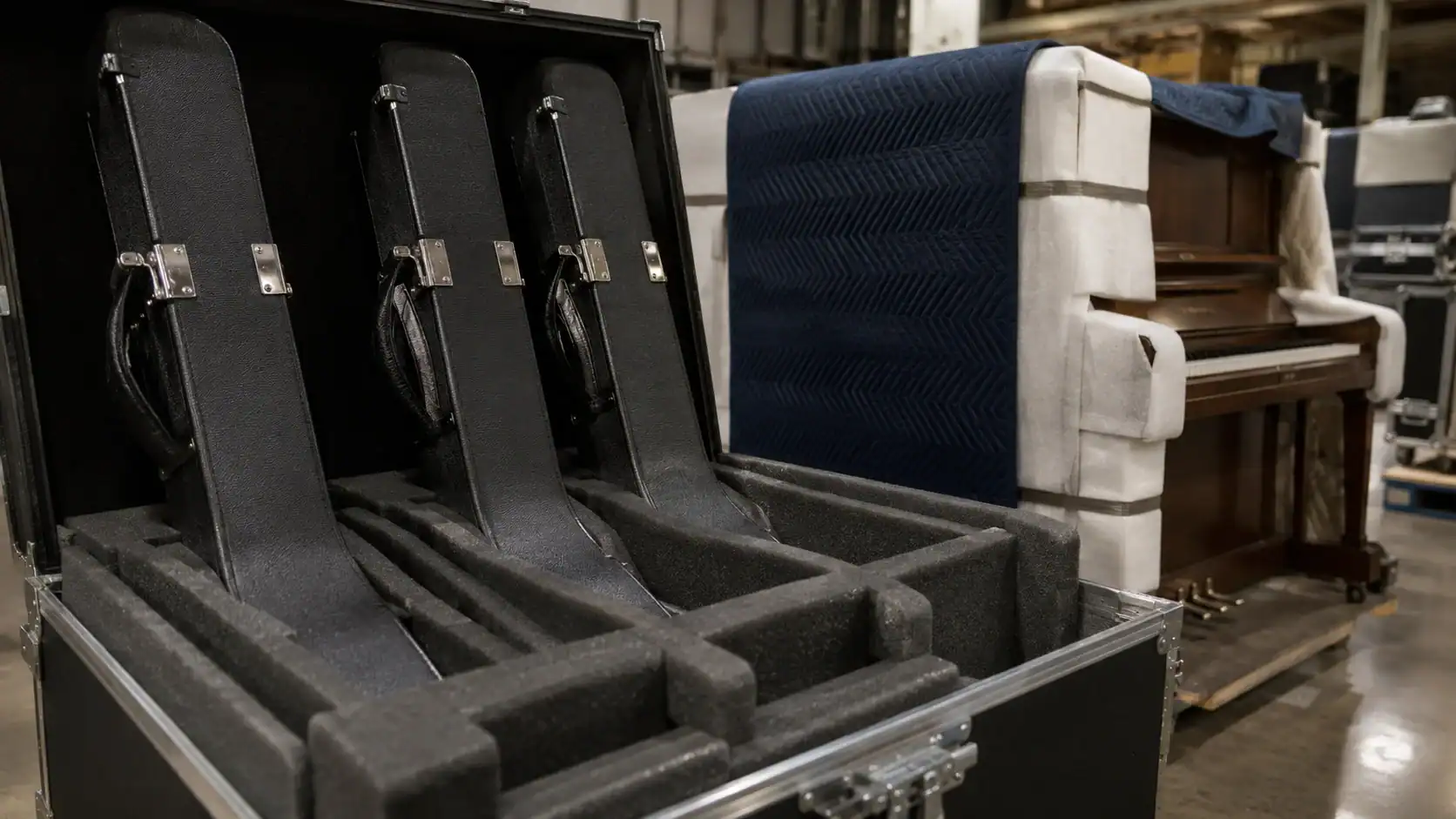
Acoustic Pianos: The Hardest Household Item There Is
Start with the worst case, because everything else looks easy afterwards. An acoustic piano is the single most demanding object in household shipping. An upright weighs 200–300kg; a baby grand 250–350kg; a full concert grand can pass 500kg. That weight is not evenly distributed. Most of it is a cast-iron frame holding around 20 tonnes of string tension, and the case around it is thin veneered wood that marks if you look at it wrong.
You cannot treat a piano as furniture. It needs specialist piano movers at both ends: at origin to get it out of the house (stairs, doorways, sometimes a hoist through a window), and in Thailand to get it into a Bangkok condo, which frequently means negotiating a service lift with a strict weight limit and a juristic office that wants paperwork before anything heavy enters the building. Between those two teams sits a purpose-built crate: internal bracing, the piano wrapped and blocked so it cannot shift, moisture barrier around the whole assembly.
Upright and grand pianos travel differently. An upright ships on its back or upright on a piano board, essentially intact. A grand is partially dismantled: legs and pedal lyre come off, and the body travels on its straight side on a padded skid board. That dismantling and reassembly is skilled work, and it is one more reason the quotes are what they are. Expect the piano alone to add $2,000–4,000 to a household move once specialist handling at both ends, crating and the extra cube are counted.
Then comes the climate shock. A piano is a wooden soundboard under tension, and it will react to Thailand the way the Martin did: swelling, pitch drift, sticking keys in the worst cases. Every piano needs at least one tuning after arrival, usually two across the first six months as it settles. Plan for it to live in an air-conditioned room, ideally with a soundboard humidity-control system fitted.
The Ship-or-Sell Calculus
This is the honest arithmetic most movers won’t volunteer. Bangkok has a real piano market: new Yamahas and Kawais through established dealers, and a steady flow of well-kept second-hand uprights, many already acclimatised to Thai conditions. A decent used Yamaha U1 in Bangkok costs roughly what you’d pay to ship a similar piano from Europe. Unless your instrument has genuine sentimental value, is a high-end grand worth well into five figures, or is a specific instrument you cannot replace, selling at origin and buying in Thailand is very often the better financial and musical decision. The piano you buy locally has already survived the climate transition. Yours hasn’t.
Digital pianos and stage keyboards, by contrast, are almost trivially easy. No strings under tension, no soundboard, no climate sensitivity worth worrying about. Original box if you have it, or a double-walled carton with 5cm of foam all round if you don’t; remove the stand; they ride in the container like any other electronics. An 88-key digital piano is roughly 15–25kg and takes up a fraction of a cubic metre.
Guitars: Humidity Is the Killer
Guitars break in shipping far less often than people fear and suffer from climate far more often than people realise. The physical risk (a cracked headstock from a drop) is real but manageable with a hard case. The humidity risk is subtler and does more total damage.
A solid-wood acoustic guitar is built at a controlled humidity, typically 45–50%. Take it below 35% and the top shrinks and can crack; take it well above 60% for a long period and the top swells, the dome rises, the action climbs, and over years glue joints can soften. A 40-day container transit passes through multiple climate zones, and container “rain” (condensation cycles as the box heats and cools) is a documented phenomenon. Then the guitar arrives in a country running 70–80% relative humidity every month of the year.
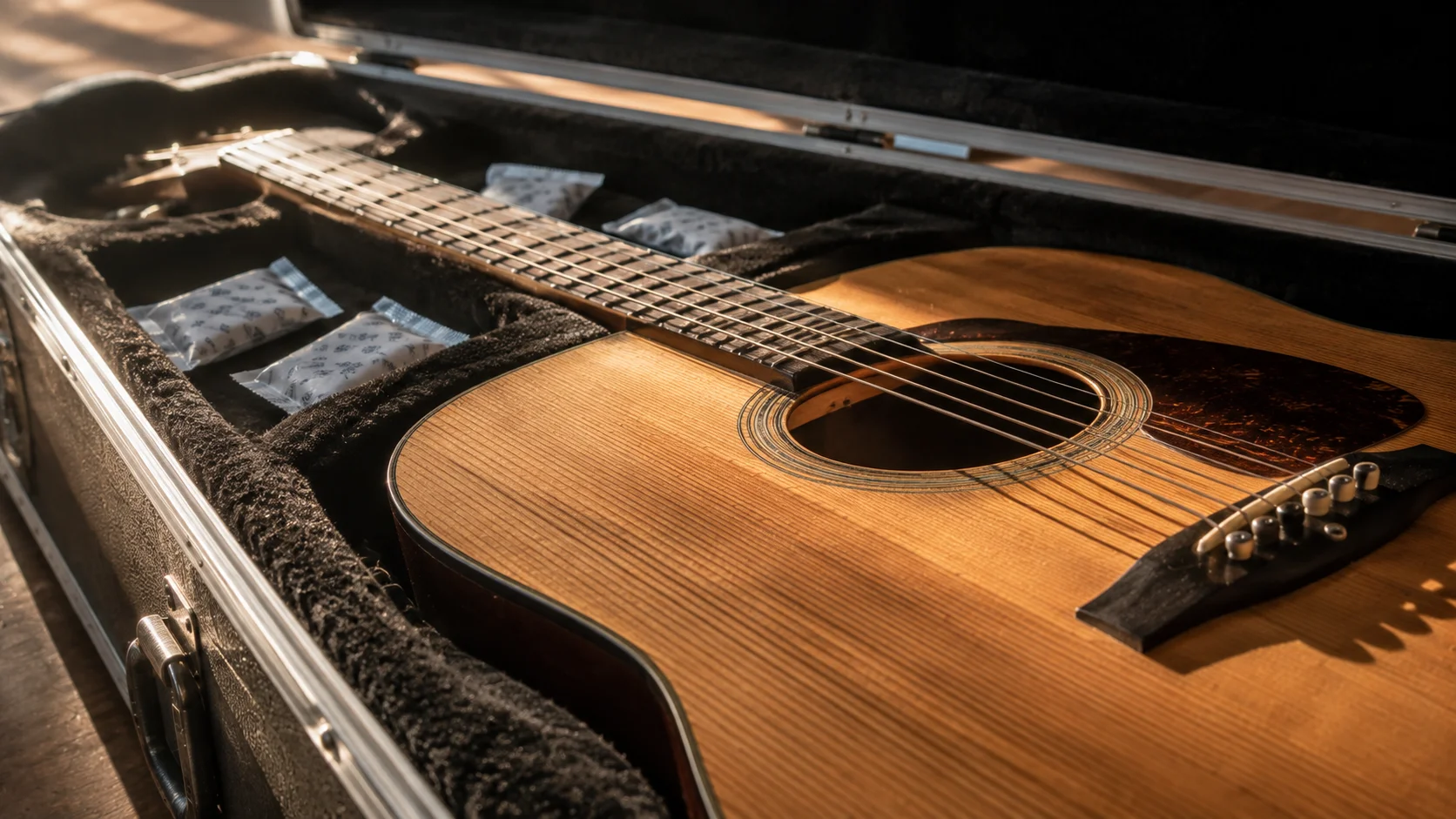
The transit fix is straightforward: two-way humidity control packs (the Boveda-style 49% packs musicians use) sealed inside the case with the guitar. They release moisture when the case air is dry and absorb it when wet, and they will hold a stable case environment for well over the length of an ocean transit. Laminate-construction guitars (most beginner and mid-range instruments) are far more tolerant and need less fuss.
The truss rod question divides luthiers, so here is the balanced version. Fully detensioning the strings removes the pull the truss rod is adjusted against, and a rod left counteracting nothing for six weeks can push the neck into a back-bow. Leaving full concert tension on adds stress if the case takes an impact. The consensus middle ground: slacken each string two or three semitones, support the neck on its case cradle, pad the headstock, and book a setup on arrival regardless.
For a valuable instrument (anything from a vintage Martin to a modern custom build), the standard is hard case inside a crate or double-walled carton, with the guitar immobilised in the case (padding under the headstock, crumpled paper filling voids), the case immobilised in the box, and nothing able to move at any layer. Loosen nothing structural; label nothing tempting. A crate that says “GUITAR, FRAGILE” advertises its contents; plain marking with a fragile symbol is smarter.
Violins, Violas and Cellos: Fly Them
The violin family occupies the opposite corner of the freight matrix from a piano: tiny mass, enormous value density. A professional violin can be worth more than everything else in the container combined while weighing under 2kg with its case. That changes the correct answer entirely.
For any violin or viola of real value, air freight is usually right, and for the truly valuable, neither air freight nor courier: the instrument travels in the cabin with you, in a modern suspension case, as carry-on. Airlines will generally accept a violin case in the overhead; buy the case a seat if the instrument justifies it. Six weeks of uncontrolled ocean humidity is simply not a risk worth taking to save a few hundred dollars on an instrument worth tens of thousands.
Cellos are the awkward middle: too big for overhead bins (a cabin seat purchase is the professional’s solution), expensive but manageable as air cargo in a flight case. Student-grade instruments of the whole family can travel by sea in the household shipment with the same case-plus-carton approach as guitars, plus humidity packs: a carved spruce top cares about moisture exactly as much as a guitar top does.
One insurance note that belongs here because it bites string players hardest: a bow is a separate object. A good pernambuco bow can be worth thousands on its own, and insurers treat instrument and bow as separate scheduled items. More on that below.
Brass, Woodwind, Drums and the Studio
Brass is the robust end of the orchestra. A trumpet or trombone in a hard case, boxed, survives sea freight without drama. Dents are the risk, humidity barely matters to the metal. Do empty and dry the instrument thoroughly: six weeks of trapped moisture inside brass tubing is how you grow corrosion and smells.
Woodwind needs one caveat: pads and corks. Clarinet and saxophone pads are leather and felt; oboe and bassoon add fragile reed mechanisms. High humidity swells pads and can throw off seating, and wooden-bodied clarinets and oboes share the crack-and-swell behaviour of any fine wood. Case humidity packs again, and budget for a pad check with a Bangkok repair tech after arrival. Thailand has a solid repair scene, particularly for saxophones.
Drum kits are the volume problem rather than the fragility problem. A five-piece kit with hardware and cymbals is not especially delicate (shells are plywood cylinders) but it eats a cubic metre or more of container space. Nest the toms, bag the hardware separately (it is absurdly heavy relative to the shells), put cymbals in a padded cymbal case, and remove or slacken resonant heads if you want to be thorough. Sea freight, always; the weight-to-value ratio makes air freight silly for all but touring professionals.
Amplifiers and studio gear come with good news first: Thailand runs 220–230V at 50Hz, so European, UK and Australian equipment plugs in and works. You will need plug adapters (Thai sockets take flat two-pin and hybrid types) but no voltage converters. American 110V gear does need a step-down transformer. Check the label on every unit, because many modern power supplies are dual-voltage anyway.
The one genuinely fragile item in the rack is the tube amplifier. Valves are glass, mounted in sockets, and they neither like impacts nor container vibration. Best practice: pull the tubes, wrap each individually, box them inside the amp cabinet’s packing, and reseat them on arrival, or at minimum stuff padding around the tube cage so nothing can rattle loose. Studio monitors, interfaces and outboard gear travel like any electronics: original boxes if you kept them, dense foam if you didn’t, and desiccant packs in every carton.
Arrival: Instruments in the Tropics
Whatever survives the ocean still has to live in Thailand, and this is the part of shipping musical instruments to Thailand that owners underestimate most. Bangkok’s relative humidity runs 70–80% essentially year-round; the European rooms most instruments come from sit at 40–60% with central-heating winters drier still. Your instrument is moving to a permanently wetter world.
Practical rules that working musicians in Thailand converge on:
- Acclimatise slowly. On arrival, leave the instrument in its closed case in the room where it will live for 24–48 hours before opening. Sudden climate transitions do more harm than gradual ones.
- Your humidifier is now a dehumidifier. The case humidification habit reverses in Thailand. Two-way packs handle this automatically: they absorb in Bangkok as readily as they release in Berlin. Single-direction sponge humidifiers become useless; rechargeable silica-gel packs become essential.
- Air-conditioned storage for solid wood. Serious players keep good instruments in one consistently air-conditioned room, in the case, with humidity packs. The enemy is not the humidity level alone but the daily cycling between a 55% aircon room and an 80% hallway.
- Expect a settling period. Guitar actions rise; a setup two to four weeks after arrival, once the wood has finished moving, is money well spent. Pianos need that first tuning at six to eight weeks and another within six months.
- Watch the hardware. Salt air near the coast and constant humidity accelerate corrosion on frets, strings and plating. Strings die faster in Thailand; buy in bulk.
Insurance: Where Instrument Claims Go Wrong
Standard household transit insurance treats a guitar as “one carton, miscellaneous.” That is precisely what you do not want for anything valuable, and the fixes are all pre-departure paperwork.
Appraisal documentation. Insurers pay against evidence of value. For any instrument worth more than roughly $2,000, get a written appraisal or recent purchase documentation before it ships, with serial numbers and dated photographs from multiple angles, including existing dings, which protects you both ways. A luthier’s or dealer’s valuation letter costs little and transforms a claim.
Agreed-value policies. Where possible, insure valuable instruments on an agreed-value basis (the payout figure is fixed in the schedule at policy inception) rather than market-value, which invites a post-loss argument about what a 1974 D-28 was “really” worth. Specialist musical-instrument insurers offer this as standard; make sure the transit leg is explicitly covered, as some instrument policies exclude sea freight unless declared.
Pairs and sets. A violin and its bow are separate scheduled items with separate values. So are a guitar and its vintage case, an amp head and its cab. List them individually. An insurer will happily pay out on “violin outfit, $8,000” at a fraction of the true combined value of a good instrument and a good bow if you let the schedule stay vague.
The owner-packed exclusion. This is the trap that catches the most people. Most transit policies exclude or restrict claims on owner-packed boxes, because the insurer cannot verify the packing standard. For valuable instruments, have the professional packers pack them (or at least crate them) and make sure the inventory records it. You can prepare the instrument yourself (humidity packs, string tension, internal case padding) and still have the crate professionally built and sealed. For a fuller treatment of marine cover generally, see our guide to cargo insurance for Thailand shipping.
Every fix in this section shares the same shape: it is paperwork that only works if it exists before something goes wrong. An appraisal written after a claim is a dispute, but the identical appraisal written before departure is evidence.
The CITES Trap: Rosewood, Ivory and Tortoiseshell
This is the section that surprises people, and the surprise happens at the worst possible moment: at inspection, with the instrument in a customs shed. The Convention on International Trade in Endangered Species (CITES) regulates cross-border movement of protected species and anything made from them, and older musical instruments are full of exactly those materials.
The three that matter:
Brazilian rosewood (Dalbergia nigra). The classic tonewood of pre-1970 high-end acoustic guitars (Martin used it as standard until 1969) and of many older violin fittings and fingerboards. It has been CITES Appendix I (the strictest tier) since 1992. Crossing a border with a Brazilian rosewood instrument legally requires CITES documentation demonstrating pre-Convention origin. Critically, the 2019 exemption that everyone half-remembers does not cover it.
That 2019 exemption, correctly stated: in 2017 all rosewood species (the whole Dalbergia genus) were added to Appendix II, briefly making every modern guitar with an East Indian rosewood fingerboard a paperwork problem. The 2019 CITES conference carved out finished musical instruments, parts and accessories from the Appendix II rosewood listing. So a modern guitar with Indian rosewood is fine to ship with no permit. A 1968 Martin with Brazilian rosewood back and sides is not: Appendix I, no instrument exemption, permits required.
Ivory. Piano keytops on instruments made before roughly the mid-1950s (later in some markets), violin and cello bow tips, tuning pegs and ornaments on older instruments. Elephant ivory is Appendix I. The practical problem is documentation: proving your piano’s keytops are pre-1975 (the pre-Convention threshold that matters for most ivory) when the original receipt vanished decades ago. Options include dated photographs, dealer letters, serial-number dating, or (for pianos) having a technician replace ivory keytops with modern material before shipping, which many owners now choose simply to make the instrument freely movable.
Tortoiseshell. Genuine hawksbill-shell picks, pickguards and inlays on older instruments: Appendix I, same regime. Modern “tortoiseshell” celluloid is fine; the genuine article on a vintage instrument is not.
The enforcement reality: undeclared CITES material can mean the instrument is seized, or the offending parts (bow tips, pegs) removed and confiscated. If any instrument in your shipment predates the 1970s, identify its materials before it ships, obtain a pre-Convention certificate from your origin country’s CITES management authority where needed, and declare it. This mirrors the regime we described for antique furniture and ivory inlay in our guide to shipping antiques and fragile items to Thailand. Instruments are just the case that ambushes people, because nobody thinks of a guitar as wildlife.
The Thai Import Side
Good news, for once. Used personal musical instruments arriving as part of a household-goods shipment fall under Thailand’s personal effects framework: with an appropriate long-stay visa (typically Non-Immigrant with a year’s stay) and evidence the goods are genuinely yours and used (the working standard is around a year of ownership), instruments come in without duty. The full mechanics of that process are in our guide to shipping household goods to Thailand, and the exemption rules get their own treatment in the duty-free Thailand import guide.
Two edges to stay away from. First, commercial quantities: one of everything reads as personal; five identical guitars, sealed boxes, or a pallet of pedals reads as stock, and Thai Customs will assess duty (typically 10% on instruments) plus 7% VAT on the whole lot. Second, new-looking gear: an instrument still in shrink-wrap with a fresh receipt is a purchase, not a personal effect. If you buy your dream guitar the month before you emigrate, play it, keep the case scuffed and the receipt handy, but understand the exemption is discretionary and recently purchased items are its weakest case. The authoritative source on all of this is Thai Customs; their published personal-effects guidance is worth reading in the original rather than trusting forum folklore.
The returning-musician scenario deserves a paragraph because it is common: a Thai national or long-term resident coming home after years abroad with a career’s worth of gear. The personal effects exemption applies to returning Thais changing residence too, with its own conditions on time spent abroad. The same commercial-quantity logic applies: a returning session guitarist with six instruments should carry evidence they are working tools of one person (photos over the years, setlists, insurance schedules), not inventory. Full pricing and process for a household move (instruments included) sits on Swift Cargo’s Thailand shipping page.
Air or Sea: Decide by Value Density
Strip away the detail and the mode decision is one ratio: value and fragility per kilogram. Sea freight to Thailand runs five to seven weeks door to door and charges by volume; air freight runs three to seven days and charges by weight. (Full mode comparison in our air freight to Thailand guide.)
- Cabin baggage: violins, violas, anything irreplaceable that fits overhead. The instrument never leaves your control.
- Air freight: instruments worth roughly $3,000+ per box where cabin carriage is impractical (a pair of high-end guitars, a cello, a vintage synth). You pay perhaps $150–400 more than sea for the box, and buy six fewer weeks of climate exposure and handling risk.
- Sea freight: everything heavy, bulky or replaceable (pianos, drum kits, amps, monitors, mid-range instruments, the whole studio rack). Properly packed, sea freight is safe; it is merely slow.
The mixed strategy is usually the right one, which brings us to the worked example.
Worked Example: A Home Studio, Three Guitars and an Upright Piano, Bangkok-Bound
The shipment: a producer relocating from Manchester to Bangkok. Inventory: a Yamaha U1 upright piano (240kg, bought used eight years ago, sentimental), a 1974 Martin D-28 (insured value $9,500, Brazilian rosewood fingerboard; pre-Convention, needs CITES paperwork), a Fender Telecaster ($1,800), a mid-range Taylor ($1,400), a Fender tube amp, two studio monitors, an interface, a synth, mic collection and cabling (studio total value ~$7,000, ~1.5m³ boxed).
Decisions made:
- The Martin flies: air freight in its hard case inside a professional crate, $340, with a CITES pre-Convention certificate obtained from the UK management authority six weeks before departure (allow at least that long; the application needed dated photos and a dealer letter). Two-way humidity packs in the case, strings down three semitones.
- The piano nearly didn’t ship. Quote: £1,850 for specialist handling at both ends, crating and its share of the container, plus two tunings in Bangkok (~4,000 THB). A comparable used U1 in Bangkok: roughly 150,000 THB. Marginal call on money; sentiment carried it. Booking the Bangkok piano crew and confirming the condo’s service-lift weight limit happened before the ship sailed, not after arrival.
- Everything else went in the groupage container. Telecaster and Taylor in hard cases inside double-walled cartons with humidity packs; tubes pulled from the amp and packed separately inside the cabinet; monitors in original boxes; desiccant in every electronics carton. Professional packers crated the guitars, keeping the owner-packed exclusion off the two most claimable boxes.
- Insurance: the Martin on an agreed-value instrument policy with transit cover declared; the rest on the household transit policy with the guitars and amp individually scheduled. Total premium ~$310.
Outcome and totals: sea freight share for studio + piano + guitars roughly £2,600; air freight $340; insurance $310; CITES certificate £74; Bangkok setups and tunings ~6,500 THB. Call it £3,600 all-in. Everything arrived working. The Taylor needed a truss-rod tweak, the piano’s second tuning fell at month five, and the Martin, as you already know, came out of its case slightly domed and entirely alive.
Five Mistakes That Keep Repeating
- Shipping a pre-1970s instrument without checking its materials. Brazilian rosewood and ivory don’t announce themselves. Identify before you book, not at inspection.
- Owner-packing the valuable instruments. The exclusion clause exists and insurers use it. Let the professionals crate anything you’d actually claim for.
- Treating the piano decision as sentimental by default. Run the numbers against the Bangkok used market first; ship it only if the numbers or the attachment genuinely justify it.
- No humidity control in the case. Two-way packs cost a few dollars and address both the transit and the destination climate. There is no reason to skip them.
- Playing the instrument the hour it arrives. Two days in the closed case in its new room, then a setup a few weeks later. Patience is the cheapest protection in this entire guide.
Related Reading
- Shipping Antiques and Fragile Items to Thailand
- Cargo Insurance for Thailand Shipping
- Shipping Household Goods to Thailand
- Air Freight to Thailand
- Duty-Free Thailand Import Rules
Design for the hardest case and the easy cases take care of themselves, which is really what the piano section above is doing. A cast-iron frame under twenty tonnes of string tension, a service lift with a strict weight limit, a juristic office that wants paperwork before anything heavy enters the building: none of that is really about pianos. It’s about what the whole shipping and receiving system needs to be capable of at its worst-case load, and a mover who has genuinely solved for a grand piano has, almost as a side effect, solved for the guitar and the drum kit too. The instinct to treat every item as its own isolated problem misses this. The right question isn’t “how do we ship this piano.” It’s “what does handling this piano tell us about gaps in how we handle everything else.”
Frequently Asked Questions
Can I ship a piano to Thailand?
Yes, but it is the most demanding household item you can move: specialist piano movers at both ends, a purpose-built crate, and several thousand dollars door to door. Given Bangkok’s healthy new and used piano market, selling at origin and buying locally is often cheaper, and the local piano is already acclimatised.
Will Thai humidity damage my guitar?
Solid-wood acoustics built in a dry climate absorb moisture in Thailand’s 70–80% humidity: the top swells, action rises, and over years glue joints can soften. Keep valuable instruments in an air-conditioned room, use two-way silica humidity packs in the case, and acclimatise in the closed case for 24–48 hours on arrival.
Do I need a CITES permit to ship my instrument?
Only if it contains listed materials: Brazilian rosewood (common in pre-1970 acoustics), elephant ivory (older piano keys, bow tips) or genuine tortoiseshell. Modern instruments with ordinary rosewood are exempt under the 2019 CITES finished-instrument carve-out. Brazilian rosewood and ivory were never part of that exemption and need pre-Convention documentation.
Is air or sea freight better for instruments?
Decide by value density. Violins and anything above roughly $3,000 per box justify air freight or cabin carriage: less transit time means less climate and handling exposure. Pianos, drums, amps and studio gear are too heavy for economical air freight and travel safely by sea when properly packed.
Do I pay Thai import duty on my own instruments?
Used personal instruments in a household-goods shipment generally qualify for Thailand’s personal effects treatment with a long-stay visa and roughly a year’s ownership. Commercial-looking quantities or brand-new sealed gear are assessed as imports with duty plus 7% VAT.
Should I loosen guitar strings before shipping?
Drop tension two or three semitones rather than removing it entirely: a truss rod left with nothing to counteract for six weeks can back-bow the neck. Support the neck in the case, pad the headstock, and budget for a setup on arrival either way.