
A Victorian pier mirror made in Birmingham in 1886 has survived two world wars, five house moves and a century and a half of children’s birthday parties. Then its owner books a shipment to Chiang Mai, and it faces the most dangerous six weeks of its long life: a forklift in Felixstowe, a crane in Singapore, 40 days of tropical humidity cycling inside a steel box, and a delivery truck on the Hang Dong Road. Whether it arrives intact has almost nothing to do with luck. It has to do with roughly a dozen decisions made before the container doors close, and most of them are made, or fumbled, in the packing room.
If you are shipping a broader household alongside the fragiles, our companion guide to shipping household goods to Thailand covers the general process; this article deals with the pieces you cannot replace.

What Counts as a High-Stakes Fragile Shipment
Movers use “fragile” loosely. For planning purposes, it helps to separate ordinary breakables (supermarket glassware, flat-pack furniture with a glass door) from high-stakes fragiles, where the combination of fragility and value (financial or sentimental) changes how the whole shipment should be engineered. The second category typically includes:
- Antique furniture, especially veneered, inlaid or gilded pieces, and anything with original glass
- Artwork: oil paintings, works on paper, framed prints, sculpture
- Ceramics and porcelain, from dinner services to individual studio pieces
- Glassware and crystal, including chandeliers, which are among the hardest household items to ship well
- Pianos: uprights and grands, which combine extreme weight with extreme internal fragility
- Mirrors, particularly antique mercury-glass mirrors whose plates cannot be replaced
- Heirloom pieces whose replacement cost is meaningless because there is no replacement
The unifying feature is asymmetry. A sofa that arrives damaged is an insurance claim. A 140-year-old mirror that arrives damaged is a small bereavement with a cheque attached. Everything below flows from taking that asymmetry seriously.
Professional Packing Standards: How the Good Firms Actually Do It
Watch a museum-trained packer work and the first thing you notice is how slowly they start. Before anything is wrapped, the piece is photographed from every side, existing damage is noted on a condition sheet, and removable elements (shelves, keys, pendants, finials) are taken off and packed separately. Only then does the wrap sequence begin, and the sequence matters.
The wrap sequence
The first layer against the object is never bubble wrap. Bubble against a French-polished or gilded surface can imprint its texture into the finish over a warm six-week voyage, and the plastic traps moisture against timber and oil paint. The correct sequence is:
- Acid-free tissue directly against the surface: inert, breathable, no chemical interaction with finishes, gilt or paint
- A soft wrap layer (furniture blanket or foam sheet) to distribute pressure
- Bubble wrap, bubbles facing outward, for shock absorption
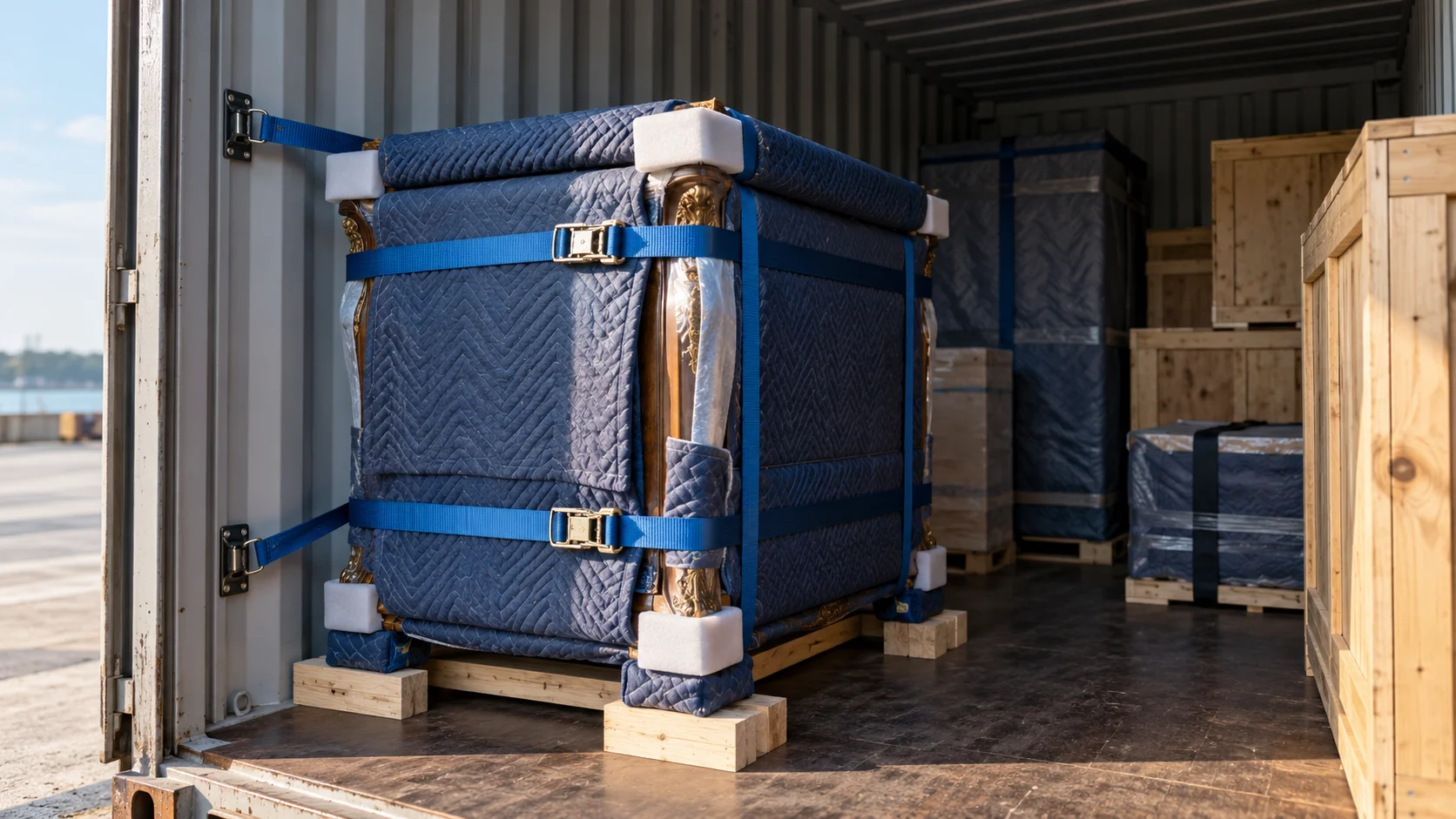
- Rigid protection (corner protectors, cardboard sheathing, or a crate) to take impacts before they reach the soft layers
Glass and mirrors get one extra step: low-tack tape applied in a lattice across the plate, so that if the glass does break, the shards stay in place instead of grinding against the frame for five thousand miles. Paintings travel face-protected with glassine, never with anything touching the paint surface, and framed works get corner blocks so the frame, often more fragile than the picture, carries no point loads.
The crating decision
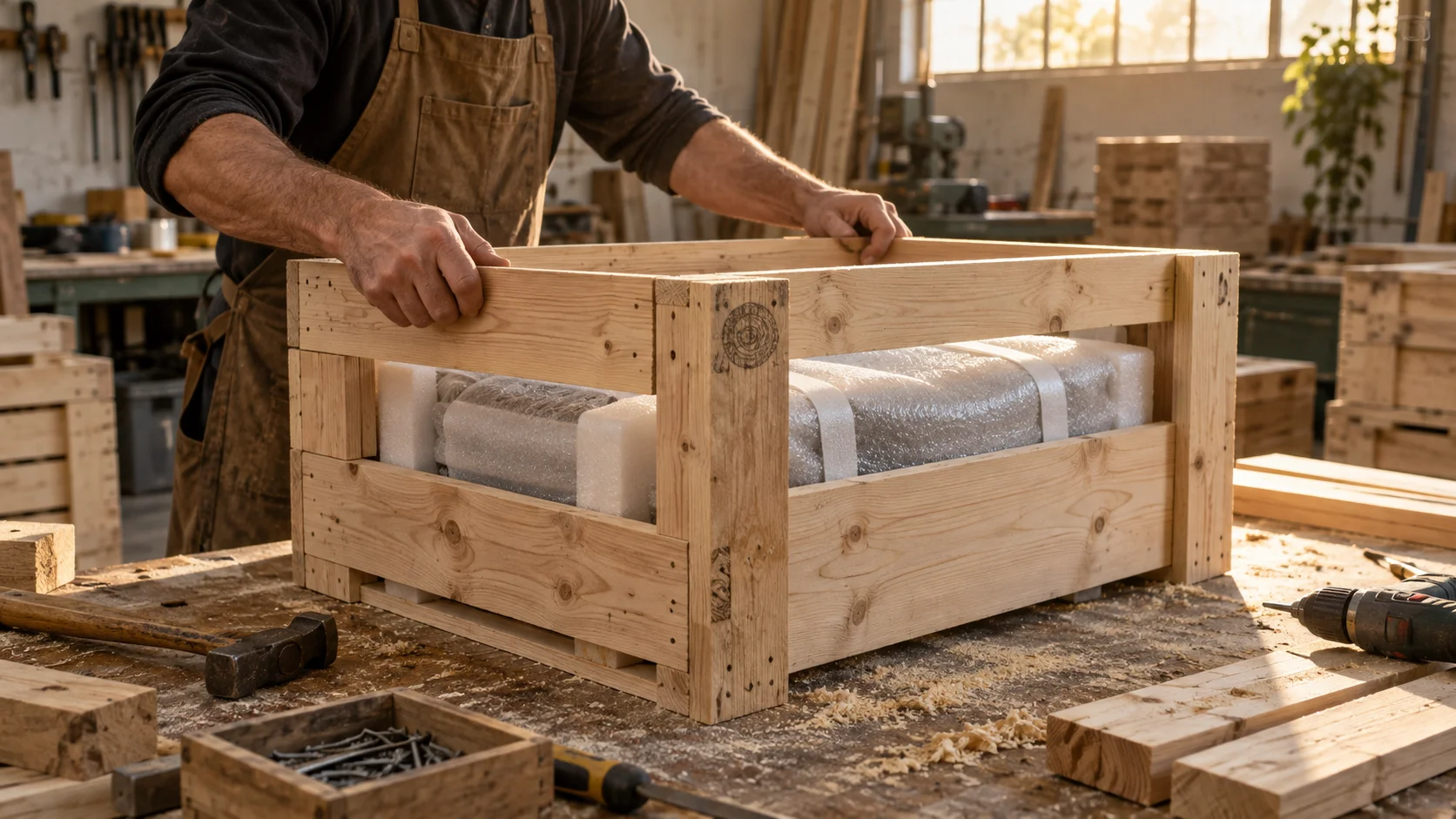
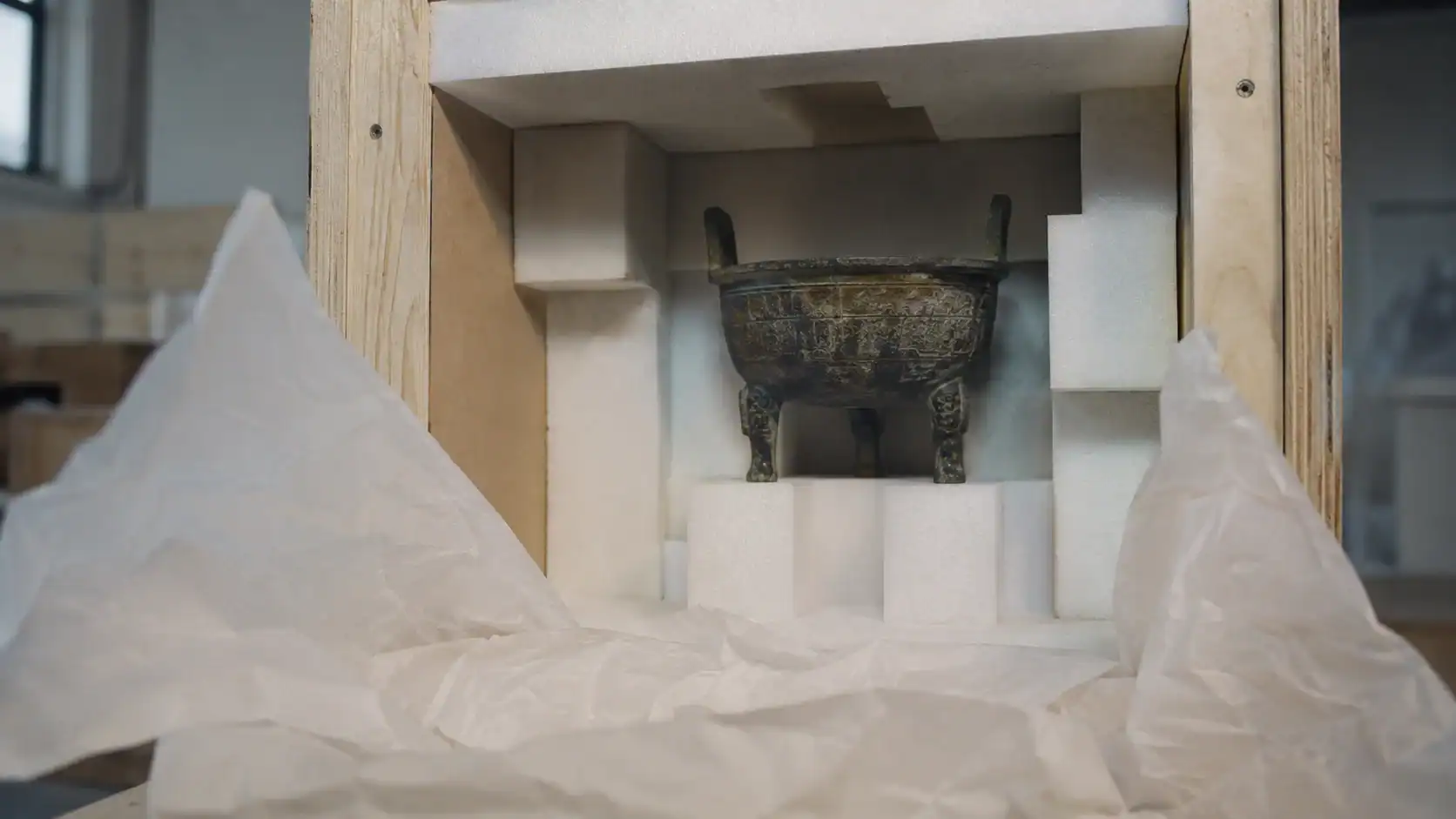
Not everything needs a crate. The working rule most fine-art shippers use is a two-axis test: value and fragility. A robust oak coffer worth GBP 800 travels fine in blanket wrap inside a container. A GBP 400 ceramic lamp probably justifies a light case. Anything that is both fragile and valuable (the mirror, the porcelain service, the marble bust) gets a purpose-built timber crate with internal foam blocking, so the object floats in a rigid box and never touches the walls.
At the extreme end sits double-crating: an inner case suspended inside an outer crate on foam or springs, so shocks that reach the outer shell are absorbed before they reach the inner one. It is standard practice for museum loans and sensible for any single item worth north of GBP 15,000–20,000, or for items (mercury-glass mirrors again) where any impact at all is likely to be fatal.
Who packs matters more than how
The clause that catches more antique shippers than any other: the owner-packed exclusion. Almost every all-risks marine cargo policy limits or voids breakage cover for items packed by the owner rather than by the professional firm. The insurer’s logic is blunt: they cannot verify your packing, so they will not underwrite it. You can wrap your grandmother’s tea service with genuine care and real skill, and if a cup arrives in pieces the claim will still be declined, or paid only on total-loss-of-the-whole-shipment terms. For anything on the high-stakes list above, professional packing is not a luxury upgrade. It is the price of admission to meaningful insurance.
The owner-packed exclusion is not really about packing quality. It is about who bears the tail risk. An insurer who underwrites professional packing is pricing a known, bounded process with an accountable party on the other end if something goes wrong. An insurer asked to underwrite owner-packing is being asked to price an unverifiable process with no accountable party, a different and much worse bet, so they simply decline it rather than mispricing it. The owner who packs carefully and has never had a claim denied is not evidence the exclusion is unfair. It is evidence the stress test has not happened yet. The exclusion exists precisely for the one time it does.
Custom Crating: Economics and the ISPM 15 Rule
Two things to understand about crates for Thailand: what they cost, and what timber they must be made from.
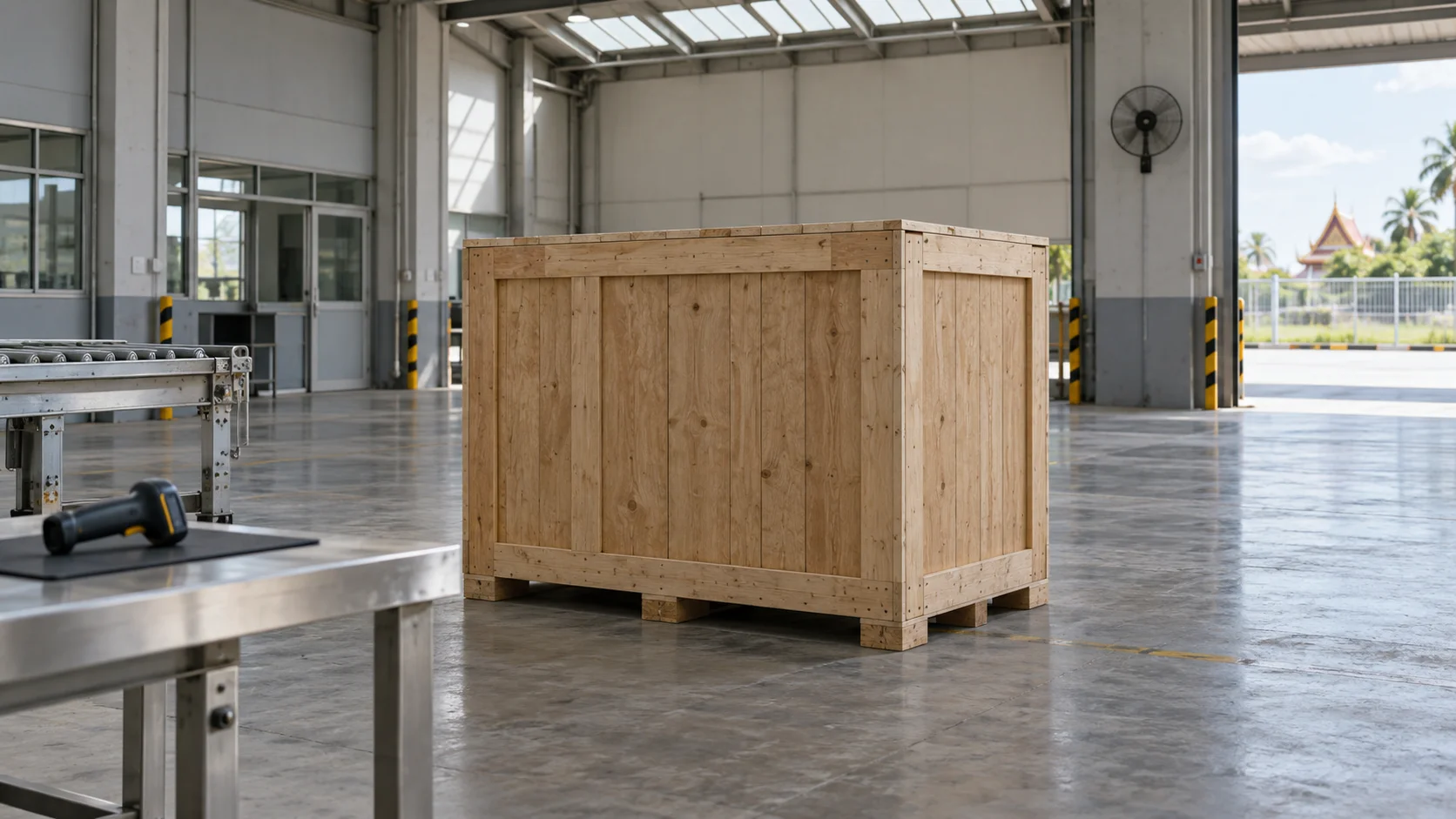
ISPM 15 first, because it is non-negotiable. Thailand enforces the international standard for wood packaging material: all solid-timber crates, cases and pallets entering the country must be heat-treated or fumigated and stamped with the IPPC mark. A beautiful crate built from untreated timber can see the whole consignment held at Laem Chabang for re-fumigation, re-packing or destruction of the packaging, at your cost and on customs’ timetable. Any competent export packer builds to ISPM 15 automatically; if you are tempted by a local carpenter’s cheaper quote, this is why you should not be. Plywood and other processed panels are exempt, which is why many fine-art cases use ply shells over a treated-timber frame.
Costs scale with volume and complexity. Indicative UK ranges for export-grade ISPM 15 crates:
- Small case (a mantel clock, a boxed ceramic): GBP 80–150
- Medium crate (a mirror, a painting up to about 120 cm, a side table): GBP 150–350
- Large crate (a wardrobe, a longcase clock, a large canvas): GBP 350–700
- Piano crate or double-crated museum case: GBP 700–1,500+
People flinch at these numbers until they run the comparison the other way. A GBP 300 crate protecting a GBP 8,000 mirror is a 3.75% premium on the item’s value (less than the insurance rate on some fragile schedules) and it reduces the probability of the claim ever being needed. Crating is the cheapest insurance you will buy in this whole exercise, because it changes the odds rather than merely compensating you after the fact.
FCL, LCL or Air: Choosing a Transit Mode by Handling Events
The single most useful mental model for fragile freight is to stop thinking in miles and start thinking in handling events: each occasion on which a human or machine picks your goods up, sets them down, or restacks them. Damage to sea freight overwhelmingly happens in warehouses and at container doors, not on the ocean. (For the full taxonomy of how cargo actually gets broken, see our breakdown of what causes shipping damage in international freight.)
Count the events by mode:
- FCL (full container load): packed and loaded into the container at your origin residence or the packer’s warehouse, container sealed, container opened at destination, unloaded once. Roughly 4 handling events touch your goods, and half of them are performed by the crew you hired and briefed.
- LCL (groupage/shared container): collected, unloaded at a consolidation warehouse, stacked, loaded into a shared container alongside strangers’ cargo, deconsolidated in Bangkok, restacked, loaded again for delivery. Typically 10–12 handling events, most performed by warehouse staff who have no idea what is inside your cases and are paid by throughput, not by care.
If each handling event carries even a modest independent chance of a drop, a tip or a bad stack, tripling the event count roughly triples your exposure, and LCL adds the specific hazard of other people’s cargo being stacked on top of yours. For high-stakes fragiles the industry consensus is emphatic: FCL wherever the volume can remotely justify it. A 20ft container from the UK to Thailand often costs only GBP 800–1,500 more than the equivalent LCL charge on a mid-sized consignment, and it buys you a sealed box that nobody opens between your driveway and your delivery address.
Air freight earns its keep in one niche: extreme-value small pieces. A GBP 25,000 porcelain figure or a small painting is far better spending three days in a rigid case in aircraft holds than six weeks at sea. Air handling is not gentle, but the journey is short, the humidity exposure is minimal, and the number of custody transfers is small. Above roughly GBP 10,000 of value in under a cubic metre, price air freight before you default to the container.
Insurance for Antiques: The Deep Dive
Standard household-goods transit insurance (a lump-sum declared value across the whole shipment, claims settled at depreciated value) is close to useless for antiques. Depreciation logic runs backwards for old things, and lump-sum declarations invite the insurer to average away your best pieces. You want a valued, itemised schedule instead, and the details below are where claims are won or lost. The general mechanics of marine cargo cover on this route are set out in our guide to cargo insurance for Thailand shipping. This section covers what changes when the cargo is irreplaceable.
Declared value per item, with evidence
Every significant piece gets its own line: description, declared value, and (this is the part people skip) photographs taken before packing and, for higher-value items, a written appraisal. A pre-shipment appraisal from an auction house or accredited valuer does two jobs. It fixes the value so there is no argument at claim time, and it documents condition, so the insurer cannot suggest the crack was already there. Appraisals cost GBP 50–150 per item or a day rate for a collection; on anything worth over about GBP 2,000 they pay for themselves the first time you need them.
Agreed value versus indemnity
Read the settlement basis clause. Indemnity policies pay “market value at the time of loss,” which invites a negotiation with a loss adjuster about what your dead grandmother’s bureau was really worth. Agreed value policies pay the scheduled figure, full stop. Agreed value costs more (often 2.5–4% of declared value for fragile schedules versus 1.5–2.5% for general household goods) and it is worth every basis point when the cargo is the kind of thing you are reading this article about.
Pairs and sets
If one of a pair of Regency chairs is destroyed, is the loss half the pair’s value, or all of it? A pair is worth far more than two singles, so without a pairs-and-sets clause the insurer will pay for one chair and leave you holding an orphan. Good fine-art policies let you insure sets as sets: total loss of the set’s value, insurer takes salvage on the survivors. Ask explicitly. It is rarely the default.
The exclusions that bite
- Owner packing, as covered above: the single most common reason antique claims fail.
- Inherent vice: damage arising from the nature of the object itself. Old glue joints letting go in tropical heat, a canvas slackening, veneer lifting because the timber was always going to move: insurers class these as the object’s own frailty, not a transit accident, and exclude them. Your defence is climate management (see below), not paperwork.
- Unattended vehicle and storage extensions: check that cover runs door to door including any storage period in Thailand, not just port to port.
Thai Customs: Exemptions, Export Permits and the Buddha Image Trap
The personal effects route
Thailand’s used-household-effects concession is the friendliest door for antiques to enter through. Items that are demonstrably personal household goods, owned and used before the move, imported as part of a genuine change of residence by someone holding a qualifying status, can be admitted duty-free at Thai Customs’ discretion. The qualifying statuses are a one-year Thai work permit, a non-immigrant visa with a confirmed one-year working period, Thai permanent residence and a full one-year Smart Visa. A retirement visa is not among them, so a retiree importing antiques pays duty and 7% VAT on them like any other importer. Beyond the full eligibility mechanics in our duty-free Thailand import guide, two antique-specific wrinkles deserve attention here.
First, the collection problem. Six antique clocks reads to a customs officer less like “household effects” and more like “stock” or “an investment collection,” and duty can be assessed on items that exceed what a household plausibly uses. If your shipment is collection-heavy, brief your forwarder in advance so the packing list and valuation are framed honestly and consistently, and be prepared for duty on the excess.
Second, the ownership-and-use test. That Chippendale-style chest you bought at auction two months before flying? Thai Customs expects goods you owned and used before the move, so a recent purchase like that can be assessed for duty. Keep purchase receipts and older photographs of pieces in your home. They are the cheapest evidence of prior use that exists.
Export permits at origin: the step everyone forgets
Import is only half the customs story. Many countries restrict the export of cultural property, and the thresholds are lower than people expect. In the UK, cultural goods over specified age and value limits require an individual export licence administered through Arts Council England. As a rule of thumb, most objects over 50 years old need checking against the thresholds, though the value limits mean ordinary household antiques usually pass without a licence. EU states operate parallel regimes under the EU cultural goods framework, some considerably stricter. An unlicensed export can mean seizure at origin, and it permanently taints the piece’s provenance. Build a two-to-four-week buffer into your schedule for licence checks on paintings, manuscripts, clocks and anything with museum-adjacent significance.
Religious artifacts: the trap with teeth
Now the rule that genuinely catches people out. Thailand treats Buddha images as protected religious objects, and exporting Buddha images and certain other religious artifacts from Thailand requires permission from the Thai Fine Arts Department, a licence process involving photographs, inspection and fees. Note the direction: this bites when you leave. Expats routinely ship a Buddha figure into Thailand with the household effects (small quantities for personal worship are generally tolerated on import, though antique or historically significant images attract scrutiny), live there for five years, and then discover during the outbound move that the same statue cannot legally leave without Fine Arts Department clearance, including the one they imported themselves. The defence is documentation: keep the import packing list and photos showing the piece arrived with you, and start the export permission process weeks before any onward move. And if you are ever tempted to ship home an antique Buddha head bought in a Bangkok river market: genuinely old religious artifacts may be refused export outright, and trafficking them is a criminal matter.
Condition Documentation: The Protocol That Wins Claims
Insurance pays on evidence, and the evidence window opens before packing and closes shortly after delivery. The protocol is simple and boring, which is why so few people follow it:
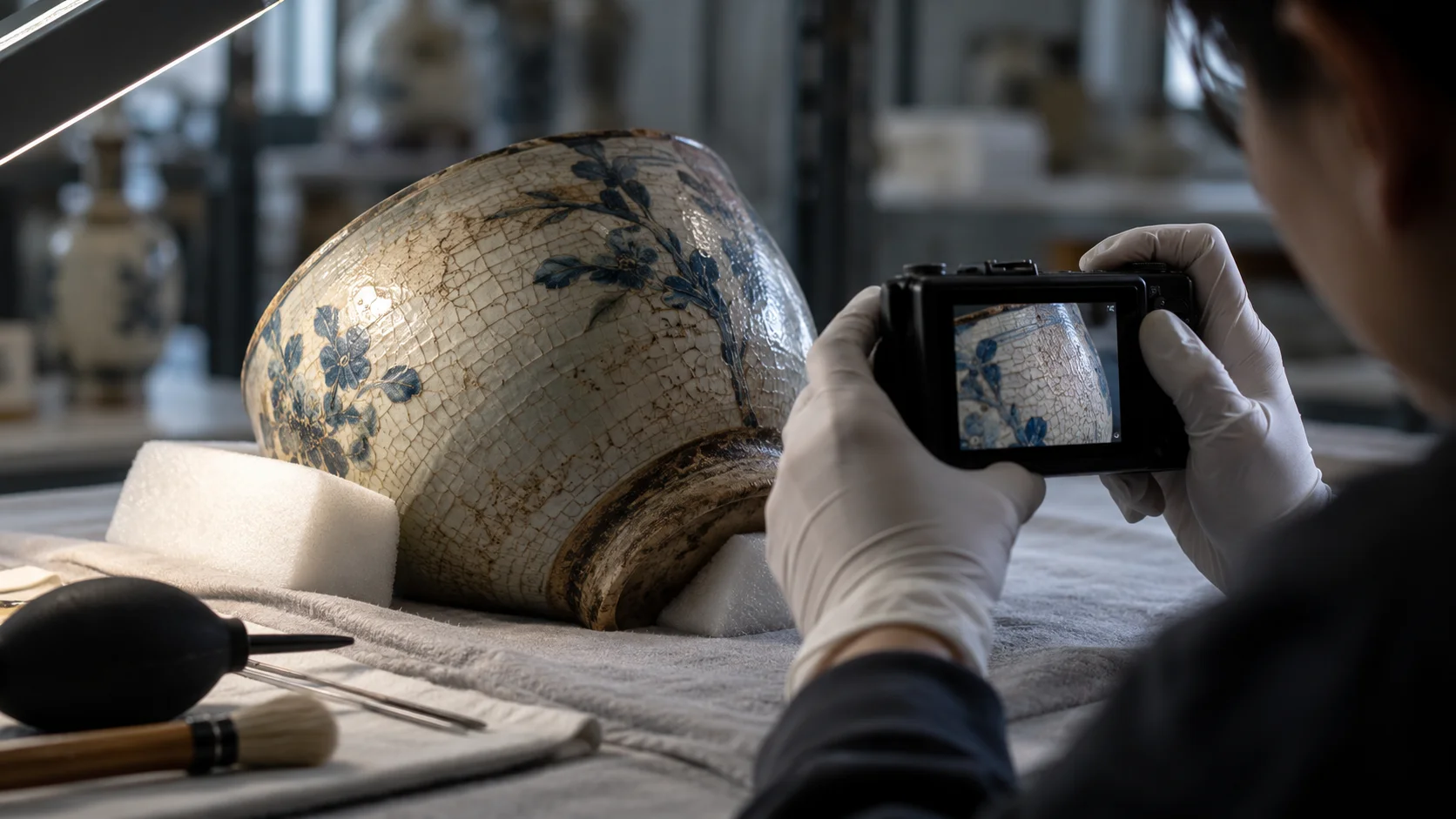
- Timestamped photographs before packing. Every significant piece, every side, close-ups of existing flaws, shot on a phone with location and date metadata intact. This is your baseline; without it, “pre-existing damage” is the adjuster’s favourite phrase.
- Packing video for high-value items. Two minutes of footage showing the mirror intact, then being tissue-wrapped, bubbled and lowered into its crate. It proves condition and professional packing in one artifact, neutralising the two biggest claim defences simultaneously.
- Condition report at delivery, before the crew leaves. Open every crate containing a scheduled item while the delivery team is present. Photograph anything wrong immediately, note it on the delivery receipt in writing, and never sign a clean receipt for a shipment you have not inspected. “Subject to unpacking inspection” written above your signature preserves your position if full unpacking must wait.
- Claim window discipline. Transit policies typically require written notice of damage within a short window, commonly 7 days from delivery, sometimes less for visible damage. Diarise it. A valid claim reported late is just a sad story with photographs.
Climate Risk: Forty Days in a Steel Box
A container on the UK–Thailand rotation spends 35–45 days at sea, crossing from a temperate winter through the Suez, the Indian Ocean and into the Gulf of Thailand. Inside the box, air temperature can swing from near-freezing to over 50°C at the roof line, and each swing drives a humidity cycle: warm moist air condenses on the coldest surface (often the underside of the container roof) and drips. Shippers call it container rain. Antiques hate all of it.
- Solid timber swells and shrinks across the grain; old glue joints and veneers, laid down with hide glue that softens in heat, are the first casualties. This is exactly the damage insurers file under inherent vice: prevention is the only remedy.
- Oil paintings respond to humidity cycling with canvas slackening, craquelure and, in bad cases, paint delamination.
- Leather and textiles risk mould above roughly 65% sustained relative humidity, and a tropical container interior can sit above that for weeks.
The countermeasures are cheap relative to the risk. Desiccant poles or bags (calcium chloride units hung inside the container) cost GBP 60–150 per 20ft box and materially flatten the humidity curve. Breathable wraps (that acid-free tissue again) stop condensation sitting against surfaces. Stow fragile organic pieces low and central, away from the roof and walls where temperature swings are sharpest. For genuinely important paintings or instruments, sealed case liners with conditioned silica gel create a stable micro-climate inside the crate itself, and for collections at the top of the value range, climate-controlled reefer containers exist, though they are expensive and rarely necessary if the passive measures are done properly.

White-Glove Delivery: The Last Mile Tiers
The final 20 kilometres in Thailand carry real risk: soi access too narrow for the truck, condominium freight-lift bookings, stairs. Delivery service comes in tiers, and it is worth knowing what you are buying:
- Kerbside/economy: the crate comes off the truck and becomes your problem. Never appropriate for scheduled antiques.
- Standard room-of-choice: crew carries items to the designated room; you unpack. Fine for blanket-wrapped robust pieces.
- Full white-glove: uncrating, placement, assembly, debris removal, and, critically, a crew present while you complete the delivery condition report. For pianos, mirrors and large crated pieces this tier is the correct default, and in Bangkok it typically adds a modest amount to the destination charges relative to what it protects.
- Fine-art specialist: art handlers, hanging service, condition reporting to museum standard. Justified for the top slice of the schedule.
Worked Example: A GBP 30,000 Antique Collection, UK to Chiang Mai
Numbers make the trade-offs concrete. Take a realistic collection accompanying a retirement move: the Victorian pier mirror (appraised GBP 8,000), a George III bureau (GBP 6,500), a 48-piece Royal Worcester service (GBP 4,000), two oil paintings (GBP 5,500 the pair), a longcase clock (GBP 4,500), and assorted smaller ceramics and glass (GBP 1,500). Total declared value: GBP 30,000, occupying about 12–14 m³, comfortably inside a 20ft container with the rest of a modest household.
- Pre-shipment appraisals (valuer’s day rate, six lots documented): GBP 450
- Export licence checks (Arts Council England thresholds reviewed; clock and paintings assessed, no licence ultimately required): GBP 0–150 in professional time
- Professional packing, museum-grade materials, two packers for two days: GBP 900
- Custom ISPM 15 crates (double-crate for the mirror at GBP 550, crates for the clock, bureau and paintings, cases for the porcelain): GBP 1,750
- Freight share, the fragiles’ pro-rata share of a 20ft FCL, UK door to Chiang Mai door, including THC and destination handling: GBP 2,400
- Desiccants and container preparation: GBP 120
- Insurance, an agreed-value itemised schedule with pairs-and-sets clause at 3% of GBP 30,000: GBP 900
- White-glove delivery upgrade, uncrating and condition reporting in Chiang Mai: GBP 350
Total protection and transport stack: roughly GBP 6,900–7,000, about 23% of the collection’s value. That ratio startles people. Then run the counterfactual: the budget alternative (owner packing, LCL groupage, lump-sum indemnity insurance) might come in near GBP 3,000, while tripling the handling events, voiding breakage cover on anything you wrapped yourself, and settling any surviving claim at depreciated value. Cheap shipping for antiques is not cheaper. It is a different product: transport without protection.
Five Common Mistakes (and What They Cost)
- Owner-packing the valuables to save money. Voids breakage cover under the owner-packed exclusion. The GBP 900 saved on packing is repaid the first time a GBP 4,000 dinner service arrives as mosaic tiles with no valid claim.
- Choosing LCL for a fragile-heavy consignment. Ten-plus handling events versus four, strangers’ cargo stacked on your crates, and warehouse staff who cannot see what “FRAGILE” is protecting. The FCL premium is the cheapest risk reduction on the invoice.
- Skipping the appraisal and photo baseline. Without pre-shipment evidence, every claim becomes a negotiation about whether damage is new and what the piece was worth. Both negotiations favour the insurer.
- Ignoring export licensing at origin. Discovering three days before collection that the longcase clock needs an Arts Council England licence check adds weeks; discovering it after export creates a provenance problem that follows the piece forever.
- Shipping religious artifacts casually. Buddha images enter Thailand easily and leave it only with Thai Fine Arts Department permission. Undocumented pieces can be stuck in the country, or seized. Keep import records for every religious item from day one.
Getting It Right
The pattern across every section of this guide is the same: with high-stakes fragiles, money spent before departure (packing, crating, appraisal, permits, desiccants) changes the probability of loss, while money spent on insurance merely changes who pays for it. Both matter, but the order matters more. The Victorian mirror does not care how good your policy is; it cares whether it is floating in foam inside two boxes of heat-treated timber in a container that nobody opens until Chiang Mai.
Swift Cargo arranges fine-art-grade packing, ISPM 15 crating, itemised agreed-value insurance and FCL shipping to Thailand as a single coordinated service, with export licence checks handled before collection is booked. If your shipment includes pieces that cannot be replaced, tell us early. The mirror’s next 140 years depend on the next six weeks.
Related Reading
- Cargo Insurance for Thailand Shipping: What It Covers and What It Costs
- What Actually Causes Shipping Damage in International Freight
- How to Ship Household Goods to Thailand
- International Removals to Thailand: The Complete Guide
- Duty-Free Import to Thailand: Who Qualifies and How
- Part Load Removals to Thailand: Sailing Dates, Duty and Crates
- Shipping Furniture to Thailand: Crating, Duty and What Breaks
Frequently Asked Questions
Can I pack my own antiques for shipping to Thailand?
You can, but you probably shouldn’t. Most all-risks transit policies carry an owner-packed exclusion: items you packed yourself lose breakage cover entirely or drop to total-loss-only terms. For anything valuable or irreplaceable, professional packing is effectively a condition of being insured at all.
Do antiques qualify for Thailand’s personal effects duty exemption?
Household antiques you owned and used before the move generally qualify when they arrive as part of a genuine relocation and you hold a qualifying status: a one-year work permit, a non-immigrant visa with a confirmed one-year working period, Thai permanent residence or a full one-year Smart Visa. A retirement visa does not qualify, so a retiree pays duty on antiques. Large collections, recently purchased pieces, or anything resembling commercial stock can be assessed for duty at Thai Customs’ discretion, so keep receipts and older photographs that show you owned and used the pieces before the move.
Do I need an export licence to ship antiques out of the UK?
Cultural goods above certain age and value thresholds need an individual export licence, administered through Arts Council England. Most everyday household antiques fall under the value limits, but paintings, manuscripts, clocks and higher-value pieces frequently require checking. Allow two to four weeks for the process and complete it before the crate is sealed.
Is FCL or LCL better for fragile antiques?
FCL, almost without exception. Your goods see roughly four handling events in a full container versus ten to twelve in shared LCL groupage, and nobody else’s cargo is ever stacked on your crates. The extra cost of a container you do not completely fill is usually the cheapest risk reduction in the whole shipment.
How should I insure an antique collection in transit?
Itemise every significant piece on a valued schedule with photographs and pre-shipment appraisals, insist on agreed-value rather than depreciated-indemnity settlement, and add a pairs-and-sets clause if any items belong together. Expect a premium around 2.5–4% of declared value for a fragile schedule.
Can I bring a Buddha statue into Thailand, and take it out again?
Small quantities of Buddha images for personal worship are generally tolerated on import, though antique or significant pieces attract scrutiny. Export is the trap: taking Buddha images out of Thailand requires Thai Fine Arts Department permission, including pieces you originally imported yourself. Keep your import paperwork so you can prove provenance if you later move on.