
Moving from the Netherlands to Thailand is one of the longer logistics journeys a European can take. Rotterdam to Laem Chabang spans roughly 19,000 kilometres via the Cape of Good Hope, which since 2024 has become the standard routing for commercial shipping avoiding the Red Sea. The practical freight questions (how long, how much, what qualifies for duty-free, what does not) have specific answers, and getting them right before your goods are sealed in a container saves significant cost and complication at the Thai end.
Who makes this move and why
Three distinct expat profiles drive the Netherlands–Thailand relocation route. The first is retirement: the Netherlands has a substantial retirement-age expat community in Thailand, particularly in Chiang Mai and coastal areas like Hua Hin and Phuket, drawn by lower cost of living, warm climate, and access to quality healthcare at Thai private hospitals. The second is remote work or digital business: Dutch nationals in tech, consulting, or online business who can work from anywhere and choose Thailand’s Non-Immigrant visa ecosystem as their operating base. The third is Thailand-based business: Dutch entrepreneurs running operations in Bangkok or the Eastern Economic Corridor, where Dutch-Thai trade relationships in agriculture, logistics, and manufacturing create employment and investment opportunities.
Each profile has slightly different freight considerations: the retiree bringing 25 years of household goods, the remote worker shipping two suitcases worth of essentials plus a good desk setup, the business owner moving an operational household. The customs rules apply equally to all, but the container choice and duty exposure differ significantly by volume.
Departure ports: Rotterdam, Antwerp, and the gateway question
The Netherlands has two practical departure options for sea freight to Thailand: Rotterdam (the main Dutch port, Europe’s largest container terminal) and Antwerp (across the Belgian border, roughly 60 minutes by road from many Dutch cities). Both serve Laem Chabang via the same major carriers (Maersk, CMA CGM, MSC, Evergreen), and transit time differences between the two ports are minimal.
For most Dutch households, Rotterdam is the natural choice. It offers more frequent sailings, more carrier options, and lower local transport costs from Dutch pickup addresses. Antwerp becomes relevant for households in the southern Netherlands (Eindhoven, Maastricht, Breda) where road distance to the Belgian port is shorter than to Rotterdam’s Maasvlakte terminals.
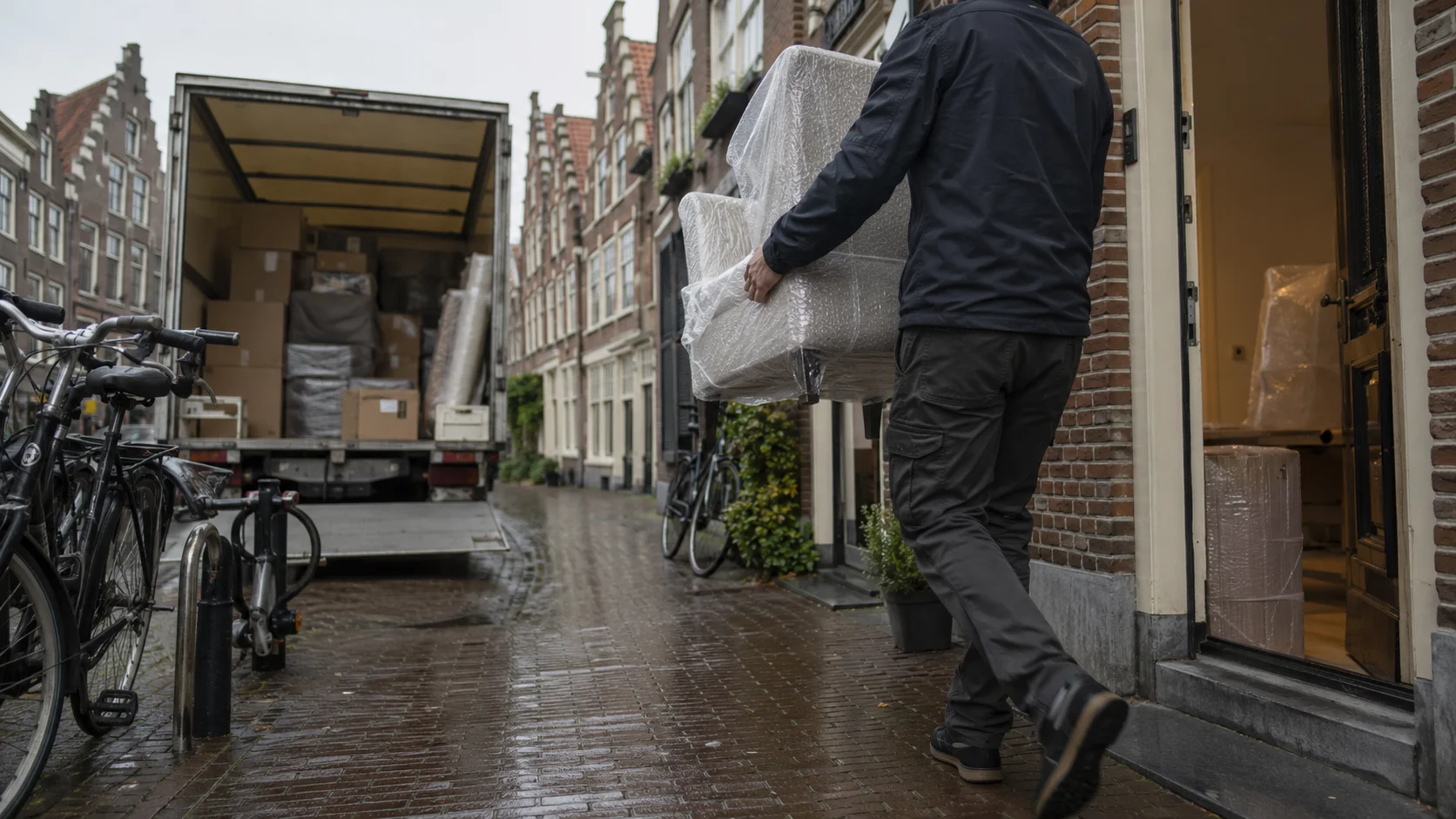
The origin side of the shipment involves collection from your Dutch address (road transport to the CFS facility or directly to the port), consolidation into the container (for LCL shipments), export customs clearance via the Dutch Douane, and container loading at the terminal. For LCL shipments, allow 3–5 working days between collection and vessel departure. FCL shipments can sometimes be packed at your address using a door-to-door container service, eliminating the CFS stage.
The shipping route: Rotterdam to Laem Chabang
Sea freight from the Netherlands to Thailand now travels via the Cape of Good Hope rather than the Suez Canal. Since late 2023, major carriers have rerouted to avoid Houthi attacks on commercial shipping in the Gulf of Aden. The Cape routing adds approximately 10–14 days to the journey and a structural surcharge to freight costs: USD 500–1,500 per TEU depending on carrier and contract.
The standard routing is Rotterdam → (Atlantic transit) → Cape of Good Hope → (Indian Ocean) → Singapore or Port Klang (transshipment) → Laem Chabang. Port-to-port transit time on this route is 28–35 days. Most European-origin shipments to Thailand transship at Singapore, which is the primary hub for Southeast Asian distribution. Transshipment adds a connection-change step: your container (or LCL cargo) transfers from the deep-sea vessel to a feeder vessel at Singapore for the final 700-kilometre leg to Laem Chabang.
Door-to-door (from collection at your Dutch address to delivery inside your Thai property) runs 6–10 weeks. The range reflects variability in: how quickly export documentation is finalised, whether you use LCL (which adds consolidation lead time) or FCL, whether Thai customs processes your entry as Green Line (no inspection, 3–5 days) or Red Line (physical examination, 7–21 days), and last-mile delivery complexity in Thailand.
For planning purposes, use 8 weeks as your base assumption and build in a 2-week buffer if you have a firm move-in date at your Thai destination.
Dutch export formalities
BRP deregistration
Uitschrijving uit de Basisregistratie Personen (BRP deregistration) is the formal process of removing yourself from the Dutch municipal population register when you emigrate. You submit aangifte van vertrek (notice of departure) at your local gemeente before leaving. The gemeente issues a bewijs van uitschrijving (deregistration certificate) and a BRP uittreksel (population register extract) confirming your registered address history.
Critical sequencing note: do not complete BRP deregistration before you have your Thai visa and Thai address documentation. The BRP uittreksel showing your Dutch registered address is one of the supporting documents for Thai customs personal effects duty-free exemption. Thai customs uses it as evidence of prior residence in the Netherlands, proving that the items you are shipping were genuinely part of a Dutch household, not goods purchased for Thai import. Once the BRP record is closed, obtaining a historical extract becomes more complicated and may require a request through the RvIG (Rijksdienst voor Identiteitsgegevens).
The Nederlandse Ambassade in Bangkok (located in Sathorn) can assist with documentation queries related to your Dutch status in Thailand, but they do not process BRP changes. That remains a Netherlands-based administrative function.
Dutch Douane export customs
Personal effects and household goods departing the EU require a Douane export declaration (uitvoeringsaangifte) when the declared value exceeds EUR 1,000. Your freight forwarder or customs broker handles this as a standard part of the export service. You provide an itemised inventory (packing list) with declared values, and they file the EAD (Export Accompanying Document) with Dutch Douane. Keep a copy of the EAD: Thai customs may request evidence that goods were properly exported from the EU.
There is no specific permit requirement for most household goods leaving the Netherlands, but certain items require additional documentation: antiques over 50 years old may require a cultural export licence; CITES-listed items (certain wood furniture, ivory, tortoiseshell) require a CITES permit; and any firearms require a Douane export licence and advance import permit from Thai authorities.
Thai customs: the personal effects exemption
Thailand’s personal effects duty-free exemption is the most consequential customs question for Dutch expats shipping household goods. Getting it right saves 10–30% in duty costs on the value of everything you ship. Getting it wrong at Laem Chabang (because the documentation is incomplete or the timing is off) results in a full duty assessment you cannot easily appeal after the container has cleared.
The exemption rules are set out in the Thai Customs Act B.E. 2560 (2017). The practical requirements are:
1-year ownership and use rule: items must have been owned by the claimant and in daily use for at least one year before the date of departure from the Netherlands. Thai customs interprets this strictly: new goods in original packaging, items purchased in the 12 months before emigration, and goods that appear commercially new rather than genuinely used do not qualify. The 1-year rule is assessed on item condition, purchase documentation if requested, and inventory consistency with the claimed household volume.
6-month arrival window: the shipment must arrive at Laem Chabang within 6 months of the date of your first valid Thai visa entry. This is a hard deadline, not 6 months from when the container was packed, or from when you signed the lease in Bangkok, but from the date you first entered Thailand on your qualifying visa. An expat who entered Thailand in March and whose container arrives in October has missed the window and owes full import duty.
Qualifying visa types: the exemption applies under Thai Customs’ standard criteria to holders of a Non-B (business/work-permit) visa or an LTR visa. A Non-O for retirement is excluded from that standard test and does not qualify. Tourist visas (TR) and Destination Thailand Visas (DTV) do not qualify. This is a common error for Dutch expats who arrive on a DTV or multiple-entry tourist visa while their goods are in transit. The container clears Thai customs, but the importer cannot claim exemption because their visa category is wrong.
Here is the part most guides skip: the visa-category rule is not a paperwork technicality invented to trip people up. Thai customs is not actually checking your visa type. It is using visa type as a proxy for something harder to verify directly, which is whether you are genuinely relocating or extending a long holiday with a container of belongings behind you. A Non-B or LTR visa signals a commitment (a work permit, a ten-year residency application) that is expensive and slow to fake. A tourist visa or a DTV signals the opposite: cheap, fast, reversible, which happens to be exactly the profile of someone importing goods to sell rather than goods to live with. The rule looks arbitrary until you see it as a fraud filter calibrated on visa cost and reversibility, not a random bureaucratic line. Understanding that logic will not change your visa category, but it explains why arguing the point with a customs officer rarely works: you are not disputing a technicality; you are disputing the entire proxy the system is built on.
The complete documentation package for Thai customs personal effects duty-free clearance includes: Thai customs Form 130/1 (personal effects declaration), passport (current and prior, showing departure from the Netherlands and entry to Thailand), valid qualifying visa, itemised inventory in Thai and English with estimated values, BRP uittreksel (Dutch population register extract), proof of Thai address or lease, and for high-value electronics, original purchase receipts. You’ll also need the shipping line’s Bill of Lading, and your customs broker files the entry electronically through Thailand’s National Single Window system rather than on paper.
For more detail on exactly what qualifies and what does not under Thai customs rules, including the specific categories of goods that are always dutiable regardless of prior ownership, see duty-free moving to Thailand: what actually qualifies.
Dutch-specific pitfalls
Bicycles
The Netherlands exports more bicycles per capita than any country in Europe, and Dutch expats moving to Thailand frequently ask whether their bicycle can be included in the personal effects shipment duty-free. The answer is no. Thai customs does not classify bicycles as personal effects. They fall under the HS code for vehicles and wheeled transport, which carries import duty of 10–20% plus 7% VAT. A quality Dutch bicycle declared at EUR 800 generates a duty and tax bill of approximately EUR 135–175. Most Dutch expats sell their bicycle before departure.
E-bikes with lithium batteries have an additional complexity: lithium batteries above a certain Wh threshold are subject to IATA DGR Class 9 restrictions for air freight and IMDG Code requirements for sea freight. A standard 500Wh e-bike battery requires proper IMDG declaration and carrier acceptance, which some carriers refuse for personal effects shipments. If you are determined to bring an e-bike, get carrier acceptance in writing before booking.
Dutch electrical appliances
The Netherlands operates on 230V/50Hz electricity, identical to the rest of continental Europe and compatible with Thailand’s 220V/50Hz standard. In practical terms, this means your Dutch appliances will work in Thailand without a voltage converter. Dutch washers, refrigerators, televisions, and kitchen equipment can be shipped and used directly.
The complication is plug type. The Netherlands predominantly uses the Type F (Schuko) two-round-pin plug with earthing clips. Thailand’s standard socket (TIS 166-2549) accepts Type A (US flat-blade), Type B (US three-pin), and Type C (Europlug two-round-pin without earthing), but not Type F Schuko because the earthing clips prevent insertion into the Thai socket. You will need Schuko-to-Type-C or universal adapters for earthed Dutch appliances. These cost less than EUR 5 each and are widely available in Thailand, so adapter supply is not a reason to leave appliances behind. Just budget for adapters before your goods arrive.
Wine and spirits
Dutch expats who are serious wine or spirit collectors face a stark customs reality in Thailand. The personal effects duty-free allowance for alcohol is 1 litre per adult, approximately one standard wine bottle or one bottle of spirits. Everything beyond that limit is subject to Thai excise duty, which runs at 400%+ on spirits on a combined basis (excise rate × base value × VAT × 7%). A EUR 30 bottle of Dutch jenever declared correctly at Laem Chabang can generate a duty and tax bill of EUR 120+.
The practical conclusion most Dutch expats reach is that wine and spirits are not worth shipping. Thailand has a well-developed wine import trade (particularly through Bangkok specialist retailers and Makro), and while Thai wine prices are higher than Dutch prices, the freight cost and duty liability on a wine collection make shipping economically irrational compared to selling the collection in the Netherlands and rebuilding it in Bangkok.
Container options and volume guide
Container selection is the first major logistics decision. The choice between LCL (Less than Container Load, shared space) and FCL (Full Container Load, dedicated container) turns primarily on volume and timing tolerance. If you are not sure which bracket your household falls into, working out how much space your belongings actually occupy is worth doing on paper before you call a forwarder. See this practical guide to estimating your CBM volume for a room-by-room method that converts furniture and boxes into a number a quote can be built around.
LCL for 1-bedroom apartments and small moves
LCL is the right choice for moves up to approximately 10–12 CBM, roughly the contents of a 1-bedroom Dutch apartment after removing large furniture you plan to leave behind or sell. At 5 CBM, a typical LCL shipment for a minimalist Dutch mover includes: a bed frame and mattress, 15–20 boxes of personal items and books, a desk setup, kitchenware, and soft furnishings. Ocean freight on the Rotterdam–Laem Chabang LCL lane runs approximately USD 80–140 per CBM, so a 5 CBM shipment generates USD 400–700 in ocean freight before origin and destination charges are added.
LCL lead time adds 3–7 working days at origin (consolidation at the Rotterdam CFS facility) and 2–5 working days at destination (deconsolidation at the Laem Chabang CFS before delivery). Total door-to-door for LCL is typically 8–10 weeks on this lane.
FCL 20ft for 2–3 bedroom households
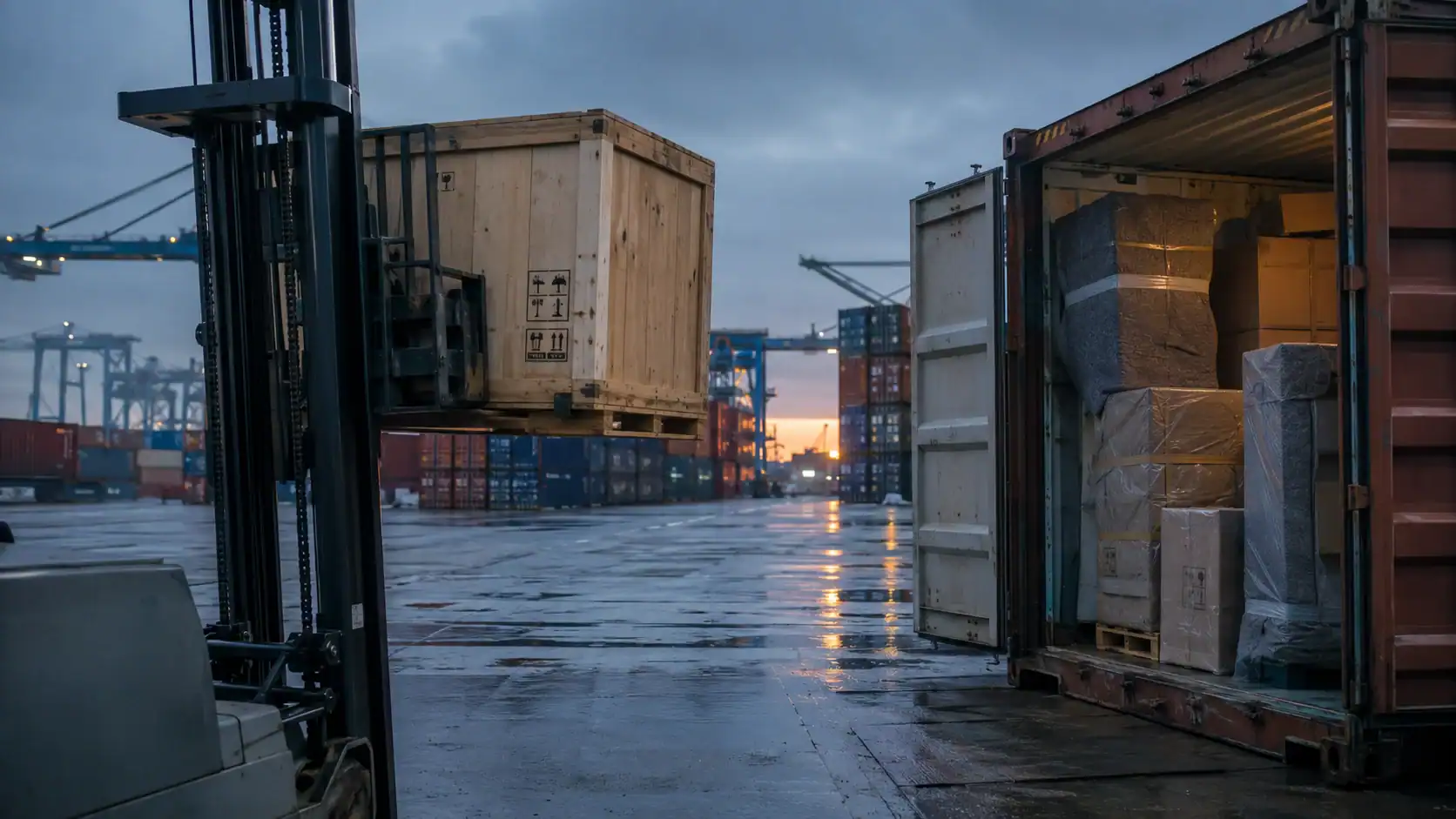
A 20-foot container holds approximately 25–28 CBM of packed household goods, enough for a comfortably-furnished 2–3 bedroom Dutch apartment including sofas, dining furniture, wardrobes, and appliances. At the FCL crossover point (approximately 12–15 CBM), FCL becomes cost-competitive with LCL once per-CBM LCL rates and CFS charges are factored in, and it eliminates the consolidation and deconsolidation steps that add time.
A 40-foot container (50–55 CBM) is appropriate for larger Dutch households moving a complete 4–5 bedroom house, but relatively rare for Netherlands-Thailand expat moves. Most Dutch expats moving to Bangkok or resort areas downsize significantly before the move, selling or donating furniture that will not suit Thai apartment living.
For a practical guide to shipping household goods to Thailand, including volume benchmarks for different apartment and house sizes, see the linked article which covers the full container-packing process.
Cost ranges: Rotterdam to Bangkok
Costs vary based on departure date, carrier selection, volume, Thai destination address, and whether additional services (packing, unpacking, customs brokerage in the Netherlands and Thailand) are included. The figures below are indicative for mid-2026 and include ocean freight only unless stated.
| Shipment type | Volume | Ocean freight (USD) | Indicative door-to-door (EUR) |
|---|---|---|---|
| LCL: small move | 3–5 CBM | USD 240–700 | EUR 2,500–4,000 |
| LCL: 1-bed apartment | 8–12 CBM | USD 640–1,680 | EUR 4,000–6,500 |
| 20ft FCL | ~25 CBM | USD 2,800–4,500 | EUR 6,000–9,500 |
| 40ft FCL | ~50 CBM | USD 4,500–7,000 | EUR 9,500–15,000 |
Door-to-door estimates include: Dutch origin collection, CFS or FCL packing, Rotterdam export documentation, ocean freight, Thai customs brokerage, destination THC, last-mile delivery to a Bangkok or major city address. They do not include packing labour, Thai customs duty (if applicable), or storage.
Cape rerouting surcharges are included in current ocean freight rate quotes from carriers. They are no longer itemised separately in most carrier quotes as of 2026, having been absorbed into base rates on the affected lanes.
Visa timing and the duty-free window
The interaction between your visa entry date and your shipment arrival date is the most consequential timing decision in the entire move. Misalign these two events by more than 6 months and you lose the personal effects duty-free exemption on everything in the container.
The standard approach for Dutch expats retiring to Thailand is the Non-Immigrant O-A visa (retirement visa), which requires proof of funds (THB 800,000 in a Thai bank account or monthly pension equivalent), a police clearance from the Netherlands, and a medical certificate. The O-A is issued by Thai consulates. The Royal Thai Consulate-General in The Hague handles Dutch applications.
The LTR (Long-Term Resident) visa is a newer option that has gained traction among Dutch expats with investment income, pension income, or remote work. Depending on category, the LTR offers a 10-year renewable visa, work permit eligibility, and either exemption from Thai tax on foreign-sourced income (the Wealthy Pensioner, Wealthy Global Citizen and Work-from-Thailand Professional categories most Dutch applicants use) or a 17% flat rate on Thai employment income (Highly-Skilled Professional category only): more stable legal status than the annual O-A renewal cycle.
Timing the move correctly means booking your shipping so the container arrives at Laem Chabang within the 6-month window from your first Thai entry. For a Dutch expat who enters Thailand in January, the container must clear Thai customs no later than July. With 8 weeks sea freight transit and 2–3 weeks Thai customs processing, the container needs to leave Rotterdam no later than April. If you enter Thailand in January and want to ship your household goods, your collection date in the Netherlands should be February–March at the latest.
Working backwards further: your BRP deregistration should happen after you have your Thai visa in hand (so you can present the Dutch consulate with proof of Thai residence for your BRP uittreksel), and your Dutch departure should be close to your shipping date so that items recently in use at your Dutch address match the packing inventory your freight forwarder compiles.
For more on the practical customs delays that can threaten the 6-month window, including what happens if Thai customs holds your goods for documentation queries, see how to avoid customs delays when moving to Thailand.
What to Ship and What to Leave Behind
Generally worth shipping from the Netherlands:
- Quality clothing, particularly cold-weather and business attire; Dutch fashion is not easily replicated in Thailand
- Books and personal libraries
- Artwork, antiques, and objects of sentimental or monetary value
- Professional and specialist equipment
- Children’s belongings and comfort items
- Quality Dutch-made or European furniture with significant replacement cost
Typically not worth shipping:
- Bicycles: the Netherlands’ bicycle culture does not translate to Thailand’s roads, traffic, or terrain. City bikes are bulky to ship, and comparable bicycles for Thai conditions are readily available locally. High-performance road or mountain bikes may be an exception if they are high-value and not easily replaced.
- Standard flatpack or mid-market furniture: available in Thailand at comparable prices
- Large white goods: washing machines, dishwashers, large fridges. Thai apartments are smaller and local replacements are affordable
- Bulky items (heavy sofas, large wardrobes) where shipping cost approaches replacement cost
- Dutch-voltage electrical appliances not usable on Thailand’s 220V/50Hz grid (most modern appliances are dual-voltage, but older Dutch-purchased items may not be)
A quick word about the bicycle, because we know it’s the one that stings. If you’re Dutch, that bike probably isn’t “a bike”. It’s the thing you’ve ridden to work in the rain for fifteen years, the one with the basket that knows the way home. Leaving it at the kerb feels like leaving a small piece of the Netherlands behind. Here’s the honest version, friend to friend: it won’t be happy on a Bangkok soi, and you won’t enjoy watching it seize up in the heat. Ship the road bike you actually race, if you have one. Photograph the old city bike, hand it to someone who’ll love it, and buy something built for the country you’re moving to. You’re allowed to feel a bit sad about it and still make the sensible call.
Prohibited and Restricted Items
Prohibited, remove before packing:
- Lithium batteries of any kind: power banks, e-bike batteries, laptop batteries, power tool batteries. Prohibited from sea freight under IMDG dangerous goods regulations. Remove all batteries from devices before packing; carry them in your cabin luggage. This is especially relevant for Dutch movers who commonly own e-bike batteries.
- Flammable substances, aerosols, gas canisters, paint
- Narcotics and controlled substances
- Pornographic material
- Counterfeit goods
- Weapons and firearms (without Thai police permit)
- CITES-protected wildlife and derivatives
Restricted, documentation required:
- Alcohol: not covered by the personal effects duty-free exemption; Thai excise duty applies. Small personal quantities may be accepted; consult your removal company.
- Buddha images and religious antiques: Fine Arts Department permit required
- Plants and plant material: phytosanitary certificate from NVWA (Nederlandse Voedsel- en Warenautoriteit) required; easier to leave behind
- Prescription medication in excess of personal use: carry documentation
Common mistakes Dutch expats make
Deregistering BRP before obtaining Thai residence proof. This is the single most frequent administrative error. A Dutch expat who cancels their BRP registration at their gemeente before they have their Thai visa and address in hand loses the ability to produce a current BRP uittreksel showing Dutch registered address. Thai customs expects this document. Without it, proving prior Dutch residence for the personal effects exemption becomes significantly more difficult, and you may end up paying duty on goods you were legally entitled to import duty-free.
The correct sequence: obtain Thai visa → secure Thai address (lease or letter of invitation) → submit BRP deregistration at gemeente → collect BRP uittreksel before the record closes → pack goods and book shipping.
Assuming Dutch plug sockets work in Thailand. Voltage is compatible (220–230V), but the Type F Schuko plug does not fit standard Thai sockets (TIS 166-2549). Dutch expats who do not budget for adapters discover this within 24 hours of delivery. Buy Schuko-to-Type C adapters in the Netherlands before departure, or plan to buy them in Thailand. They are inexpensive and widely stocked. The voltage compatibility means you do not need transformers or converters, which saves both space and cost compared to British or American expats whose equipment requires voltage conversion.
Shipping wine and spirits assuming personal effects exemption covers them. The 1-litre duty-free allowance per adult applies. Beyond that, Thai excise on spirits makes shipping economically irrational. Dutch expats who ship a wine rack worth EUR 500–1,000 can face duty assessments of EUR 800–2,500+ depending on what is in it. Sell the collection or drink it before departure.
Missing the 6-month arrival window because of delayed booking. Sea freight takes 8–10 weeks door-to-door, and Thai customs processing adds another 1–3 weeks for clean paperwork. The Dutch expat who enters Thailand in March, then spends April and May enjoying Bangkok before thinking about shipping, is leaving Rotterdam no earlier than June for an August–September arrival at Laem Chabang, which is within the 6-month window, but without any buffer if Thai customs requests additional documentation and delays clearance by 2–3 weeks. Expats who genuinely cannot align their departure with the shipping timeline (a Dutch lease that runs longer, a job handover that has not finished) have a third option beyond rushing the shipment or missing the exemption: holding goods in storage at either end while the visa and shipping timelines catch up to each other, which is worth planning deliberately rather than discovering as a last-minute scramble.
How Swift Cargo handles Netherlands-to-Thailand moves
Swift Cargo offers door-to-door relocation freight from the Netherlands to Thailand: collection from your Dutch address in any province, Rotterdam export customs clearance, sea freight to Laem Chabang, Thai customs brokerage, and delivery to your Bangkok, Chiang Mai, Phuket, or Hua Hin destination.
For Dutch expats, the value is in the documentation coordination: BRP uittreksel guidance, correct Customs Form 130/1 preparation, itemised inventory in the format Thai customs expects, and a customs broker in Thailand who handles the personal effects clearance process rather than leaving you to navigate it alone at Laem Chabang.
Ready to plan the move? Get a quote for shipping to Thailand from Swift Cargo.
None of the individual choices in this move (which visa route to start, how much to leave behind, which container size to book) make complete sense on their own while you are making them. They only connect into a coherent decision once you are standing in the Bangkok apartment looking at what actually arrived and what you wish you had left in Rotterdam. That is not a reason to skip the planning. It is a reason to trust the sequence laid out here even when one step (downsizing harder than feels necessary, or booking a smaller container than the inventory suggests) does not yet look like it is going to pay off. The families who move well are usually the ones who followed the order of operations before they could see why it mattered, not after.
Related Reading
Frequently Asked Questions
How long does shipping from the Netherlands to Thailand take?
Sea freight from Rotterdam to Laem Chabang (Bangkok’s deep-water port) takes 28–35 days port-to-port. Door-to-door, including collection from your Dutch address, consolidation at the port, ocean transit, Thai customs clearance, and final delivery in Thailand, is typically 6–10 weeks total. The Red Sea rerouting via Cape of Good Hope has added roughly 10–14 days compared to pre-2024 Suez Canal transit times.
Do I need to deregister from the BRP before moving to Thailand?
Yes. Uitschrijving uit de Basisregistratie Personen (BRP deregistration) is legally required when you emigrate from the Netherlands. You submit aangifte van vertrek (emigration notice) at your gemeente. However, do not deregister until you have your Thai visa and proof of Thai address. The BRP uitreksel (extract) showing your Dutch registered address is supporting documentation for Thai customs personal effects duty-free exemption, and you need it before it is closed.
Can I ship my bicycle duty-free to Thailand?
No. Bicycles are not classified as personal effects under Thai customs law and do not qualify for the duty-free personal effects exemption. Import duty applies at 10–20% of declared value plus 7% VAT. E-bikes with lithium batteries are additionally restricted under IATA DGR Class 9 rules for air freight and require IMDG declaration for sea freight. Most Dutch expats leave bicycles behind or sell them before departure.
What is the 6-month rule for personal effects in Thailand?
Under Thai Customs regulations, personal effects shipped duty-free must arrive in Thailand within 6 months of your first valid visa entry date. Items must also have been owned and in use for at least 1 year prior to your move. If your shipment arrives after the 6-month window, or if you cannot demonstrate 1-year prior ownership and use, import duty applies at standard rates.
How much does it cost to ship a container from the Netherlands to Thailand?
As of mid-2026, a 20ft FCL (Full Container Load) from Rotterdam to Laem Chabang runs approximately USD 2,800–4,500 ocean freight, plus origin costs (THC, documentation, collection from your address), destination costs (Thai customs broker, destination THC, CFS handling if LCL, last-mile delivery), and insurance. Total door-to-door for a 20ft FCL typically runs EUR 6,000–9,500 depending on volume, pickup location, and destination in Thailand. LCL (Less than Container Load) runs approximately USD 80–140 per CBM ocean freight for this lane.