

The Five Stages of a US-Australia Freight Timeline
The shipping time from the USA to Australia is not a single number. It is the sum of five variable stages that each carry their own delay risk. An importer who knows only the vessel transit time is planning around approximately 60% of the actual factory-to-warehouse timeline. The other 40% (US domestic trucking, port dwell at origin, Australian customs clearance, and last-mile delivery) is where most of the variance occurs and where most of the avoidable delays happen.
The five stages, each with typical ranges for sea freight, are: US factory to US port of loading (1–5 days, depending on inland distance and booking lead time); US port dwell before vessel departure (1–3 days, longer during peak periods); ocean transit (18–38 days depending on US origin port and Australian discharge port); Australian port discharge and customs clearance (1–10 days depending on clearance channel and biosecurity); and last-mile delivery from Australian port to warehouse (1–4 days depending on delivery location). The total end-to-end timeline for a West Coast US shipment to Sydney ranges from approximately 24 to 38 days under normal conditions. For an East Coast US shipment to Melbourne, the same model produces a range of 38 to 54 days.
The difference between these ranges is not carrier performance variance. It is a function of how well the importer controls the stages they can control: booking lead time, documentation accuracy, pre-arrival lodgement, and delivery appointment scheduling at the warehouse end. An importer who treats freight as an event rather than a managed process will consistently experience the upper end of these ranges.
Sea Freight Timelines by US Port of Origin
The US port of loading determines both the vessel transit time to Australia and the available sailing frequency. Not all US export ports have direct services to Australian ports: some routes require transhipment at an Asian hub (Singapore, Port Klang, Hong Kong), which adds 3–7 days and introduces an additional transhipment risk.
US West Coast: Los Angeles, Long Beach, and Seattle
The US West Coast, and specifically the Los Angeles and Long Beach port complex (LALB), is the primary export gateway for US goods destined for Australia. Most major carriers (Maersk, MSC, CMA CGM, Hapag-Lloyd, Evergreen) operate services from LALB to Australian east coast ports either directly or via Singapore, with sailing frequencies of 1–2 departures per week depending on the carrier and service loop.
Ocean transit from Los Angeles to Sydney (Port Botany) runs 18–22 days on direct services. The same origin to Melbourne is 20–24 days. Services that route via Singapore add 4–7 days to these figures depending on the transhipment window. Seattle-origin cargo typically moves via LALB for Australian services, adding 2–3 days of domestic transit before vessel loading. During Q4 peak shipping season (September–December), LALB congestion regularly adds 3–7 days to port dwell times, a factor that should be accounted for in any US supplier delivery schedule covering that window.
US East Coast: New York, Savannah, and Charleston
US East Coast exports to Australia are a longer and more variable route. From New York (Port Newark), the standard routing transits the Panama Canal and connects to Australian services at a west coast transhipment hub. Total transit from New York to Sydney runs 28–35 days; to Melbourne, 30–37 days. The Panama Canal transit itself, now handling Neopanamax vessels, is a bottleneck that historically causes seasonal delays, particularly during periods of low water levels when draft restrictions apply.
Savannah (Georgia) and Charleston (South Carolina), both significant US export hubs for manufactured goods and agricultural products, have similar routing profiles to New York, with transit times of 28–36 days to Australian east coast ports. For importers whose US suppliers are located in the Southeast or Mid-Atlantic, consolidation at Savannah or Charleston is more cost-effective than trucking inland cargo to LALB, despite the longer ocean transit. The freight rate differential between East Coast and West Coast services typically offsets the additional transit days in landed cost terms for lower-value or lower-time-sensitivity goods.
US Gulf Coast: Houston and New Orleans
The US Gulf Coast, primarily Houston (Port of Houston) and to a lesser extent New Orleans, handles significant volumes of petrochemical goods, machinery, and agricultural commodities bound for Australia. Gulf Coast routing to Australia goes via the Panama Canal, with transit times of 32–40 days to Australian east coast ports. Fewer direct or near-direct services operate on the Gulf-Australia corridor compared to the West Coast, meaning transhipment windows, and the associated delay risk, are a more common feature of this route. For importers shipping heavy machinery or breakbulk cargo from Texas or Louisiana, specialist freight forwarders with Gulf-Australia experience are important for navigating the limited carrier options on this lane.
Australian Port of Discharge and Last-Mile Timelines
The Australian port of discharge is driven by the delivery destination, not the US origin port. Choosing a discharge port that requires an additional coastal leg or long-haul road transport adds time and cost that is not visible in the vessel transit figure.
Sydney (Port Botany)
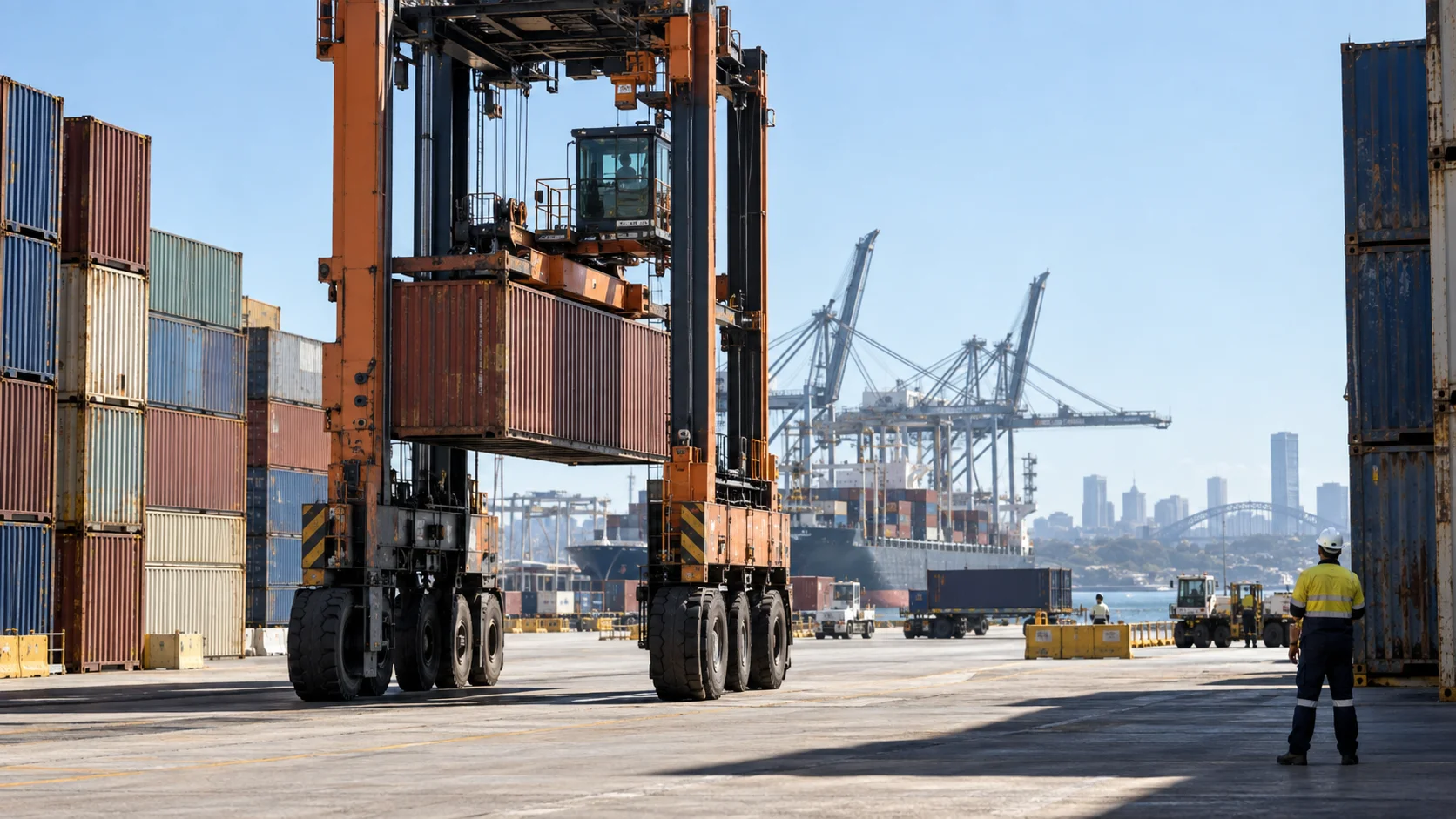
Port Botany is the primary container terminal for NSW and ACT deliveries. It operates through three terminals: DP World Australia, Patrick Terminals, and Hutchison Ports. Standard container availability after vessel discharge runs 1–2 working days for FCL and 2–4 working days for LCL (dependent on the consolidator’s deconsolidation schedule). Pre-arrival lodgement with ABF (submitting the import declaration before the vessel berths) reduces the time between container availability and release to 4–8 hours for green channel clearances. Without pre-arrival lodgement, the declaration queue can add 1–2 working days before the container is released.
Last-mile delivery from Port Botany to warehouse in metropolitan Sydney is 1–2 days for a standard truck delivery. Regional NSW delivery (Newcastle, Wollongong, Central Coast) adds 1 day. Country NSW and regional delivery to ACT can add 2–4 additional days depending on freight network coverage.
Melbourne (Webb Dock and Swanson Dock)
Melbourne is the primary gateway for Victoria, South Australia, and Tasmania. Webb Dock (DP World) and Swanson Dock (Patrick) handle the majority of container traffic. Container availability timelines are broadly similar to Port Botany (1–2 days for FCL, 3–5 days for LCL) with the same pre-arrival lodgement advantage on customs clearance speed. Melbourne’s terminal operations have historically experienced periodic industrial action that can add 1–5 days to port dwell; this risk is lower than it was in the early 2020s but is not zero and should be reflected in buffer planning.
Last-mile delivery from Melbourne’s Docklands/Webb Dock area to metropolitan warehouse is 1–2 days. Adelaide delivery via Melbourne adds 2–3 days of road freight. Hobart (Tasmania) requires a Bass Strait coastal service, adding 2–4 days beyond Melbourne port release.
Brisbane, Fremantle, and Adelaide
Brisbane (Fisherman Islands terminal, operated by Patrick and DP World) serves Queensland and is a viable discharge option for northern NSW. Most US West Coast services connect to Brisbane via transhipment at Singapore or an intermediate Asian port rather than directly: the transhipment leg adds 3–7 days to the vessel transit figure and a transhipment window of 2–5 days. For importers in Queensland, it is worth evaluating whether discharging at Sydney or Melbourne and trucking north is faster and cheaper than waiting for a transhipment service to Brisbane, particularly for time-sensitive cargo.
Fremantle (Western Australia) is the gateway for WA-destined goods. US West Coast services to Fremantle typically route via Singapore with a transit of 24–30 days from LALB plus the transhipment window. Adelaide (Outer Harbor) is served by feeder services from Melbourne with a coastal leg of 2–3 days after Melbourne discharge. For cargo destined for Adelaide, discharge at Melbourne and road transport is often faster than waiting for a direct Adelaide service.
Air Freight Timelines: USA to Australia
Air freight from the USA to Australia is not a niche option. It is the standard mode for high-value goods, time-sensitive replenishment, and samples. The transit time is consistent and predictable in a way that sea freight is not, which makes it a more reliable planning tool even at its significantly higher cost.
Standard commercial airfreight from major US origin cities (Los Angeles, Dallas-Fort Worth, Chicago O’Hare, New York JFK) to Australian gateway airports (Sydney, Melbourne, Brisbane) runs 2–4 days. The variance reflects connection routing: direct services from Los Angeles to Sydney are approximately 15–17 flying hours; services from East Coast US cities typically connect at Los Angeles or Dallas, adding 4–8 hours of transit plus a connection window. Express courier services (DHL, FedEx, UPS) using their own aircraft networks deliver in 1–3 days from any US origin, with next-day delivery from the US West Coast to Sydney available on some services at premium rates.
Australian customs clearance for air freight runs 1–4 hours for green channel releases with pre-lodged declarations. Documentary examination adds 1–2 days; physical examination adds 2–4 days. DAFF biosecurity inspection for air freight on regulated product categories adds 1–3 days, which is shorter than the sea freight equivalent because DAFF air freight inspection is prioritised at airports. Last-mile delivery from Sydney Kingsford Smith or Melbourne Tullamarine to metropolitan warehouse is typically same-day or next-morning.
The cost differential between air and sea is real and significant: air freight from the US to Australia typically runs AUD 8–18 per kilogram for commercial airfreight, compared with sea freight at AUD 0.50–2.00 per kilogram equivalent for FCL volumes. For goods with a high value-to-weight ratio (electronics, medical devices, luxury goods, fashion) the air freight cost is a smaller percentage of the landed value and the transit time saving justifies the premium. For goods with a low value-to-weight ratio (heavy manufactured goods, raw materials, general merchandise), sea freight is the only economically viable option. The decision point is rarely about transit time preference alone. It is about the ratio of freight cost to goods value, and the inventory holding cost of the longer sea transit.

AUSFTA and Customs Duty Treatment
The Australia-United States Free Trade Agreement, in force since 2005 and fully phased in for most goods categories, has eliminated tariffs on the vast majority of manufactured goods traded between the two countries. For most product categories, the AUSFTA preferential rate is 0%, compared with the MFN (Most Favoured Nation) rate that would otherwise apply, typically 5% for manufactured goods in general categories.
AUSFTA duty preference requires that the goods qualify as originating in the United States under AUSFTA Rules of Origin. Unlike ChAFTA and AANZFTA, it does not require a third-party Certificate of Origin. Article 5.12 of the agreement lets the importer, exporter or producer self-certify, in any format carrying the required data elements; no specific certificate is required for this agreement, per the US Department of Commerce. The obligation that replaces it is record-keeping: an importer claiming preference must be able to produce the supporting cost and manufacturing evidence on request, and must retain it for five years after importation. Goods manufactured in a third country and merely shipped through the US, or goods with insufficient US transformation to meet the Rules of Origin test, do not qualify for the AUSFTA rate. For goods sourced from US manufacturers with straightforward US manufacturing profiles, this is not a practical concern: a supplier origin statement on the invoice is enough. For goods with complex multinational supply chains, the Rules of Origin qualification should be confirmed before the first shipment. The implication for landed cost planning: see the total landed cost guide for how AUSFTA duty treatment flows through to the landed price model.
GST at 10% applies to the customs value of all imported goods regardless of origin or FTA status, and is typically collected at the border for commercial shipments above the AUD 1,000 import threshold. The Goods and Services Tax on commercial imports is recoverable for GST-registered importers through the normal BAS cycle.
Pre-Arrival Lodgement: The Biggest Single Timeline Lever
Pre-arrival lodgement (submitting the import declaration to ABF before the vessel berths at the Australian port) is the single most impactful step an importer can take to reduce their customs clearance timeline. Under the Integrated Cargo System, an import declaration lodged before vessel arrival allows ABF to complete risk assessment while the vessel is still in transit. A green channel determination (the outcome for approximately 75–80% of commercial shipments) is issued within 1–4 hours of vessel berth, meaning the container can be collected on the day of discharge.
Without pre-arrival lodgement, the import declaration is lodged after vessel arrival. The risk assessment queue, declaration processing, and any queries from ABF all occur after the container is already sitting at the terminal. For a green channel result, this adds 1–2 working days to the clearance timeline. For a yellow channel (documentary examination) or a DAFF biosecurity hold, the container sits at the terminal accumulating storage and demurrage charges (typically AUD 80–250 per day storage and AUD 100–200 per day demurrage) while the examination is completed. Pre-arrival lodgement does not guarantee a green channel result, but it ensures that any examination outcome is resolved before or concurrent with vessel discharge rather than after the container is already generating demurrage.
Pre-arrival lodgement requires the full suite of shipping documents (commercial invoice, packing list, Bill of Lading or Air Waybill, and the AUSFTA origin declaration where preference is claimed) to be in the customs broker’s hands before vessel arrival at the Australian port. For sea freight from the US West Coast, this means documents must be received by the customs broker at least 3–5 days before the estimated arrival date. Document collection from US suppliers (particularly for shipments with complex documentation requirements such as AUSFTA origin declarations, DAFF permits, or multi-line packing lists) should be built into the purchase order timeline rather than treated as a post-shipment administrative task. For the full clearance timeline breakdown, see the guide to Australian customs clearance timelines.
What Causes US-Australia Freight Delays
The most common causes of delay in the US-Australia freight lane fall into three categories: documentation failures, port congestion and vessel schedule variance, and biosecurity examination at the Australian border.
Documentation failures are the most controllable delay category and the most common: a commercial invoice carrying no AUSFTA origin statement, a packing list with weight discrepancies against the Bill of Lading, or an origin claim that was never verified against the Rules of Origin before the goods shipped. Each of these triggers a documentary examination at ABF that adds 1–3 working days to clearance. A Bill of Lading issued in the wrong name (a common issue when US suppliers ship via a freight forwarder who appears on the B/L as the shipper) can complicate the import declaration and require an amendment before clearance. These failures are correctable but costly in time and storage charges.
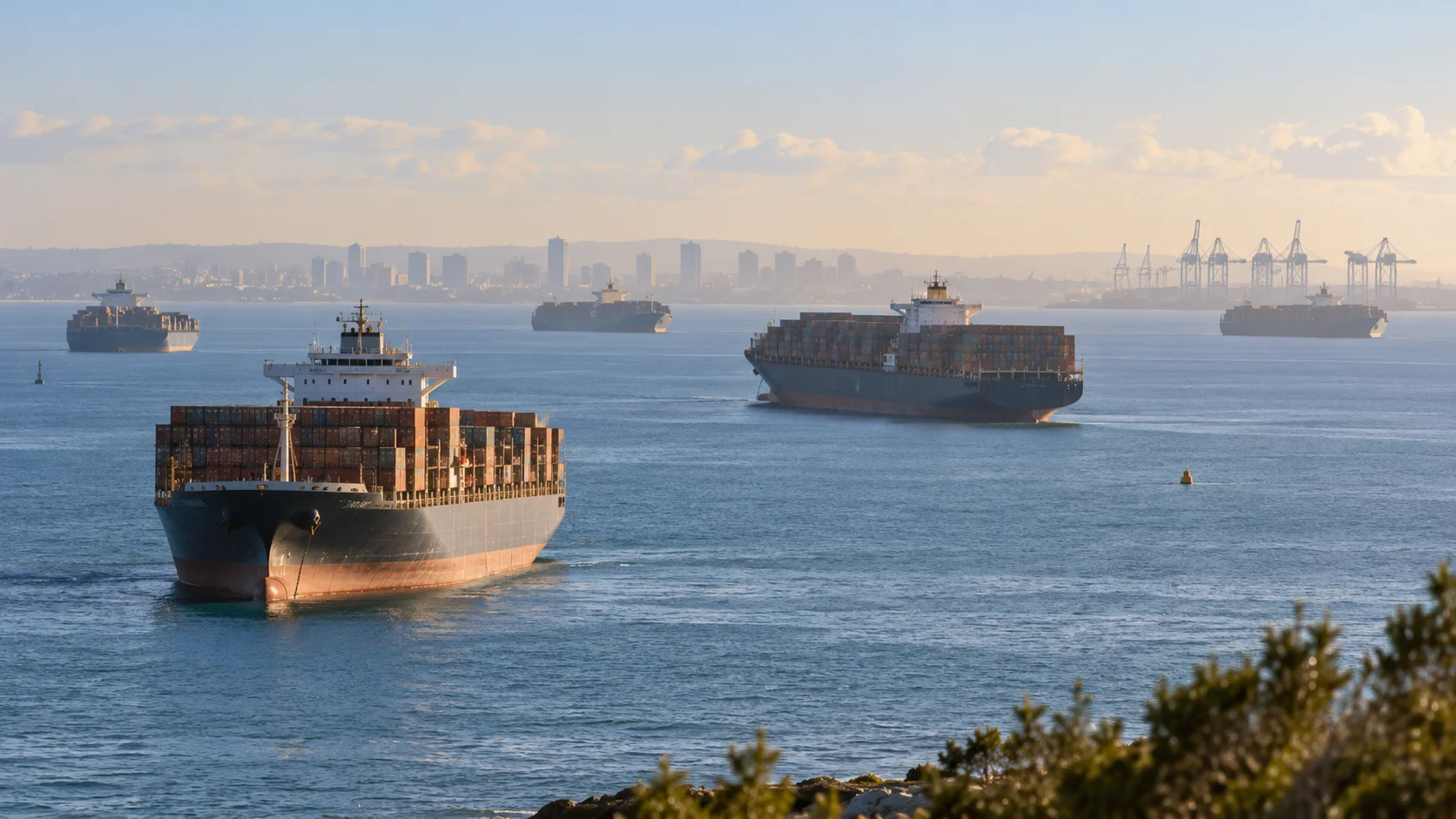
Port congestion at LALB, the most common US export port for Australian cargo, is a seasonal and cyclical risk. Q4 peak shipping (September–December) regularly produces US port dwell times of 3–7 days above baseline. Vessel blank sailings (carrier-initiated cancellations of scheduled sailings) can delay departure by 7–14 days for cargo already booked on the cancelled vessel and rolled to the next available service. For importers with defined inventory cycles, building a 7–10 day buffer above the modal transit time specifically for the Q4 window is the most practical mitigation.
DAFF biosecurity examination at the Australian border adds 3–7 days for sea freight and 1–3 days for air freight when triggered. Certain US product categories carry elevated biosecurity risk profiles that increase the probability of examination: timber and wood products, agricultural products and food items, textiles and clothing with natural fibres, and goods with soil or plant material contamination risk from US agricultural origin states. For these product categories, the DAFF examination probability is high enough that it should be included in the baseline transit time estimate rather than treated as an exceptional outcome.
Full Timeline Model: Factory Gate to Warehouse Arrival
The following model illustrates the complete end-to-end timeline for representative US-Australia freight scenarios. All figures are under normal operating conditions: not peak season, not DAFF-examined, with pre-arrival lodgement and documentation submitted on time.
US West Coast (Los Angeles) to Sydney, Sea freight FCL: US factory to trucking origin 1–2 days; US port booking and dwell 2–3 days; ocean transit LALB to Port Botany 19–21 days; Australian port discharge and customs clearance (pre-lodged, green channel) 1–2 days; last-mile Sydney metropolitan 1–2 days. Total: 24–30 days. With DAFF examination: add 3–7 days. With documentation delays (no pre-arrival lodgement): add 2–4 days.
US East Coast (New York) to Melbourne, Sea freight FCL: US factory to trucking origin 1–3 days; US port booking and dwell 2–4 days; ocean transit New York to Melbourne via Panama 30–36 days; Australian port discharge and clearance 1–3 days; last-mile Melbourne metropolitan 1–2 days. Total: 35–48 days. This timeline reflects the reality of East Coast US to Australia imports: a minimum 5-week cycle from factory to warehouse under optimal conditions, and 7 weeks with documentation issues or peak season congestion.
US West Coast (Los Angeles) to Sydney, Air freight commercial: US factory to freight forwarder handoff 0–1 day; airside processing and loading at LAX 1–2 days; flight transit to SYD 1–2 days; Australian customs clearance (pre-lodged, green channel) 0–1 day; last-mile Sydney 0–1 day. Total: 2–7 days. The air freight model is the planning anchor for replenishment orders where stockout cost exceeds the freight premium.
Inventory Buffer Planning for US Import Programs
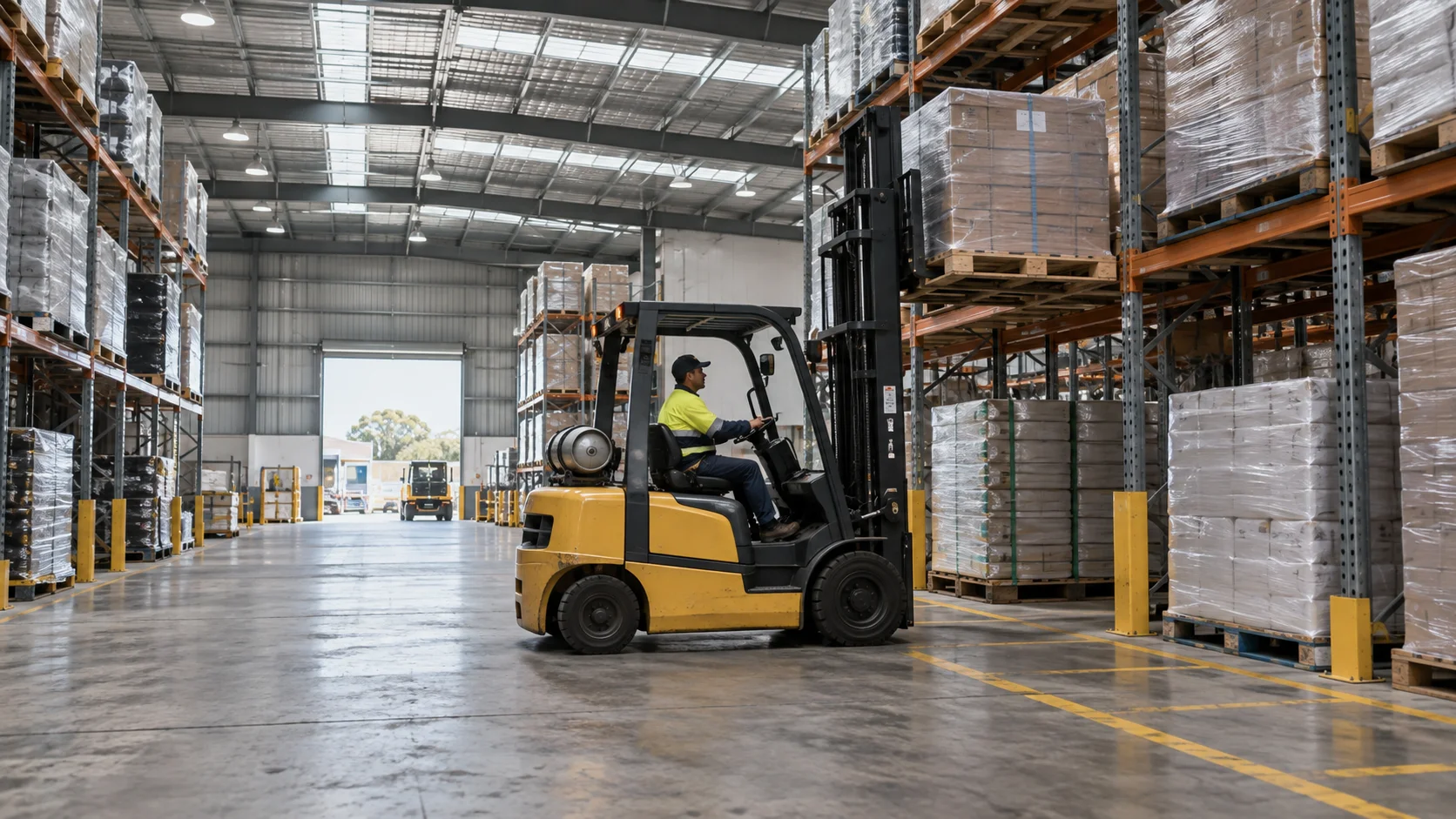
The inventory buffer for a US-Australia sea freight import program should be sized against the worst-case timeline at your supply frequency, not the best-case transit figure. An importer who orders monthly from a Los Angeles-area supplier and holds only the 20-day median transit as safety stock will experience stockouts in any month where a vessel blank sailing, US port congestion, or a DAFF examination pushes the timeline beyond 28 days, which occurs more often than the median implies.
The mistake is almost never ignorance of the numbers: the importer who under-buffers usually has the transit ranges in a spreadsheet. The mistake is trusting the median. A Melbourne homewares importer we spoke with sized safety stock to a 20-day West Coast transit for two years without incident, then hit a single Q4 where a blank sailing and a DAFF hold stacked to 34 days. The stockout did not cost the freight difference; it cost a AUD 14,000 emergency air replenishment on 600 kg and a cancelled retail promotion that a 30-day buffer would have absorbed for roughly a tenth of that. The buffer is not insurance against the average shipment. It is insurance against the one shipment a year that behaves nothing like the average.
A practical buffer model for monthly order cycles from the US West Coast: 30-day supply on hand at time of order placement, covering the expected transit plus a 5–8 day contingency. For US East Coast origin, the equivalent buffer is 50 days. For importers who use air freight as a replenishment mode for fast-moving SKUs between sea freight shipments, the air freight safety stock is typically 7–10 days, sized to cover the airfreight cycle from order trigger to warehouse receipt.
Q4 peak season (September through December) requires an additional layer of buffer planning. Pre-Christmas demand peaks and US pre-Thanksgiving shipping surges consistently produce LALB congestion and vessel blank sailings that extend transit by 7–14 days above baseline. Importers who need to land goods before December 15 should target vessel departure from US ports by November 1 for West Coast origin and October 20 for East Coast origin, accounting for peak transit extension, Australian port congestion approaching Christmas, and warehouse closure schedules. For detailed guidance on buffer stock as a tool for managing transit variance in import programs, see the guide to avoiding stockouts when importing to Australia.
For importers evaluating the freight mode decision (whether to consolidate into an FCL, ship LCL, or use air freight for specific SKUs) the transit time differential is one input into the decision alongside freight cost per unit, inventory holding cost, and minimum order quantity economics. For the full LCL versus FCL evaluation framework, see the LCL vs FCL guide for Australian importers.
Everyone assumes the slow part of shipping from the US to Australia is the ocean crossing. It isn’t. Transpacific transit is close to the most predictable, most physically constrained part of the entire timeline: a ship cannot go faster than the ocean allows, and everyone plans around that fact accordingly. The actual variable is what happens on land, before and after: how fast the exporter’s paperwork is filed, whether pre-arrival lodgement happens before the vessel docks, how quickly DAFF clears a biosecurity referral if one is triggered. None of that is physically constrained the way ocean transit is. It is constrained by whether a human filed a form on time. The importers obsessing over which carrier is “faster” are optimising the one variable that barely moves. The ones who fix their own paperwork timeline are optimising the one that actually does.
Frequently Asked Questions
How long does sea freight from USA to Australia take?
Sea freight transit time from the US West Coast (Los Angeles, Long Beach) to Australian east coast ports (Sydney, Melbourne) is 18–22 days. From the US East Coast (New York, Savannah) to Australia, transit is 28–35 days. From the US Gulf Coast (Houston) to Australia, allow 32–38 days. These are vessel transit times only. Add 2–5 days for US domestic trucking to the origin port, 2–3 days US port dwell, 2–7 days Australian customs clearance, and 1–4 days last-mile delivery to warehouse to build the complete factory-gate-to-warehouse timeline.
How long does air freight from USA to Australia take?
Air freight from the USA to Australia takes 2–4 days for standard commercial airfreight and 1–3 days for express courier services (DHL, FedEx, UPS). The transit time is consistent across US origin cities due to the number of direct and one-stop services between major US hubs (Los Angeles, Dallas, Chicago, New York) and Sydney, Melbourne, and Brisbane. Australian customs clearance adds 1–4 hours (green channel) to 1–3 days (documentary examination) on the Australian end.
What duty rate applies to goods imported from the USA to Australia?
The Australia-United States Free Trade Agreement (AUSFTA) has eliminated tariffs on the vast majority of goods traded between the two countries. For most manufactured goods, the AUSFTA rate is 0%. AUSFTA does not require a third-party Certificate of Origin. The importer or exporter self-certifies that the goods meet the AUSFTA Rules of Origin, on the commercial invoice or a separate declaration. What decides preference is qualification rather than paperwork format: goods manufactured in the USA but sourced through a third-country intermediary may not qualify. Sensitive categories including certain agricultural goods, textiles, and apparel may retain residual tariffs or quota arrangements. Confirm the specific HS classification and applicable AUSFTA schedule rate with a licensed customs broker before the first shipment. Swift Cargo handles freight from the US to Australia on both LCL and FCL. see how the process works from US port to Australian warehouse.
Which Australian port should I use for USA imports?
The port of discharge decision is driven by your delivery destination, not your US origin port. For NSW and ACT delivery, Port Botany (Sydney) is the primary gateway. For Victoria, South Australia, and Tasmania, Melbourne (Webb Dock or Swanson Dock) is the primary gateway. For Queensland, Brisbane (Fisherman Islands) is standard. For Western Australia, Fremantle handles the majority of US cargo. Most carrier routes from US West Coast ports serve Sydney and Melbourne directly; Brisbane and Fremantle may involve transhipment at Singapore, Port Klang, or Hong Kong. For LCL shipments, the forwarder’s consolidation network determines the discharge port options.
How much inventory buffer should I hold for US-Australia imports?
For sea freight from the US West Coast, a minimum 28-day inventory buffer covers the modal transit time plus clearance. For US East Coast origin, a 45-day buffer is more appropriate. Add 7–10 days to these figures if your product category is subject to DAFF biosecurity inspection (timber, agricultural products, textiles with natural fibres, food products). For air freight replenishment of fast-moving lines, a 7–10 day buffer covers transit plus clearance for standard airfreight. Seasonal surges (particularly pre-Christmas and Q4 peak) add 3–7 days to vessel transit due to congestion at both Los Angeles and Australian east coast ports.