

How to Move a Dog or Cat from Europe to Thailand
Moving a dog or cat from Europe to Thailand is relatively easy compared with moving a pet to most other countries. You need a DLD import permit, the right vaccinations and an official health certificate, and a healthy pet with the right paperwork isn’t normally quarantined on arrival. What it costs depends on a lot of moving parts, and we cover those below.
You still want time for things to go wrong. We recommend getting everything ready at least 90 days before shipment. A mistake in this process can get expensive, and time is what lets us put it right before it does: a missing vaccine, a certificate that’s out of date, a flight with no pet space. With 90 days in hand you’ll know exactly what you need and you’ll have room to fix it.
This guide covers dogs and cats, with a short note on other pets. Moving from the UK? The rules are the same but the paperwork differs, and our guide to moving pets from the UK to Thailand covers that route.
On this page: The five documents · Arrival and quarantine · Flights and crates · Timeline · Cost · FAQ
Thailand’s Pet Import Authority, the DLD
All pet imports are regulated by the Department of Livestock Development (DLD), part of the Ministry of Agriculture and Cooperatives. Its Animal Quarantine Station at the airport reviews your import permit request and inspects your pet when it arrives.
Find out what the DLD requires for your pet before you book a flight or ask your vet for any certificate. Requirements can change, so the DLD’s own instruction sheet and your nearest Thai embassy are the sources to trust. A pet relocation agent who works with the DLD every week will know about recent changes.
The Five Documents You Need Before Departure
Five documents get your pet into Thailand, and they have to be done in the right order: microchip, then vaccinations, then your flight booking, then the DLD permit, then the official health certificate.
1. ISO-standard microchip
Your pet needs a 15-digit ISO microchip (ISO 11784 and 11785) that a universal scanner can read. Most European pets already have one. The microchip certificate goes in with your permit request, and the chip number has to match every document, because a chip that doesn’t scan or doesn’t match the paperwork can see your pet returned or detained.
The order matters. Under EU and UK rules a rabies vaccination only counts if the microchip was fitted first. If your pet was vaccinated before it was chipped, the vaccination has to be repeated and your timeline starts again.
2. Vaccinations
Thailand’s vaccination list depends on the species:
- Dogs: rabies, distemper, hepatitis, parvovirus and leptospirosis.
- Cats: rabies and feline panleukopenia.
A primary vaccination, or one that has lapsed, has to be given at least 21 days before departure. A valid booster needs no wait, but send the earlier vaccination records with your permit request. A primary rabies vaccine counts only if the pet was at least 12 weeks old when it was given. A dog without a current leptospirosis vaccine can have a negative leptospirosis test within 30 days of departure instead. The vaccination record has to be in English, with the pet’s microchip number, the vaccine and date, and the vet’s full name, licence number and signature. Some Thai embassies ask for more. The embassy in The Hague, for example, asks for Dutch vaccination records to be legalised by the Dutch Ministry of Foreign Affairs and then by the embassy, so check with the embassy for your country.

3. DLD import permit
This is the document most European owners discover too late. The permit has to be in place before your pet leaves Europe, and some airlines ask to see it before they’ll accept your pet.
A pet flying as cargo needs its permit before it travels. You request it by email from the Animal Quarantine Station at least 7 working days before arrival, and the DLD says its staff send the permit within 7 working days of a complete request, so apply early. The request includes the R1/1 form, a copy of your passport (or the pick-up person’s, if your pet flies as cargo), a photo of your pet, your flight itinerary, the English vaccination record and the microchip certificate. Because it needs the itinerary, book the flight first. The permit is valid for 60 days, and if your flight moves within that time you can use the same permit.
A pet travelling in the cabin or as checked baggage can apply in advance in the same way, or apply on arrival with the documents ready for inspection. We would still apply in advance, so nothing is left to sort out at the station.
The permit is not the import licence. On arrival you collect the Notice of Import Approval and the Import License from the Animal Quarantine Station and pay the fee.
4. Official health certificate
Once the permit arrives, you take it to your country’s government veterinary authority for the official health certificate, in English, endorsed and stamped. Thai embassies say the certificate is valid for 10 days after endorsement, so your pet has to land inside that window. Book the vet visit late rather than early. A certificate that’s older than 10 days when your pet arrives is out of window and will be rejected.
The certificate has to carry the microchip number, the vaccination details and a statement that your pet is healthy and fit to fly. A letter from a regular private vet isn’t enough: the paperwork has to come from, or be endorsed by, your government’s veterinary authority. How that works differs between the EU and the UK, and we cover both below.
5. Airline paperwork
Each airline sets its own forms and booking requirements for pets, separate from the DLD paperwork. Expect a separate pet booking that depends on availability, the airline’s own health declaration at check-in, and confirmation that the crate meets the IATA live animal requirements.
Arriving in Thailand: Inspection and Quarantine
Thailand doesn’t routinely quarantine dogs and cats. The Royal Thai Embassy in The Hague puts it plainly: as long as pets do not show any sign of illness, they would not be quarantined. A healthy pet with the right paperwork is inspected at the Animal Quarantine Station and released.
What happens on arrival is an inspection. A DLD officer checks your documents against your pet and scans the microchip. You hand over the original health certificate, the vaccination record and a printout of the permit, along with your passport (or the pick-up person’s, if your pet flies as cargo). The station then issues the Notice of Import Approval and the Import License, and charges a processing fee of 500 baht per animal, in cash.
The DLD’s guidelines put the Suvarnabhumi station on the first floor of the Customs Export Building in the Free Zone, open Monday to Friday, 8:30 to 12:00 and 1:00 to 3:30, except Thai public holidays. Some embassy pages list longer cargo hours, 8:30 to 4:30, and a counter next to carousel 8 that is open around the clock for hand-carried pets. The official sources don’t agree, so confirm with the station which hours apply to your pet and your flight. Either way, the day and time your pet lands matter. Phuket, Chiang Mai and Samui have their own stations, and you request the permit from the station you’ll arrive at.
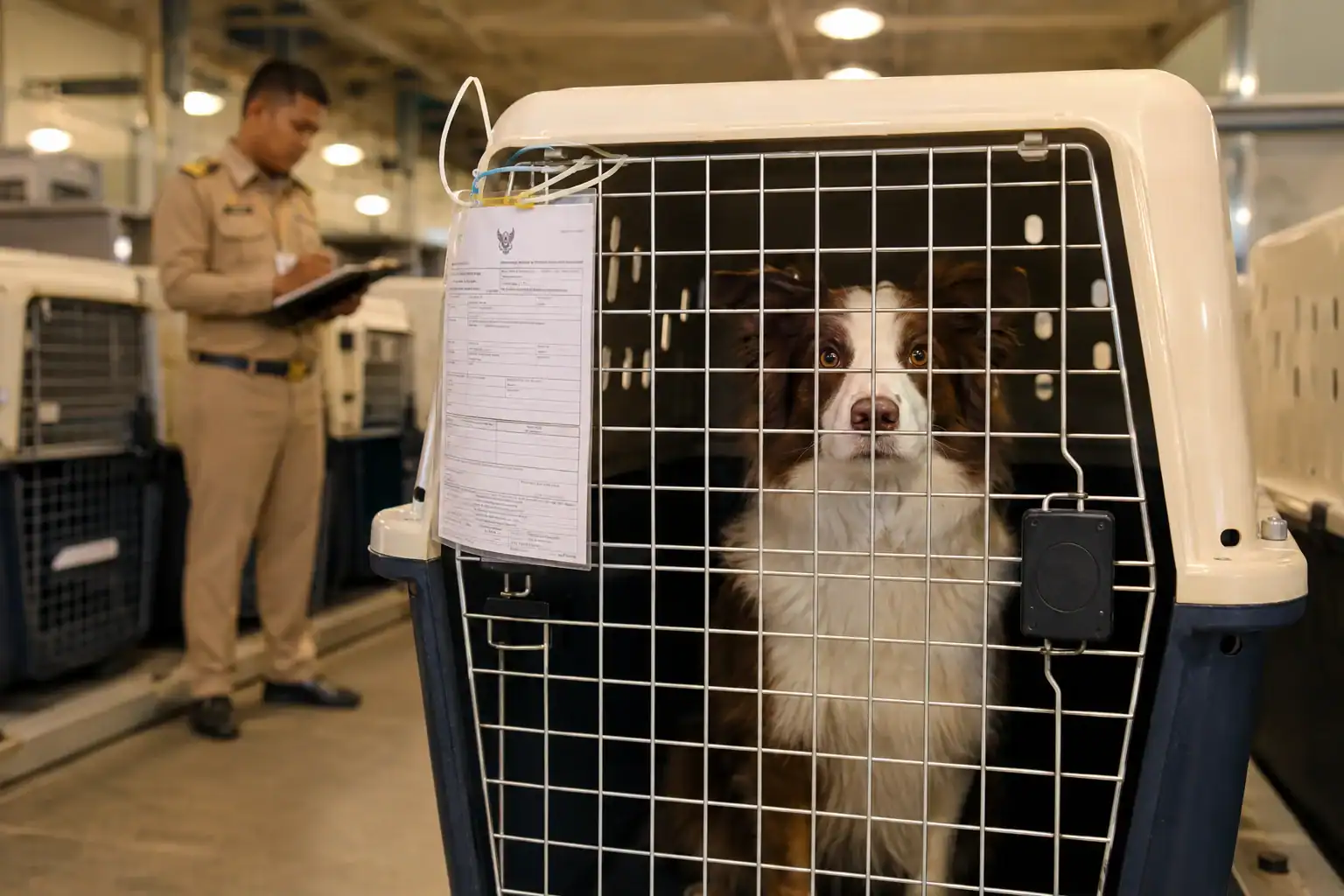
Quarantine is at the officer’s discretion. A quarantine officer can detain any pet at a quarantine station. The DLD says that a pet that doesn’t meet the requirements, or whose microchip number doesn’t match its documents, may be returned to the country it came from or detained, with all costs paid by the importer. These are the usual reasons:
- The microchip won’t scan, or its number doesn’t match the paperwork
- The permit is missing, expired or names a different port of entry
- The health certificate is out of date
- A required vaccination is missing, out of date or was given inside the 21-day window
- The pet shows signs of illness
A paperwork mistake can put your pet back on a plane to Europe, which is why we recommend 90 days. How long a detained pet stays depends on what the officer needs to test or treat, and the cost falls to you.
Flights and Crates for Pets Going to Thailand
Airlines are the second set of rules. The International Air Transport Association (IATA) publishes the Live Animals Regulations that govern how live animals fly. Most airlines use them as their baseline and add their own policies on top.
In the cabin or in the hold
Many airlines only allow small pets in the cabin, and the weight limit includes the carrier, so most dogs travel in the hold, either with you as accompanied baggage or as cargo. Some cats and small dogs can fly in the cabin on airlines that allow it, so check the policy for your route. Our guide shows how cabin and cargo travel compare. The hold used for pets is temperature-controlled and pressurised. A long journey with several connections is hard on an animal, so choose the shortest routing you can.
IATA-approved crates
Your pet must travel in an IATA-approved crate. In short, it should be:
- Hard-sided, with ventilation on at least three sides
- Latched securely, but openable by emergency staff
- Big enough for your pet to stand, turn around and lie down, but not so big that it’s thrown around in turbulence
- Lined with absorbent bedding
- Fitted with food and water access for journeys over 8 hours, such as an external water container
- Labelled with Live Animals labels, your name and your contact details in Thailand
The airline sets the exact size from your pet’s measurements, so measure your pet before you buy a crate: nose to base of tail, floor to top of head when standing, and width at the widest point. A crate that’s too small will be refused at check-in. Our guide shows you how to measure your pet for a travel crate.
Booking and winter
Airlines cap the number of animals on each flight, so pet space can run out. Book your pet at the same time as your own ticket, or as soon after as you can. Last-minute pet bookings are often unavailable.
Airlines cap animals per flight and decide the travel method, so the useful first move is telling us about your dog or cat before you fix a flight date.
Winter adds another risk. Some airlines and airports put embargoes on pet shipments in cold weather, so a European winter can be a hard time to send a pet out of Europe. An embargo can start at short notice, which is one more reason to leave time. If you’re moving in winter, tell us early.

Paperwork in the EU and the UK
Where you start decides who signs the health certificate.
European Union
From an EU country, the official health certificate is issued, or endorsed, by your national competent authority through an official veterinarian. The EU has a standard format for third-country export certificates for dogs and cats, and your vet or a pet relocation agent can get the format Thailand needs. The blue EU pet passport is a useful vaccination record, but it isn’t enough on its own for Thailand. You still need the separate official certificate.
United Kingdom
From England, Scotland or Wales you need export health certificate 2917 (Export cats and dogs to Thailand), which your official vet applies for online through APHA. In Northern Ireland the application goes through DAERA. The Animal Health Certificate is for travel to the EU. Our guide to moving pets from the UK to Thailand covers certificate 2917 and the UK flights, and if you’re moving yourself too, our UK to Thailand relocation guide covers the wider move.
Breed Restrictions
Official guidance on dog breed import restrictions is not consistent across Thai government channels. Some consular pages state there are no breed-specific import bans; the Royal Thai Embassy‘s own import-requirements notice names two breeds as barred from entry:
- American Pit Bull Terrier
- American Staffordshire Terrier
We found no official, currently published Thai government source for a longer restricted-breed list. The wider list of guard and fighting breeds sometimes cited online, including Rottweilers, Dobermans, and several other breeds, does not appear on any Thai government page we could verify as current. Guidance also varies by embassy post and can change, so if your dog is one of the two breeds above, a closely related cross-breed, or another guard or fighting breed, confirm the current position directly with the DLD or your transport agent before you arrange any travel. Discover a breed restriction after you have booked flights and obtained the health certificate, and there is no easy way out.
This is separate from Bangkok’s 2026 pet-ownership ordinance. It requires every dog and cat in the city to be registered and microchipped, and owners of dogs it treats as dangerous, such as Pit Bulls and Rottweilers, to report them to their local district office for extra supervision. That domestic keeping rule is enforced by the Bangkok Metropolitan Administration, not the DLD, applies only after your pet has already entered the country, and is not an import restriction.
There are no breed restrictions for cats. Our guide to cat transport to Thailand covers vaccines, carriers and flights for cats. So much of what constrains a dog move has no feline equivalent, from airline breed embargoes to IATA crate sizing across a far wider weight range, that our dedicated guide to taking a dog to Thailand covers those dog-only requirements in full.
Other Species: Birds, Reptiles and Exotic Pets
This guide covers dogs and cats. Rabbits are on the same DLD instruction sheet: they need a rabies vaccination and treatment for internal parasites at least 7 days before departure. The import of birds, reptiles, rodents and other animals to Thailand falls under entirely different regulations. Those include CITES controls (the Convention on International Trade in Endangered Species) for many exotic species, species-specific disease controls, and in some cases an outright import ban. If you are moving with a pet that is not a dog, cat or rabbit, seek specialist advice from a licensed wildlife import agent before making any arrangements.
Timeline: What to Do and When
Everything depends on everything else, so work backwards from your travel date. We recommend starting at least 90 days out:
| When | Action | Notes |
|---|---|---|
| About 90 days before | Check your pet’s microchip and vaccination dates with your vet, then choose your flight and book your pet’s space | Fix mistakes now: a chip fitted after a vaccination means repeating the vaccination, and airlines cap animals per flight |
| At least 21 days before | Primary or lapsed vaccinations given (five for dogs, two for cats) | A valid booster needs no wait. A dog without a current leptospirosis vaccine needs a negative test within 30 days of departure |
| 60 to 7 days before | Email the DLD import permit request | It needs your flight itinerary. Send it at least 7 working days before arrival, because the DLD can take up to 7 working days to reply |
| After the permit arrives | Official health certificate issued and endorsed | Valid for 10 days after endorsement, so time it close to departure |
| Day of departure | Check in with your pet and hand all documents to the airline | Arrive early, because pet check-in takes longer than standard check-in |
| Arrival in Thailand | Inspection at the Animal Quarantine Station and the 500 baht fee | Check the station’s hours for your pet and your flight: the DLD lists Monday to Friday, 8:30 to 12:00 and 1:00 to 3:30 |
What Goes into the Cost of Moving a Pet from Europe to Thailand
There are so many variables in the price of moving a pet that it’s very hard to give an honest number before we know your pet, your route and your dates. It’s easier to understand once you see the pieces. Here’s what goes into a price, in the order your pet travels. A lot of people and companies touch it: your vet, your government’s veterinary authority, the airline, ground handlers and agents at each end, Thai quarantine and us.
- Vet work. A health check, a microchip if your pet doesn’t have one, vaccinations (five for dogs, two for cats), a leptospirosis test for some dogs, parasite treatment, and a breathing assessment for short-nosed breeds when an airline or country asks for one.
- The official health certificate. Your vet’s time, and the fee for the government endorsement or, in the UK, the export health certificate.
- Thai paperwork. The DLD permit request, and the processing fee of 500 baht per animal when your pet arrives.
- The crate. Hire or purchase of an IATA-approved crate that fits your pet.
- Pickup. Collecting your pet and getting it to the departure airport. Ground transport is priced on time and distance for the whole round trip the driver makes, and a feeder flight is added if you live far from an airport that handles pets.
- Loading and handling. The airline’s handling, and loading your pet onto the aircraft.
- The flight. Airlines charge for the larger of your pet’s weight and the volume of its crate, so a large dog costs far more than a cat. A direct flight is usually cheaper and easier on the animal than several connections.
- Stops and boarding. Connecting airports that look after live animals, comfort stops for large dogs, boarding between flights when a connection is long, and extra food and care if a flight is delayed or a winter embargo forces a rebooking.
- Clearance in Thailand. Inspection at the Animal Quarantine Station, timed to suit the station’s opening hours.
- Delivery. Getting your pet from the airport to your home, by road or on a domestic flight if you live outside Bangkok.
Thailand is one of the easier destinations, so the biggest swings from Europe are your pet’s size, the route and whether the paperwork goes right the first time. A mistake can mean new vet visits, a rebooked flight and boarding, which is why time helps.
How We Give You a Number
When you ask us for a budget, we start from a recent job: a dog of a similar size from a similar region. We tell you what that customer paid, door to door, once everything was paid for, and we give you an estimate a little above it. That way you have a budget, and you may well get some change from it.
A firm price is a lot of work. Depending on where you are, we go back and forth with agents, airlines and vets, and it takes our team about half a day to price a pet move. So we do it once you’re ready to go ahead, and we ask for a deposit first. Our guide lists what to ask when comparing pet transport quotes, whoever you’re comparing.
Doing It Yourself or Using a Pet Relocation Agent
An organised owner can move a pet from Europe to Thailand without an agent, as long as they’re willing to deal directly with the Thai Animal Quarantine Station, their vet, their government’s veterinary authority and their airline. It takes time, the order of the steps leaves no room for error, and there’s a lot of back and forth.
A pet relocation agent is a company that specialises in international animal transport. It manages the permit request, confirms the paperwork format with the DLD, coordinates your vet, books your pet’s flight and checks that every document is in the right order. That’s how it avoids the mistakes that cost a pet its flight or land it in detention because a document was out of date.
An agent is worth it if you’re moving more than one pet, a large breed that needs an oversized crate, or a breed that draws extra attention at the permit stage. The independent route suits experienced pet travellers with a good relationship with their vet and a well-chipped, well-vaccinated animal, provided they leave enough time.
Settling In After Arrival
A long journey is stressful for any animal, however well it’s handled. Bring your pet home quietly, with a familiar blanket or toy from Europe, a steady routine and patience with any odd behaviour in the first week or two.
Thailand’s heat is a big adjustment for European pets. Keep shade, fresh water and cool places to rest available at all times, and watch for heat stress in dogs with thick coats. Register with a local vet soon after you arrive and ask which vaccinations and preventatives Thailand requires or recommends. Bangkok, Chiang Mai and Phuket all have international-standard animal hospitals used to expat pets.

Moving your belongings too? Our guides to shipping household goods to Thailand and shipping from Europe to Thailand cover the freight side. International removals to Thailand walks through the process from collection to delivery, and our guide to hidden costs explains the destination charges that fall outside a headline rate. If you’d like us to look after your household move to Thailand alongside your pet, we’ll coordinate the timing so your belongings arrive when you and your pet are ready for them. Our wealth team also offers free international tax advice as part of a move.
We manage the Thai import permit, the crate and arrival clearance.
Tell us about your dog or cat, and one coordinator sequences the permit, the vaccinations and the flight so nothing is completed out of order.
Dog and Cat Transport from Europe to Thailand FAQ
Can I bring my dog or cat from Europe to Thailand?
Yes. You need a DLD import permit, a microchip, the right vaccinations (a primary vaccination has to be given at least 21 days before departure) and an official health certificate that’s still valid when your pet arrives. A healthy pet with the right paperwork is inspected at the Animal Quarantine Station and released after paying a fee of 500 baht. We recommend getting everything ready at least 90 days before shipment.
Do pets arriving in Thailand from Europe go into quarantine?
Not normally. Thai embassies say pets that show no sign of illness are not quarantined. A quarantine officer can still detain any pet, most often when the microchip doesn’t match the paperwork, a document is missing or out of date, or the pet is unwell, and the owner pays the costs.
What vaccinations does my dog or cat need for Thailand?
Dogs need rabies, distemper, hepatitis, parvovirus and leptospirosis. Cats need rabies and feline panleukopenia. A primary vaccination has to be given at least 21 days before departure, and a valid booster needs no wait. A dog without a current leptospirosis vaccine can have a negative leptospirosis test within 30 days of departure instead.
What is the Thai DLD import permit?
It’s Thailand’s permission to bring your pet in, issued by the Department of Livestock Development. You request it by email from the Animal Quarantine Station at least 7 working days before arrival, with your flight itinerary, vaccination record and microchip certificate, and the DLD sends it within 7 working days. It’s valid for 60 days once issued.
How long does it take to get a dog or cat from Europe to Thailand?
Plan for at least 90 days to get everything ready. The DLD can take up to 7 working days to send the permit, and the health certificate is valid for 10 days after endorsement, so the final steps are tight. The extra time is there to fix mistakes before they cost you.
How much does it cost to take a dog to Thailand from Europe?
It depends on many things: your dog’s size, the route, where you start, the vet and government paperwork, the crate, pickup and delivery, and any boarding or delays. We give a budget based on a recent job with a similar dog from a similar region, and a firm price once you’re ready to go ahead. Ask us for an estimate for your own dog.
Is winter a bad time to ship a pet from Europe?
It can be. Some airlines and airports put embargoes on pet shipments in cold weather, and they can start at short notice. Leave extra time if you’re moving in winter.
Can I take my dog to Thailand from the UK?
Yes. As well as the Thai permit, the vaccinations and the microchip, you need export health certificate 2917, which your official vet applies for online through APHA. The paperwork is the main difference from the EU.
Are there breed restrictions for importing dogs to Thailand?
Possibly. Official Thai guidance is not consistent. Some consular pages state there are no breed-specific import bans, while the Royal Thai Embassy in Canberra names two breeds as barred from entry: the American Pit Bull Terrier and the American Staffordshire Terrier. We found no current official Thai government source for a longer list. If your dog is one of those two breeds, a closely related cross-breed, or another guard or fighting breed, confirm the current DLD position directly before booking travel.
Sources
- Department of Livestock Development, Instructions for bringing pets to Thailand via Suvarnabhumi Airport (cargo and baggage permit timing, booster rule, 12-week rabies age, 60-day permit, station location and hours, Phuket, Chiang Mai and Samui stations)
- Department of Livestock Development, Animal Quarantine Station Suvarnabhumi, Requirements for importation of dogs, cats and rabbits into Thailand (vaccinations, permit request, health certificate, arrival inspection, 500 baht fee, detention)
- Royal Thai Embassy, The Hague, Bringing pets to Thailand (no quarantine for healthy pets, certificate valid 10 days after endorsement, legalised vaccination records, arrival stations and hours)
- Royal Thai Embassy, Chicago, Bringing pets to Thailand (permit valid 60 days, certificate valid 10 days, vaccinations 21 days before departure)
- Royal Thai Embassy, Canberra, Bringing pets to Thailand (the two breeds named as barred from entry)
- GOV.UK, Export cats and dogs to Thailand: certificate 2917 (export health certificate for pets leaving Great Britain, online application, Northern Ireland)
- Gulf News, Bangkok’s new pet rules: Microchip or miss out (registration, microchipping and supervision of dangerous breeds from January 2026)