
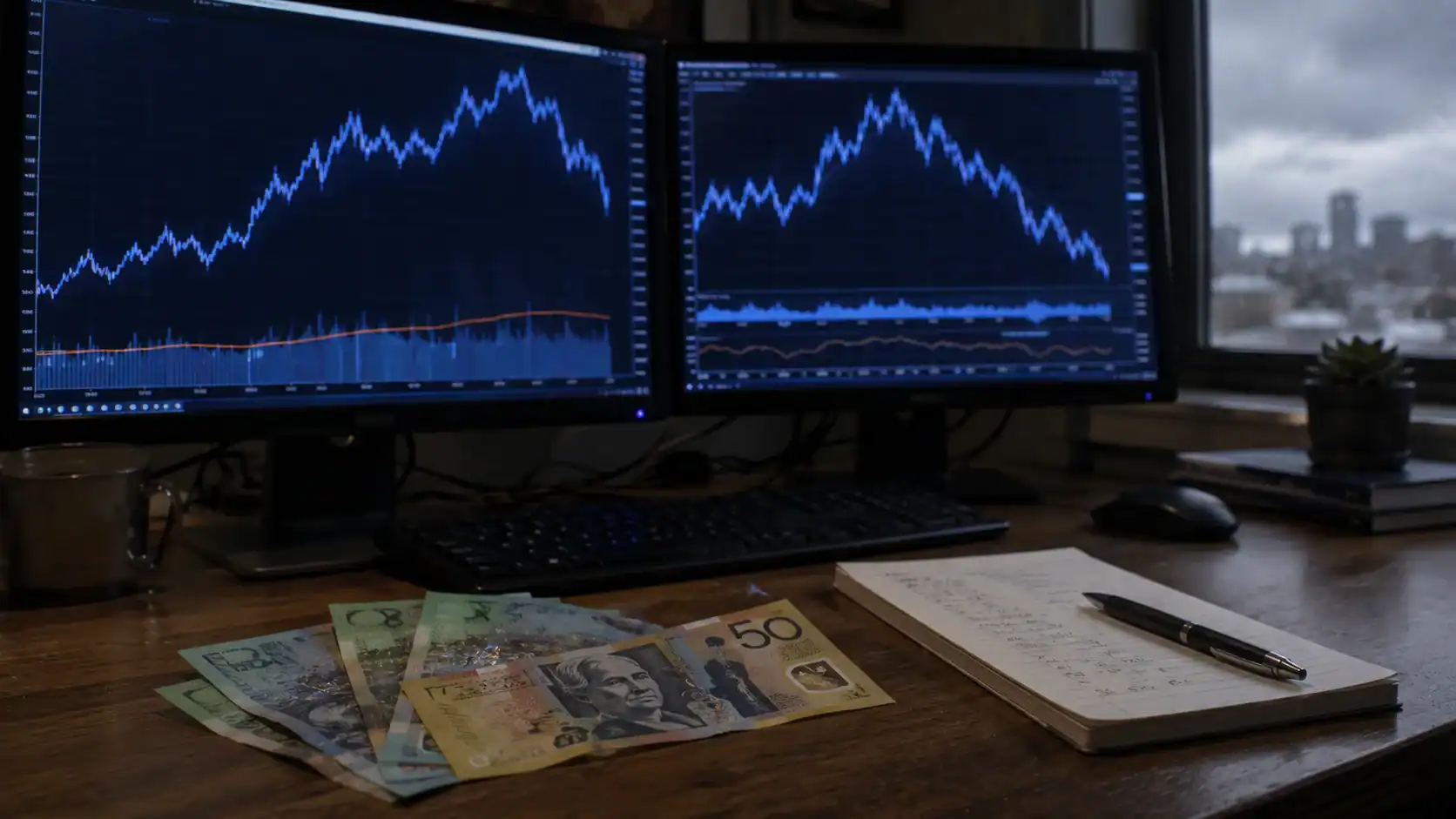
Currency history matters when it teaches a durable planning lesson. One of those lessons is the Australian dollar’s path from the strong post-boom years into 2020 volatility. It shows that the currency can move through very different regimes depending on macro conditions, commodity drivers, risk sentiment, and crisis pressure. For importers, that matters because budgeting assumptions built in one regime often break badly in another.
Our companion article on commodity prices and the AUD covers the structural relationship: why iron ore and coal export earnings drive the exchange rate, and what that means for import cost planning.
Why the peak years created false confidence
When the AUD was strong, it was easy to treat the currency as a stable backdrop for imports. That kind of period produces bad habits. Companies start assuming the budget environment is normal, they make supplier choices around those assumptions, and the idea that the exchange rate could deteriorate sharply begins to feel theoretical. The lesson of the later cycle is that those assumptions were softer than they looked.
The post-float high for AUD/USD was approximately 1.10 in mid-2011, driven by the mining boom and strong Chinese commodity demand. By early 2013 the rate had pulled back to around 1.04, still well above long-run averages and still sufficient to make USD-denominated sourcing feel comfortable. The RBA’s exchange rate explainer documents the structural factors behind that strength: elevated terms of trade, high iron ore and coal prices, and a wide interest rate differential relative to the US and Europe.
In that environment many Australian importers locked in supplier contracts and sourcing relationships priced around rates in the 0.95–1.05 range. The assumption embedded in those contracts was not always explicit; it rarely is. But when you quote a landed cost to a customer or set an internal budget without specifying a currency range, you are implicitly betting the rate stays close to where it is today. That is the soft assumption the later cycle exposed.
The AUD descent: 2013 to 2020
The AUD did not fall from 1.04 to 0.57 in a single move. It fell in phases, with partial recoveries between them, which is exactly what makes it a difficult planning problem. Each recovery tempts the importer back into complacency.
The broad trajectory, drawing on RBA research on exchange rate drivers:
- 2013–14: AUD falls through 0.90 as commodity prices soften and the US Federal Reserve signals tapering of quantitative easing.
- 2015–16: AUD falls through 0.80, then 0.70. Iron ore prices drop sharply. The Reserve Bank cuts the cash rate.
- 2017–19: Partial recovery to the 0.72–0.80 range. Commodity prices stabilise. Some importers treat this as a new floor.
- March 2020: COVID-19 global risk shock. AUD/USD reaches approximately 0.57 on 19 March 2020, the lowest level since the early 2000s, before recovering sharply as commodity prices held up and global stimulus measures took hold.
For a business that started budgeting at 1.04 in early 2013, a USD-denominated purchase costing AUD 100 at that rate cost approximately AUD 182 at the March 2020 low. That is not an unusual event in an asset class known for volatility. It is the normal operating range of the Australian dollar under stress.
Why 2020 mattered so much
The COVID shock mattered beyond its severity because of its speed. The AUD moved from around 0.66 in late February 2020 to 0.57 in roughly three weeks. Importers with shipments already at sea, with supplier invoices already issued in USD, had no practical hedge available at that point. The exposure had already been taken on.
In practical terms, this means importers should stop treating exchange-rate stability as a default between shocks. Commodity conditions, global risk events, and local economic expectations can all move the AUD at once, and none of them announce themselves in advance.
Once you accept that, landed-cost planning becomes more serious and less complacent. Customs value for duty purposes is assessed in AUD at the exchange rate applicable at the time of export, which means currency moves directly affect the duty bill, not just the supplier invoice. The ABF’s customs valuation framework spells this mechanism out.
How this changes import thinking today
The useful takeaway is not the chart. It is the range of outcomes the currency has already shown it can produce.
If the AUD has already shown that it can move from around 1.04 to 0.57 in seven years, with a partial recovery in the middle, then any landed-cost model built on a single exchange rate assumption is thinner than it looks. Run the model at three rates: a base case at current spot (AUD/USD traded near 0.72 in August 2026, having ranged roughly 0.67 to 0.73 across that year), a stress case at the 2020 low of 0.57, and a favourable case at 0.78 to 0.80, a level last sustained in 2021. If the business only works at the base case, that is a risk position that needs to be named and managed, not hidden inside a budget line.
The three-rate model is really a probability discipline in disguise. Most importers do not ignore the stress case because they think it impossible; they ignore it because they quietly price its probability at close to zero. That is the error. In early 2013 a fall to 0.57 would have looked like a one-in-fifty scenario, the kind of number that rounds to “won’t happen.” It happened inside seven years. Running the model at 0.57 is not an attempt to predict it. It is a refusal to assign a real, recurring outcome a probability of zero simply because it is inconvenient to budget for.
Think of it the way an insurer prices a policy rather than the way a forecaster predicts weather. An insurer doesn’t claim to know whether your warehouse burns down next year; it prices the premium against the historical frequency of warehouse fires, whatever that frequency turns out to be. A three-rate landed-cost model does the same job for currency exposure: it isn’t a bet on where the AUD goes next, it’s a premium you pay upfront, in the form of slightly more conservative margins and contract terms, against a range the currency has already proven it can occupy. The businesses that struggled hardest through 2013-2020 weren’t the ones with bad luck on timing. They were the ones that had never priced the premium at all, because the stress case felt too unlikely to be worth the discomfort of planning for.
That affects pricing discipline on customer quotes, the buffer you carry in supplier contracts, and how much value you place on customs timing or shipment flexibility when rates are moving.

Building a currency buffer for Australia imports
A practical buffer predicts nothing. It marks the range your unit economics can survive. The 2013–2020 history gives you a data point: the AUD sat at 1.04 in early 2013 and reached 0.57 in March 2020, a spread of 0.47 across seven years. Most ongoing import businesses need to survive at least one full cycle.
A workable approach: build your base-case landed cost at current spot, then calculate the same landed cost at 0.68 (the 2015–16 low) and at 0.57 (the 2020 extreme). The gap between the base case and the 0.68 scenario gives you a defensible buffer to hold as margin headroom or to price into customer contracts. If that gap is larger than your current margin, you have a structural problem that no amount of freight optimisation will solve, but at least you can see it clearly.
Put a number on it. An importer landing USD 100,000 of goods at a base-case spot of 0.72 pays roughly AUD 138,900. Re-run the same USD 100,000 invoice at the 0.68 buffer rate and the landed cost rises to about AUD 147,100. That is an AUD 8,200 swing on a single shipment before freight or duty even enter the calculation. Run it again at the 2020 extreme of 0.57 and the same invoice costs AUD 175,400, nearly AUD 36,500 more than the base case. That gap is not a rounding error to absorb quietly; it is the exact number a pricing model needs to survive, and most importers only discover it exists the year the rate actually gets there.
The fix costs nothing but arithmetic done in advance. Run your own landed-cost model at 0.68 and at 0.57 before you sign the next supply contract, not after the rate has already moved against you. Price the difference into either your margin or your customer contracts while you still have the choice.
The ABS international trade price indexes track how import prices move in AUD terms as the exchange rate shifts, which is useful for checking whether your specific import category behaves in line with the broader AUD pattern or diverges due to supplier pricing power or commodity inputs.
Two things compound currency exposure for Australian importers in a way other import markets do not face. First, the AUD is a commodity-linked currency: it tends to fall hardest during global risk-off events, which are often the same moments when supply chains are under stress and freight costs are rising. So the three headwinds (weaker AUD, higher freight, disrupted supply) tend to arrive together. Second, Australian customs duty is calculated on the AUD customs value, which is the transaction value converted at the ABF ruling rate for the day of export. An importer cannot retrospectively choose a more favourable rate. The date the goods leave the origin port sets the exchange rate for the entire duty calculation. Two identical shipments therefore carry different duty bills if one left Shanghai on 19 March 2020, the day the AUD hit 0.57, and the other left two weeks earlier. Understanding that mechanism is not just historically interesting. It changes how you think about shipment timing when rates are moving fast.
During periods of AUD weakness, accelerating or deferring shipment timing has genuine value if the rate is moving against you. That is not always possible, because production lead times, vessel schedules and inventory cycles impose their own constraints, but knowing the mechanism means you can at least model the cost of different timing choices before committing, rather than discovering the impact on the customs entry.
What disciplined importers do with this history
The right mental model for using a currency cycle is closer to a stress test than a forecast. Importers who try to predict the next AUD turn usually lose money. Importers who instead build pricing models for the full 0.60 to 0.80 AUD/USD range lose far less, far less often, and they do it without breaking margin discipline. Run your current landed-cost model against the historical extremes. If your unit economics fall apart at 0.62, or only hold together above 0.78, you have currency exposure dressed up as commercial strategy. Most teams do the opposite: take today’s rate, apply it forward twelve months, and call it planning. The 2013-to-2020 cycle is a worked example of how badly that habit breaks under stress.
One more thing the headline number hides. Ask anyone who imported through the 2013 to 2020 window and they will say the dollar was weak, but that framing does unearned work. Against the USD the fall was severe; on a trade-weighted basis it was far milder; against the yuan the story changes again. The yuan is the rate that actually matters if you buy from China. If your supplier invoices in CNY, AUD/USD is a proxy you are using out of habit. The importers who priced most accurately through that window were not the ones who forecast the cycle better, but the ones who modelled the rate they actually paid in.
Knowing the range makes timing tractable. Buying forward while the rate is temporarily strong, or accelerating a container departure as the AUD softens, both depend on knowing where spot sits inside the historical band: timing decisions on Australian freight shipments interact directly with that exposure.
Importers planning Australia-bound freight can see how currency exposure fits into total shipment cost at Swift Cargo’s Australia shipping overview.
Related reading: Customs Exchange Rates: Why the Day of Export Matters in Australia
Frequently Asked Questions
Why does the 2013 to 2020 AUD cycle matter to importers?
Because it shows how quickly the currency environment can move from strength to severe volatility, which directly affects import budgets.
Is this mainly a macro story or a freight story?
It is both. The macro cycle matters because it changes the cost environment inside which importers make freight and customs decisions.
What is the practical lesson for importers?
Do not assume a favourable currency regime is permanent. Build landed-cost plans that can survive sharper moves; the 2020 low of 0.57 is a useful stress-test floor.
How does this connect to customs timing?
Currency volatility becomes more operationally important when customs timing rules can lock in specific exchange-rate effects on shipment value.