
Since January 2021, UK nationals have been navigating a different relationship with international borders. Freedom of movement within the EU is gone. This is a physical relocation: the contents of a Hackney flat or a Surrey semi-detached, shipped to Bangkok or Chiang Mai. For that kind of move, post-Brexit status affects the UK departure side in specific ways. What it does not change is how Thai customs treats your household goods when they arrive. Thailand never applied EU rules at Laem Chabang; it applies Thai customs rules, uniformly, to everyone. Moving from the UK to Thailand therefore turns on the Thai side of the paperwork more than the British one.

The Thai side matters more: which visa you arrive on determines whether your goods qualify for duty-free import. That question catches a significant proportion of UK nationals moving to Thailand, because the most accessible route (the retirement visa) does not qualify under the standard criteria at all.
The Visa Decision: Thai Customs Rules Haven’t Changed
Thai customs’ duty-free personal effects exemption has never been nationality-dependent. It is visa-dependent. The rules are the same for a UK national as for any other nationality:
| Visa / Status | Duty-Free Eligible? | Notes |
|---|---|---|
| Non-Immigrant B (work permit) | Yes | One-year work permit required; 6-month shipment window applies |
| Retirement (O-A / O-X) | No | Excluded from the standard criteria; Thai Customs does not accept a retirement visa as a qualifying status |
| Thai Elite / Privilege Card | No | Lifestyle visa; no work permit, no exemption |
| Long-Term Resident (LTR) | Seek ruling | Conditions vary by LTR sub-category |
| Education (ED) | No | No exemption |
| Tourist / visa-exempt | No | No qualifying status |
| Returning Thai national | Yes | Must prove 12+ consecutive months abroad |
The retirement visa case is the one that matters most for UK movers. A large proportion of British nationals relocating to Thailand do so on the O-A retirement visa (available from age 50, well-understood, and renewable). It does not qualify for the duty-free household goods exemption. Import duties of 10–30% and 7% VAT will apply to the declared CIF value of everything in your shipment. If your household contents are valuable, this materially changes the cost calculation for what is worth shipping from the UK.
For those moving on a Non-Immigrant B visa with a valid work permit, the qualifying conditions are:
- A valid one-year Thai work permit, issued before your shipment arrives at Laem Chabang
- Proof of 12+ consecutive months of residence in the UK (or country of origin) before the move
- Shipment arriving no earlier than one month before your initial Thailand entry and no later than 6 months after your own arrival in Thailand
- One sea shipment and one air shipment, not multiple sea consignments
- All goods demonstrably used and personally owned; one unit of each appliance type
What Brexit Changed on the UK Departure Side
Before January 2021, personal effects departing the UK to a non-EU destination like Thailand were already subject to standard international removal procedures. Brexit changed the UK’s relationship with the EU but had little practical effect on UK-to-Thailand removal shipments, which were always international rather than intra-EU.
The specific changes to be aware of:
No more TOR (Transfer of Residence) relief via EU mechanisms: UK nationals who had lived in an EU country before moving to Thailand previously had access to EU Transfer of Residence relief when passing goods through EU member states. Post-Brexit, if your removal transits an EU port (say, Antwerp or Rotterdam for consolidation), additional documentary steps may apply. A UK-accredited removal company with post-Brexit experience will manage this.
UK export documentation for household goods: The UK is now a third country for EU customs purposes. However, when household goods and personal effects are permanently exported as part of a relocation, licensed removal companies generally handle them under simplified procedures. HMRC governs UK export customs requirements. See gov.uk’s export goods guidance. For personal effects below commercial thresholds, your removal company will manage the UK-side documentation using established HMRC procedures.
The British Association of Removers (BAR): For UK origin removals, a BAR-accredited company (the UK equivalent of Germany’s BAVC) has the export procedures and insurance required for international household goods shipments.
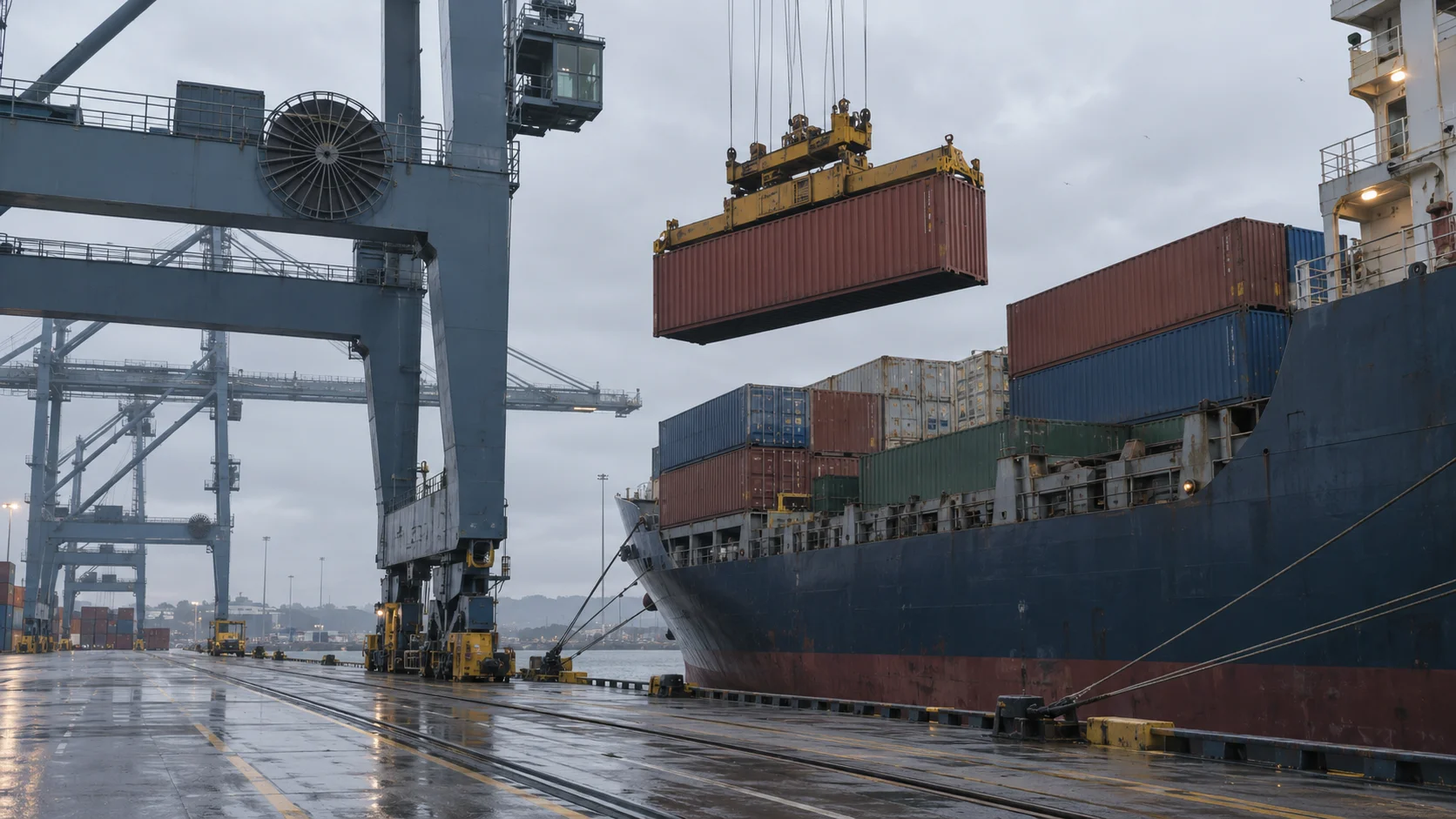
UK Departure Ports and the Route to Laem Chabang
Felixstowe (Port of Felixstowe, Suffolk) is the UK’s largest and busiest container port. The majority of UK containerised exports, including household goods and groupage shipments, depart from here. Well-served by major carriers operating Asia routes.
Southampton (Port of Southampton, Hampshire) handles significant household goods and removal volumes, particularly from the South and South-West of England. For movers in that region, Southampton may offer faster inland transit to port.
Tilbury and DP World’s London Gateway (both Thames Estuary) are alternatives for movers based in London and the Home Counties, with direct feeder services to Felixstowe and deep-sea routes.
From any of these departure ports, the routing to Laem Chabang follows one of two paths:
Via Suez Canal: Through the English Channel, Mediterranean, Suez Canal, Red Sea, Indian Ocean, transshipment at Singapore or Port Klang (Malaysia), then Laem Chabang. Ocean leg approximately 28–33 days.
Via Cape of Good Hope: Around southern Africa, across the Indian Ocean, transshipment, then Laem Chabang. This is still the routing most carriers use on this lane, following the 2024 Houthi disruptions in the Red Sea. The return to Suez that began in 2026 is happening service by service, and the carriers running direct Laem Chabang calls have not made the switch yet. Ocean leg approximately 35–45 days, adding 10 to 14 days versus the Suez route. Yang Ming’s published June 2026 schedule puts Southampton at 40 days to Laem Chabang on a single vessel with no transshipment.
Door-to-door timeline from the UK:
- Collection and packing in the UK: 1–3 days
- UK port handling and vessel loading: 5–10 days
- Ocean transit (Suez routing): 28–33 days
- Ocean transit (Cape routing): 35–45 days
- Thai customs clearance at Laem Chabang: 5–10 working days
- Delivery to Thai address: 1–3 days
Total: 6–9 weeks (Suez) or 8–11 weeks (Cape). Plan to the upper end of whichever applies: global schedule reliability ran 62.6% in June 2026, and vessels that arrived late averaged 5.3 days behind. As with all Europe-to-Thailand routes, any quote giving a 30-day figure is vessel transit only. Plan to the door-to-door number. Given the 6-month qualifying window for the duty-free exemption, book freight promptly after your work permit is issued.
LCL or FCL: Sizing Your Shipment from a UK Property
UK properties range from London studio flats to large detached houses. Most UK-to-Thailand relocators ship a curated selection rather than the entire household. Furniture is generally cheaper to buy in Thailand than to ship from the UK, and the cost of shipping large items over 10–12 weeks is rarely justified unless the piece has significant monetary or sentimental value. For most households moving from the UK to Thailand, a curated selection is the realistic shipment, not the whole house.
| Property Type / Volume | Estimated CBM | Recommended Mode | Approximate Cost |
|---|---|---|---|
| Studio / 1-bed flat (personal items) | 5–15 CBM | LCL groupage | £600–£2,200 |
| 2–3 bed flat or small house (selective) | 15–35 CBM | LCL or 20ft FCL | £2,000–£5,000 |
| Large house / full family move | 35–60+ CBM | 20ft or 40ft FCL | £3,500–£8,000+ |
Costs shown are approximate freight-only ranges; they exclude Thai import duty, VAT, and local delivery in Thailand. See the full breakdown of hidden costs in Thailand shipping.
LCL (groupage): Your goods consolidated with others in a shared container. Charged per CBM. Practical for studio to 2-bed flat volumes. Adds handling steps at origin and destination CFS: marginally higher inspection risk and slightly longer clearance time at Laem Chabang.
FCL: Your container, your goods only. Better handling security. Right for 2–3 bed house volumes once CBM exceeds 15. Faster port clearance. UK-based removal companies with Asia operations typically handle both. Choose based on volume.
What to Ship and What to Leave
This is the part that keeps people up at night, and it is rarely about logistics. You’re standing in a Surrey hallway, deciding whether the bookshelf your father built comes with you. That’s not a shipping question. It’s a question about what you’re willing to let go of. Here is the honest answer: ship the things you would grieve, and be ruthless about the rest. A UK three-piece suite that cost £400 is not worth its share of a container: the same money buys new in Bangkok. The battered kitchen table your children did their homework at is worth it, because you cannot buy that back at any price. Decide on that basis first. The cubic metres will sort themselves out afterwards.
Worth shipping from the UK:
- Clothing, particularly cold-weather and business attire
- Books and professional libraries
- Artworks, heirlooms, and items of monetary or sentimental value
- Specialist equipment (musical instruments, photography gear, professional tools)
- Children’s belongings and comfort items
- Custom-built or high-quality furniture not easily replaced
Typically not worth shipping:
- Standard flatpack or mid-market furniture, available throughout Thailand at competitive prices
- Large white goods (fridge, washing machine, dishwasher): Thai apartments typically have these or the local equivalent; UK plugs differ, although the 230V/50Hz supply is compatible
- Bulky sofas and dining sets
- Electronics running on UK-only frequencies or power profiles

Prohibited and Restricted Items
Prohibited (remove before packing, or these will be seized at Laem Chabang):
- Lithium batteries of all types: installed in devices or standalone (power banks, e-bike batteries, tool batteries). Prohibited from sea freight containers under IMDG dangerous goods regulations. Carry them in your cabin luggage.
- Flammable substances, aerosols, gas canisters, paint
- Narcotics and controlled substances
- Pornographic material
- Counterfeit goods
- Weapons and firearms (without Thai police permit)
- CITES-protected wildlife and derivatives
Restricted (documentation or permit required):
- Alcohol: limited personal quantities accepted; excise duty may apply even under the personal effects exemption
- Buddha images and religious antiques: Fine Arts Department permit required
- Plants and plant material: phytosanitary certificate required; easier to leave behind
- Prescription medication in excess of personal use quantities: carry documentation
Required Documents for Thai Customs
Your removal company coordinates most documentation, but you must supply:
- Passport copy: all pages including current valid visa stamps
- Work permit copy: valid one-year Thai work permit (if claiming duty-free exemption)
- Detailed packing inventory: every item listed in English with description, quantity, and estimated value. Thai customs compares against this during physical inspection.
- Bill of Lading: issued by the shipping line
- Proof of UK residence for 12+ months: utility bills, bank statements, or council tax documents covering the relevant period
The complete document checklist for shipping to Thailand covers the full set, including the electronic import declaration your Thai customs broker files through the National Single Window system.
All household goods enter the Red Line at Laem Chabang: physical inspection against the declared inventory. With complete, accurate documents, clearance takes 5–10 working days. Missing or inconsistent documents mean bonded storage and daily fees. Documentation gaps are the primary cause of clearance delays.
Here is the part that catches British movers off guard, and it has nothing to do with packing. Two households leave the UK in the same month, ship comparable goods out of Felixstowe on the same service, and use competent agents at both ends. One clears Thai customs with personal effects relief granted. The other pays duty and VAT on the lot. The difference is that the second household arrived in Thailand on a tourist entry and intended to convert to a longer visa once they had found somewhere to live. That’s a completely reasonable plan for the move, and the wrong plan for the container. Thai duty relief is assessed against the importer’s status at the time of clearance, not against their intentions. Nobody in the UK removals chain is paid to notice that. The removal company is paid to get the crate to the port, the shipping line to move the box, and the Thai agent inherits whatever visa position the customer turns up with. The gap between those responsibilities is where the duty bill lives, and it is the single most expensive thing on a UK-to-Thailand move that no one quotes for.
Tax, Pensions and Healthcare: The UK-Specific Traps
Most relocation tax problems do not come from doing something illegal. They come from assuming that one country’s definition of resident settles the other country’s. Two tests run at once, and the shipping decision above sits inside them.
HMRC’s Statutory Residence Test on one side, Thailand’s 180 days on the other
UK tax residency is decided by HMRC’s Statutory Residence Test: days in the UK, overseas work patterns, and the ties that keep you anchored. If you are serious about leaving, plan it like a project, with a day count and evidence you can defend. Thailand treats you as tax resident once you spend 180 days or more in a calendar year, and that switch changes how your remittances are assessed.
The post-2024 remittance rule reaches pension drawdowns
Since 1 January 2024, foreign-sourced income earned by a Thai tax resident can become taxable when it is brought into Thailand. The operative guidance is Revenue Departmental Instruction Paw. 161/2566 and its follow-up Paw. 162/2566, summarised for foreign readers by KPMG. It reaches pension drawdowns and investment income, not just salary. If your lifestyle depends on regular transfers into Thailand, model the remittance pattern before you move and take advice from someone who works the UK-to-Thailand corridor specifically.
UK pensions: a treaty allocates taxing rights, it does not remove compliance
The common bad assumption is that the UK-Thailand tax treaty makes a pension automatically tax-free. It does not. If your funding relies on the State Pension, a private pension, a SIPP or drawdown, decide where the pension is paid (UK account or Thai account), how often you transfer (monthly or lump sums), which year the income was earned versus when it is remitted, and what statements you can produce if asked. For UK-based treaty claims, HMRC’s DT-Individual form is the formal route to relief at source or a reclaim of UK Income Tax. For the retirement decision tree itself (visa, budget, location), see the Retiring in Thailand guide.
The NHS and the S1 form stop at the EU border
The comforting myth is that some NHS paperwork follows a British passport abroad. It does not. The S1 and related portable documents cover healthcare arrangements in the EU, EEA and Switzerland only; Thailand is outside that scope entirely. Private healthcare is the default for UK movers, and if you are older, have pre-existing conditions, or plan to stay long term, treat insurance as part of the visa-and-budget stack rather than an optional add-on. The O-A retirement visa requires it in any case.
Before Moving from the UK to Thailand
Confirm your visa first, because retirement visa holders pay 10 to 30% duty plus 7% VAT on the whole shipment, and book freight promptly once a work permit is issued so the goods land inside the 6-month window. Plan to the door-to-door figure, not the vessel transit time alone. For the full visa-and-shipping timeline that applies regardless of departure country, see our Thailand Relocation Guide 2026.
Frequently Asked Questions
Can UK nationals import household goods duty-free when moving to Thailand?
Yes, if arriving on a qualifying visa. A Non-Immigrant B visa with a one-year work permit qualifies. Retirement visa (O-A, O-X) holders are excluded from the standard criteria and do not qualify; full duties of 10-30% plus 7% VAT apply. Thai customs rules are visa-based, not nationality-based; Brexit had no effect on these Thai regulations.
How long does sea freight take from the UK to Thailand?
Door-to-door: 6–9 weeks via Suez, 8–11 weeks via Cape of Good Hope (current 2024–2026 routing for many carriers due to Red Sea disruptions). Don’t plan around the vessel-transit-only figure of 35–45 days, which excludes UK collection, port handling, Thai customs, and last-mile delivery.
Do I need a UK export declaration for my household goods?
For personal household effects exported as part of a permanent relocation, formal HMRC export declarations are generally handled by your removal company using established procedures. Thai customs requires a detailed packing inventory in English, not a UK export declaration.
Which UK port do household goods to Thailand depart from?
Felixstowe is the primary departure point for most UK-to-Thailand container shipments. Southampton and Tilbury/London Gateway are alternatives depending on your location in the UK. Your removal company will advise which port their consolidation and carrier arrangements favour.
Does the NHS or an S1 form cover healthcare in Thailand?
No. The NHS does not provide healthcare coverage in Thailand, and the UK S1 certificate only applies within the EU/EEA and Switzerland. Long-term residents in Thailand typically rely on private international health insurance or Thai private healthcare services.
Do UK pensions get taxed in Thailand?
UK pension income may be taxable in Thailand if you become a Thai tax resident and remit pension funds into Thailand. The interaction between the UK-Thailand tax treaty and Thailand’s foreign income remittance rules can be complex, so professional cross-border tax advice is strongly recommended.
How does Thai tax residency work for expats?
Thailand generally considers you a tax resident if you spend 180 days or more in the country within a calendar year. Tax residents may face Thai taxation on Thai-sourced income and potentially foreign income remitted into Thailand under updated post-2024 guidance.
What is the 6-month rule for importing household goods into Thailand?
Your shipment must arrive at Laem Chabang no earlier than one month before your initial Thailand entry and no later than 6 months after your own arrival in Thailand. With UK-to-Thailand door-to-door times of 6–11 weeks, book immediately after your work permit is issued. The window can fill without much slack.
The step-by-step guide to shipping household goods to Thailand covers eligibility verification, volume assessment, document preparation, and Laem Chabang clearance in full. Swift Cargo manages UK-origin household goods shipments to Thailand, including customs broker coordination and delivery to your Thai address.
Contact Swift Cargo for a UK-to-Thailand freight assessment →