
Most people who ship household goods to Thailand don’t get it wrong because they’re careless. They get it wrong because they focus on the move itself and treat the freight as an afterthought. The apartment, the visa, the job: those get the attention. The boxes get packed. A moving company is called. And somewhere between Le Havre and Laem Chabang, they discover that Thai customs has rules they didn’t know existed.

The good news: those rules are clear. Thai customs duty-free exemption for personal effects has specific eligibility conditions, a specific timing window, and a specific document set. Get those right, and your shipment moves smoothly. Get them wrong, and your belongings sit in bonded storage accumulating daily fees while you try to fix documents from a Bangkok apartment.
Step 1: Confirm Your Visa Eligibility
Before you plan what to ship or book freight, confirm whether you qualify for Thailand’s duty-free personal effects exemption. Your visa type is the determining factor, not your moving volume and not your residency history.
| Visa / Status | Duty-Free Eligible? | Notes |
|---|---|---|
| Non-Immigrant B (work permit) | Yes | One-year work permit required; 6-month window applies |
| Retirement visa (O-A / O-X) | No | Does not qualify; standard duties apply to all goods |
| Thai Elite (Privilege Card) | No | Lifestyle visa, not a work visa, so no exemption |
| Long-Term Resident (LTR) | Seek ruling | Conditions vary by LTR category; confirm with Thai customs before shipping |
| Education visa (ED) | No | Student visa, so no exemption |
| Tourist / visa-exempt | No | No qualifying status |
| Returning Thai national | Yes | Must prove 12+ continuous months of residence abroad |
Retirement visa holders make up a significant proportion of all expat relocations to Thailand, and they do not qualify for duty-free clearance of their household goods. Duties of 10–30% on declared value plus 7% VAT (CIF basis) will apply. That changes the economics of what’s worth shipping substantially. Many online guides either miss it entirely or bury it in small print.
If you do qualify, the exemption applies under these exact conditions:
- You hold a valid one-year Non-Immigrant B visa at the time your shipment arrives at port
- You hold a valid one-year Thai work permit, issued before your shipment arrives
- You can demonstrate you resided in your origin country for at least 12 consecutive months before the move
- Your shipment arrives no earlier than one month before your first Thailand entry, and no later than six months after the date your work permit was first issued
- The shipment covers one sea freight consignment and one air freight consignment, but not multiple sea shipments
- All goods are used and personally owned, which means items must be at least six months old
- Each type of appliance is represented once (one television, one washing machine). Duplicate units are dutiable
Step 2: Decide What to Ship
This decision matters more than most people realise. Thailand is not a country where you need to bring everything. Thai furniture markets are excellent. Electronics are widely available and competitively priced. Large appliances often don’t suit Thai apartments. They tend to be smaller than European or Australian equivalents, and they frequently come with appliances included.
Worth shipping:
- Clothing and personal wardrobe (high value relative to weight)
- Books, artworks, sentimental objects (irreplaceable)
- Specialist equipment (photography, music, professional tools)
- Custom-made or irreplaceable furniture pieces with genuine sentimental value
- Children’s comfort objects, toys, books
- High-end audio equipment
Usually not worth shipping:
- Standard flat-pack or IKEA-equivalent furniture: available in Thailand at lower prices
- Large white goods (fridge, washing machine, dryer): Thai apartment voltage is compatible, but most landlords include appliances and local replacements are inexpensive
- Bulky sofas and sectionals: Thai apartments are smaller, and Thai-made furniture is good quality
- Garden furniture and outdoor equipment: the Thai climate is different, and these items rarely get used
The rough rule is simple. If the combined shipping cost and applicable duty (or even just the shipping cost, for eligible shipments) exceeds 50–60% of what you’d pay to replace the item in Bangkok, leave it. Ship the things that genuinely can’t be replaced, and furnish locally for everything else.
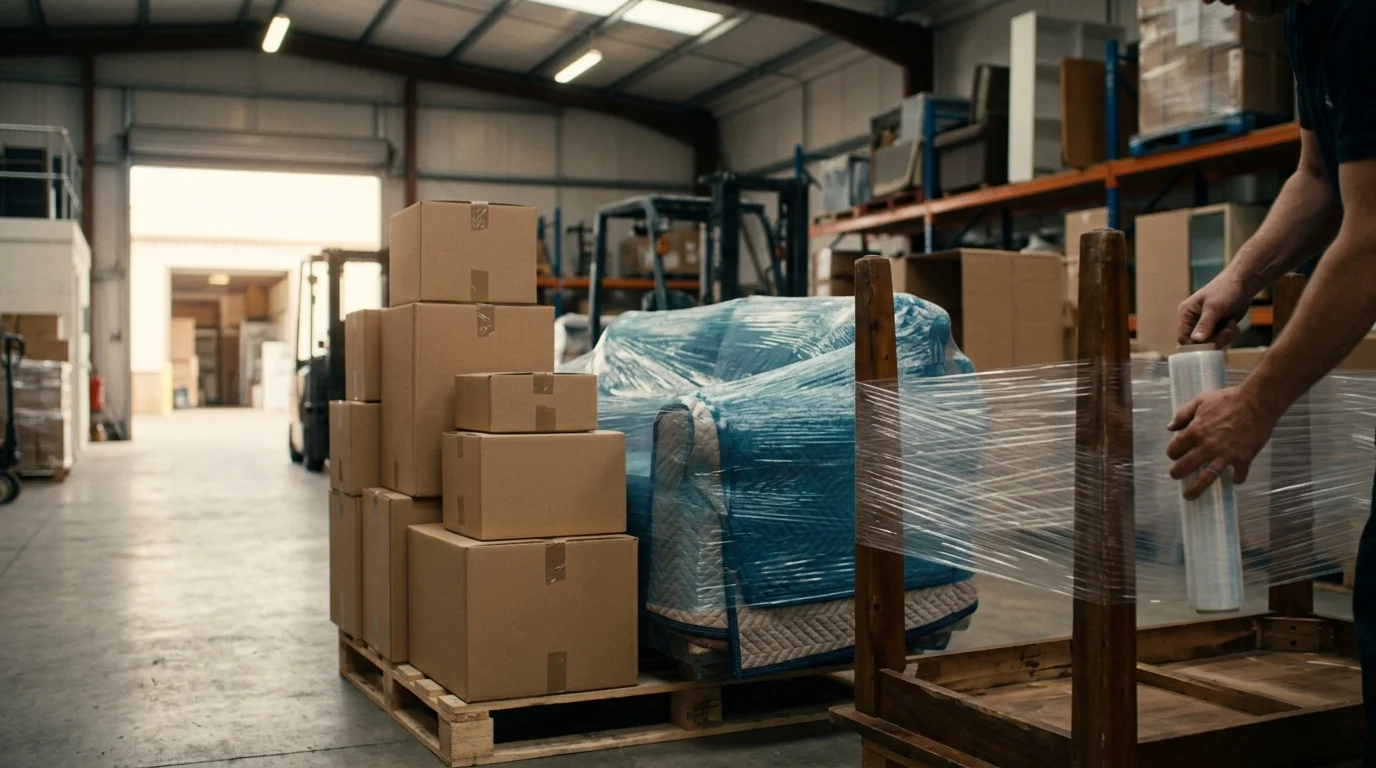
Step 3: Estimate Your Volume and Choose LCL or FCL
Volume drives the shipping method decision. Measure realistically in cubic metres of furniture and boxes, not in bedroom count.
| Move Type | Estimated Volume | Recommended Option |
|---|---|---|
| Studio / 1-bed (personal items only) | 3–10 CBM | LCL groupage |
| 1–2 bed apartment (selective) | 10–20 CBM | LCL or 20ft FCL |
| 2–3 bed apartment (most items) | 20–30 CBM | 20ft FCL (25–28 CBM usable) |
| Full house move | 30–60+ CBM | 40ft FCL (55–60 CBM usable) |
LCL (Less than Container Load / groupage): Your goods share a container with other exporters’ shipments. You pay per cubic metre. It is cost-effective for smaller volumes. Transit time may be 2–5 days longer than FCL due to consolidation and deconsolidation handling. Inspection risk at Thai customs is marginally higher because a shared container carries multiple declarations.
FCL (Full Container Load): You get your own container, and your goods travel alone in it. You pay a flat rate regardless of how full the container is. Clearance in Thailand is faster because there’s only one consignee per container, and fragile or high-value items fare better because nobody handles other shipments around yours. The 20ft FCL is the right choice for most expat apartment moves once volume exceeds about 15 CBM.
Step 4: Prepare Your Documents
Thai customs clearance of household goods requires a specific document set. Missing or incorrect documents are the primary reason personal effects shipments get delayed at Laem Chabang. Prepare everything before your vessel departs, not on arrival.
Required documents:
- Passport copy: a full copy including the visa stamp pages showing your Non-Immigrant B visa (or equivalent qualifying visa)
- Work permit copy: your one-year Thai work permit, valid at the time your shipment arrives
- Bill of Lading: issued by the shipping line. Your customs broker needs the original or an express release copy
- Detailed packing inventory: every item in your shipment listed with description, quantity, and estimated value. This is not optional, and it must match the physical contents exactly. Thai customs officers compare the physical goods against the inventory during inspection
- Proof of residence abroad: required if you are claiming the 12-month residency condition. Utility bills, rental contracts, or bank statements from your origin country covering the relevant period will do
Additional documents for specific items:
- Buddha images, antiques, religious artefacts: Fine Arts Department permit (must be obtained before shipment departs)
- Firearms: Royal Thai Police import permit
- Plants: Phytosanitary certificate from origin country
The full document requirements for shipping to Thailand cover the complete framework including NSW electronic submission and the Kor Sor Kor 99/1 import declaration form that your customs broker lodges for sea freight personal effects.
Step 5: Understand What Thai Customs Does on Arrival
All household goods shipments are directed to the Red Line, which means physical inspection. This is standard procedure, not a flag. A Thai customs officer compares your physical goods against your declared inventory.
Goods valuation: Thai customs uses the Transaction Value Method. For personal effects, officers assess whether items are genuinely used and personally owned. Keep this in mind when packing:
- Thai customs may reclassify items as commercial goods, and charge duty accordingly, if they are in original packaging, appear brand new, or arrive in quantities inconsistent with personal use, such as six identical garments in different sizes
- Declare values accurately. Undervaluation creates a valuation dispute that delays clearance, and Thai customs has reference price databases for common goods
- Used items should look used. A flat-screen television still in manufacturer’s packaging from three years ago is a problem. The same television mounted, with remote and cables packed beside it, is not
Bonded storage and the 45-day rule: If your documents are not in order on arrival, your goods enter bonded storage at Laem Chabang. Daily warehouse fees accrue. Shipping line detention and demurrage fees also accrue separately. You have 45 days from arrival to submit a formal import entry, or 60 days once an entry is submitted. After those periods, Thai customs can formally auction goods that remain unclaimed.
This is not a theoretical risk. It happens to real shipments with real goods because documents were incomplete. You prevent it entirely at the front end: complete documents, prepared and confirmed with your customs broker before the vessel leaves your origin port.
What Bonded Storage Actually Costs, in Real Numbers
“Daily fees accrue” is easy to read past without registering what it means. For a standard 20-foot or 40-foot household shipment held at Laem Chabang, warehouse storage typically runs THB 500–1,500 per day depending on cargo type and the terminal operator. That is separate from whatever the shipping line charges for container detention and demurrage, often another THB 1,000–3,000 per day once the free period expires, since the line wants its container back in circulation regardless of why your paperwork is delayed. Two weeks of missing documentation can easily add up to THB 20,000–60,000 in combined fees on top of your original freight cost, and that is before you have resolved whatever caused the hold in the first place. Two weeks is not an unusual delay when a required certificate has to be re-issued from the origin country.
The arithmetic matters because it changes the calculus on document preparation. Pay a customs broker an extra fee to triple-check your paperwork before the vessel sails. That is cheap insurance against a cost that compounds daily and has no upper limit until you fix the underlying problem. Importers who cut document preparation to save money are betting against exactly that.
One category is worth naming specifically. The documents most likely to trigger this delay are the ones that have to travel back to the origin country to be corrected: a missing signature on an inventory, a work permit copy that doesn’t match the visa stamp, an incomplete valued list. Documents you control locally in Thailand can usually be fixed in a day or two. Documents that require your former employer, your bank, or a government office back home to reissue something are the ones that turn a minor gap into a multi-week hold, because you are now waiting on someone else’s processing time on top of your own. Identify which category each required document falls into before you fly, not after your container is already sitting in bond.
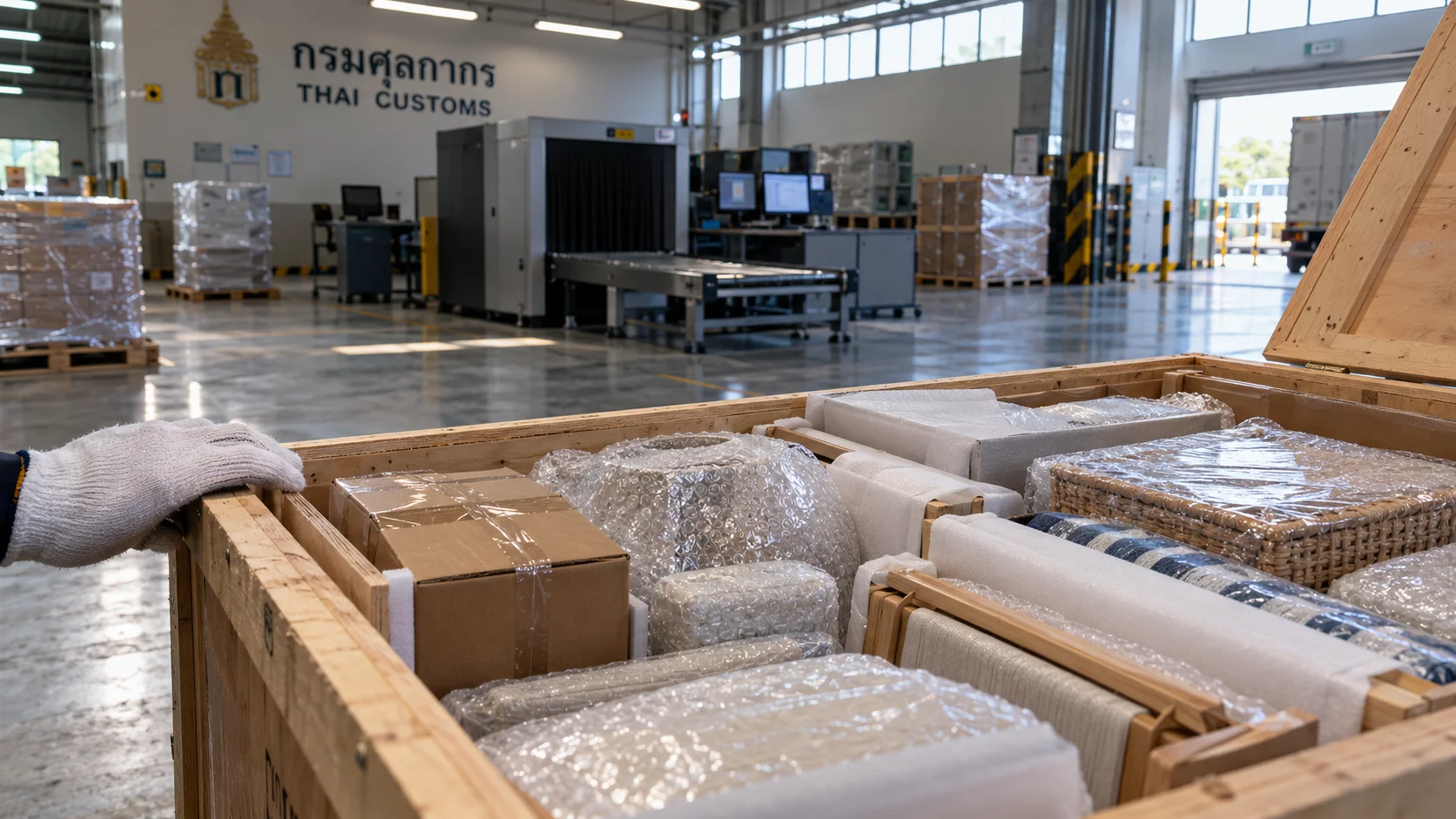
Step 6: Prohibited and Restricted Items
Remove these from your shipment before packing. Thai customs will find them during the Red Line inspection. Thailand maintains a strict restricted and prohibited goods list that applies to personal effects as much as commercial imports.
Prohibited (will be seized): Narcotics, counterfeit goods, pornographic material, endangered wildlife products (CITES-listed species)
Restricted (permit required before arrival):
- Alcohol: dutiable even under the personal effects exemption; beer and wine in personal quantities are generally accepted; a full bar isn’t
- Firearms: Royal Thai Police permit required; process is lengthy; obtain it before booking freight
- Plants and seeds: phytosanitary certificate from origin country; easier to leave behind
- Antiques and Buddha images: Fine Arts Department assessment and permit required
- Prescription medication in large quantities: carry Thai prescriptions or documentation
Related reading: Part Load Removals to Thailand: Sailing Dates, Duty and Crates
Frequently Asked Questions
Who qualifies for the duty-free exemption on household goods in Thailand?
Only holders of a valid one-year Non-Immigrant B visa with a corresponding one-year work permit qualify. Retirement visa (O-A, O-X) holders, Thai Elite members, education visa holders, and tourist visa arrivals do not qualify. Returning Thai nationals may qualify if they can prove 12 months of continuous residence abroad.
What is the 6-month timing rule for household goods?
Your shipment must arrive in Thailand no earlier than one month before your first entry and no later than six months after the date your work permit was first issued. If your shipment arrives outside that window, even by a few days, you lose the duty-free exemption regardless of your visa status.
What size container do I need for a Bangkok apartment?
For a studio or one-bedroom (selected personal items): LCL groupage, 5–10 CBM. For a two-bedroom apartment: LCL 10–20 CBM or a 20ft FCL. For a three-bedroom or larger: 20ft or 40ft FCL. Most Bangkok expat moves fit within LCL or a 20ft FCL.
How does Thai customs value used household goods?
Thai customs uses the Transaction Value Method. Officers assess whether items are genuinely used and personally owned. Items in original packaging, appearing brand new, or in quantities inconsistent with personal use may be reclassified as commercial imports and dutiable accordingly. Declare accurately.
What happens if my goods aren’t cleared within 45 days at Laem Chabang?
Thai customs allows goods to remain in bonded warehouse for up to 45 days without an import entry submission. After that period, or upon expiry of any extension, customs can formally auction unclaimed goods. Daily warehouse and port storage fees accrue throughout. Complete documents before shipment prevent this entirely.
Ready to Ship Your Household Goods to Thailand?
Swift Cargo manages household goods and personal effects shipments to Thailand end-to-end, including document coordination, customs broker engagement, and clearance at Laem Chabang. Confirm your eligibility and document requirements before you pack.