
Most Australian importers who run into problems with electronics shipments from China are not caught by complicated regulations. They are caught by a small number of well-documented requirements they did not know applied to them: compliance marks they did not have, certificates of origin they did not request, or duty concessions they did not claim. To import electronics from China to Australia without those surprises, line up three things before the goods arrive: a ChAFTA Certificate of Origin, EESS registration for in-scope electrical equipment, and ACMA compliance for anything with Wi-Fi, Bluetooth or other radio functions.
Key Takeaways
- Most electronics from China attract 0% import duty under ChAFTA, but you must hold a valid Certificate of Origin from your supplier to claim the preferential rate.
- GST at 10% applies to all imported electronics regardless of duty rate, calculated on the customs value plus duty, freight and insurance.
- Level 2 and Level 3 household and personal-use electrical equipment operating between 50V–1000V AC must be registered under the Electrical Equipment Safety Scheme (EESS) before it can be sold in Australia.
- Telecommunications equipment requires ACMA compliance, typically demonstrated via the RCM (Regulatory Compliance Mark).
- Most delays trace to one of four things: a missing Certificate of Origin, no EESS registration, an undeclared value, or an incorrect HS code.
The Compliance Stack: Which Regulators Govern Electronics Imports
Electronics imports into Australia do not sit under one regulator. They sit under a stack of them, and different products trigger different layers. Work out which rules apply to your specific goods before you place a supplier order.
The main layers are:
Australian Border Force (ABF): Handles customs entry, import declaration, duty assessment, and GST collection at the border. Every commercial import above AUD 1,000 requires a formal Import Declaration lodged through the Integrated Cargo System (ICS). ABF assesses duty on the customs value, generally the FOB price excluding international freight and insurance, and GST on that value plus duty, freight and insurance. Source: ABF: Cost of importing goods
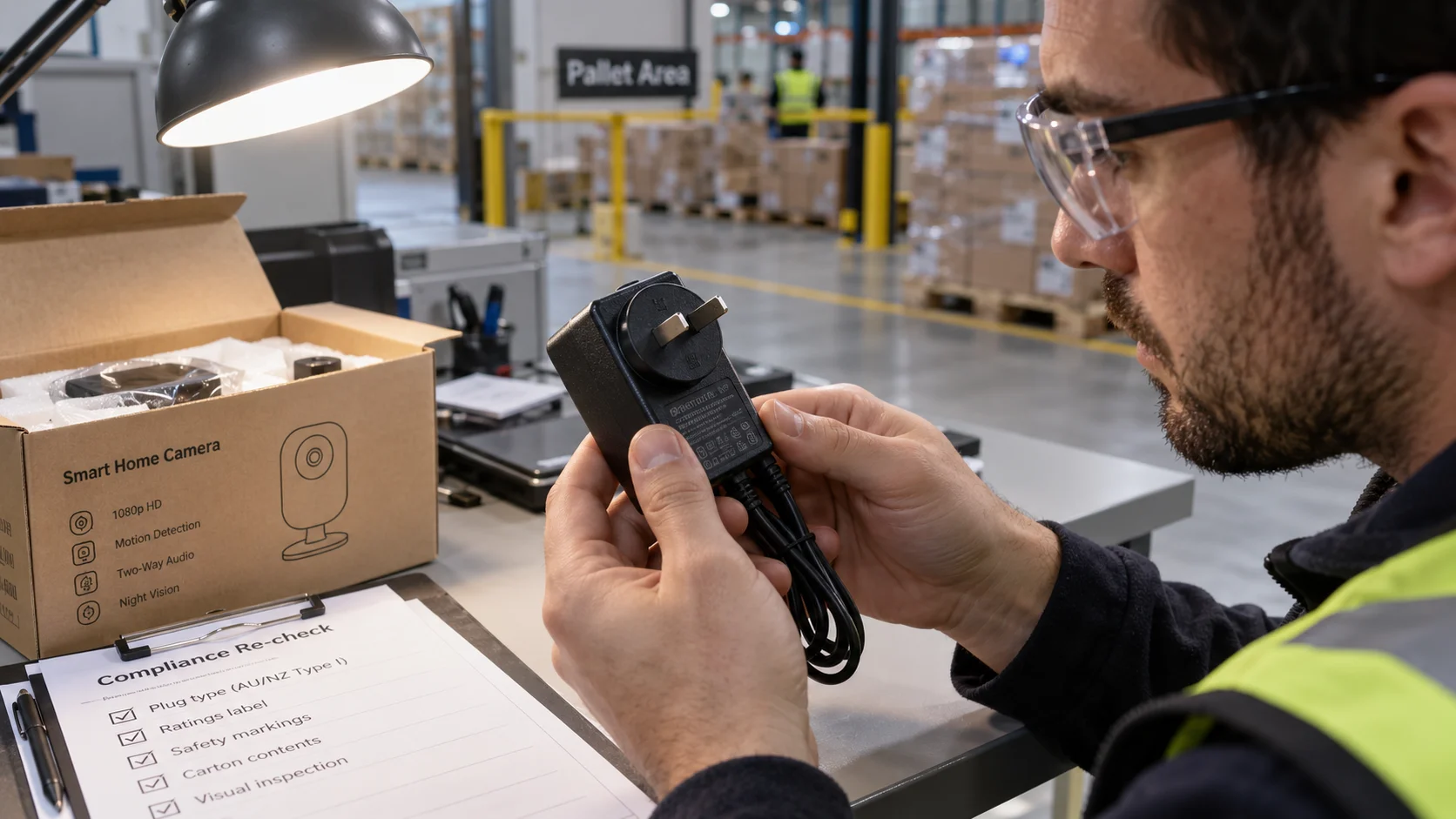
Electrical Equipment Safety Scheme (EESS): Governs the sale of electrical equipment operating between 50V and 1000V AC (or 75V–1500V DC) designed for household, personal, or similar use. This captures most consumer electronics: chargers, cables, power adaptors, smart home devices, lighting, and most household appliances. Importers must register as a Responsible Supplier with the EESS national database before their goods can be sold in Australia. Level 2 and Level 3 equipment must be formally registered; Level 3 requires a Certificate of Conformity. Source: EESS: Steps for compliance
Australian Communications and Media Authority (ACMA): Governs telecommunications and radio devices. Any product that transmits or receives radio frequency signals must comply with ACMA’s Radiocommunications Act requirements. That covers Wi-Fi devices, Bluetooth equipment, mobile phones, routers, and smart speakers. Compliance is typically demonstrated through the RCM (Regulatory Compliance Mark), which covers both electrical safety (EESS) and electromagnetic compatibility (EMC) in a single mark. Source: ACMA: Supplier labelling requirements
Therapeutic Goods Administration (TGA): Applies when electronics have a medical or therapeutic function: blood pressure monitors, glucose meters, hearing devices, and CPAP machines. Medical electronics require TGA registration before import and sale, with significant lead time.
Most business electronics importers sell consumer gadgets, accessories, smart home products, and computing equipment. For them, the relevant stack is ABF + EESS + ACMA. Confirm where your specific product sits in this stack before you ship. Our guide to Australia’s commercial import rules covers how they interact.
Duty and GST: What You Owe Under ChAFTA
The China–Australia Free Trade Agreement (ChAFTA) entered into force in December 2015 and eliminated tariffs on most Chinese goods by 2019. How it applies to your goods determines whether you have a duty liability at all.
0% duty: Most IT products, computing equipment, and high-technology devices qualify for zero duty under ChAFTA. This includes laptops, tablets, servers, networking equipment, phones, and most HTS Chapter 85 electronics. Australia also participates in the WTO Information Technology Agreement (ITA), which independently eliminates duties on a broad range of technology products. Source: DFAT: Guide to using ChAFTA
5% duty: Non-IT consumer electronics may attract a 5% general tariff if they do not qualify under ChAFTA or the ITA. That group covers smart home devices, some appliances, and certain audio equipment. Check the specific HS code classification for your product before assuming zero duty applies.
To claim the preferential ChAFTA rate: Your Chinese supplier must provide a valid Certificate of Origin (COO) confirming the goods were manufactured in China and meet ChAFTA rules of origin requirements. The COO must be issued by an authorised Chinese body, typically the China Council for the Promotion of International Trade (CCPIT) or China Customs. Without a valid COO on file, ABF will apply the general tariff rate rather than the preferential rate.
GST: 10% GST applies to all imported goods regardless of duty rate, calculated on the customs value (FOB price) plus duty and international freight and insurance. Even at 0% duty, a AUD 50,000 electronics shipment carries at least AUD 5,000 in GST at the border. GST-registered businesses recover this as an input tax credit, but the cash stays tied up until the credit comes through, so plan for it. Source: ATO: GST on imported goods
Import Processing Charge (IPC): A flat ABF processing charge applies to formal import declarations. Budget AUD 50 for consignments from AUD 1,000 to under AUD 10,000 and AUD 152 from AUD 10,000. Source: ABF: Import Processing Charges
Duty and GST interact differently across import scenarios than many importers expect. Our guide to import duty and GST in Australia breaks down each one.
Required Documentation for Customs Clearance
For electronics imports from China, the standard set covers:
Commercial Invoice: Must show the FOB (Free on Board) price, HS codes for each line item, country of origin (China), supplier and buyer details, and a clear description of the goods. Vague descriptions like “electronic components” slow clearance. Specific descriptions help ABF match goods to HS classifications quickly, for example “USB-C laptop charging cables, 65W, 1.8m, Model XYZ”.
Packing List: Must show quantities, weights (gross and net), dimensions per carton, and a description consistent with the commercial invoice. Customs commonly flags discrepancies between the invoice and packing list.
Bill of Lading or Air Waybill: Issued by your freight carrier. The consignee details must match your import declaration exactly.
Certificate of Origin: Required to claim the ChAFTA preferential rate. Request this from your supplier when you place the order, not when you are booking freight. Chinese suppliers can take 7–14 days to obtain a COO from the relevant authority. The certificate must also be valid at the time of import entry. Leaving it late is a common way to import electronics from China to Australia at the general tariff rate instead of 0%, or to pay port storage while the certificate catches up.
EESS registration evidence: If you are importing in-scope electrical equipment, have your EESS responsible supplier registration in place before the goods arrive. ABF does not always check at the border. Registration is still required before the goods can legally be sold, and it is cleaner to resolve this before a shipment is sitting in a warehouse.
Insurance certificate: Documents the insurance cost that forms part of the GST value. Recommended regardless. Electronics in transit carry material loss and damage risk.
Air vs Sea Freight for Electronics from China
Electronics from China move by both air and sea. The right choice depends on the value density of the goods, the urgency of the order, and the volume being shipped.
Air freight is the default for high-value, low-volume electronics: phones, laptops, tablets, and precision components. Transit from Shenzhen, Shanghai, or Guangzhou to Sydney or Melbourne typically runs 3–7 days. For goods worth AUD 500 per kilogram or more, the freight cost as a percentage of value stays manageable. For lower-value goods in bulk, air freight economics deteriorate quickly.
Sea freight is appropriate for larger volumes: bulk accessories, cables, audio equipment, smart home devices, and lighting. LCL (Less than Container Load) shipments run 18–28 days from China to Australian east-coast ports. FCL (Full Container Load) offers similar transit times and becomes relevant when you are consistently shipping enough volume to fill a container. Sea freight typically costs 80–90% less per kilogram than air, which matters for lower-value goods where freight is a large component of landed cost.
For most business electronics importers starting out, LCL sea freight makes sense for bulk replenishment orders, and air freight for urgent or high-value lines. As volume grows, you move from LCL to FCL once your regular shipments pass the LCL break-even point, typically around 10–12 CBM. The timing and cost trade-offs across LCL, FCL and air are laid out in full in our guide to shipping timelines to Australia.
Electronics-Specific Risks in Transit
Moisture and condensation: Ocean containers experience wide temperature swings over a 3–4 week transit, particularly through tropical shipping lanes. Condensation inside packaging can damage circuit boards and connectors. Desiccant packs inside cartons and moisture-barrier bags around individual units reduce this risk.
Static discharge: Pack sensitive components in anti-static bags, not generic plastic packaging. This is standard practice for component importers but sometimes overlooked for finished consumer goods.
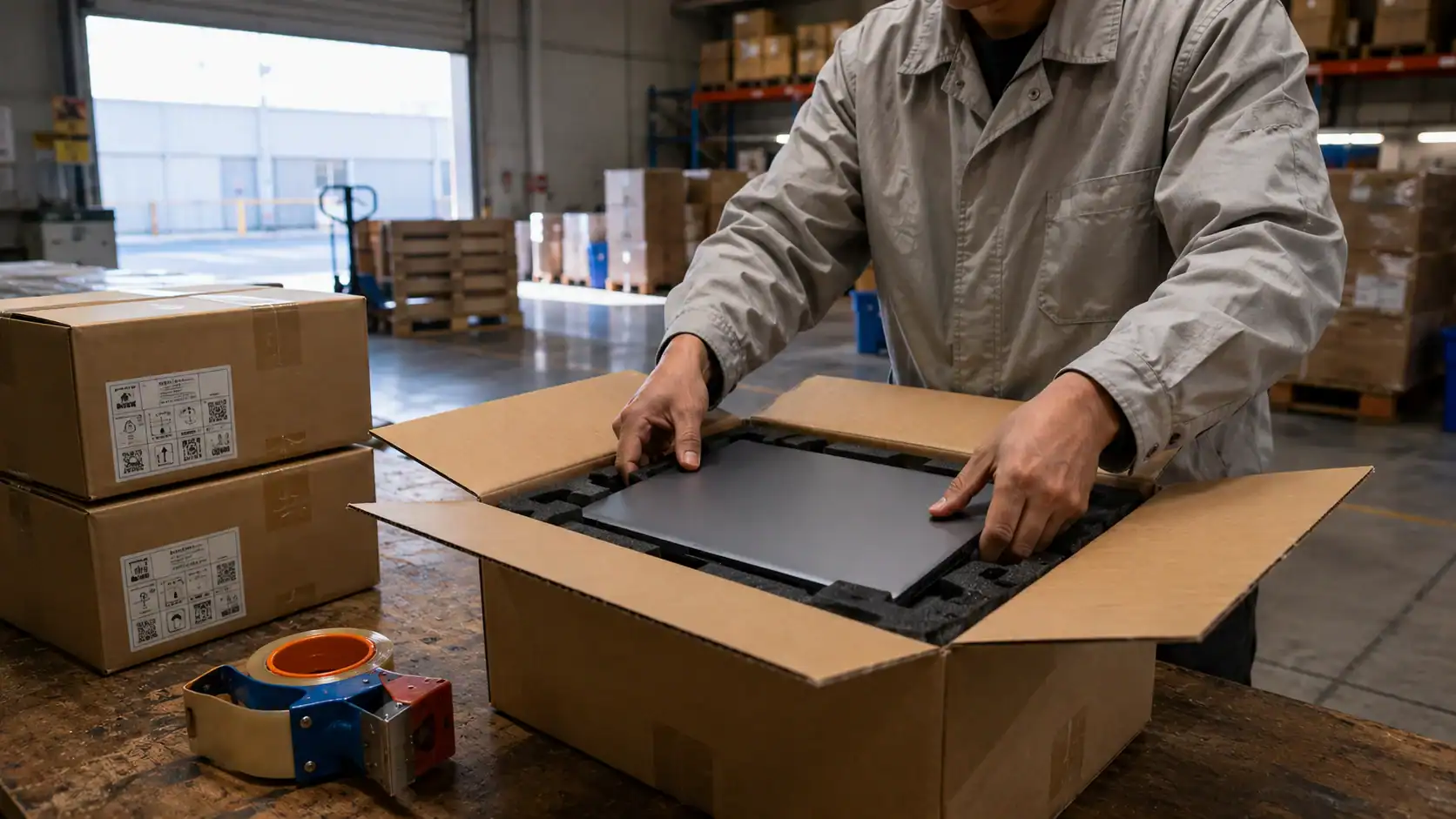
Physical handling damage: Electronics packaged for retail display are often not packaged for freight. A full sea freight journey covers factory to port, loading, transit, unloading, port storage, customs, and delivery. Products need carton packaging robust enough for that repeated handling. Double-walled outer cartons and proper internal cushioning reduce damage rates.
Cargo insurance is strongly recommended for electronics shipments. A standard all-risk marine cargo policy covers loss and damage during transit for roughly 0.3–0.5% of shipment value. For a consignment worth AUD 100,000, that is AUD 300–500 to protect the full shipment value.
Worked Landed Cost Example
Scenario: 500 units of wireless earbuds, FOB Shenzhen price USD 28 per unit = USD 14,000 total. Shipped by sea freight LCL to Sydney.
| Cost Component | Calculation | Amount (AUD) |
|---|---|---|
| FOB value (goods) | USD 14,000 × 1.55 exchange rate (indicative) | AUD 21,700 |
| International sea freight (LCL) | Approx 2 CBM at AUD 180/CBM + surcharges | AUD 650 |
| Cargo insurance (0.4%) | 0.4% × AUD 22,350 | AUD 89 |
| Value of taxable importation | FOB goods + freight + insurance (customs value AUD 21,700) | AUD 22,439 |
| Import duty | 0% (ChAFTA, with valid COO) | AUD 0 |
| GST at 10% | 10% × AUD 22,439 | AUD 2,244 |
| Import Processing Charge | ABF electronic declaration, AUD 10,000+ | AUD 152 |
| Customs broker fee | Typical broker rate | AUD 180 |
| Sydney port charges + delivery | Port THC + last-mile to warehouse | AUD 420 |
| Total landed cost | AUD 25,435 | |
| Landed cost per unit | AUD 25,435 ÷ 500 | AUD 50.87 |
GST is recoverable as an input tax credit for GST-registered businesses. The effective landed cost for a registered importer is therefore AUD 23,191 (AUD 46.38 per unit) once the GST credit is applied.
This example assumes you hold a valid ChAFTA COO. Without it, a 5% duty on the AUD 21,700 customs value adds AUD 1,085 to the cost, a meaningful difference at scale.
Common Mistakes Australian Electronics Importers Make
Not requesting the Certificate of Origin when you place the order. Importers forget the COO request while they focus on product specs and pricing. By the time the shipment is booked, it is too late to get a properly issued COO in time for the import entry. You then pay the general tariff rate rather than 0%, an avoidable cost.
Assuming ChAFTA covers everything. Not all goods from China qualify. The rules of origin require that goods are manufactured in China and meet specific content or processing criteria. Goods assembled in China from third-country components may not qualify. When in doubt, ask your supplier for their COO supporting evidence before relying on the preferential rate.
Ignoring EESS registration until after the goods arrive. EESS registration is a prerequisite for selling in-scope electrical equipment in Australia, not a post-arrival formality. If you start registering after the shipment has landed, the goods can sit in a warehouse for weeks before they can legally go on sale.
Using vague HS codes to simplify the invoice. Some importers classify a mixed electronics consignment under a single broad HS code to reduce paperwork. That increases inspection risk, and ABF may assess the duty incorrectly. Each distinct product type should have its own HS code and its own invoice line.
Underinsuring or not insuring at all. Electronics have high value-to-weight ratios and material transit damage risk. A single water-damaged carton on a sea freight shipment can be a significant loss. Cargo insurance at 0.3–0.5% of value is one of the lower-cost line items in a landed cost calculation.
Not building freight time into inventory planning. Sea freight from China to Australia takes 18–28 days in transit plus port processing time at both ends. Importers who plan inventory on supplier lead time alone, without adding freight time, run into stockouts when shipping is delayed. See our guide to biosecurity clearance timelines for the additional buffer needed when goods require DAFF inspection on arrival.
Swift Cargo handles electronics imports from China for Australian businesses: freight booking, customs documentation, EESS guidance, and delivery coordination. If you are planning your first electronics import or scaling an existing supply line, request a corporate freight quote for a freight assessment.
What to Confirm Before You Import Electronics from China to Australia
Confirm the HS code and duty treatment for each product line, request the Certificate of Origin with the purchase order, and have EESS registration and RCM evidence in place for in-scope products before the shipment lands. Then budget 10% GST on the customs value plus duty, freight and insurance, and insure the consignment, which typically costs 0.3 to 0.5% of its value.
Frequently Asked Questions
What is the import duty rate for electronics from China to Australia?
Most IT and high-technology electronics from China attract 0% import duty under the China-Australia Free Trade Agreement (ChAFTA). Some non-IT consumer electronics may attract a 5% general tariff. To claim the 0% preferential rate, you need a valid Certificate of Origin from your Chinese supplier confirming the goods meet ChAFTA’s rules of origin. GST at 10% applies regardless of duty rate.
What is EESS and does it apply to my electronics import?
EESS stands for the Electrical Equipment Safety Scheme. It applies to electrical equipment operating between 50V and 1000V AC designed for household, personal, or similar use, which covers most consumer electronics. Importers must register as a Responsible Supplier with the EESS national database before their goods can legally be sold in Australia. Some higher-risk categories (Level 3) also require a Certificate of Conformity before registration.
Do I need ACMA certification for electronics from China?
If your electronics transmit or receive radio frequency signals (Wi-Fi, Bluetooth, cellular, or other RF technologies), ACMA compliance is required. This is typically demonstrated through the RCM (Regulatory Compliance Mark), which covers both electrical safety and electromagnetic compatibility. Products without RCM cannot legally be supplied in Australia.
How long does it take to ship electronics from China to Australia?
Sea freight typically takes 18 to 28 days in transit from major Chinese ports (Shenzhen, Shanghai, Guangzhou) to Australian east-coast ports. Air freight from the same origins to Sydney or Melbourne runs 3 to 7 days. Port processing and customs clearance add 1 to 3 business days at the Australian end for straightforward shipments.
What is the Certificate of Origin and why does it matter?
A Certificate of Origin (COO) is a document issued by an authorised Chinese body confirming that the goods were manufactured in China and meet ChAFTA’s rules of origin. It is required to claim the 0% preferential duty rate at the Australian border. Without a valid COO, the general tariff rate applies. The COO can take 7 to 14 days to obtain, so request it from your supplier when you place the order.