
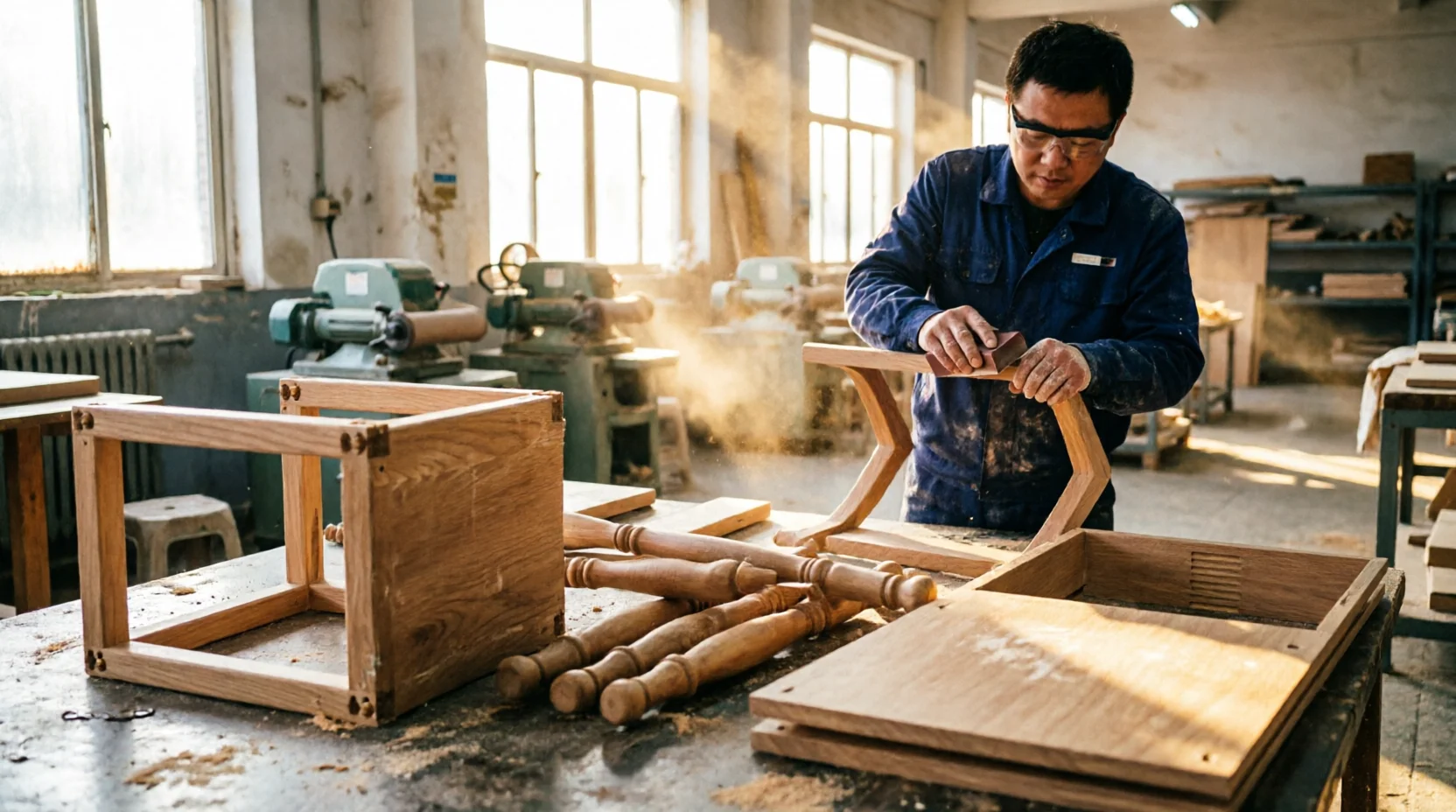
Furniture importers who’ve already sourced general merchandise from China tend to arrive at their first furniture order with the wrong mental model. They’ve read about Guangzhou versus Yiwu, they understand factory-direct versus market-stall wholesale in the abstract, and they assume furniture will slot into one side of that divide the same way a homewares SKU would. It doesn’t, not cleanly. Furniture has its own geography, its own hub logic, and its own failure modes. Foshan and Dongguan come up most often. They sit only forty minutes apart on a map but run almost entirely different sourcing models underneath.
Both are in Guangdong province, both feed the same ports, and both will happily quote you a dining set. But Foshan built its reputation as a market-plus-factory ecosystem centred on the Lecong furniture market, while Dongguan grew as a broader industrial base (furniture, electronics, toys, textiles) where the furniture side leans harder into factory-direct, solid-wood and export-grade joinery work. Importers who pick between them without understanding that difference end up with the wrong MOQ commitment, the wrong quality assumption, or a container that’s a third empty because nobody planned for flat-pack ratio. This guide works through the hub logic, the MOQ and cost economics, the compliance angle that furniture carries and general merchandise doesn’t, and a worked example splitting a mixed dining and living range across both cities.
What Foshan Actually Is
Foshan sits immediately southwest of Guangzhou, close enough that many buyers treat a Foshan sourcing trip as a day extension of a Canton Fair visit. It is, by most estimates, the largest furniture manufacturing and trading cluster on earth: a claim that sounds like marketing until you see the scale of Lecong, the town within Foshan that anchors the industry. Lecong furniture market is not one building but a sprawl of interconnected wholesale complexes, showroom towers and factory outlets covering an area measured in square kilometres, with thousands of vendors representing everything from single-workshop operations to factories with their own export departments.
Foshan functions as a market-plus-factory ecosystem, not a pure trading market or a pure factory zone. That’s its defining feature. A showroom in Lecong is frequently the factory’s own retail front, staffed by people who can walk you back to the production floor if you ask, or it’s a dealer representing several factories whose goods sit side by side for direct comparison. Either way, you are looking at physical, full-scale furniture (not a swatch, not a rendering) and you can compare five versions of the same sofa frame from five different vendors in an afternoon. That’s a genuinely different buying experience from ordering a piece sight-unseen against a spec sheet.
Foshan’s category breadth is the other half of the story. The cluster covers everything from budget knockdown furniture sold by the container-load to premium hospitality-grade pieces destined for five-star hotel chains, with every price and quality tier represented somewhere in between. That breadth is an advantage for range-building and a trap for the unwary: it means the Foshan “quality level” question has no single answer, and it depends entirely on which of the thousands of vendors you happen to be standing in front of.
What Dongguan Actually Is
Dongguan sits east of the Pearl River, closer to Shenzhen. It built its industrial identity on breadth rather than a single category. It is one of the Pearl River Delta’s most diversified manufacturing bases: furniture alongside electronics, toys, textiles and footwear. That gives it a more conventional industrial-park character than Foshan’s market-driven sprawl. You don’t wander Dongguan’s furniture factories the way you wander Lecong; you arrange a visit to a specific factory whose product line matches what you’re trying to buy.
Within that broader base, Dongguan carries a real furniture-adjacent cluster, particularly strong in solid wood and export-grade joinery. Factories here tend to have grown up serving export clients from the start, often American and European furniture brands running long-term OEM programs. That history shows up in how they operate: engineering drawings taken seriously, tooling built for a specific customer’s joinery detail, and quality systems built around repeat production runs rather than one-off showroom sales. It is a more industrial, more factory-direct character than Foshan’s market-trading character, and that difference in character is the real reason to choose one hub over the other.
The Fundamental Difference: Market-Plus-Factory vs Factory-Direct
Strip the geography away and the two hubs represent different points on the same spectrum Guangzhou and Yiwu occupy for general merchandise, though shifted. Even Dongguan’s factory-direct furniture side isn’t quite the pure OEM model you’d find sourcing electronics. Still, the practical contrast holds.
Foshan (market-plus-factory): lower barrier to entry, because you can browse finished physical showrooms before committing to anyone. Moderate MOQs, often startable at container-partial quantities through consolidation, similar to the crossover economics that apply across most China-sourcing categories. Faster initial engagement: a buyer can walk into Lecong with no prior contact and leave three days later with samples ordered from four vendors. The trade-off is quality variance: because the ecosystem spans budget to premium in the same few city blocks, physical inspection matters here more than in almost any other sourcing category on this blog.
Dongguan (factory-direct): a higher barrier to entry (you need a specification before you show up, not after) but tighter control once you’re in. Better suited to larger volume orders and custom or OEM furniture programs where dimensional tolerance, joinery detail and finish consistency need to be locked down in a drawing rather than eyeballed off a showroom floor sample. MOQs scale with the factory’s own production line minimums rather than a market vendor’s flexible consolidation arrangement, which typically means committing to more volume per SKU.
Framed as a job-to-be-done question: if the job is “let me see and compare physical furniture before I commit, and start at a quantity that doesn’t bet the business on one range,” that’s a Foshan job. If the job is “manufacture this exact piece, to this exact specification, at a volume that justifies dedicated tooling,” that’s a Dongguan job. Importers who try to force the wrong hub into the wrong job end up either overpaying Dongguan factory minimums for a range they haven’t validated, or discovering too late that a Foshan showroom vendor can’t hold the tight joinery tolerance a hospitality contract demands.
MOQ Economics: What Each Hub Actually Asks For
The MOQ gap between the two hubs is the first number a new furniture importer needs to internalise, because it changes the shape of the whole order.
Foshan showroom orders can often start at container-partial quantities: a handful of each SKU rather than a full production run of any single one, particularly when placed through a trading company or consolidator working several Lecong vendors on your behalf. This mirrors the consolidation economics that show up across other China-sourcing content on this blog: you’re not asking one factory to justify a dedicated run, you’re asking several vendors to each contribute a smaller quantity into a shared container. A first-time importer building a 15-SKU mixed range might realistically start with 20 to 40 units per SKU from a Foshan showroom path.
Dongguan factories work differently. Because the furniture side of the cluster is genuinely factory-direct, MOQs scale with the production line’s own minimums rather than a vendor’s flexibility. A solid-wood dining chair program might carry an MOQ in the low hundreds per finish variant: not because the factory is being difficult, but because setting up a run of fewer units than that doesn’t cover the tooling and changeover cost against their margin structure. For a buyer who already knows they want volume and consistency on a small number of hero SKUs, that’s a fair trade. For a buyer still validating which pieces will sell, it’s a much larger bet per SKU than the Foshan path requires.
The practical rule that falls out of this: use Foshan to build and test a range across many SKUs at moderate quantity, and move the pieces that prove themselves (the ones that reorder) to a Dongguan factory relationship once the volume justifies dedicated production. That sequencing shows up again in the worked example below.
Quality and Materials: Two Different Risk Shapes
Furniture quality risk in Foshan and Dongguan doesn’t just differ in degree, it differs in shape.
Foshan’s risk is variance. Because the cluster genuinely spans everything from low-cost knockdown furniture assembled with cam-lock fittings to premium hotel-grade case goods with hand-finished veneer, the same product category can be quoted at wildly different quality levels by vendors sitting a few doors apart in the same showroom building. A price that looks aggressive relative to a competitor’s quote is sometimes just a lower-grade substrate or a thinner veneer layer, not a better deal. Physical inspection matters more in Foshan than almost any other sourcing category, precisely because the market’s breadth means you cannot infer quality tier from the address alone. That means walking the showroom sample, checking drawer runners under load, and examining a cut edge for substrate quality.
Dongguan’s risk is narrower but not absent. Because its export-oriented factories have typically already served American and European furniture brands, many arrive with international compliance experience already built into their process: testing protocols, documentation habits, and materials sourcing that assumes an export-grade buyer rather than a domestic Chinese retail customer. That prior experience is a reasonable quality proxy, though not a guarantee. A factory is more likely to hold consistent materials specification if it’s used to meeting CARB Phase 2 or EPA TSCA Title VI formaldehyde limits for the US market, or E1 requirements for the EU, than if it has only ever sold domestically. It’s a signal worth asking about directly during supplier vetting: our guide on vetting Chinese suppliers covers how to verify export history rather than take a claim at face value.
The Formaldehyde and VOC Angle
Engineered wood adds a compliance dimension to furniture sourcing that most general-merchandise categories don’t carry. MDF and particleboard are the substrate behind a large share of mid-market case goods, from bookshelves to bed frames. Both use formaldehyde-based resins in manufacture, and those resins continue to off-gas at a low level for months after production. That matters for two separate reasons: worker and consumer safety in an enclosed room, and, increasingly, retailer sourcing requirements that treat emission class as a condition of stocking a range at all.
Australia does not currently mandate a single formaldehyde emission limit for furniture the way the EU’s E1 classification system or the US CARB Phase 2 rule do: a gap our furniture import compliance guide covers in more detail. That absence of a mandatory Australian standard is not a reason to skip the question. It’s a reason to set your own bar and hold every supplier to it regardless of which hub they’re in: ask for E1 or lower emission class certification on any MDF or particleboard component, in writing, before the order is confirmed. Dongguan’s export-experienced factories will generally have this documentation on file already, since it’s routine for their US and EU clients. Foshan vendors vary: some showroom-adjacent factories will have it, some genuinely won’t have tested for it because no prior customer has asked. Either way, treat it as a standing requirement in your purchase order, not a follow-up question after goods have shipped.
Freight and Consolidation: Same Ports, Different Loading Math
Geographically, Foshan and Dongguan both feed the same port network. Foshan sits close to Nansha, Guangzhou’s own deep-water terminal; Dongguan sits closer to Shenzhen’s Yantian and Shekou terminals, with Hong Kong also within reach for both. A mixed order can still consolidate into a single container, even when it pulls pieces from a Lecong showroom vendor and a Dongguan factory, provided the pickup schedule and any pre-shipment inspection are planned around both suppliers’ lead times. The same consolidation mechanics apply whether the goods are coming from one factory or several, as covered in our guide to freight consolidation for Australian imports. Once the container clears the port, our Australia customs and import guide covers what Australian Border Force expects on the way through.
Furniture adds one more factor to that picture: the loading math itself. Furniture is a volume-heavy category: a container fills on cubic space well before it hits its weight limit. That makes the flat-pack-to-assembled ratio of your range one of the biggest levers on landed cost you control. Our garden and outdoor furniture guide walks through the numbers for a knock-down outdoor dining setting: assembled, a set can occupy nearly three times the cube of the same set flat-packed, and that ratio moves directly through freight cost per unit. The same physics applies indoors. A dining chair with a mortise-and-tenon frame built fully assembled is genuinely a better piece of joinery in some cases. But it is also genuinely triple the container space of the same chair shipped knocked-down, with the legs, seat and back packed separately. Neither Foshan nor Dongguan solves this for you: it’s a specification you decide with the factory, and that decision needs to be locked in before tooling is cut, not discovered when the container comes back a third empty.
Quality Control Specifics for Furniture
Two QC checks matter for furniture that simply don’t come up sourcing soft goods or general merchandise, and both deserve a line in your quality plan regardless of which hub you’re buying from.
Structural load testing for seating and tables. A chair or a dining table carries real, repeated load in normal use in a way a cushion or a lamp doesn’t. A visual finish check tells you nothing about whether the frame joints will hold under a static load test or survive a cyclic test simulating years of sitting down and standing up. Ask for load-test data on seating specifically, as a standard line item in the factory’s quality report, not a special request reserved for premium orders. That means static load capacity and, ideally, cyclic test results for the frame and joint construction. Dongguan’s export-experienced factories usually have this on file already, since American and European furniture buyers ask for it routinely. Foshan vendors are more of a mix; ask explicitly and treat a factory that can’t produce any load-test history as a signal to inspect more, not less.
Finish and lacquer consistency across a batch. The showroom sample and the two hundred units that actually ship can diverge in colour depth, sheen level and finish texture, particularly on stained or lacquered timber where batch-to-batch variation in the finishing process is a known industry problem. This is a visual inspection matter more than a lab-test matter: walk the factory floor before shipment, or commission a pre-shipment inspection, and check finish consistency across multiple pieces pulled from different points in the production run, not just the first unit off the line.
Worked Example: Sourcing a Mixed Dining and Living Range
Consider an Australian homewares importer building a 12-SKU range: a dining table, six dining chairs sold as a set, a sideboard, a coffee table, a two-seat and three-seat sofa frame (upholstery to be finished locally), and a media console.
The Foshan showroom path: the importer spends four days walking Lecong, comparing three or four vendors per category, and orders samples from the strongest match in each. MOQs across the range average around 25 units per SKU through a consolidator. That brings total product commitment to roughly US$38,000, at an average landed-adjacent FOB of about US$130 per piece. The range is heavily weighted toward the smaller case goods and lighter on the sofa frames, which carry a higher per-unit cost. Lead time from deposit to ex-factory runs four to six weeks, since most SKUs are variations on existing showroom stock rather than new tooling. The risk sits in quality variance: two of the twelve SKUs arrive with visibly inconsistent lacquer across the batch and need to negotiate a rework. Both were ordered from a lower-tier vendor on price alone.
The Dongguan factory-direct path: the importer arrives with finished technical drawings for the same 12 SKUs and negotiates directly with one solid-wood furniture factory capable of the full range. MOQs run higher: the factory wants 150 to 200 units per SKU to justify tooling for the joinery details specified. That pushes total commitment to roughly US$96,000, at a lower average per-unit FOB of about US$95 that reflects the volume discount and the absence of a market-vendor margin layer. Lead time stretches to ten to twelve weeks to allow for tooling and a full production run. Quality is tighter and more predictable across the batch, with load-test data supplied as standard. But the importer has committed nearly three times the capital before knowing which of the twelve SKUs will actually sell.
The hybrid, and the more common real-world outcome: this path works in two stages. First, validate the full 12-SKU range through the Foshan showroom path, at the lower commitment and shorter lead time. Then move the two or three pieces that prove strong sellers (typically the dining set and one sofa frame, in this kind of range) to a Dongguan factory relationship for the second production run, once volume justifies dedicated tooling and tighter joinery control. First-order product spend under this approach lands close to the all-Foshan figure, roughly US$38,000, with the scaling investment deferred until sales data justifies it rather than committed upfront. It’s the same validate-then-scale logic that applies sourcing general merchandise between Guangzhou and Yiwu, adapted to furniture’s higher per-unit stakes and its structural QC requirements.
Common Mistakes
Ordering premium-grade expectations from a budget Foshan factory without inspecting samples first. A quote that undercuts three other Lecong vendors by 20 per cent is not automatically a better deal: it is frequently a thinner substrate, a lower-grade veneer, or hardware rated for lighter use. Inspect the physical sample against the spec you actually need before confirming volume, not after the first container lands.
No formaldehyde emission spec in the purchase order. Because Australia has no single mandatory standard, it’s easy to let this slide as an assumption rather than a written requirement. Put E1 or lower emission class certification in the PO explicitly, for every MDF or particleboard component, regardless of hub: don’t rely on a factory volunteering it.
Underestimating container utilisation loss on assembled versus flat-pack pieces. A range that looks fine on a per-unit FOB comparison can lose most of its margin advantage once the actual cube is loaded, if half the range ships assembled where it could have shipped flat-pack. Audit the flat-pack ratio of every SKU before confirming tooling, the same way you’d audit it for outdoor furniture.
Treating the two hubs as interchangeable because they’re forty minutes apart. Proximity on a map says nothing about sourcing model. Match the hub to the job (showroom validation in Foshan, tooled production in Dongguan) rather than defaulting to whichever city a supplier directory happened to list first.
Related Reading
- Guangzhou vs Yiwu: Where Should You Source Your Products in China?
- Importing Furniture from China to Australia: The Complete Guide
- Freight Consolidation for Australian Imports
- Importing Garden and Outdoor Products to Australia
- How to Vet Chinese Suppliers Before You Order
Frequently Asked Questions
Is Foshan or Dongguan better for a first-time furniture importer?
Foshan, in most cases. The Lecong furniture market lets you walk physical showrooms, compare finishes side by side, and place moderate-quantity orders through consolidation without committing to a single factory relationship sight unseen. Dongguan’s factory-direct model rewards buyers who already know their specification and can commit to fuller production runs, which is a harder starting position for a first order.
What MOQ should I expect from a Foshan furniture supplier versus a Dongguan factory?
Foshan showroom orders can often start at container-partial quantities, particularly through a trading company or consolidator working across several Lecong vendors. Dongguan factories typically set MOQs against their own production line minimums, which for furniture usually means a fuller container commitment per SKU or per finish variant, sometimes in the hundreds of units depending on the piece.
Does Chinese furniture need to meet a formaldehyde emission standard for Australia?
Australia has no single mandatory formaldehyde emission limit for furniture the way the EU’s E1 classification or the US CARB Phase 2 rule do. That gap does not make the issue optional. Ask every factory, in Foshan or Dongguan, for E1 or lower emission class certification on any MDF or particleboard component, both for occupant safety in an enclosed room and because more Australian retailers are starting to require it as a condition of stocking a range.
Why does container utilisation matter more for furniture than most import categories?
Furniture is volumetric cargo: a container fills on cubic space long before it reaches its weight limit. An assembled dining chair can occupy two to three times the cube of the same chair knocked down flat-pack, so the flat-pack-to-assembled ratio of your range decides how many units land in a single container and therefore your per-unit freight cost more than almost any other single sourcing decision.
Should I ask for load-test data on Chinese-made chairs and tables?
Yes, and this is a real point of difference from soft goods or general merchandise. Seating and tables carry structural load in normal use, so a factory quality report should include static and cyclic load-test results for the frame and joints, not just a visual finish check. Reputable Dongguan export factories usually have this data on file already; it is worth asking for explicitly from any Foshan supplier too.
Can Foshan and Dongguan furniture both ship through the same Australian consolidation process?
Yes. Both hubs feed the same Pearl River Delta port network (Nansha, Yantian, Shekou and Hong Kong) so a mixed order pulling pieces from Lecong showrooms and Dongguan factories can still consolidate into a single container at a Shenzhen or Guangzhou warehouse before it ships to Australia, provided you plan the pickup schedule and inspection timing around both suppliers’ lead times.