
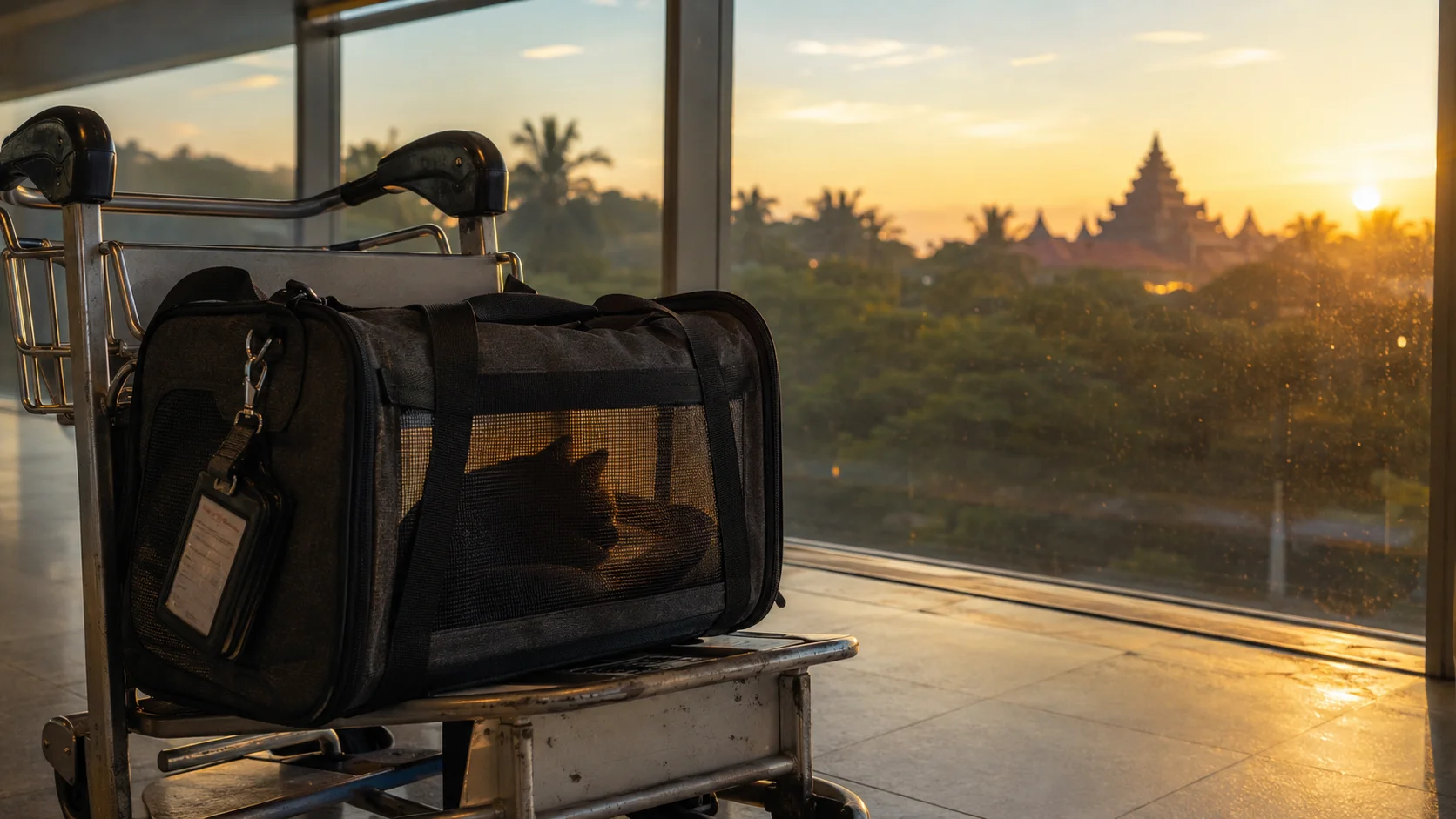
Somewhere above the Bay of Bengal, or the Timor Sea, or wherever the flight path happens to cross that day, a dog in the forward hold of a Boeing or an Airbus is breathing pressurized, temperature-controlled air that is, mechanically, the same air the passengers three metres above its head are breathing. That part of pet air cargo is not the dangerous part, and it arguably never was. The part that decides whether the trip goes well happened hours earlier, on the ground, in a sequence almost nobody outside freight operations ever sees explained: a document check, a crate check, a holding room, and, depending on the route, possibly a second aircraft entirely.
This is the departure side of that journey: what actually happens between drop-off at the freight terminal and the moment a crate is loaded into the hold. If you are looking for what happens after landing in Bangkok (immigration, the Animal Quarantine desk, Carousel 8), that is a later, separate stage of the trip, covered in full in SwiftCargo’s Suvarnabhumi arrival guide. This piece picks up earlier and stops at the aircraft door. It also assumes manifest cargo transport is already the confirmed method for your pet. Your booking agent settles that separate question, cabin versus checked baggage versus manifest cargo, well before travel day, not on travel day itself.
The Drop-Off Window: Why Pets Arrive Hours Before Anyone Else
Passengers on the same flight can turn up ninety minutes before departure and still make it. A pet flying as manifest cargo cannot, and the reason is not caution for its own sake. It is that a live animal shipment has to clear a documented acceptance process before ground staff will agree to load it. That process takes real time to work through. Freight terminals typically ask for pets to be presented several hours ahead of scheduled departure, enough time to verify documents, inspect the crate, and move a live animal shipment into the loading sequence before the aircraft is ready for cargo.
The airline and ground handling agent are working through what is, in effect, a checklist: IATA’s Live Animal Acceptance Checklist runs to 23 yes-or-no questions covering booking arrangements, air waybill accuracy, container specification, labelling, and feeding and watering instructions. A single “no” answer is a documented reason to refuse the shipment, not a note to fix later. That is the actual purpose of the drop-off window: buffer time for a problem to surface while there is still time to fix it, not at the aircraft door when there is not.
On the Australian export side, most of that buffer time is already spent long before travel day itself. A Notice of Intention to Export goes to the relevant Department of Agriculture, Fisheries and Forestry (DAFF) regional office at least 10 working days ahead of departure, and a registered vet completes the health checks, vaccinations, and blood work behind the Veterinary Health Certificate presented at the terminal. Owners who complete that timeline arrive at drop-off with a document set that matches cleanly, which is what turns the terminal stop into a formality rather than the anxious moment first-time exporters expect. SwiftCargo’s guide to pre-export testing requirements for dogs covers that timeline in full.
The Document Check: What Has to Match Before Anyone Touches the Crate
Before a DAFF-registered exporter or biosecurity officer signs off on a live export, they are checking that a set of independently created documents describe the same animal without contradiction. The Veterinary Health Certificate has to match the microchip number on the export permit. The permit has to match the destination country’s import conditions. And under IATA’s regulations, the airline requires a completed Shipper’s Certification for Live Animals, filled out in English, in two original copies: one retained by the carrier that accepts the shipment, the other travelling with the animal all the way to its final destination.
None of this is decided at the terminal counter. It is assembled over the preceding weeks, and the terminal check is simply where all of it gets tested against the actual animal standing in front of an official for the first time. A microchip that scans to a different number than the one printed on the certificate, a vaccination date that falls just outside a validity window, or a permit issued for a slightly different destination airport are the kinds of small mismatches that stop a shipment cold, not because officials are being pedantic, but because the paperwork is the only thing establishing, legally, which animal this is and what has already been verified about it.
The Crate Check: IATA’s Container Requirement, and Why a Bad Crate Gets an Animal Bumped
Alongside the documents, ground staff physically inspect the travel container against IATA’s Container Requirement 1 (CR1), the live animal transport standard covering ordinary pet dogs and cats. This is not the moment to rebuild an entire crate-sizing guide; the practical version is that inspectors are checking a short list of pass/fail points. The container has to be rigid: fiberglass, metal, rigid plastic, or solid wood or plywood, not a soft-sided carrier. It needs ventilation openings on at least three sides for a domestic sector and four sides for an international one, with individual opening sizes capped at roughly 2.5cm for dogs and smaller again for cats, so airflow is real but an animal cannot get a paw or muzzle through the mesh. And the animal has to be able to stand at full height, turn around completely, and lie down in a natural position inside it. Snub-nosed breeds are required to have a container at least 10% larger again, given their comparatively higher heat and respiratory risk.
A crate that fails any one of those points is not a paperwork technicality. It is a shipment ground staff are not permitted to load. No exception process exists at the terminal counter for “close enough,” because the person signing off on acceptance is putting their own compliance record against the container, not just the paperwork. This is also why legitimate operators check crate compliance well before travel day rather than discovering a problem at drop-off, when there is no longer time to source a compliant replacement before the flight closes out.
The Live Animal Holding Area: Not General Cargo, and Not a Kennel
Once accepted, a pet does not sit among pallets and boxes in the general freight shed. IATA’s live animal handling standards require dedicated space: an area monitored for temperature and ventilation, staffed only by personnel trained specifically in live animal handling, and disinfected on a fixed 24-hour cycle regardless of how many shipments have passed through it that day. It is a deliberately narrower environment than general cargo handling: fewer people are authorised to enter it, and the animals inside it are checked on a schedule general freight never is.
It is also not a kennel in the boarding-facility sense. The space offers no walking, no play, and typically only the minimal handling needed to confirm the animal is stable and its container is secure. The holding area exists to safely bridge the gap between acceptance and loading, not to provide enrichment. For a short domestic connection that gap might be under an hour. For an international routing with a scheduled ground stop, it can run considerably longer, which is precisely the detail that makes the distinction covered further down (transit versus transhipment) a practical one rather than a technicality.
Loading the Aircraft: Inside the Forward Hold
Many people assume a pet flying cargo rides in an unpressurized, unheated section of the aircraft. That assumption is simply wrong for the compartment live animals are actually required to travel in. Live animal shipments on the aircraft types flying this corridor travel in the forward hold. That section is pressurized to the same standard as the passenger cabin above it and draws from the same environmental control system. That means temperature and airflow are actively regulated for the duration of the flight, not left to fluctuate with altitude. This is a mechanical fact about how the aircraft is built, not a courtesy extended to live cargo.
Loading itself is a ground handling procedure. Trained staff move the container from the holding area to the aircraft and position it in the section of the hold designated for live animals, deliberately separated from heavier freight that could shift against it. They then secure it for the flight. This is also the last point at which the crate and the animal are visually confirmed to match the paperwork before the aircraft door closes. That is why the document and crate checks earlier in the sequence matter more than a first-time exporter usually expects: everything downstream of the terminal assumes those checks were done correctly, because there is no second checkpoint once the aircraft is loaded.
Transit vs Transhipment: The Distinction That Actually Decides How the Layover Goes
Most explanations of pet air travel skip straight from “the flight departs” to “the flight arrives,” as though a routing with a stop in between is a minor detail. It is not, and the reason comes down to a distinction the freight industry treats as basic but almost nobody explains to the person actually booking a pet’s flight: the difference between transit and transhipment.
Transit means the animal remains aboard the same aircraft through an intermediate stop. The plane lands, does its ground turnaround, and continues on the same airframe with the same flight. The animal, still in the hold, is not required to be unloaded or rehandled. Some airports still carry out a hold check or a brief physical check on the animal even during a technically-transiting stop, but the animal is not moved through a separate facility or handed to a different set of ground staff.
Transhipment means the animal is transferred to a different aircraft at the intermediate airport, a genuinely different flight, sometimes a different airline. The container has to be unloaded, moved through (or via) a live animal handling facility at the connecting airport, and reloaded onto the next aircraft. IATA’s own guidance on this is explicit that it cannot be improvised: “if a trans-shipment is needed, the container must be received in advance and located appropriately with any necessary equipment readily available.” In other words, transhipment has to be planned into the booking, not discovered at the connecting airport.
The practical consequence is what actually matters to an owner booking a route. Transhipment means more ground exposure, a second facility with its own standards and disinfection schedule, an additional handling handoff, and more points at which a delay on the first leg can cascade into a missed second aircraft. Singapore’s Animal & Veterinary Service makes the practical cost concrete. Singapore is a genuinely well-run example, and a relevant one, since it is the staging country most often used on this exact corridor: a pet transhipping through Singapore for a connection longer than six hours is moved to the ground handling agent’s holding area, kept in an air-conditioned space with water provided, but with no feeding and no walking, because handling staff are not trained or resourced to provide either during a transfer. If the connecting flight is later in the day, the animal may be moved again to the Changi Animal & Plant Quarantine facility for a longer accommodated stay, at an additional fee. None of that is a failure of the system. It is what a well-run transhipment looks like when it works exactly as designed. It is simply a longer, more exposed process than staying aboard one aircraft.
| Transit (same aircraft) | Transhipment (different aircraft) | |
|---|---|---|
| What happens at the stop | Aircraft lands, completes ground turnaround, continues with the same airframe and flight | Animal is unloaded, moved to a connecting flight, sometimes a different airline |
| Who handles the animal | Typically nobody; animal remains in the hold | A second ground handling team and, often, a live animal facility at the connecting airport |
| Ground exposure | Limited to the scheduled turnaround time | Extends for the full connection window; can run to several hours |
| Feeding / walking | Not applicable; animal is not removed from the hold | Not guaranteed; many facilities provide water only, by policy, not oversight failure |
| Failure points | Few; mainly delay on the single aircraft | More: missed connection, facility handling quality varies by airport, extra document handling |
| Booking implication | Generally the lower-exposure option when available on a routing | Sometimes unavoidable; worth knowing in advance rather than discovering at the gate |
This is exactly where the distinction stops being trivia and starts being a real decision on the Thailand-to-Australia corridor specifically. Thailand is not on Australia’s list of approved countries, for reasons covered fully in why pets cannot fly directly from Thailand to Australia and the 180-day approved-country rule, which is why pets on this route travel through an approved staging country, commonly Singapore, rather than flying direct. SwiftCargo’s guide to choosing a staging country covers how that decision gets made. What matters here is narrower and more operational: once Singapore (or another staging country) is fixed as the routing, whether that leg is booked as a transit or a transhipment is a real, askable question. The answer changes how many hours your pet spends being handled by a second team in a second facility rather than simply staying in the hold.
What Ground Handlers and Airlines Are Actually Responsible For During a Layover
Within a live animal facility, responsibilities are narrower than most owners assume. Ground handling staff monitor the animal’s condition and maintain the holding space’s temperature and ventilation. They also keep the facility on its disinfection schedule and move the container safely to the next aircraft on schedule. Airlines’ cargo support teams track the shipment and notify the booking agent, not typically the owner directly, if a disruption occurs.
What they are generally not resourced to do is feed or walk an animal mid-connection, as Singapore’s example above shows: that sits outside the trained scope of ground handling, whose job is safe monitoring, not boarding-kennel care. More than anything else, that boundary is why a transit-based routing is usually the lower-friction choice when one is genuinely available on the booking.
What Can Go Wrong on Travel Day, and How Legitimate Operators Mitigate It
The realistic risks on travel day cluster around a small number of causes. Extreme heat or cold at the origin, transit, or destination airport can trigger an operator’s embargo on live animal transport for that sector: airlines and ground handlers weigh temperature, ventilation, hydration, journey duration, and container suitability together as welfare factors, and a booking can be held or rescheduled rather than flown into conditions outside safe range. Flight delays and cancellations (weather, mechanical issues, air traffic control) are never about the animal, but they can still turn a comfortable transit connection into a longer, unplanned ground stay. On transhipment-heavy routings specifically, a late-running first leg can turn a scheduled two-hour connection into a missed one. The animal then waits for a later flight, through no fault in how the trip was booked.
Operators who handle this corridor routinely mitigate these risks the way any experienced freight planner mitigates operational risk: building in connection time that survives a realistic delay rather than the legal minimum, checking seasonal temperature patterns across the full routing before confirming a booking date, resolving crate compliance days ahead of drop-off rather than at the terminal, and choosing a transit-based routing over a transhipment-heavy one wherever both are genuinely available. None of that removes risk entirely, but it is the difference between a delay being an inconvenience and a delay becoming a genuine welfare problem.
Who Actually Coordinates This Sequence
A pet transport operator normally coordinates every stage above (document assembly, terminal drop-off, crate compliance, and the transit-or-transhipment routing decision) rather than leaving it to the owner to manage piece by piece. SwiftCargo’s guide to comparing pet transport quotes covers what that coordination is actually worth when weighing operators against each other. Once the aircraft lands and the pet clears the destination country’s own arrival process (for Australia, ultimately Melbourne’s Mickleham quarantine facility), travel day is over, and a different set of government checkpoints takes over. SwiftCargo’s pet transport team books and coordinates this exact sequence as one managed schedule rather than a set of separate risks for an owner to track individually.
Related reading: Moving Pets from Canada to Thailand: CFIA, Flights and Timing
Frequently Asked Questions
What actually happens to a pet between drop-off and boarding the aircraft?
After arriving at the freight terminal, the animal goes through a document check (matching the export permit, health certificate, and microchip), a physical crate inspection against IATA’s container standard, and a period in a temperature-controlled live animal holding area before ground staff load the container into the aircraft’s forward hold, a pressurized and temperature-controlled section of the plane.
How many hours before a flight do pets need to be at the cargo terminal?
Freight terminals typically require pets several hours ahead of scheduled departure, since document verification and a physical crate inspection both take real time and any failed check needs to be resolved before the flight closes for cargo. The exact window is set by the airline and ground handler at each airport, so it is confirmed as part of the booking rather than assumed.
What is the difference between transit and transhipment for a pet flying cargo?
Transit means the animal stays aboard the same aircraft through an intermediate stop and is generally not unloaded or rehandled. Transhipment means the animal is transferred to a different aircraft at the connecting airport, which requires ground handling through a live animal facility, more time on the ground, and an additional handling handoff, all of which add exposure and potential failure points that a same-aircraft transit avoids.
Is the aircraft cargo hold really pressurized and temperature-controlled?
Yes, for the forward hold section live animals are required to travel in. It is pressurized to the same standard as the passenger cabin and draws on the same environmental control system, so temperature and airflow are actively regulated throughout the flight rather than left to fluctuate with altitude.
What happens if a pet’s travel crate doesn’t meet IATA’s container requirements?
Ground staff are not permitted to load a non-compliant container, and no exception process exists at the terminal counter. This is why crate compliance against IATA’s Container Requirement 1 standard needs to be confirmed well before travel day, when there is still time to source a compliant replacement if needed.
Can extreme weather delay or cancel a pet’s scheduled flight?
Yes. Airlines and ground handlers weigh temperature, ventilation, hydration, and journey duration as welfare factors, and can hold or reschedule a live animal booking if conditions at the origin, transit, or destination airport fall outside safe range on the scheduled day. Experienced operators check seasonal temperature patterns across the full routing before confirming a travel date, specifically to reduce the chance of this happening.