
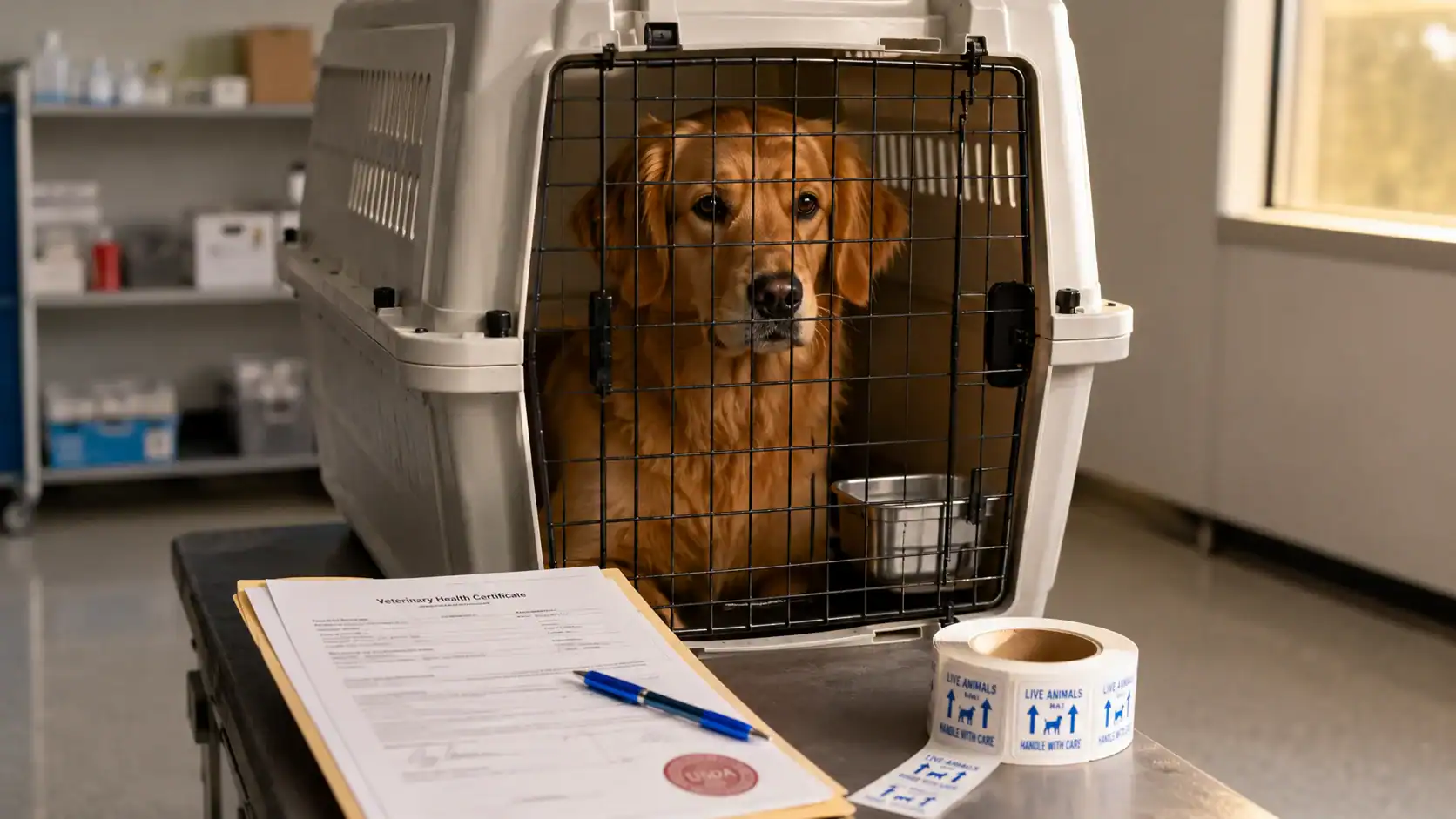
Until 1 November 2022, DAFF required a negative Ehrlichia canis blood test before any dog could board a flight to Australia. Then the requirement disappeared, not because the bacteria became harmless, but because it was already circulating on Australian soil, and testing arriving dogs for a disease already established here had stopped serving any biosecurity purpose. Some pet-relocation checklists still list Ehrlichia canis as a requirement. DAFF’s own policy has not required it in more than three years.
DAFF’s disease and parasite requirements for pet import are not a fixed list. A checklist copied from an old forum post or an agency’s boilerplate PDF can be wrong without any carelessness on the writer’s part. That gap shows most clearly in the disease-specific blood tests and parasite treatments that make up Australia’s dog import test panel.
Dog Import Tests: The Blood Panel DAFF Requires
Three pathogens make up the disease-testing panel for dogs entering Australia, and all three sit inside the same 45-day pre-export window, part of why owners get the sequencing wrong. One of the three, Brucella canis, applies only to dogs that are not desexed. All three need a specific test method, not just a negative result from whichever test the vet’s clinic runs by default.
Getting any one of the three wrong does not usually mean the dog is unhealthy. It means the paperwork does not match what DAFF’s import conditions specify, and a mismatch found during permit review or at the border does not get waved through as a technicality. It gets sent back for correction, which at minimum costs time and at worst means re-testing inside a window that has already mostly closed.
Brucella canis: required for intact dogs only
Brucella canis testing applies only to dogs that have not been desexed. A desexed dog skips this requirement. For an intact dog, DAFF’s step-by-step import guide for dogs requires a blood sample collected within 45 days of export, tested by one of three accepted methods: the rapid slide agglutination test (RSAT), the tube agglutination test (TAT), or the indirect fluorescent antibody test (IFAT). The result has to come back negative.
The accepted-methods list matters more than it looks like it should. DAFF does not accept the AGID test, or the 2ME-modified variants of RSAT and TAT, for Brucella canis. Some export laboratories, and even some veterinary clinics, get this distinction wrong, because those tests are legitimate diagnostic tools in general veterinary practice, just not ones DAFF’s import policy recognises. Confirm the exact test name the lab will run before the sample is even drawn, then look for that name on the report, not just “Brucella canis: negative.”
Leishmania infantum: where “rapid” tests get rejected
Leishmania infantum testing is required for dogs within the same 45-day window, and here the accepted-method list is narrower still: only the standard quantitative IFAT or the standard quantitative ELISA. Rapid or SNAP versions of either test, the faster, cheaper, in-clinic options many veterinary practices default to, are explicitly not accepted. A dog can fail this step not because it has the disease, but because the test itself was the wrong one.
Leptospira interrogans serovar Canicola: the one almost no guide mentions
The third requirement barely appears outside DAFF’s own documentation: every dog, desexed or not, also needs to clear Leptospira interrogans serovar Canicola, within the same 45-day window. The test is a microscopic agglutination test (MAT), and it needs to come back negative: specifically, less than 50% agglutination at a 1:100 serum dilution.
Full vaccination against L. Canicola, instead of testing, is a second way to satisfy this requirement. It sounds like the easier option, and for a dog prepared well in advance it can be. But DAFF’s own guidance flags a practical trap for dogs already living in Australia and travelling out and back: L. Canicola vaccines are not available in Australia, so a dog that has spent its life here is unlikely to already carry that vaccination history. For most outbound-then-returning Australian pets, testing ends up the only realistic route; for pets moving to Australia for the first time from a country where the vaccine is available, either path can work.
The Test DAFF Removed: Ehrlichia canis
Until late 2022, Ehrlichia canis sat alongside Brucella canis and Leishmania infantum as a mandatory pre-export blood test for every dog, desexed or not. On 1 November 2022, DAFF removed it, for all dogs, including assistance dogs and working defence and police dogs.
The reason is not that Ehrlichia canis stopped being a real disease. It is that the disease has since been detected and become established within Australia itself. Testing an incoming dog for an already-established domestic pathogen no longer reduces any biosecurity risk; the department’s own ehrlichiosis guidance now focuses on management within Australia, not exclusion at the border.
One narrow exception survived the change: dogs moving from mainland Australia to Norfolk Island, Christmas Island, or Cocos Island still need Ehrlichia canis testing, and so do Australian-origin dogs exported from New Zealand to Norfolk Island, because those island territories have not had the same established-disease outcome as the mainland. For the overwhelming majority of pet owners moving a dog into mainland Australia, this test is not part of the current panel, whatever an older checklist still says.
If an agency, a vet clinic’s boilerplate paperwork list, or a forum post still tells you to book an Ehrlichia canis test for a standard mainland import, that is outdated information carried over from before November 2022, not a current DAFF requirement. An owner who books and pays for a no-longer-required test has spent a veterinary appointment, inside an already tight 45-day window, on something that does nothing for the permit application.
Anyone importing a second or third dog years from now should expect this list to look at least a little different, and should check it fresh rather than trust the version that worked last time.
External Parasite Treatment: Contact-Kill Only
Every dog and cat entering Australia needs an external parasite treatment effective against ticks and fleas. A government-approved veterinarian must administer it, treatment must start at least 30 days before export for a dog (21 for a cat), and it has to remain effective through the actual export date. The requirement sounds simple until you check DAFF’s accepted-product guidance, which rules out several of the most commonly used flea and tick preventatives on the market.
The dividing line is mechanism, not brand. DAFF requires a product that kills ticks and fleas on contact. Oral and topical isoxazoline-class products (Bravecto, NexGard, Simparica, and Credelio are the common names) do not qualify, and neither does topical selamectin, sold as Revolution, because all of them work by requiring the parasite to bite the animal first. That bite is exactly the event a pre-export treatment is meant to prevent, since the bite itself is what can transmit disease onward. A product that only acts after that point defeats the purpose DAFF is checking for. Tick collars are excluded too, for a more practical reason: they can be removed, and their effectiveness drops off in some weather conditions, so DAFF cannot treat them as a reliable guarantee.
For an owner whose dog or cat has been on one of these products for years, this is often the most disruptive line item on the entire pre-export checklist. Not because it is complicated, but because it means switching the animal’s regular parasite prevention to a contact-kill product for the export window, on a government-approved vet’s recommendation, rather than assuming the existing prescription already qualifies.
Internal Parasite Treatment: Two Doses, Not One
Internal parasite treatment follows a stricter shape than most owners expect: two separate treatments, at least 14 days apart, both administered by a government-approved vet, with the second dose given within 5 days of the export date. A single treatment, even a recent one, does not satisfy the requirement, regardless of species.
The product also has to cover both nematodes and cestodes, the tapeworms. A wormer that only handles one parasite group fails the requirement even if the timing is perfect, which makes the product choice as important as the schedule. This applies identically to dogs and cats, one of the few requirements on this page that does not split by species.
The first dose falls somewhere inside the same general pre-export window as the blood tests, and the second dose carries its own tight five-day deadline right before departure.
Cats vs Dogs: What Actually Changes
Strip the requirements down to a table and the pattern is clear: almost every disease-specific blood test on this page is a dog-only requirement. Brucella canis, Leishmania infantum, and Leptospira interrogans serovar Canicola are not part of DAFF’s cat import guides at all. A cat does not need any of them, regardless of whether it is desexed. What a cat does share with a dog is the parasite treatment protocol, both external and internal, applied on near-identical terms. From Group 3 countries, both species also need their own separate rabies antibody test, which has its own dedicated process covered in full in SwiftCargo’s RNATT guide.
| Test / Treatment | Applies To | Timing Before Export | Method / Product Requirement | Dogs vs Cats |
|---|---|---|---|---|
| Brucella canis | Dogs only (intact/non-desexed) | Within 45 days | Blood test: RSAT, TAT, or IFAT, negative result. AGID and 2ME-modified variants not accepted. | Not required for cats at all; desexed dogs are exempt too |
| Leishmania infantum | Dogs only | Within 45 days | Standard quantitative IFAT or ELISA only. Rapid/SNAP versions rejected. | Not part of DAFF’s cat import requirements |
| Leptospira interrogans serovar Canicola | All dogs (desexed or not) | Within 45 days | MAT blood test (negative below 1:100 dilution) or full L. Canicola vaccination as an alternative | Not part of DAFF’s cat import requirements |
| Ehrlichia canis | Neither, for mainland import (removed 1 Nov 2022) | Not applicable | No longer tested; still required only for movement to Norfolk, Christmas, or Cocos Islands | Historically a dog-only test before removal; never a cat requirement |
| External parasite treatment | Both dogs and cats | Start at least 30 days before export (dogs) or 21 (cats); effective through the export date | Contact-kill product only. Oral/topical isoxazoline products and tick collars not accepted. | Same product rule for both species |
| Internal parasite treatment | Both dogs and cats | Two doses 14+ days apart; second dose within 5 days of export | Must cover nematodes and cestodes; administered by a government-approved vet | Identical rule for both species |
Owners moving a mixed household, a dog and a cat together, should plan for two different preparation checklists running on two different budgets, not one shared list with the same line items doubled.
Who Counts as a “Government-Approved Veterinarian”
Every test and treatment above has to come from a specific category of vet, and DAFF’s terminology here is worth getting right before booking anything. A government-approved veterinarian is not simply any registered vet the family already uses. It is a formally recognised status. An official government veterinarian is a different role, typically employed directly by the exporting country’s competent authority rather than working in a private clinic.
The exact process for becoming, or confirming, a government-approved veterinarian varies by exporting country, because the competent authority in that country, not DAFF directly, approves them. Do not assume a trusted family vet already holds this status. Confirm it with the export country’s competent authority early, well before the 45-day testing windows open. A test run by a vet who does not qualify has to be redone by one who does, and that can consume the very window the test was supposed to fit inside.
Where This Fits in the Full Import Process
These blood tests and parasite treatments are one stage of a longer sequence, not the whole process. A dog or cat from a Group 3 country also needs the rabies neutralising antibody titre test, has to satisfy Australia’s 180-day approved-country residency rule, and must then spend at least 10 days, usually 30, at Mickleham quarantine on arrival. SwiftCargo’s guide to Australia’s biosecurity import conditions covers the broader biosecurity system that governs Australia’s border risk categories generally, including for commercial goods rather than live pets.
Scheduling the 45-Day Window Without Missing a Deadline
The hardest part of this stage is rarely any individual test. It is that three blood tests share a 45-day window and the internal parasite treatment’s second dose has its own 5-day window. All of it has to land before an export date that is also constrained by RNATT timing and quarantine booking elsewhere in the process. Draw the Brucella and Leishmania blood early in the 45-day window, and you still have room to redo a failed or wrongly ordered test. Draw it on day 40 and a single lab error means missing the flight.
Once the blood panel and both parasite treatments clear, the pet is done with veterinary preparation and moves into the export and travel stage. What actually happens to a pet between the vet clinic and the cargo hold is a different set of logistics again, covered separately. Owners juggling all of this alongside a household relocation and a day job are usually the ones who benefit most from having a single provider coordinate the testing schedule, the permit application, and the flight booking as one sequence rather than three separate projects. SwiftCargo’s pet transport team does exactly that, and it is worth comparing what a coordinated service costs against managing the 45-day window alone before deciding either way. The comparison is easier with actual numbers in front of you, which is the point of SwiftCargo’s guide to comparing pet transport quotes.
Frequently Asked Questions
What blood tests does DAFF require to import a dog to Australia?
Three, all within 45 days of export: Brucella canis (intact dogs only, tested by RSAT, TAT, or IFAT), Leishmania infantum (standard quantitative IFAT or ELISA only), and Leptospira interrogans serovar Canicola (all dogs, MAT test or full vaccination). Ehrlichia canis was removed from the requirements on 1 November 2022 and is not currently tested for standard mainland import.
Does DAFF still require an Ehrlichia canis test for dogs?
No, not for import to mainland Australia. DAFF removed the requirement on 1 November 2022 because Ehrlichia canis is now an established disease within Australia, so testing incoming dogs no longer reduces any biosecurity risk. The one exception is movement to Norfolk Island, Christmas Island, or Cocos Island, where testing is still required.
Do cats need the same blood tests as dogs to enter Australia?
No. Brucella canis, Leishmania infantum, and Leptospira interrogans serovar Canicola are dog-specific requirements and are not part of DAFF’s cat import guides. Cats from Group 3 countries still need the rabies neutralising antibody titre test and the same internal and external parasite treatment as dogs, but skip the disease-specific blood panel entirely.
Why are NexGard and Bravecto not accepted for pet import to Australia?
Because they are oral or topical isoxazoline-class products that only work after a tick or flea bites the animal. DAFF’s external parasite requirement calls for a product that kills on contact, since the bite itself is the event a pre-export treatment is meant to prevent. Topical selamectin, sold as Revolution, and tick collars are excluded for related reasons.
How many internal parasite treatments does my pet need before flying to Australia?
Two, spaced at least 14 days apart, both covering nematodes and cestodes and administered by a government-approved veterinarian. The second treatment has to fall within 5 days of the export date. This applies identically to dogs and cats.
Is Brucella canis testing required for a desexed dog?
No. Brucella canis testing applies only to intact, non-desexed dogs. A desexed dog is exempt from this requirement. The Leptospira interrogans serovar Canicola requirement has no such exemption: every dog needs either the MAT test or full vaccination.