
Australians drink close to two kilograms of coffee per person per year, and almost none of it grows here. A small crop comes off farms in northern New South Wales and far north Queensland: charming, expensive, and a rounding error against national demand. Everything else arrives by sea: green beans for the roasters, roasted and packaged product for the supermarket shelf, soluble coffee for the office kitchen. If you are a roaster moving from a domestic green bean merchant to importing your own, or a brand bringing packaged roasted coffee in from overseas, the pathway is well worn but full of specific traps. This guide walks the whole route: the two regulatory regimes, the origin maths, the container physics, and a full worked landed cost for a five-tonne specialty order from Colombia to Melbourne.
Two Products, Two Regimes
The first thing to understand about importing coffee to Australia is that the border treats green beans and roasted coffee as fundamentally different cargo, because biologically they are.
A green coffee bean is a seed. It is alive in the botanical sense that matters to the Department of Agriculture, Fisheries and Forestry (DAFF): it can carry insects, fungal spores, soil, weed seeds and plant debris from a farm on the other side of the world. Green coffee is therefore a biosecurity-controlled plant product, and its import conditions live in BICON, the department’s import conditions database. The good news is that green coffee from the major producing origins is permitted without an import permit for standard commercial consignments. The conditions are conditions, though, not formalities: beans must be free of live insects, contaminant seeds, soil and plant material, and every consignment is subject to inspection on arrival. Fail the inspection and your options narrow quickly: treatment (usually fumigation), export, or destruction, all at your cost, all while your working capital sits in a bonded store.
Roasted coffee is a different animal. Roasting takes the bean to 200°C or more; nothing survives that. Biosecurity risk collapses to almost nothing, and the regulatory centre of gravity shifts from DAFF’s plant quarantine function to food law. Roasted and packaged coffee is a processed food, which means it falls under the Imported Food Inspection Scheme at the border and must comply with the Australia New Zealand Food Standards Code (the FSANZ framework) once it is on a shelf. Lower biosecurity bar, higher paperwork-and-labelling bar. We will come back to labelling in detail, because it is where packaged coffee importers most often stumble.
Instant coffee, coffee capsules, cold brew concentrate and ready-to-drink products all follow the roasted-product logic: processed food, food compliance, minimal plant quarantine interest. Anything that is still a viable seed (green beans, and certainly unroasted specialty micro-lots) follows the plant pathway. Know which regime you are in before you sign a contract, and if your origin is anything other than the big five producers, run the specific country and product through BICON first. Conditions genuinely differ by origin, and an unusual provenance (say, a boutique lot out of Yemen or a Pacific island origin) can carry requirements that the Brazilian mainstream never sees.
The Origin Map: Where Australian Coffee Comes From
Five origins dominate the trade into Australia, and each has its own logistics personality.
Vietnam is the volume play. The world’s largest robusta producer sits 10–15 days by sea from the Australian east coast, with dense, frequent services out of Ho Chi Minh City (Cat Lai) and Cai Mep. Robusta feeds the instant coffee industry and increasingly the espresso-blend market. The short transit is a genuine quality advantage: less time in the box means less moisture cycling and less flavour drift.
Indonesia supplies both robusta and some of the most distinctive arabicas in the trade: Sumatran Mandheling, Sulawesi Toraja, Java estates. Transit from Jakarta, Surabaya or Belawan runs roughly 10–18 days depending on port pair and transhipment, often via Singapore. Like Vietnam, Indonesia sits inside the AANZFTA free trade area, which matters less than you might expect (more below) but simplifies documentation habits.
Brazil is the world’s largest producer and the backbone of most commercial blends. Santos is the great coffee port, and the haul to Australia is long: 30–45 days depending on routing, sometimes eastward via the Cape and Asian transhipment hubs, sometimes across the Pacific. Long transits raise the stakes on packaging and moisture management, because the container will cross multiple climate zones.
Colombia ships washed arabicas from Buenaventura on the Pacific coast (shorter routing to Australia) and Cartagena on the Caribbean side. Count on 30–45 days port to port, typically with at least one transhipment. Colombian milds are a staple of the Australian specialty scene, and the long ocean leg is simply the price of them.
Ethiopia (the botanical home of arabica) is landlocked. Coffee trucks from Addis Ababa down to Djibouti, then sails via the Red Sea and Asian hubs, arriving in 25–35 days when the routing behaves. Ethiopian logistics carry extra inland complexity and paperwork, and shipment windows after the October–January harvest get congested. Book early in the season.
Two planning consequences fall out of this map. First, transit time is a quality variable, not just a cash-flow variable: a Vietnamese lot arrives three to five weeks fresher than a Brazilian one, and green coffee ages in the container just as surely as it ages in a warehouse. Second, arrival timing interacts with the Australian seasons in a way that matters enormously for condensation, which brings us to the physics.
Moisture Is Everything: The Green Bean Freight Decision
If you remember one number from this article, make it this: green coffee should ship at 10–12% moisture content. Below about 9% the bean fades: flat cups, faded acidity. Above 12.5% you are running a mould and condensation experiment at sea. The moisture spec belongs in your purchase contract, in writing, with a pre-shipment certificate to back it, not as an aspiration but as a rejection criterion. A surprising number of first-time importers leave it out, and they are the ones who open a container in Melbourne to the smell of damp hessian and a claim nobody will pay.
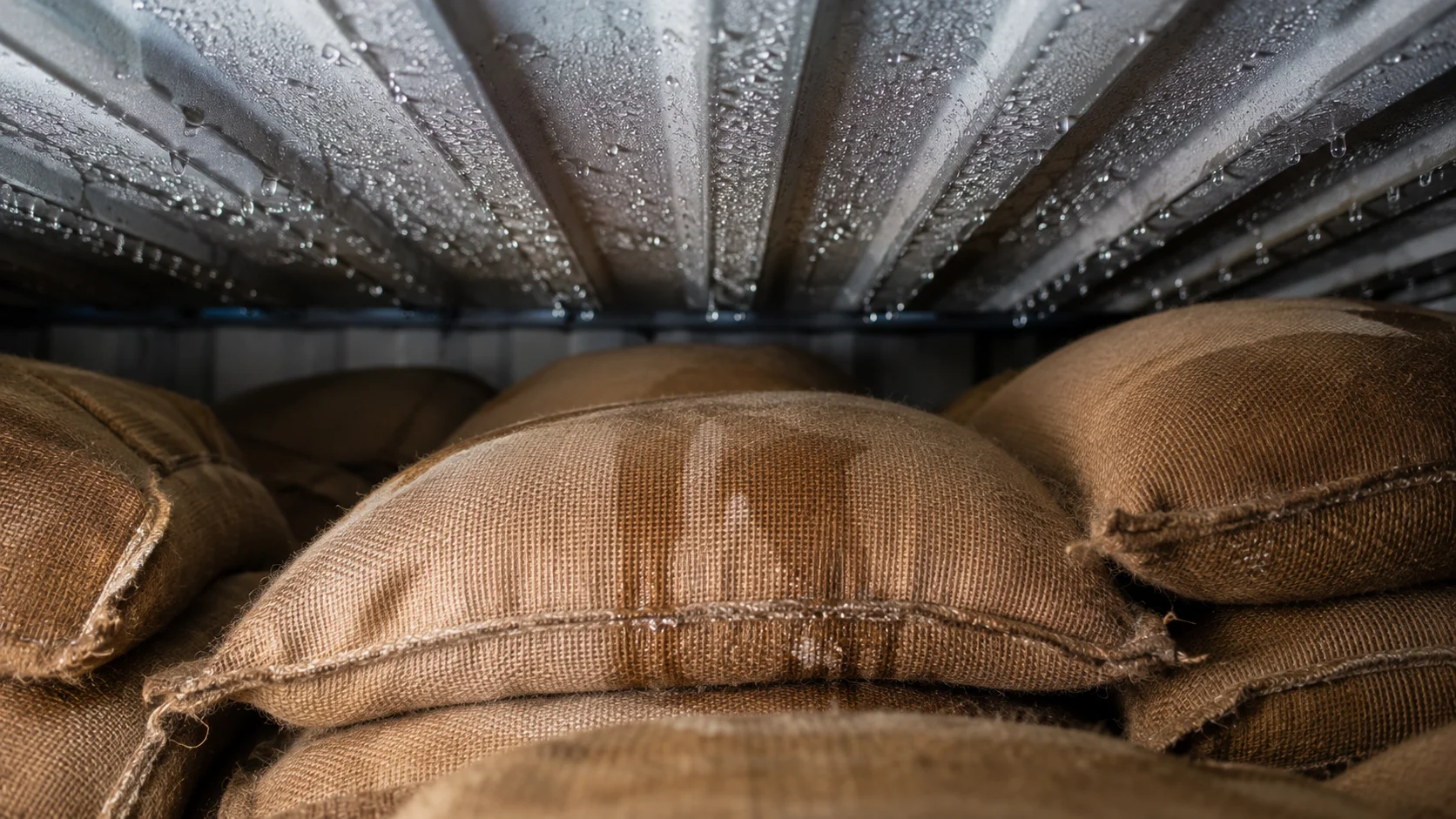
This is the physics you are managing. A container loaded in Buenaventura at 28°C carries warm, humid air and roughly 1,000–1,500 kg of water bound inside 19 tonnes of coffee, perfectly happily, as long as temperatures hold. Sail that box south into a Melbourne July, where the container roof might sit at 8°C overnight, and the dew point arithmetic turns hostile. Warm moist air inside meets cold steel above; water condenses on the roof and rains back onto the top tier of bags. The trade calls it container rain, and it is the single most common cause of green coffee damage on the Australia run. Winter arrivals after a tropical transit are the worst case, which is why experienced importers look at the calendar, not just the freight rate, when they book. If your shipment schedule allows it, avoid landing high-value lots into the depths of the southern winter; if it does not, engineer the container properly and accept the residual risk knowingly.
Engineering the container means, in rough order of importance:
- Moisture at origin. 10–12%, certified, contractual. No liner or desiccant fixes wet coffee.
- Hermetic or lined bags. Grainpro, Ecotact and similar multilayer hermetic liners inside the traditional 60kg bag have become the specialty standard precisely because they decouple the bean from the container atmosphere. Jute and hessian breathe, which is romantic and also means they exchange moisture and odour freely with everything around them. Hessian alone is fine for hardy commercial robusta on a short Vietnam run; for a 40-day South American transit of an expensive washed lot, hermetic lining pays for itself the first time it saves a container.
- Container dressing. Kraft paper or thermal liner on walls and roof, cardboard on the floor, and desiccant. Note that desiccant strategy means calculating dosage (typically 6–10 kg of high-capacity desiccant per TEU for coffee, more for long or winter transits), hanging poles along the top rails where condensation forms, not tossing a few sachets on the floor.
- Stow position. Ask your forwarder to request under-deck or at minimum protected stow, away from the vessel’s weather deck where diurnal temperature swings are most violent. Not every carrier will guarantee it, but the request costs nothing and is honoured often enough to be worth making on every booking. Inside the box, keep bags off the doors and leave the classic air gap under the roof.
Then there is the ventilated-versus-dry-container debate. Ventilated containers (the “coffee containers” of the old trade) have passive vents that let the box breathe and equalise with ambient air. They genuinely reduce roof condensation on some routings. They are also scarce in the fleets serving Australian trades, attract premium pricing, and on a voyage that ends in a cold, damp Australian winter, breathing the ambient air is not obviously what you want. The practical consensus in the specialty trade has settled on standard dry containers, properly dressed, with hermetic bags and calculated desiccant. Save the argument about ventilated equipment for the rare case where your carrier actually has one to offer.
Why LCL and Green Coffee Are a Bad Marriage
Small roasters starting out often want to bring in 20 or 30 bags (less than two tonnes), and the obvious mode is LCL, sharing a container with other shippers’ cargo. Understand what you are agreeing to. Green coffee is one of the most absorbent cargoes in general trade: it takes up moisture, and it takes up odour, with enthusiasm. In a co-loaded container you have no control over the neighbours. Spices, rubber, camphor-treated furniture, freshly sawn timber, detergents, chemicals in drums that seep vapour: any of them can taint a coffee lot beyond commercial use, and taint claims are notoriously hard to prove and harder to recover. Moisture migration works the same way: your carefully dried 11% coffee will happily equalise with someone’s damp cargo two pallets away over a five-week voyage.
If LCL is genuinely the only way to trial an origin, mitigate: hermetic bags non-negotiable, ask the consolidator directly what co-load restrictions apply, keep the transit as short as possible, and treat the shipment as a trial in the full sense. Cup it hard on arrival before it goes anywhere near production. But run the numbers early on going FCL instead. A 20-foot container takes roughly 19.2 tonnes of green coffee in 320 sixty-kilo bags; a standard pallet carries about ten bags, call it 600 kg. The FCL crossover comes surprisingly low: somewhere around 40–60 bags, the sum of LCL per-tonne charges, port service fees and risk premium starts to approach the flat cost of your own box, and your own box means your own atmosphere. Many small roasters solve the volume problem by sharing a dedicated coffee-only container with two or three other roasters buying from the same origin: all the control of FCL, a fraction of the volume commitment. Formats above the 60kg bag exist too: one-tonne bulk bags cut handling labour for commercial-grade coffee, and full bulk lining of a container (coffee poured loose into a liner) is common at the commodity end, though specialty stays loyal to bags because lot identity is the product.
The FCL/LCL threshold math here follows the same logic as any consolidation decision. The broader decision framework, including sharing a dedicated container with other buyers from the same origin, is covered in our guide to freight consolidation strategies for Australian importers.
Duty, GST and the FTA Question
The pleasant surprise in an article full of warnings: coffee generally enters Australia at a 0% customs duty rate. Green, roasted, ground, decaffeinated: the tariff schedule is benign across the board. This is not an FTA concession; it is the general rate. Which means AANZFTA certificates of origin for Vietnamese or Indonesian coffee are, for straight coffee, largely academic: there is no duty to eliminate. Where origin certification can still earn its keep is on blended or further-processed products, on coffee mixed with other ingredients (3-in-1 sachets, flavoured preparations), and simply as clean supporting documentation for customs. Do not pay a supplier extra for a certificate you do not need; do check the tariff classification of anything that is not plain coffee, because “coffee preparation” headings behave differently from “coffee”.
Zero duty does not mean zero cost at the border. GST applies at 10% on the value of the taxable importation: customs value plus international freight plus insurance plus any duty (here, nil). If you are registered for GST and importing for your business, this is a cash-flow item you claim back on your BAS, and deferred GST registration can eliminate even the cash-flow hit. You will also pay the Australian Border Force import processing charge on entries over the $1,000 threshold, and DAFF’s fees for document assessment and any physical inspection. None of these are large individually; all of them belong in your landed cost model, which we will build shortly.
Our guide to Australian import duty and GST explained sets out how duty, GST, and customs value combine into landed cost across any product category, not just coffee.
The Specialty Supply Chain: Contracts, Samples and the Cupping Table
Between the farm and your roastery sits a set of commercial arrangements worth understanding even if you never see the paperwork. At one end, direct trade: the roaster contracts with the producer or export cooperative, takes title early, and manages (or hires out) the entire logistics chain. Maximum story, maximum margin capture, maximum exposure: you own every problem from the mill to your door. At the other end, importing merchants and brokers hold position: they buy at origin at scale, ship on their own account, and sell to roasters from Australian warehouses in single-bag quantities, spot or forward. Most Australian roasters live somewhere between the two, and the honest advice is to earn your way left along that spectrum. Import your first containers through or alongside an experienced intermediary; go fully direct once you have seen a season’s worth of what can go wrong.
Whichever structure you use, the specialty trade runs on two disciplines: forward contracts and samples. Coffee is harvested once a year per origin (with some fly crops), so serious buyers contract against the harvest months in advance, fixing quantity and quality terms, sometimes fixing price, sometimes pricing later against the futures market. Forward contracting is what secures the specific lots you cupped and loved; spot buying is what you do when planning failed.
The sample protocol is your quality control system, and it has stages. A type sample or offer sample gets you interested. A pre-shipment sample, drawn from the actual milled lot before it loads, is the one that matters: cup it, grade it, and approve it in writing before the coffee ships, because it is your last realistic chance to reject at the supplier’s cost. Then an arrival sample from the landed lot, cupped against the retained pre-shipment sample. The gap between the two cups is your transit story told in flavour: a lot that left Buenaventura bright and clean and lands in Melbourne papery and flat has aged or moisture-cycled in the box, and the side-by-side cupping is both your early warning and your evidence for any claim. Keep retained samples, keep cupping notes, and log moisture readings at every stage. A $60 moisture meter reading at devanning has settled more than one argument.
Harvest timing also belongs in your freight calendar. Colombian main crop, Ethiopian harvest, Brazilian season: each origin has shipment windows when fresh-crop coffee becomes available, and the specialty market prizes freshness. Book vessel space against those windows, remember the transit time, and note the collision we flagged earlier: some origins’ natural shipment windows land coffee in Australia in mid-winter. That is not a reason to skip fresh crop; it is a reason to specify hermetic packaging and dress the container like you mean it.
Roasted and Packaged Coffee: The Food Compliance Lane
Importing finished roasted coffee (whole bean, ground, or capsules) swaps quarantine physics for regulatory precision. The border mechanism is the Imported Food Inspection Scheme: entries are referred for possible inspection against the Food Standards Code, with rates that fall as you build a compliant history. The compliance substance is mostly labelling, and the requirements are specific:
- Country of origin labelling under Australia’s mandatory information standard: the familiar statement and, for many food categories, the standardised mark. Packaged overseas with an overseas brand? The label still has to carry compliant origin labelling for retail sale in Australia.
- Date marking: a best-before date in the prescribed format. “Roasted on” dates beloved of the specialty scene are welcome extras, not substitutes.
- Name and Australian street address of the supplier: an overseas address alone does not satisfy the Code, which is a genuine gotcha for brands shipping retail-ready stock from origin.
- Product name, lot identification, and ingredient labelling where the product is more than pure coffee (flavourings, milk solids in mixes, and so on).
The practical answer for most importers is either to have compliant labels applied at origin against a specification you provide, or to bring stock in and over-sticker under supervision in Australia: legal, common, and cheaper than reprinting offshore, though it adds a handling step and looks what it is. Get the label specification reviewed before the first production run, not after the first detained consignment.
One packaging note that rewards attention: nitrogen-flushed bags with one-way valves are not just shelf-life marketing. Roasted coffee stales by oxidation, and a sea freight leg of three to six weeks plus distribution time consumes a meaningful slice of the product’s fresh window. Nitrogen flushing at packing holds residual oxygen low enough that the transit leg costs the product very little, and it also stabilises the packs against pressure and temperature changes in the container. If you are importing packaged roasted coffee at any quality level above commodity, make flushing and residual-oxygen limits part of your packing specification, and be realistic about the calendar: a product roasted in week one, shipped in weeks two through seven, and sold over months three through nine needs a shelf-life claim built on that timeline, not on domestic assumptions.
Worked Example: 5 Tonnes of Colombian Specialty, Buenaventura to Melbourne
Numbers make the theory honest. Take a realistic first serious order: 5 tonnes of washed Colombian specialty green coffee. That’s 84 bags at 60 kg, Grainpro-lined, on pallets in a 20-foot container (a partial load by weight, which is common for specialty; the box is yours regardless). Contract price US$4.40/kg FOB Buenaventura, exchange rate A$1 = US$0.66. All figures are illustrative mid-2026 planning numbers; your quotes will differ, but the structure will not.
| Cost line | Basis | AUD |
|---|---|---|
| Green coffee, 5,040 kg @ US$4.40/kg FOB | US$22,176 ÷ 0.66 | $33,600 |
| Ocean freight, 20′ Buenaventura–Melbourne (incl. surcharges) | ~US$2,600 | $3,940 |
| Marine insurance | ~0.35% of CIF-ish value | $140 |
| Container dressing: Grainpro (in FOB), liner, desiccant, top-stow request | origin charge | $420 |
| Customs duty | 0% on coffee | $0 |
| ABF import processing charge | electronic sea entry | $102 |
| DAFF document assessment + full inspection (first-time importer) | fee for service | $620 |
| Customs broker + clearance | agency fee | $380 |
| Port, terminal and destination charges | port service, handling | $1,150 |
| Transport to roastery + devanning, metro Melbourne | sideloader delivery | $780 |
| Landed cost before GST | $41,132 | |
| GST (10% on value of taxable importation ≈ goods + freight + insurance) | claimable if registered | $3,768 |
| Cash outlay at import | $44,900 |
Read the table the way an analyst would. Landed cost before recoverable GST is $41,132 for 5,040 kg, $8.16 per kilo, against a bean cost of $6.67. The logistics and compliance wrap adds about 22% to the FOB price on a partial container over one of the longest routes in the coffee trade. Freight is the biggest single addition, and here is the scale lesson: that same container carries 19.2 tonnes for nearly the same ocean freight and fixed charges. At full utilisation the wrap falls to roughly 6–8% over FOB, and per-kilo landed cost drops by about a dollar. The single most powerful landed-cost lever in coffee importing is not negotiating the freight rate. It is filling the box. For a deeper template that extends this method to any commodity, see our total landed cost guide.
Two sensitivities deserve a line each. Currency: at 0.66, a one-cent move in AUD/USD shifts this order’s bean cost by roughly $500. Hedge or at least time your conversion deliberately on forward contracts. Inspection: the table assumes a clean first-time inspection; a failed one adds fumigation ($400–900), storage during treatment, and days of delay. The cheapest insurance against that outcome was purchased back at origin, in the moisture certificate and the clean, debris-free milling you specified.
It is worth asking why so many first-time coffee importers spend their negotiating energy on the freight rate rather than the fill rate. Part of the answer is that a freight quote arrives as a single visible number you can push back on in an email, while under-utilisation is invisible: it never shows up as a line item, only as a slightly worse landed cost that looks normal because you have nothing to compare it against. Negotiating $50 off a freight quote feels like a win you can point to. Consolidating two half-loads into one full container rarely feels like anything, because no one sends you an invoice for the mistake of not doing it.
The Five Mistakes That Cost Real Money
1. Green beans in LCL next to aromatic cargo. The classic. A trial lot co-loaded with spice cartons or rubber goods arrives smelling of its neighbours, and the taint goes all the way through the cup. If you must LCL, hermetic bags and hard questions to the consolidator; better, share an FCL with other roasters.
2. No moisture spec in the contract. If 10–12% with a pre-shipment certificate is not written down, you have no rejection right and no claim basis when the meter reads 13.5% at devanning. This is a one-sentence fix at contract time and an unwinnable argument afterwards.
3. Skipping the BICON check on an unusual origin. Brazil and Colombia are routine; the interesting micro-lot from a niche origin may not be. Ten minutes in BICON before you commit beats discovering a permit requirement or an unexpected condition when the coffee is already on the water, a check our biosecurity requirements guide walks through step by step.
4. Ignoring the winter-arrival condensation cycle. A tropical loading, a long transit, and a July arrival into Melbourne is the textbook container-rain scenario. Either schedule around it or engineer for it: thermal liner, calculated desiccant, hermetic bags, top-stow request. Hoping is not a strategy the dew point respects.
5. Treating samples as a formality. Approving shipment without cupping the pre-shipment sample, or failing to cup arrival against retention, throws away both your quality gate and your evidence trail. The cupping table is where import problems are caught early and claims are won.
Getting the First Container Right
Coffee is a forgiving cargo compared with frozen food or dangerous goods: zero duty, permitted from the major origins, unrefrigerated, stable when handled well. The craft is entirely in the handling: get the moisture spec, the container strategy and the compliance paperwork right at the start, and the second container is dramatically easier than the first. If your volumes are growing past occasional pallets, Swift Cargo’s corporate freight service can help build the landed-cost model and shipping schedule around your own numbers.
Related Reading
- Importing Food to Australia: The Complete Compliance Guide
- Biosecurity Requirements for Importing to Australia
- DAFF Biosecurity Inspection Triggers and How to Avoid Them
- Total Landed Cost: What Importing to Australia Really Costs
- Shipping Routes to Australia: Transit Times by Origin
Frequently Asked Questions
Do I need an import permit to bring green coffee beans into Australia?
For most major origins (Brazil, Colombia, Ethiopia, Indonesia, Vietnam), no import permit is required, but green beans are biosecurity-controlled and must meet the conditions published in BICON: clean, free of live insects, soil, contaminant seeds and plant debris, and subject to inspection on arrival. Always run your specific origin through BICON before contracting, because conditions vary and unusual origins can carry extra requirements.
What duty applies to coffee imported into Australia?
Coffee generally attracts a 0% customs duty rate whether green, roasted, ground or decaffeinated. You still pay 10% GST on the customs value plus freight and insurance (claimable if you are GST-registered), the import processing charge, and biosecurity fees. AANZFTA certificates for Vietnamese or Indonesian coffee are mostly academic at a zero general rate, though they can matter for blended or processed products.
Should green coffee ship in a ventilated or standard dry container?
The modern specialty consensus is a standard dry container, properly dressed: kraft or thermal liner, calculated desiccant along the top rails, hermetic Grainpro-style bags, and a top-stow/under-deck request to the carrier. Ventilated containers help on some routings but are scarce and expensive, and the bigger levers are moisture at origin and arrival timing.
Is LCL shipping safe for green coffee beans?
It is risky, because coffee absorbs moisture and odour from co-loaded cargo you cannot control. For unavoidable small trial lots, insist on hermetic bags and ask the consolidator about co-load restrictions. From around 40–60 bags, FCL (or a shared coffee-only container with other roasters) usually wins on both cost and quality control.
How long does coffee take to ship to Australia from major origins?
Vietnam roughly 10–15 days, Indonesia 10–18, Ethiopia via Djibouti 25–35, and Brazil or Colombia 30–45 days port to port, plus 5–10 days at the Australian end for inspection, clearance and delivery. Transit time is also a freshness variable: shorter voyages land livelier coffee.
What labelling does roasted coffee need to be sold in Australia?
Retail packs must meet the Food Standards Code: product name, best-before date marking, lot identification, the supplier’s name with an Australian street address, ingredient labelling where relevant, and compliant country of origin labelling. Imported roasted coffee is also subject to the Imported Food Inspection Scheme at the border, so keep specifications and supplier declarations on file.