
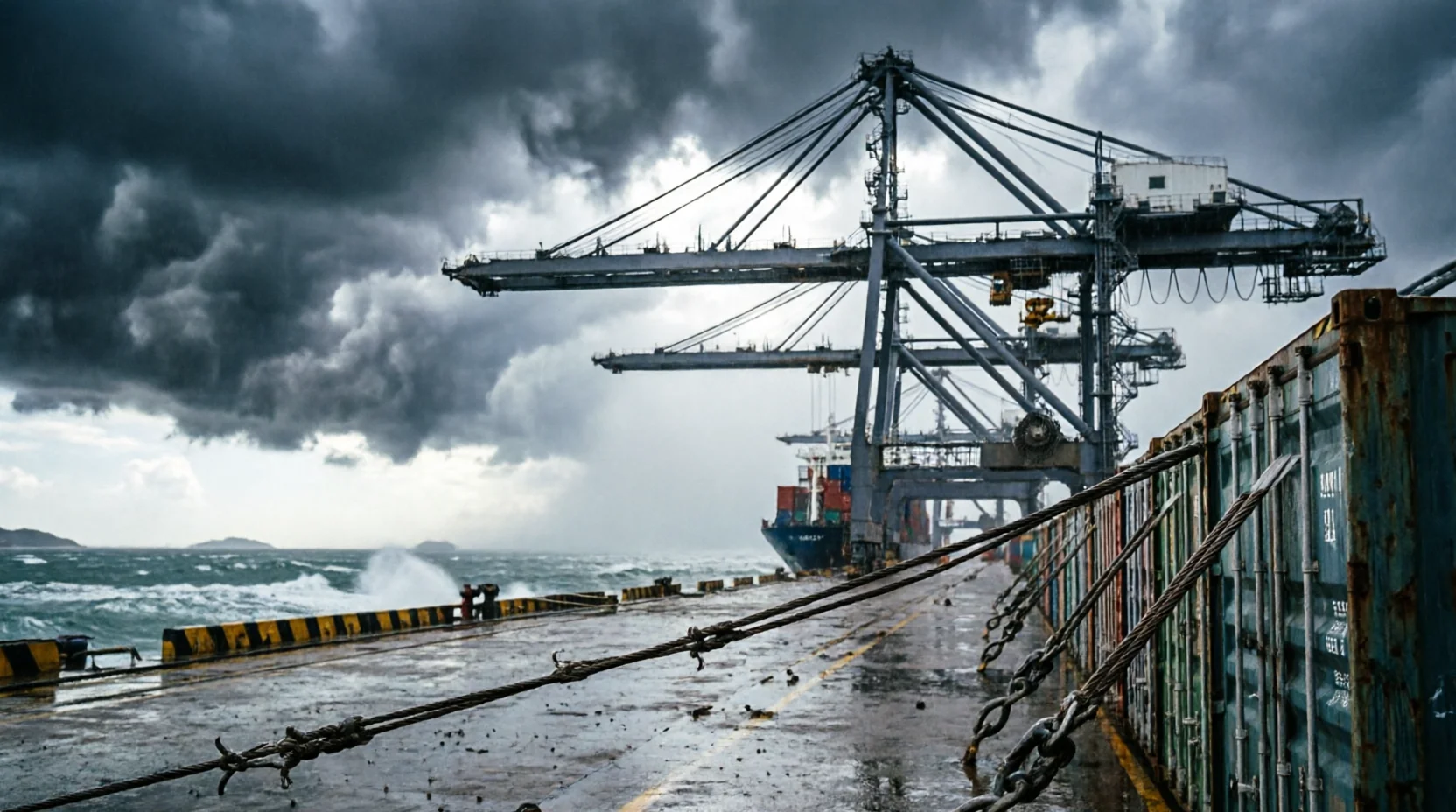
Every June, freight moving out of Hong Kong starts operating under a condition that has nothing to do with demand, capacity, or pricing: the weather itself becomes a scheduling variable. From roughly May through November, with the sharpest concentration of activity in July, August, and September, tropical cyclones move through the South China Sea on a pattern that is well understood, well forecast, and consistently underestimated by shippers who plan their bookings as if the season doesn’t exist.
This isn’t a piece about a specific storm. There’s no single typhoon to name here, no year to cite, because the planning problem is structural, not episodic. Hong Kong’s port and airport infrastructure shuts down under defined, publicly documented conditions every single typhoon season, on a schedule nobody can predict day-to-day but everybody can predict seasonally. The gap between unpredictable timing and a predictable pattern is exactly where good freight planning either earns its keep or fails.
How Hong Kong’s Typhoon Season Actually Works
Hong Kong sits inside one of the most active tropical cyclone basins on earth. The Northwest Pacific generates more named storms in an average year than the Atlantic and Eastern Pacific combined, and a meaningful share of that activity tracks close enough to the Pearl River Delta to matter for shipping. The Hong Kong Observatory (HKO), the territory’s official meteorological authority, tracks this activity year-round, but the operational season runs from roughly May to November. That’s the window in which freight planners actually need to account for cyclone risk.
Within that window, activity isn’t evenly distributed. July through September is the period where the odds of a system approaching close enough to trigger port or airport restrictions rise sharply. This is climatology, not forecasting: it describes where the probability mass sits across a normal season, not what will happen in any given week. A freight planner who treats “typhoon season” as a single flat risk from May to November is already behind a planner who knows that the back half of summer carries disproportionately more of that risk.
None of this varies much year to year in its broad shape. The number of systems, their tracks, and their intensity vary: details nobody can plan around six months out. The seasonal shape itself can be planned around: a five-to-six-month window where cyclone-driven disruption is a live possibility, concentrated but not confined to the middle third.
The Signal System, and What Each Level Actually Shuts Down
The Hong Kong Observatory communicates cyclone risk through the Tropical Cyclone Warning Signal system: a numbered scale (1, 3, 8, 9, 10) that the whole territory, including its logistics infrastructure, keys its operational decisions off. For freight purposes, the number that matters most is 8.
Below Signal 8, port and airport operations largely continue, sometimes with precautionary adjustments. At Signal 8 and above, the operational picture changes fast and predictably:
- Container terminal operations halt. Kwai Tsing, Hong Kong’s principal container terminal complex and the point through which the overwhelming majority of the territory’s containerized freight moves, stops gate operations, crane work, and yard handling once Signal 8 is hoisted.
- Vessel berthing and departure are suspended. Ships already alongside typically stay put or reposition to shelter depending on the specific threat; vessels scheduled to berth or sail during the signal period simply don’t, and their windows shift to whatever slot becomes available once the signal drops.
- Airport operations are affected at higher signal levels. Hong Kong International Airport doesn’t necessarily close outright at Signal 8 the way the port does, but flight schedules (cargo and passenger alike) see delays and cancellations that scale with signal severity, and operations become significantly more constrained at Signal 9 and 10.
The mechanism is simple and, from an operational standpoint, entirely sensible: moving cranes, open containers, and aircraft in sustained gale-to-storm-force winds is a safety risk nobody in the chain is willing to take, and nobody should want them to. The signal system exists precisely so that this decision doesn’t have to be renegotiated storm by storm: it’s a standing protocol, which is exactly why it’s plannable in a way that, say, a sudden customs policy change is not.
The Disruption Window Is Longer Than the Storm Itself
Here’s the part that catches shippers who’ve only budgeted for “the day the port is closed.” The disruption doesn’t start when Signal 8 goes up and end when it comes down. It starts before, in the form of pre-storm vessel repositioning, and it continues after, in the form of backlog clearance.
In the run-up to a system that looks likely to require Signal 8, shipping lines start moving vessels out of harm’s way (repositioning to deeper anchorage or delaying arrival) well before the signal is actually hoisted. That’s a rational precaution on their end, but it means berthing windows start slipping before the closure officially begins. On the back end, once the signal drops and Kwai Tsing reopens, the terminal isn’t simply back to normal capacity on hour one. It’s working through a backlog of vessels that all wanted the same slots, a yard that didn’t get worked for the closure period, and a trucking fleet trying to clear a sudden surge of both inbound and outbound container moves through the same limited number of gates.
Add those two effects to the closure period itself and the real disruption window commonly runs 2 to 5 days beyond the hours the signal was actually up. A shipper who only accounts for the closure itself is missing the larger part of the delay.
How Long Does a Typhoon Delay Actually Last? Separating What’s Known From What Varies
It’s worth being precise here, because vague answers are how buffers get sized wrong in both directions. Two numbers matter, and they are not the same number.
The closure itself is typically under 24 hours for a single Signal 8 event. This is the period during which Kwai Tsing is not handling cargo and vessels are not berthing or sailing. That’s the part people picture when they think “typhoon shuts down the port.” It’s real, but it’s the smaller piece of the total delay.
The total delay to an affected shipment is a different and larger number, built from a missed vessel window, container yard congestion clearing, and trucking backlog resolution. For shipments actually caught by the closure, total delay of 3 to 7 days is the common range. That’s not a worst-case figure; it’s the ordinary outcome for a shipment whose vessel or gate slot fell inside or immediately adjacent to a Signal 8 period.
The gap between “under 24 hours” and “3 to 7 days” is the single most consistently underestimated number in Hong Kong typhoon-season planning. If you’re pricing risk off the closure duration alone, you’re pricing roughly a quarter of the actual exposure. The rest is knock-on effect, and knock-on effect is where the real cost sits. A missed sailing becomes a missed connecting service, a missed customs slot at destination, or a missed delivery window for whatever the cargo was actually for.
What’s genuinely uncertain is which specific week in a given season will see a Signal 8 event, how many events a season will bring, and exactly how severe any one system will be. This is where honest planning has to stop pretending to more precision than it has. Nobody can forecast that six months out with any real confidence, and a planning approach that requires that kind of precision is the wrong approach. What’s not uncertain is the range of outcomes once a closure does happen. That range is stable enough, season after season, to build a standing policy around. That’s the whole point of the next section.
When a Typhoon Hits During an Already-Tight Season
Typhoon disruption doesn’t happen in a vacuum. It lands on top of whatever the underlying freight market is already doing, and the underlying freight market has its own seasonal shape: general seasonal pricing pressure that peaks and eases independent of weather. When a Signal 8 closure hits during a period when vessel space, container availability, and terminal capacity are already tight from ordinary seasonal demand, the combined effect is worse than either factor alone.
The reason is straightforward: a typhoon-driven backlog has to compete for the same limited vessel space and terminal slots that seasonal demand is already stretching thin. In a slack period, a carrier can often absorb a few days of lost capacity by running extra loaders or accepting a lighter-than-usual sailing on the next available service. In a tight period, there’s no slack to absorb into: the backlog simply queues behind demand that was already exceeding supply before the storm arrived. Shipments caught in that overlap tend to see the longer end of the 3-to-7-day range, not the shorter end, and in a genuinely bad overlap, longer still.
This is the compounding effect worth planning around specifically: not “typhoon season is riskier,” which is obvious, but “typhoon season stacked on peak season is riskier than the sum of its parts,” which is the actual planning insight.
Building the Buffer: A Standing Practice, Not a Reactive Scramble
The buffer isn’t something you reach for once a storm is bearing down. That’s the discipline point that separates operators who handle typhoon season well from operators who get surprised by it every single year. By the time a system is close enough to worry about, your options are already narrowing. The buffer has to be built into the plan before the season starts, as a standing practice applied to every Hong Kong-origin booking from June through October: not a reaction you improvise in week three of a bad August.
Concretely, that means adding 5 to 7 extra days to lead-time estimates for HK-origin shipments across that window, as a default, not as a contingency you only invoke once you see a storm forming. Booking with that buffer already built in is easiest to arrange through our Hong Kong shipping quote page, where the timeline accounts for the season from the start. Every booking made in that period carries the buffer, whether or not a typhoon ends up materializing that particular week. Most weeks, nothing happens, and the buffer costs you nothing but a slightly earlier booking date. Some weeks, a Signal 8 event hits, and the buffer absorbs it without a scramble.
This is not a hedge against a single bad outcome. It’s a standing operating posture for a five-month window where the base rate of disruption is high enough to price in as a certainty of the season, even though no individual week is certain. Extreme ownership of a shipment schedule means accepting that responsibility up front, at the booking stage, rather than explaining after the fact why a cargo missed its connection. Nobody who reads a forecast the day a system forms and only then starts asking about alternatives is executing a plan: they’re improvising, and improvising during a live closure is a worse position than a boring buffer built in three months earlier.
Is There a Viable Alternative Port? Addressed Honestly
For genuinely time-critical shipments, the obvious question is whether routing around Hong Kong altogether is worth considering during the riskiest months. The honest answer, for most shippers, is no: and it’s worth saying plainly rather than gesturing vaguely at “alternatives” the way some guidance does.
If your sourcing, your supplier relationships, or your consolidation network is genuinely tied to Hong Kong (which is the normal case for a large share of freight moving through the territory) there usually isn’t a practical substitute port that preserves your existing supply chain. Rerouting cargo to a different port means rerouting the trucking, the consolidation, and often the supplier relationship that got the cargo there in the first place. That’s not a same-week decision; it’s a structural change to how your goods move. Making that change reactively, mid-season, in response to a specific forecast, usually costs more in disruption than the typhoon delay it’s meant to avoid.
Edge cases exist: a shipment genuinely flexible on origin, a supplier with dual-sourcing already in place, cargo where air freight from an alternate gateway is already a live option regardless of weather. For those, alternative routing is worth having as a standing contingency, evaluated in advance rather than invented under pressure. But for the general case, the honest planning answer isn’t “find another port.” It’s the buffer. The buffer is the real answer, not a compromise version of one.
Tracking Systems and Turning Forecast Lead Time Into Action
One genuine advantage typhoon disruption has over some other categories of port disruption is warning time. The Hong Kong Observatory tracks approaching systems and issues forecasts that typically give several days’ notice before a system reaches the point where Signal 8 becomes likely. That’s meaningfully different from disruption categories that arrive with no notice at all: a sudden customs enforcement action, an unplanned equipment failure, a labor action called on short notice. A typhoon, by contrast, is visible on a forecast track days before it matters operationally.
The value of that lead time depends entirely on whether anyone is watching for it. A forecast that nobody checks is not a warning system: it’s a public record that a mistake was foreseeable. The practical use of HKO’s lead time is straightforward: when a system is tracking toward the region, that’s the signal to accelerate any bookings that can be moved earlier, confirm space on the next available sailing rather than waiting for the originally planned one, and flag time-sensitive cargo for closer monitoring. None of that requires special access or a paid monitoring service: HKO’s forecasts are public, and the several-day lead time is generally enough to adjust proactively at least once before a closure actually lands.
The failure mode here isn’t a lack of information. It’s not checking it until the closure is already a problem.
Insurance and Force Majeure: What They Do and Don’t Cover
This is a distinction worth stating plainly, because it’s the source of a lot of misplaced expectation: typhoon disruption is generally not a claimable transit loss unless the cargo itself actually sustains physical damage. A shipment that sits in a Kwai Tsing yard for five extra days because of a Signal 8 backlog has not, in most cases, suffered an insurable loss. It’s been delayed. Delay, on its own, usually isn’t covered the way physical loss or damage is under a standard cargo insurance policy.
This matters because it’s a common and expensive misunderstanding. Shippers sometimes treat cargo insurance as a general-purpose safety net for anything that goes wrong with a shipment, including schedule slippage. It isn’t. Insurance responds to loss and damage: cargo that’s crushed, wetted, contaminated, or lost outright. A container that sat safely, undamaged, in a closed yard for five days and arrived intact five days late has not triggered the kind of event most cargo policies are written to pay out on. If your planning assumes insurance will absorb the cost of a typhoon delay, that assumption is wrong, and it’s better to find that out in a planning conversation than in a claim rejection.
Force majeure clauses in freight contracts occupy similar territory. They typically excuse a carrier or forwarder from liability for delay caused by events genuinely outside their control. A Signal 8 typhoon closure, mandated by a government meteorological authority, generally qualifies. Force majeure clauses typically don’t compensate the shipper for the delay. They protect the party invoking them from being held liable for something they couldn’t control; they don’t create a payout for the party on the receiving end of the delay. Knowing the difference matters, because “force majeure covers this” and “force majeure pays for this” are two different claims, and only the first one is usually true.
The upshot is the same one this whole piece keeps returning to: delay risk during typhoon season is not a risk you insure away. It’s a risk you plan around with lead time.
Worked Example: A Signal 8 Closure During Peak Season
Put numbers against it. A container shipment books out of Hong Kong in late August: solidly inside the peak window, both for typhoon activity and for the general seasonal demand pressure covered in Swift Cargo’s seasonal pricing guide. The original vessel window is a Tuesday sailing.
A system tracking toward the region prompts a Signal 8 hoist starting Monday evening. Kwai Tsing suspends terminal operations. The Tuesday sailing is missed entirely: not delayed a few hours, missed, because the vessel doesn’t berth during the signal period and the terminal isn’t loading regardless.
Signal 8 drops Tuesday afternoon, so the closure itself runs under 24 hours, exactly in line with the typical pattern. But the shipment doesn’t sail Tuesday, or even Wednesday. The terminal spends Wednesday and part of Thursday clearing the yard backlog that built up during the closure, working through the queue of vessels that all wanted the same berthing windows. The shipment’s line secures a spot on a Friday sailing instead: four days after the original Tuesday slot, not one.
Because this booking sat inside an already-tight peak-season window, the next available vessel space wasn’t simply sitting open waiting to absorb the backlog; carriers were already running close to full ahead of the disruption. That’s the compounding effect: the same closure during a slack period might have found space on a Wednesday sailing instead of waiting until Friday.
The cost side of this isn’t abstract. Four extra days in a Hong Kong container yard means demurrage and storage charges accruing on top of the original freight cost: real money, not a rounding error, especially if the shipment includes multiple containers. If part of that cargo was genuinely time-critical (a retail shipment tied to a launch date, a manufacturing input feeding a production line with no slack) the shipper may need to decide whether to air-freight a portion of the load as a rescue shipment. That means absorbing air freight’s substantially higher per-kilo cost to protect the deadline on just the urgent fraction, while the bulk of the shipment rides out the four-day slip by sea.
None of this was avoidable once the storm was tracking toward the region: by Monday, the options had already narrowed to accepting the delay or paying for an air rescue on the urgent portion. What was avoidable is being surprised by it. A shipper who’d built the standard 5-to-7-day buffer into their original booking date wouldn’t have needed the Tuesday sailing to hold; their delivery commitment downstream would already have absorbed a four-day slip without missing anything. The disruption is the same either way. The consequence isn’t.
Common Mistakes Shippers Make During Typhoon Season
Three mistakes account for most of the pain importers report during Hong Kong’s typhoon months, and all three are avoidable with the planning already covered above.
Booking with zero buffer. Treating a June-through-October Hong Kong booking exactly like a February booking, with no schedule margin, is the single most common mistake. The season’s risk is well documented and well understood; booking as if it isn’t is a choice, not an accident.
Assuming insurance covers delay. Discovering, mid-claim, that a policy pays for damage but not for a schedule slip is a bad time to learn the distinction covered earlier in this piece. It’s a planning question, not a claims question, and it needs to be answered before the season starts, not after a closure.
Not tracking HKO forecasts proactively. The several-day lead time HKO typically provides is only useful to someone actually watching for it. Shippers who only check the forecast after hearing secondhand that a storm is approaching have already given up most of the lead time that made the warning valuable in the first place.
Related Reading
- Port Delays and Australia Shipping: What to Expect and How to Plan
- Seasonal Freight Pricing to Australia: What Drives the Swings
- Moving from Hong Kong to Australia: The Complete Freight Guide
- Hong Kong to Australia Air Freight: Routes, Timing, and Costs
- Cargo Insurance for Thailand Shipping: What’s Actually Covered
Frequently Asked Questions
When is Hong Kong’s typhoon season and when is the highest-risk period?
Hong Kong’s typhoon season runs roughly from May through November, with the highest concentration of activity typically falling between July and September. This is a general seasonal pattern rather than a forecast for any specific year, and it reflects the period during which tropical cyclone activity in the Northwest Pacific most often tracks close enough to Hong Kong to affect port and airport operations.
What does a Signal 8 warning actually shut down?
At Signal 8 and above, the Hong Kong Observatory’s warning triggers a halt to container terminal operations at Kwai Tsing, including gate access, crane work, and yard handling. Vessel berthing and departures are suspended for the duration. Airport cargo and passenger flight operations are also affected, with delays and cancellations that increase in scale at higher signal levels such as 9 and 10.
How long does a typical typhoon delay actually last for a shipment?
The port closure itself during a Signal 8 event is typically under 24 hours. However, the total delay experienced by an affected shipment commonly runs 3 to 7 days, once missed vessel windows, container yard congestion, and trucking backlog are accounted for. The closure duration significantly understates the real scheduling impact.
Does cargo insurance cover delays caused by a typhoon closure?
Generally, no. Cargo insurance responds to physical loss or damage to the goods, not to schedule delay on its own. A shipment that is delayed by a typhoon closure but arrives undamaged has typically not triggered an insurable event under a standard cargo policy. Delay-related costs such as storage or demurrage are usually not recoverable through cargo insurance.
How much booking buffer should I build in for Hong Kong shipments during typhoon season?
A common standing practice is to add 5 to 7 extra days to lead-time estimates for Hong Kong-origin shipments across the June through October window, applied to every booking in that period rather than added reactively once a storm is forecast. This buffer is designed to absorb the typical 3-to-7-day total disruption from a Signal 8 event without requiring schedule changes downstream.
Is there an alternative port to avoid Hong Kong’s typhoon risk?
For most shippers whose sourcing and supplier relationships are genuinely tied to Hong Kong, rerouting to an alternative port during typhoon season is not a practical solution, since it would require restructuring the supply chain rather than making a same-week decision. A built-in booking buffer is generally the more realistic and effective planning response than seeking an alternative port.