
Food is one of the few import categories where two Australian regulators get a say before you can sell a single unit. Most product categories deal with customs and maybe a safety standard. Food deals with the Department of Agriculture, Fisheries and Forestry (DAFF) at the biosecurity gate, and then with the Food Standards Australia New Zealand (FSANZ) rulebook enforced through the Imported Food Inspection Scheme. Miss either one and your container sits on the wharf accruing storage charges, or worse, gets ordered onto a ship back to origin at your expense.

The Two-Regulator Model: One Question Each
The single most useful mental model for food importing is this. Australia asks two separate questions of every imported food, and a different agency owns each one.
Question one: can it enter? This is biosecurity, and it belongs to DAFF. Australia is an island continent free of many pests and diseases that are endemic elsewhere, and DAFF’s job is keeping it that way. Whether your product can physically cross the border depends on what it is, how it was processed, and where it came from. A commercially sterilised canned product from Thailand sails through. Fresh cheese made from unpasteurised milk, certain meat products, and fresh produce from most origins face permits, treatment requirements, or outright prohibition.
Question two: is it safe and compliant to sell? This belongs to FSANZ, whose Food Standards Code sets composition, contaminant limits, and labelling rules for all food sold in Australia. FSANZ does not stand at the border itself; DAFF enforces the Code on imported food through the Imported Food Inspection Scheme (IFIS). Your product can clear biosecurity perfectly and still fail IFIS because the allergen declaration is in the wrong format or a lab test finds histamine above the limit.
Step One: Check BICON Before You Order Anything
BICON is DAFF’s Biosecurity Import Conditions database, and it should be the first tab you open, before you sign a supplier agreement, before you pay a deposit, before you even request samples in commercial quantity. Search your product and country of origin and BICON tells you one of four things:
- No conditions beyond standard requirements. Shelf-stable, commercially processed foods often land here. Document the BICON case and move on.
- Conditions apply. The product can enter if it meets specified processing standards (retorted, pH-controlled, shelf-stable), comes with manufacturer declarations, or carries specific certificates. Common for coconut products, sauces, and snack foods containing dairy or egg.
- Import permit required. You must apply and be granted a permit before the goods ship. Permit assessment can take weeks to months depending on complexity. Dairy-heavy products, some meat-containing foods, and certain seeds fall here.
- Prohibited. Some products from some origins simply cannot come in. Fresh produce from most countries, raw milk cheeses outside specific approved arrangements, many meat products.
Two things trip people up. First, BICON conditions are product-and-origin specific. Coconut milk from Thailand and coconut milk from a different origin can have different conditions. Roasted peanuts and raw peanuts are different cases. A snack bar with 2% milk powder is a different case from the same bar without it. Search the exact product, not the category.
Second, conditions attach to processing details you may not know until you ask the manufacturer. “Commercially manufactured and retorted” is a specific claim your supplier must be able to document. Get the manufacturer’s declaration template sorted at the same time you negotiate price, not when the container is already on the water.
The most expensive sentence in food importing is “we ordered before checking BICON.” If the product needed a permit you did not have, or is prohibited, your options at the border are re-export or destruction. Neither is cheap, and neither is negotiable. Australian biosecurity requirements cover the DAFF side of that risk in more depth.

Risk Food vs Surveillance Food: How the Inspection Lottery Works
Once biosecurity is satisfied, IFIS takes over. Every food import declaration is profiled, and whether your consignment gets pulled for inspection depends on which of two classifications your product falls into.
Risk foods are those FSANZ has assessed as posing a medium or high risk to public health. The list includes certain soft and semi-soft cheeses, cooked crustaceans and some other seafood, dried and fermented meats, some seed and paste products (tahini has been on the list following salmonella events), and a rotating set of others as risk advice evolves. Risk foods face an escalating-trust inspection schedule:
- 100% of consignments inspected and tested while you have no history: every single shipment, until you accumulate five consecutive passes;
- 25% after five consecutive compliant consignments;
- 5% after a further twenty consecutive passes at the 25% rate.
A single failure resets you back up the schedule.
Surveillance foods are everything else: the great majority of imported food lines, from biscuits to canned vegetables to sauces. Surveillance foods are referred for inspection at a flat 5% rate, randomly. Inspection here is mostly visual and label assessment, with testing applied to a subset. Nineteen consignments in twenty float through on the paperwork; the twentieth gets a proper look.
Run the numbers on what classification means in practice. Say a risk-food inspection with lab testing costs you roughly $300–$600 in fees plus three to ten working days of delay while results come back. A new importer of a risk food pays that on 100% of consignments. Call it $500 and a week of buffer stock on every single order. The same importer with a mature compliance history pays it on 5% of consignments, an expected $25 per shipment and a delay so rare it barely affects inventory planning. Same product, same supplier, twenty-fold difference in inspection cost and a transformed cash-conversion cycle, purely as a function of history. Inspection rate is not a fixed cost of the category; it is a variable you manage.
What Actually Happens at Inspection, and When It Goes Wrong
When a consignment is referred, an authorised officer inspects it against the Food Standards Code. That means a label assessment (the most common failure point by a wide margin), a visual check of the product and packaging condition, and (for risk foods and targeted surveillance lines) sampling for laboratory analysis. Tests depend on the product: microbiological counts, histamine in fish products, aflatoxins in nuts, additives and preservatives against permitted limits.
Pass, and the consignment is released, the result logged to your compliance history. Fail, and the consignment is held. Your options narrow to three:
- Treatment or correction, where the failure is fixable: relabelling under supervision is sometimes permitted for label-only failures, and it is tedious and expensive (a team physically over-stickering thousands of units in a bonded facility) but far cheaper than the alternatives;
- Re-export, at your cost, including the freight both ways and every storage day in between;
- Destruction, at your cost, with certified disposal fees on top of the written-off stock.
A failed test result on a food safety ground (as opposed to labelling) generally cannot be “fixed”. Contaminated product is re-exported or destroyed, full stop. And every failure is recorded. For a risk food, one failure can knock you from the 5% tier back to a higher inspection rate; the five-shipment ladder starts again. The compliance record follows the importer and the product line, which is why established food importers treat a single failure as a serious event rather than a cost of doing business.
If your consignment is held for inspection during a busy period, expect the delay to stack with normal port congestion. We walk through how holds compound, and what buffer to build into your planning, in our piece on customs delays for Australian imports.
Labelling: Where Most Failures Actually Happen
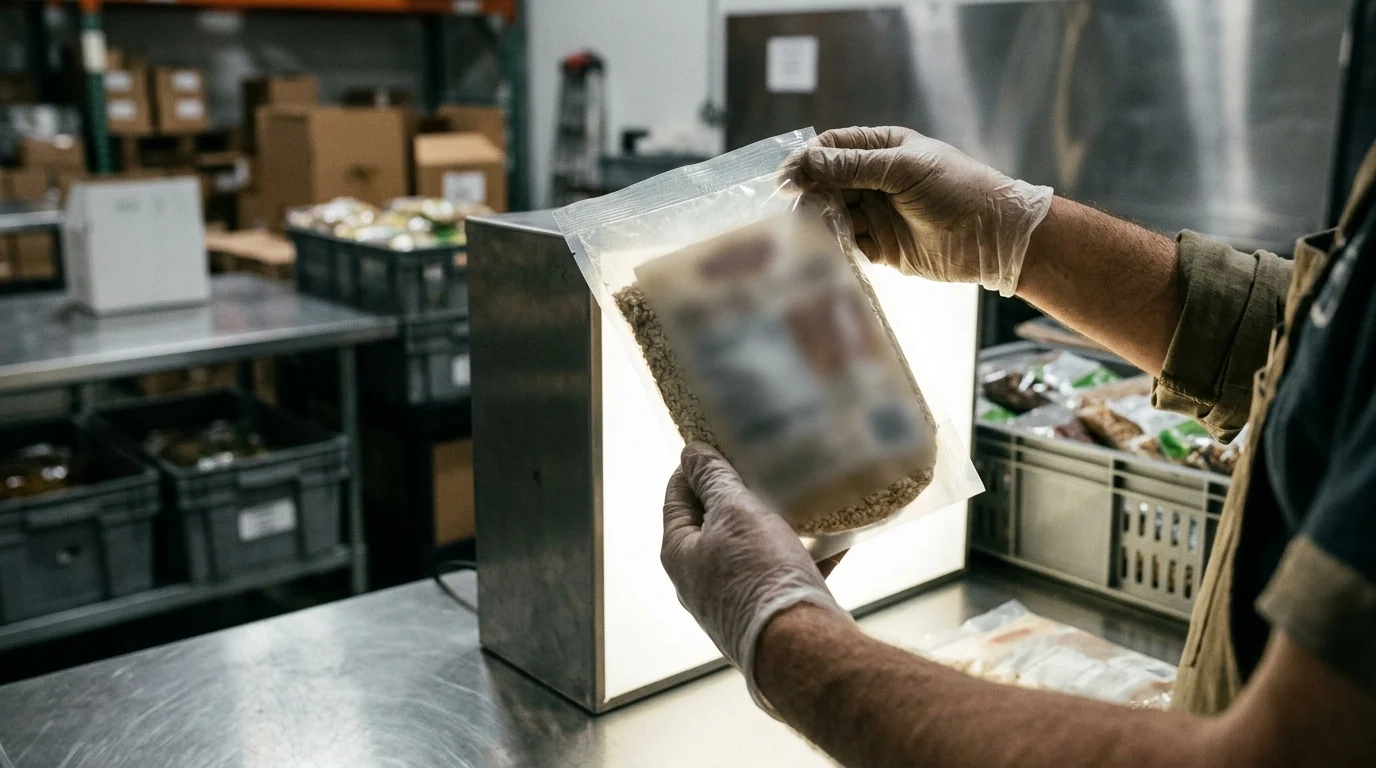
Ask anyone who works around IFIS what fails most and the answer is labels. Not contamination, not fraud: labels printed at origin for a different market, arriving on product that is otherwise perfectly good. The Food Standards Code labelling requirements for retail food include:
- English language. All mandatory information in English. Bilingual labels are fine as long as the English is complete and legible.
- Ingredient list in descending order by ingoing weight, with compound ingredients broken out and additives declared by name or number.
- Allergen declarations in the mandatory format. This is the one that catches importers who “did labels years ago and haven’t looked since.” The Plain English Allergen Labelling rules became fully mandatory in February 2024: allergens must be declared using required names (e.g. “milk”, “egg”, “wheat”, specific tree nut names, not just “nuts”), in bold, in the ingredient list, plus a separate “Contains:” summary statement in bold. An EU-style label with allergens merely italicised does not comply. A label saying “gluten” where the Code requires the cereal named does not comply.
- Nutrition information panel in the prescribed Australian format: per serving and per 100g columns, the standard nutrient rows. A US-format Nutrition Facts panel is not a substitute.
- Date marking: a best-before date (or use-by for foods that become unsafe), day/month/year in an acceptable format. Foods with a shelf life of two years or more are exempt from best-before marking, which matters for canned goods.
- Name and Australian address of the importer or distributor.
- Country of origin labelling for retail food: the familiar kangaroo-in-a-triangle mark with the bar chart applies to food grown/produced/made in Australia; imported food requires a country of origin statement in the prescribed box format (“Product of Thailand”). Retail food without compliant CoOL cannot legally be sold, even if it clears the border.
The strategic point: get label artwork approved before the production run at origin. Have the compliant label printed on the packaging in the factory, not stickered on later. Over-stickering 20,000 units in a Sydney 3PL at $0.20–$0.40 a unit is a rite of passage nobody needs. It gets worse the second time, when the first sticker batch’s allergen statement wasn’t bolded. Send your artwork to a food labelling consultant or have it reviewed against the Code. The review costs a few hundred dollars and protects the entire consignment.

Shelf Life, Date Marking and the Calendar Problem
Shelf life interacts with freight in a way spreadsheets often miss. A product with a 12-month best-before date does not give you 12 months of selling time. Subtract production-to-departure time at origin (often 2–6 weeks), the ocean transit (2–4 weeks from Asia, 5–7 from Europe), customs and any inspection hold, and the retailer’s minimum remaining shelf life requirement. Major Australian grocery buyers commonly refuse stock with less than 60–75% of shelf life remaining at delivery. On a 12-month product, arriving with 10 months left, against a 75% rule, you have roughly a one-month receiving window with the retailer and no slack for a delayed vessel.
Practical responses: negotiate production-to-shipment windows into your supplier contract (goods must ship within 30 days of production), prefer longer-dated formulations where they exist, and align order cadence so stock never sits at origin waiting for a consolidation. For canned and retorted product with 2–3 year dates this is a minor concern; for chilled, snack, and dairy-adjacent lines it drives the entire ordering rhythm.
Packaging and Food-Contact Considerations
The Food Standards Code also reaches the packaging itself. Food-contact materials must not leach contaminants into food. Migration of chemicals from packaging is covered by the Code’s contaminant standards, and ACCC product safety rules sit alongside. In practice, for imported packaged food, this means asking your manufacturer for food-grade certification of the packaging materials (can linings, laminate films, BPA status for cans if your retail customers ask, which increasingly they do). Secondary packaging matters for biosecurity too: raw timber pallets must be ISPM 15 treated and stamped, straw or plant-material dunnage is a biosecurity red flag, and cartons should be clean and new. A perfectly compliant food product on an untreated pallet earns the whole consignment a fumigation order.
Cold Chain vs Ambient: The Freight Decision
Food splits into two freight worlds, and the cost gap between them shapes what is worth importing at all.
Ambient (shelf-stable) freight is the easy world. Canned goods, dry snacks, sauces, oils, rice, and confectionery travel in standard dry containers. Your considerations are the ordinary ones: weight limits (canned goods hit the container’s payload ceiling long before its volume; a 20ft container maxes out around 24–26 tonnes of cargo, and dense canned product routinely cubes out the weight rather than the space), plus temperature awareness for products like chocolate that are technically ambient but suffer above 30°C. For chocolate and similar, shippers often book “protect from heat” stowage or pay for a reefer set to 15°C anyway.
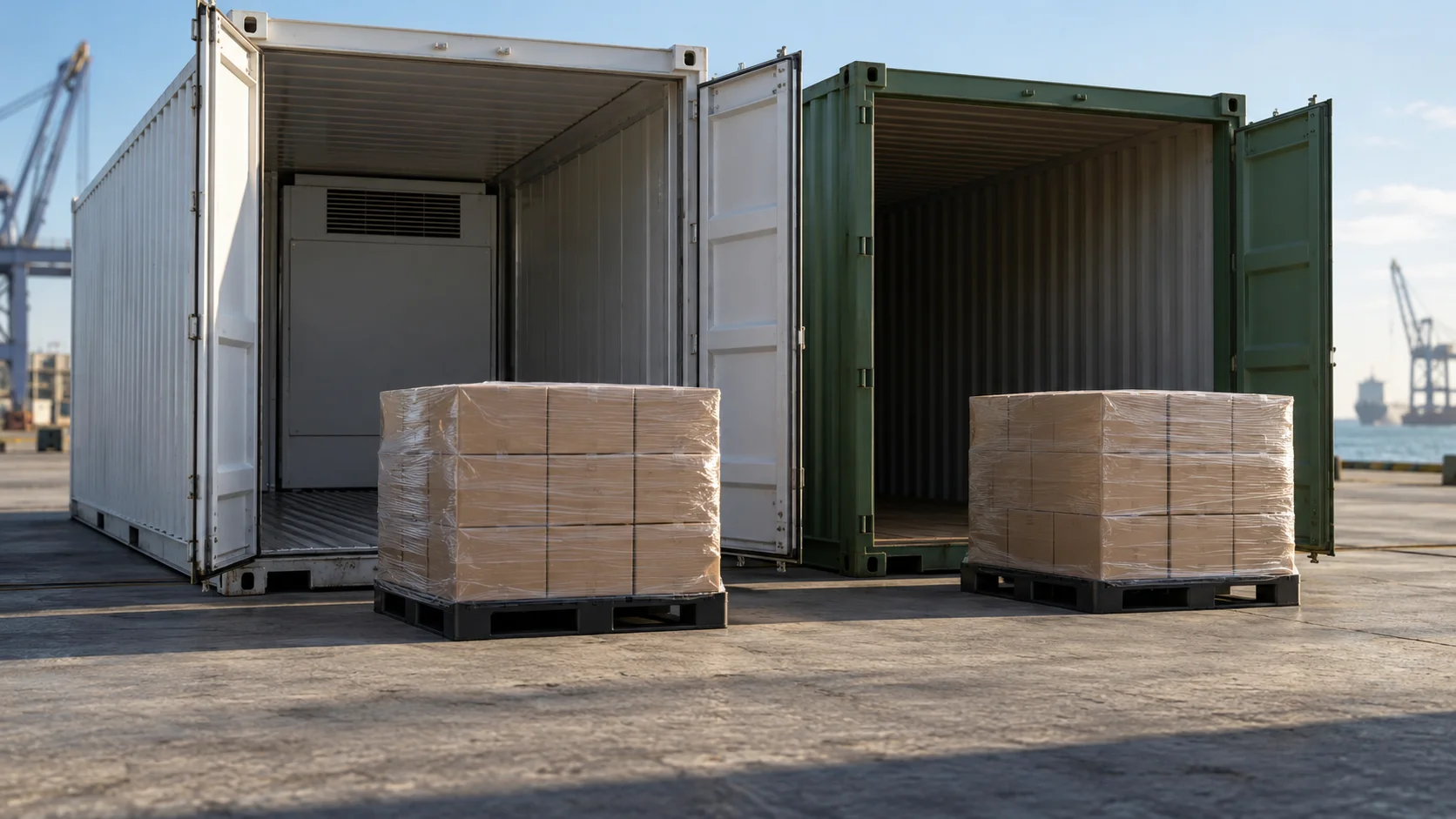
Cold chain freight means reefer containers: insulated boxes with an integrated refrigeration unit that plugs into the vessel’s power supply and into generator sets (“gensets”) for road legs. Key mechanics worth understanding:
- A reefer maintains temperature; it does not do the initial pull-down. Product must be loaded already at carriage temperature. Loading warm product into a reefer is a classic origin failure.
- Set point discipline matters: chilled (0 to 4°C typical), frozen (−18°C or below), and controlled ambient (13–15°C for chocolate and wine) are different bookings with different handling.
- Temperature recorders are your evidence. The container’s own data logger belongs to the carrier; serious food importers place an independent recorder inside the cargo. When a claim arises (and with frozen seafood or dairy, eventually one will), the recorder trace is the difference between a paid insurance claim and an argument.
- Power continuity is the risk to manage: reefer plugs at origin depot, on the vessel, at the terminal, and genset availability for trucking. Every unpowered gap is product risk.
The reefer premium is substantial: expect a reefer slot to cost roughly 2–3x the dry-container rate on the same lane, plus monitoring fees, plus power charges at terminals, plus higher insurance. On a Thailand–Australia lane where a 20ft dry container might cost US$1,200–1,800, the reefer equivalent runs US$3,000–4,500 depending on season and equipment availability. That premium is exactly why the smartest first move for a new food importer is a shelf-stable strategy: build your compliance history, your retail relationships, and your import muscle on ambient product where a freight mistake costs margin, not the whole consignment. Move into chilled and frozen once the machine works.
Duty, GST and the FTA Question
Food is, tariff-wise, one of the friendlier categories. Most processed food lines carry general duty rates of 0–5%, and Australia’s free trade agreement network takes many of those to zero:
- Thailand (TAFTA / AANZFTA / RCEP): most processed foods duty-free with a valid certificate of origin;
- EU-origin goods: general rates apply (commonly 4–5% on processed foods) unless and until preferential arrangements cover the line. Check the current tariff for your specific HS code;
- UK (A-UKFTA), USA (AUSFTA), China (ChAFTA), Japan, Korea, ASEAN: broad duty elimination on food lines with origin documentation.
The certificate of origin is worth real money: 5% of a $60,000 consignment is $3,000 per container, recovered by asking your supplier for a document that costs them an afternoon. Classify carefully. Food HS codes are granular (sugar content, packaging size, and preparation method can shift the line) and the duty rate follows the code.
Two additions to watch. GST at 10% applies to the customs value plus duty plus international transport and insurance. Many basic foods are GST-free when sold in Australia, and GST treatment at the border follows the same rules, so genuinely GST-free basic food (plain rice, canned vegetables) is not taxed at import, while snack foods, confectionery and beverages are. Get the GST status of your line confirmed; it changes landed cost by 10%. And if your product is alcohol or alcohol-adjacent (wine, cider, sake, cooking wine above threshold strength), the Wine Equalisation Tax (29% of the wholesale value) or excise duty applies on top, and the economics change completely. That is a different article; just do not stumble into WET by accident with a “gourmet cooking wine” line.
Duty, GST, and customs value combine into a landed cost figure across any product category, and the underlying mechanics get a full walkthrough in Australian import duty and GST explained.
Worked Example: Canned Coconut Milk from Thailand
Let’s land a real consignment end-to-end. The product: 400ml canned coconut milk, retail-labelled, from a manufacturer near Bangkok. One 20ft container, weight-limited at 1,900 cartons × 12 cans = 22,800 units, roughly 21 tonnes of cargo. FOB price US$0.55 per can → FOB US$12,540 ≈ A$19,000 (at 0.66).
Compliance path, in order:
- BICON check (week 0): commercially manufactured, retorted, shelf-stable coconut milk from Thailand. Conditions: no import permit required; must be commercially prepared and packaged. Save the BICON case record. Confirm the manufacturer can declare the retort process.
- Classification: coconut milk is a surveillance food, not a risk food: 5% referral rate. (Contrast: if this were tahini or certain cheeses, we would be planning around 100% inspection for the first five consignments.)
- Label pre-approval (weeks 0–3): artwork reviewed against the Code before production. English ingredient list; no tree nut declaration for coconut, which is not a required tree nut allergen name under Plain English Allergen Labelling; sulphite declaration if over 10mg/kg; NIP in Australian format; “Product of Thailand” in the CoOL box format; importer’s Australian address; best-before date optional (a 2-year shelf life meets the two-years-or-more exemption; confirm exact shelf life with the manufacturer).
- Order and production (weeks 3–7): PO issued only after BICON and label sign-off. TAFTA certificate of origin requested with the commercial documents.
- Freight (weeks 7–11): ambient dry 20ft, Laem Chabang → Sydney, ~18–22 days ocean transit.
- Border (week 11): import declaration lodged; full import declaration processing charge applies; 95% probability of release on documents, 5% chance of an IFIS referral (label assessment, possible sampling) adding 3–10 days.
Landed cost build-up (A$):
- FOB goods: $19,000
- Ocean freight (20ft dry, Thailand–Sydney): $2,300
- Marine insurance (~0.4% of CIF-ish value): $90
- Duty: general rate on this line up to 5%, but $0 under TAFTA with the certificate of origin (saving ~$950)
- GST: coconut milk is a basic food, GST-free, $0 (if this were flavoured coconut drink, add ~$2,300)
- Port and terminal charges, wharf cartage to Western Sydney: $1,450
- Customs brokerage + import declaration charges: $380
- Expected inspection cost (5% × ~$450 inspection event): $25 provisioned
- Unpack and putaway at 3PL: $600
Total landed: ≈ $23,845, or $1.05 per can against an FOB of $0.83, a landed uplift of about 26%. Wholesale into distributors at $1.60–1.80 per can leaves workable margin; the same can retails around $2.50–3.00. Note what the compliance work bought: the TAFTA certificate saved $950, the GST-free confirmation saved $2,300 of cash flow, and the pre-approved label meant the 5% inspection lottery was a delay risk, not a destruction risk. Repeat this build-up for any product line using our total landed cost guide; the Thailand to Australia importing guide adds the lane-specific detail.
The same skeleton applies to packaged snacks from Europe. The differences are a longer transit (5–7 weeks, watch the shelf-life calendar), duty at 4–5% unless preferential treatment applies, GST payable (snack foods are not GST-free), and a label conversion job that is almost always required because EU allergen formatting does not meet the Australian bold-plus-Contains-statement standard.

The Compliance History Flywheel
The strategic frame that separates food importers who scale from those who churn: your compliance history is an asset on your balance sheet that no competitor can buy, only build. Every clean consignment compounds it; every failure liquidates a chunk of it.
The mechanism is explicit in the risk-food schedule (100% → 25% → 5% inspection is a published trust ladder), but the flywheel spins even for surveillance food. A clean history means fewer holds, faster releases, cheaper insurance conversations, and retail buyers who trust your supply continuity. The flywheel logic changes decisions upstream of the border:
- Sequence your catalogue deliberately. Enter with your cleanest, simplest, most inspection-proof lines. Build five, ten, twenty clean consignments. Add the harder lines (the risk foods, the chilled products) on top of an established record, so their inspection schedule is the only new variable.
- Never let a marginal consignment ship. If the labels from a production run are questionable, fixing them at origin costs days; shipping them and failing costs the consignment and resets the ladder. The expected value calculation is not close.
- One supplier problem is a history problem. A supplier who substitutes an ingredient or changes a formulation without telling you is not just risking one shipment. They are spending your compliance asset. Written change-control requirements in supplier agreements are standard practice for exactly this reason.
Importers who think shipment-by-shipment optimise each consignment. Importers who think in flywheel terms optimise the trajectory, and after two years they are paying 5% inspection rates on lines their newer competitors are paying 100% on. That is a structural cost advantage earned entirely through boring consistency.
Common Mistakes (and What Each One Costs)
- Ordering before checking BICON. The classic. Best case, a scramble for a permit and weeks of storage. Worst case, re-export or destruction of the entire consignment. Cost: potentially everything.
- Labels printed at origin against the wrong standard. EU or US artwork reused for Australia. Cost: over-stickering at $0.20–0.40 a unit if permitted, re-export if not, plus the compliance history damage.
- Allergen format wrong. Right allergens, wrong presentation: not bold, no “Contains:” statement, generic “nuts” instead of the required specific name. Fully mandatory since February 2024, and inspected against exactly. Cost: a label failure with all the above consequences.
- No compliance history strategy. Launching with a risk food as your first-ever import and being shocked by 100% inspection on every consignment. Cost: hundreds of dollars and a week of delay per shipment that a sequenced catalogue would have avoided.
- Ignoring the shelf-life calendar. Product arrives compliant but with too little life left for the retailer to accept. Cost: fire-sale margins or write-off.
- Warm loading into a reefer. The container maintains temperature; it cannot rescue product loaded warm. Cost: an insurance argument you will probably lose.
- Missing the certificate of origin. Paying 5% duty that a free document would have eliminated. Cost: pure margin leak, ~$1,000–3,000 per container on typical food values.

Where a Freight Forwarder Fits
A forwarder experienced in food lanes does more than book the container. They will sanity-check your BICON case against the shipping documents, make sure the manufacturer’s declaration travels with the bill of lading, book the right equipment (and the genset for the road leg), lodge the import declaration with the food-questions answered correctly so the IFIS profiling runs clean, and (when a consignment is referred) manage the inspection booking so the hold costs days, not weeks. They cannot fix a non-compliant label or conjure a permit after the vessel sails. The division of labour is clear: compliance decisions happen before the purchase order; execution happens after. Get the sequence right and food is one of the most systematic, repeatable import categories there is. This sequence sits inside the broader step-by-step Australian import process guide, or jump directly to Swift Cargo’s Australia customs clearance process.
Related Reading
- Biosecurity Requirements for Importing to Australia
- Importing from Thailand to Australia: The Complete Guide
- Total Landed Cost: What Importing to Australia Really Costs
- Customs Delays on Australian Imports: Causes and Fixes
- The Australian Import Process, Step by Step
Frequently Asked Questions
Do I need a licence to import food into Australia?
There is no general food import licence. Requirements depend on the product: some foods need a DAFF import permit under BICON conditions, most need none. Every food import must satisfy both biosecurity conditions and the FSANZ Food Standards Code as enforced through the Imported Food Inspection Scheme.
What is the difference between DAFF and FSANZ?
DAFF controls biosecurity: whether the food can enter Australia without pest or disease risk. FSANZ writes the food safety and labelling standards that determine whether the food is compliant to sell; DAFF enforces those standards on imports at the border. Two separate questions, two separate ways to fail.
What is a risk food versus a surveillance food?
Risk foods are lines FSANZ has assessed as medium-to-high food safety risk; new importers face 100% inspection, stepping down to 25% and then 5% with consecutive compliant consignments. Surveillance foods (most food lines) are referred at a flat 5% rate.
What happens if my consignment fails inspection?
It cannot be released for sale. Label-only failures can sometimes be corrected under supervision; safety failures mean re-export or destruction at your cost. Every failure is recorded against your compliance history and raises future inspection rates.
Do I need to change my labels for the Australian market?
Almost always. Australian requirements (English labelling, the Plain English Allergen Labelling bold format with a “Contains:” statement, the Australian nutrition panel format, country of origin statements and an Australian importer address) differ from EU and US formats. Approve compliant artwork before the production run.
How much duty and tax applies to imported food?
Most processed foods carry 0–5% duty, often reduced to zero under free trade agreements with a certificate of origin. GST at 10% applies to taxable food (many basic foods are GST-free). Alcohol attracts Wine Equalisation Tax or excise on top.