
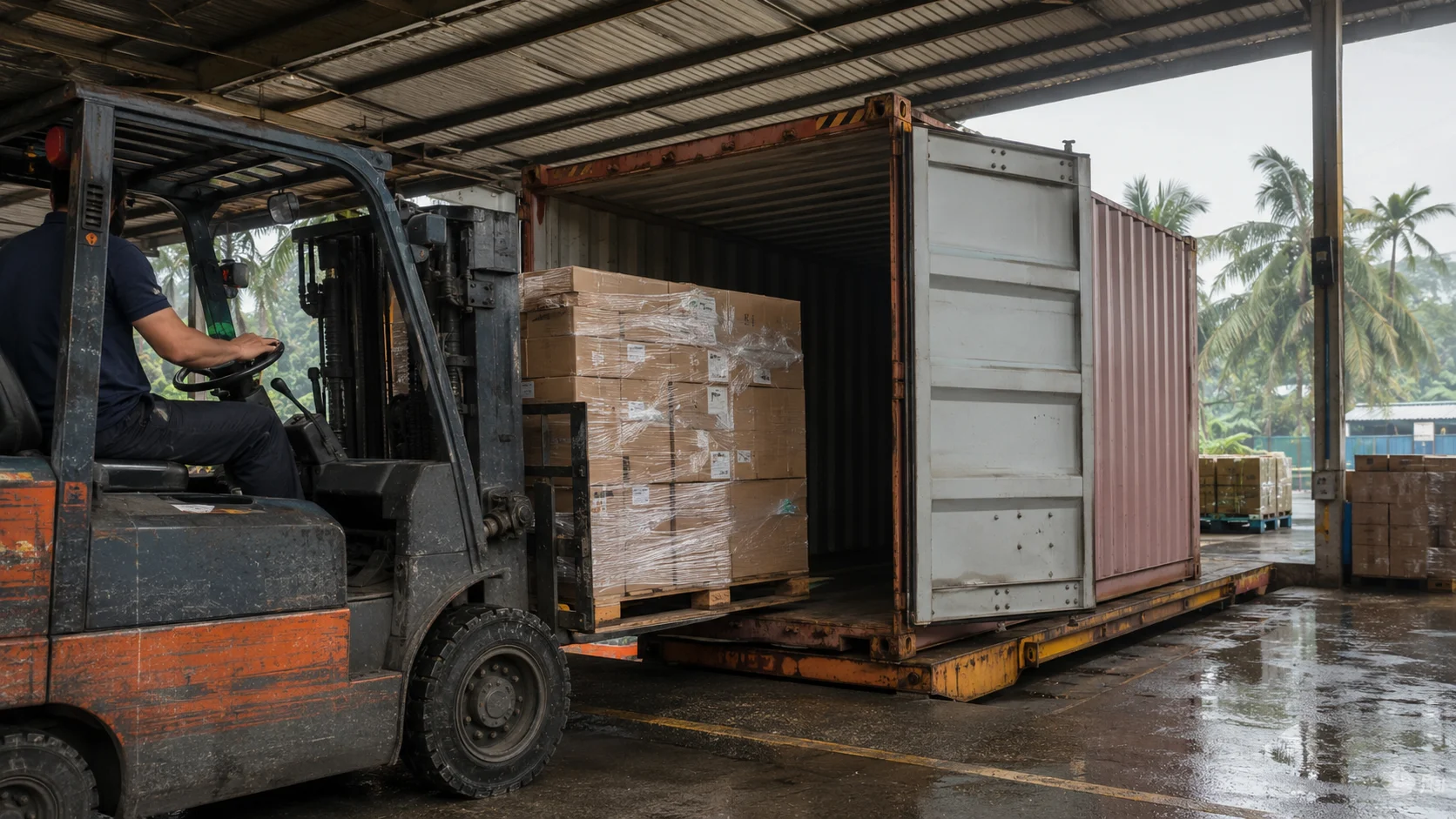
The container arrived at Laem Chabang on a Tuesday: forty treadmills and eighteen pallets of rubber gym flooring from a supplier in Guangzhou, ordered by a British-owned fitness company in Bangkok that had just signed leases on two studio locations. The goods were fine. The invoice was fine. The problem was that the importing company had never registered with Thai Customs, had no digital certificate, and could not lodge an import declaration in the e-Customs system at all. The container sat on the terminal accruing demurrage for eleven days while the paperwork caught up. Total avoidable cost came to a little over 60,000 baht, plus a delayed studio opening.
Nothing about that story is unusual. Thailand’s blog coverage (ours included) leans heavily toward personal relocations: household goods, pets, the odd motorcycle. The commercial side is a different machine with different rules, and businesses regularly walk into it assuming the personal-import playbook scales up. It doesn’t. This guide covers what actually governs commercial imports into Thailand: who can import, what you must register, how the duty stack works, where the free trade agreements help, which products need licences, and what a real shipment costs end to end.
Who This Guide Is For
Three groups keep asking the same questions, so let’s name them.
Foreign businesses supplying Thai customers. A German machinery maker with Thai factory clients. A UK supplement brand that wants shelf space in Bangkok. These companies have no Thai presence and need to understand what “delivered duty paid to Thailand” actually requires before quoting it.
Expat entrepreneurs running Thai companies. The gym owner above. Café owners importing espresso machines and specialty beans. E-commerce sellers bringing in stock. They have a Thai entity but often haven’t wired it into the customs system.
Sourcing and manufacturing operations. Businesses bringing equipment, components, or raw materials into Thailand for assembly, processing, or regional distribution. This group has the most to gain from bonded warehouses, duty drawback, and the free zone regime, and often doesn’t know those tools exist.
If you’re moving personal effects, this isn’t your article. Our relocation guides cover that. Everything below assumes goods entering Thailand for sale, use in a business, or onward processing.
The Company Prerequisite: You Need a Legal Importer
Thai Customs does not clear commercial goods for individuals or foreign entities. Every commercial import declaration names a legal importer, and that importer must be a Thai-registered entity (a Thai limited company, a registered branch office, or a partnership) with its own customs registration. This is the first gate, and it’s the one the fitness company hit.
For most foreign entrepreneurs, the entity is a Thai limited company. The default rule matters here: foreign ownership of a Thai company is capped at 49% under the Foreign Business Act for most business activities, meaning Thai shareholders must hold the majority. There are real exceptions. Companies promoted by the Board of Investment (BOI) can be 100% foreign-owned for approved activities, typically manufacturing, software, and certain services. US citizens have a separate route under the Treaty of Amity. But a garden-variety trading company importing goods for resale will usually be majority Thai-owned on paper, and structuring that properly (genuine shareholders, not illegal nominees) is a legal exercise worth doing correctly before Customs ever sees your name.
The Importer of Record alternative. If you don’t have and don’t want a Thai entity, the IOR model exists precisely for you. An IOR provider is a Thai-registered company that acts as the legal importer on your behalf: their name goes on the declaration, they hold the customs registration and any product licences, they pay the duty and VAT (billed back to you), and they carry the compliance liability. Fees typically run 1–3% of shipment value plus fixed handling charges. It’s the standard route for foreign companies testing the Thai market, shipping demo equipment, or fulfilling a one-off contract with a Thai buyer who refuses to act as importer. The trade-off is control and margin: the IOR owns the import record, and for regulated products (more below) the licences often attach to them, not you.
Decide this early. Everything downstream (registration, licensing, VAT recovery) hangs off that choice.
The Registration Stack: Getting Into e-Customs
Having a Thai company is necessary but not sufficient. Before your first commercial shipment, the company must complete paperless customs registration with the Thai Customs Department. This registers the entity in the e-Customs system (Thailand’s electronic declaration platform), and links it to a company digital certificate used to sign declarations electronically.
The process itself is bureaucratic rather than hard: company affidavit, VAT certificate, director ID documents, an application form, and issuance of the digital certificate through an approved certification authority. Done cleanly, it takes days to a couple of weeks. The catch is sequencing. Registration cannot be done retroactively to a container already on the water, and terminals charge demurrage by the day. The single cheapest piece of advice in this entire guide is: complete customs registration before you place your first purchase order, not when the shipping line sends an arrival notice.
Most companies also authorise their customs broker in the system at this stage, so the broker can lodge declarations under the company’s registration. That’s one form, and it saves a scramble later.
The Duty Landscape: How Thailand Prices an Import
Thailand values imports on a CIF basis: cost of goods, plus insurance, plus international freight to the Thai port. If your supplier quoted FOB Shanghai, the freight and insurance get added back before any tax math starts. This is the number one source of “the invoice said X, why is duty calculated on more than X” confusion.
On top of the CIF value, Thailand applies a cascading stack, each layer computed on the layers beneath it:
- Import duty: the tariff rate for the HS code, applied to CIF value. General machinery often sits at 0–5%; consumer goods commonly 10–30%; some protected categories higher.
- Excise tax: only for excisable categories (alcohol, tobacco, vehicles, batteries, certain beverages, perfume). Calculated on a base that includes duty.
- Interior tax: 10% of the excise tax, so it only exists where excise does.
- VAT at 7%: applied to the sum of CIF + duty + excise + interior. Everything compounds into the VAT base.
For non-excisable goods (most industrial and general commercial cargo), the stack simplifies to duty on CIF, then 7% VAT on (CIF + duty). Run the numbers before you price your product for the Thai market, not after. We work a full example later in this article.
Tools that reduce or defer the duty bill
Bonded warehouses. Goods can enter a licensed bonded warehouse without paying duty or VAT, stored for up to the permitted period, and re-exported duty-free, or cleared into Thailand in parts, paying tax only on what’s withdrawn. If Thailand is your regional distribution hub and a chunk of stock leaves again for Vietnam or Malaysia, bonding turns a sunk duty cost into nothing.
Duty drawback. Manufacturers import materials, incorporate them into finished products, and export those products. They can then reclaim the import duty paid on the inputs under Section 29 drawback. The paperwork discipline required is real (you must trace imported inputs into exported outputs), but for genuine manufacturing re-exporters the refunds are substantial.
Free Zones. Thailand’s industrial estate free zones (and Customs free zones) go further: goods and machinery enter the zone with duty and VAT suspended entirely. Manufacture inside the zone, export the output, and the imported inputs never incur Thai import tax at all. Sell from the zone into the Thai domestic market and tax is assessed at that point. For manufacturers weighing where to put a plant, the free zone regime (often combined with BOI promotion) is a headline part of Thailand’s pitch.
FTA Preferences: When the Tariff Drops to Zero
Thailand’s free trade agreements can cut published tariff rates dramatically for qualifying goods, and businesses leave real money behind by not claiming them. The inbound agreements that matter most:
- ASEAN (ATIGA): imports from ASEAN member states, most tariff lines at 0%. Preference is claimed with a Form D certificate of origin.
- ACFTA (ASEAN–China): imports from China, a huge share of lines at 0% or reduced rates, claimed with a Form E.
- JTEPA (Japan–Thailand): Japanese machinery, components, and materials at reduced or zero rates with a JTEPA certificate of origin.
- TAFTA (Thailand–Australia): Australian goods, most lines at 0% inbound with the TAFTA certificate.
- RCEP: overlays many of the above; sometimes the better rate, sometimes not. Your broker should check line by line.
Two operational points. First, the certificate must exist and be correct at clearance: right form, right HS code, right origin criteria, consistent with the invoice. A Form E with a typo in the consignee name can cost you the entire preference on that entry. Second, the origin rules are about where the goods were substantially made, not where they were shipped from. Transshipped goods don’t automatically qualify. Ask your supplier for the certificate at order time, as a contract term, and have your broker verify it before the vessel sails.
For the fitness company importing Chinese-made gym equipment, a valid Form E is the difference between a meaningful tariff and, for many equipment lines, zero. That’s not a rounding error; it’s margin.
Import Licensing: The Pre-Order Licence Check
Most goods enter Thailand without a licence. The exceptions are exactly the categories businesses love to trade in, so check before you order. A licence check costs an hour; a container of unlicensable goods costs the container.
- Food, beverages, supplements, drugs, medical devices: regulated by the Thai FDA. Import registration or licensing required before the goods ship. Covered in depth below.
- Cosmetics: Thai FDA notification (lighter than food registration, but still mandatory and pre-import).
- Radio and telecommunications equipment: anything with a transmitter needs NBTC (the telecom regulator) type approval or an applicable exemption. In 2026 that covers most electronics, including Wi-Fi routers, Bluetooth speakers, wearables, and IoT sensors. Importers of connected fitness equipment discover this one late and often.
- Used machinery and vehicles: restricted or permit-bound in many cases; used goods generally invite closer valuation scrutiny.
- Agricultural products, chemicals, hazardous substances: various permits from sector ministries.
- General new machinery, tools, furniture, most industrial goods: mostly open, no licence, just correct classification and the standard duty stack.
Adopt this discipline: for every new product line, get the HS code confirmed, then have your broker run it against the controlled-goods lists before the purchase order is signed. Make it a checklist item, not an assumption.
The Thai FDA Layer: Consumables Run on a Different Clock
If your product touches the body (food, drink, supplements, cosmetics, medical devices), the Thai FDA is your critical path, and it’s slower than everything else in this article combined.
The essentials. Registration must be held by a Thai-registered entity with the appropriate FDA import licence for the category; a foreign brand cannot register products directly, which is why local agents and IOR-plus-licence-holder arrangements are standard. Each product (often each SKU, each flavour, each pack size) is registered or notified individually. Labels must carry Thai-language information. And the timelines are the planning constraint: cosmetic notifications may clear in weeks; standard food products commonly take two to three months; supplements and anything with functional claims can run four to six months or longer, with document rounds in Thai.
The strategic implication is blunt: FDA timelines drive market entry, not shipping schedules. Sea freight from China is two weeks. Registration for the protein powder in the container is four months. Businesses that order stock first and start registration second end up paying storage on goods they cannot legally clear, or worse, re-exporting or destroying them. Sequence it: appoint the licence holder, register the products, then place the stock order.
One more trap: the registration attaches to the licence holder. If your local agent holds your product registrations and the relationship sours, moving them is painful. Negotiate ownership and transfer terms up front.
FDA and licensing timelines routinely run longer than the sea freight itself, so it’s worth timing your shipment to the compliance clock before goods leave the supplier.
Logistics Practicalities: Ports, Brokers, and Clearance Times
Where your freight lands. Laem Chabang, about 130 km southeast of Bangkok, is the deep-sea container port and handles the overwhelming majority of ocean freight: full containers from China, Europe, and the US arrive here. Bangkok Port (Khlong Toei) sits in the city and handles smaller vessels and some regional traffic; it’s closer to Bangkok consignees but capacity-constrained. Suvarnabhumi Airport is the air cargo hub for urgent, high-value, or light goods. At ten to twenty times sea freight cost per kilo, it’s for samples, spares, and genuinely time-critical stock, not pallets of gym flooring.
The broker question. Technically, a registered importer can self-clear through e-Customs. Practically, use a licensed customs broker. Declarations and supporting correspondence run in Thai. HS classification disputes are technical arguments with real money attached. Brokers know which documents each customs office wants formatted which way, and their fees (typically a few thousand baht per entry plus disbursements) are trivial against the cost of a misdeclared container. Vet them like a supplier: ask about your specific product categories, FTA certificate handling, and their error track record.
Clearance times. With clean documents, e-Customs green-lane entries clear in hours to a day; physical-inspection (red-lane) entries add one to three days. Most delays are not Customs being slow. They’re documentation gaps: missing origin certificate, invoice/packing-list mismatches, an unregistered importer. Which brings us to a cultural note worth stating plainly: the tea-money era of Thai customs clearance is largely over. e-Customs removed most of the human discretion that informal payments once greased. What replaced it is a system that is more predictable but far less forgiving of sloppy paperwork. Documentation precision is now the currency. Companies that internalise this clear fast, consistently.
VAT Mechanics: The 7% That Comes Back
Import VAT deserves its own moment because it’s the largest single tax line on many entries and the most misunderstood. At clearance you pay 7% VAT on the full landed tax base (CIF + duty + any excise and interior tax). For a VAT-registered Thai company, that payment is input VAT: it goes on the monthly VAT return and offsets against the output VAT you charge customers. Over a normal trading cycle it nets out. Import VAT is a cash-flow cost, not a P&L cost.
Three caveats. Your company must actually be VAT registered (mandatory above 1.8 million baht annual revenue; voluntary and usually sensible below it for importers). The import must be in the company’s name. VAT paid by an IOR belongs to the IOR’s return, and how it flows back to you is a commercial term in the IOR contract worth reading twice. And the cash still has to exist on clearance day: on a 3-million-baht landed base that’s 210,000 baht out the door weeks or months before sales revenue arrives. Budget the float.

Worked Example: Gym Equipment from China, End to End
Let’s put the whole stack together with the company from the opening, this time doing it right. A UK entrepreneur owns 49% of a Thai limited company (Thai partners hold 51%), VAT registered, operating fitness studios in Bangkok. The company imports commercial fitness equipment from Guangzhou: 40 treadmills and accessories.
Compliance path (weeks −8 to 0):
- Company completes paperless customs registration and obtains its digital certificate (done once; allow 2 weeks).
- Broker appointed and authorised in e-Customs.
- HS codes confirmed for treadmills and rubber flooring; licence check run: no FDA issue (not a consumable), but the treadmills have Bluetooth consoles, so NBTC applicability is checked. The supplier’s modules carry existing Thai type approval; confirmation obtained in writing. This check happens before the PO.
- Purchase contract requires the supplier to provide a Form E (ACFTA) certificate of origin matching the commercial invoice.
The money. Supplier invoice: USD 68,000 FOB Shanghai. Sea freight to Laem Chabang: USD 2,600. Insurance: USD 400.
- CIF value: 68,000 + 2,600 + 400 = USD 71,000 ≈ 2,485,000 THB (at 35 THB/USD).
- Import duty: the general rate on this equipment line would take roughly 10–15%, but with a valid Form E the ACFTA preferential rate is 0%. Duty = 0 THB. Without the certificate, duty at 10% would have been 248,500 THB. The Form E clause in the purchase contract just paid for itself several hundred times over.
- Excise/interior: not an excisable category. 0 THB.
- VAT: 7% × (2,485,000 + 0) = 173,950 THB, paid at clearance, recovered as input VAT on the next return.
- Broker and port charges: customs brokerage ~5,000 THB; terminal handling, D/O, and trucking to Bangkok ~35,000 THB.
Cash out at the border: ~213,950 THB, of which 173,950 comes back through the VAT return. True landed cost above CIF: roughly 40,000 THB in fees and trucking, plus the VAT float. Clearance took nine working hours because the declaration, invoice, packing list, bill of lading, and Form E all agreed with each other. The same container, without customs registration and without the Form E, costs a quarter of a million baht more and sits at the terminal for a week. The difference is entirely administrative.
Common Mistakes (and What They Cost)
- Ordering before FDA registration. The classic consumables error. Stock arrives months before it can legally clear; storage, demurrage, and sometimes destruction follow. Register first, order second.
- No importer arrangement at all. Foreign companies quote DDP Thailand without a Thai entity or IOR lined up, then discover at arrival that nobody can lodge the declaration. Fix: settle the legal-importer question before signing the sales contract.
- Skipping customs registration. The opening scenario. A two-week administrative task done late becomes eleven days of demurrage.
- Underestimating licence timelines. NBTC type approval and FDA registration are measured in months. Market-entry dates promised to investors or landlords need to be built backwards from these, not from the sailing schedule.
- The CIF surprise. Businesses budget duty and VAT on the FOB invoice value, then discover the tax base includes freight and insurance. On air freight, where freight is a large share of value, this bites hardest.
- Ignoring FTA certificates. Businesses pay 10–30% general rates on goods that qualified for 0% under ATIGA, ACFTA, JTEPA, or TAFTA because nobody asked the supplier for the form.
- Treating the broker as a formality. A broker who misclassifies your HS code cheaply is more expensive than a careful one; post-clearance audits reach back years.
The pattern across all of these is the same: Thai commercial importing punishes bad sequencing far more than it punishes complexity. Every requirement in this guide is knowable in advance. The businesses that struggle are the ones that let the goods travel faster than the paperwork.
We price Thai commercial imports around your compliance sequence.
Most SMEs get a detailed, all-inclusive quote within 24 hours, covering CIF duty, FDA categories and Laem Chabang clearance.
Related Reading
- How Thai Customs Duty Is Calculated: CIF, the Tax Cascade, and Worked Examples
- Why Shipments Get Stuck at Thai Customs (and How to Prevent It)
- Required Documents for Shipping to Thailand: The Complete Checklist
- Customs Paperwork Mistakes That Cost Money in Thailand
- Hidden Costs of Shipping to Thailand Nobody Quotes You
- Thai Customs: How “Used” Is Determined at the Border
The compliance obligation in this entire chain sits with the Thai legal-importer entity, not with the foreign supplier, and that fact gets glossed over more often than it should. A supplier can hand over a certificate of analysis or a compliance claim that turns out to be wrong, incomplete, or simply written for a different market’s standard, and none of that shifts where the Thai FDA or customs authority looks when something fails inspection. The entity that filed the import registration answers for it, full stop. Treating a supplier’s paperwork as sufficient due diligence, rather than verifying it independently, is how importers end up accountable for a compliance gap they did not create but absolutely will be the one asked to explain.
Frequently Asked Questions
Can a foreign company import commercial goods into Thailand without a Thai entity?
Not directly. Every commercial declaration names a Thai-registered legal importer. Without your own entity, use an Importer of Record service (typically 1–3% of shipment value plus handling) or sell to a Thai distributor who imports under their own registration.
How is import duty calculated on commercial goods in Thailand?
Duty is calculated on CIF value: goods plus insurance plus freight. Duty applies to CIF, excise and interior tax apply to certain categories on top, and 7% VAT is charged on the sum of everything. For non-excisable goods it’s simply duty on CIF, then VAT on CIF plus duty.
Which products need an import licence or permit?
Food, supplements, drugs, and medical devices need Thai FDA registration; cosmetics need FDA notification; anything with a radio transmitter needs NBTC type approval. Most new general machinery and industrial goods are open. Check the HS code against controlled-goods lists before ordering.
How long does Thai FDA registration take?
Roughly 2–6 months depending on category. Cosmetic notifications are fastest; supplements and products with functional claims are slowest. The registration must be held by a Thai entity, and it should set your market-entry timeline.
Is the 7% import VAT recoverable?
Yes, for VAT-registered Thai companies importing in their own name. It’s input VAT that offsets output VAT on the monthly return, a cash-flow cost rather than a permanent one. VAT paid by an IOR sits on the IOR’s return, so check your contract.
Do I really need a customs broker?
Self-clearing through e-Customs is legal but rare. Documentation runs in Thai, classification disputes are technical, and broker fees are small compared to the cost of a misdeclared or delayed container. Nearly every commercial importer uses one.