
Ask ten importers where to source in China and you’ll hear Guangzhou and Yiwu mentioned more than any other names. They sit 1,100 kilometres apart and serve completely different jobs, yet first-time buyers routinely treat them as interchangeable. They book a flight to whichever came up first on a forum, walk around for three days, and come home confused about why the prices, minimums and paperwork looked nothing like what they’d read. That trip usually happens because Guangzhou vs Yiwu sourcing gets treated as a choice of destination rather than a choice of supply chain.
The confusion is understandable. Both cities move staggering volumes of export goods. Both are full of suppliers eager to quote. But they are structurally different machines. Guangzhou is the front door to the Pearl River Delta’s factory economy: the place you go to have things made. Yiwu is the world’s largest small-commodities wholesale market: the place you go to buy things that already exist. Once you frame the choice that way, most of the decision makes itself.
What Guangzhou Actually Is
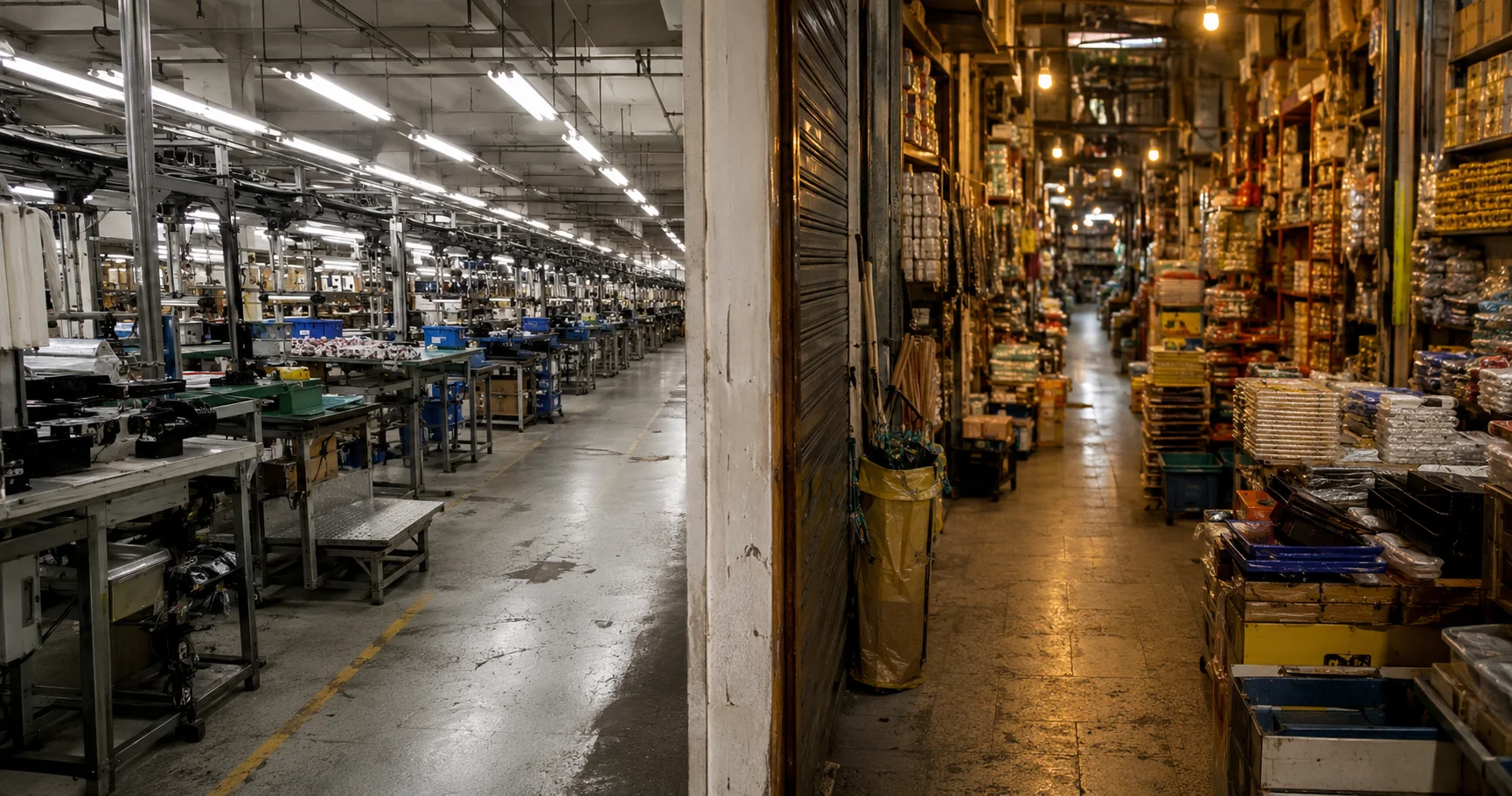
Guangzhou is the capital of Guangdong province and the commercial anchor of the Pearl River Delta: the densest manufacturing region on earth. Within a two-hour drive sit Foshan (furniture, ceramics, appliances), Dongguan (electronics, toys, footwear), Shenzhen (electronics, hardware), Zhongshan (lighting), and Guangzhou itself (apparel, leather goods, cosmetics, auto parts). When people say “sourcing from Guangzhou,” they usually mean sourcing from this entire ecosystem, with Guangzhou as the base.
It is also home to the Canton Fair, China’s largest trade exhibition, which runs twice a year in three phases: electronics and machinery first, consumer goods and home products second, textiles and apparel third. The fair matters because it is where factories, not traders, come to exhibit. A booth at the Canton Fair signals, though not infallibly, that you are talking to a manufacturer with export experience.
The Guangzhou model runs on factory-direct access. You identify a factory, negotiate a specification, agree an MOQ and a unit price, pay a deposit, and the factory produces your order. That opens the full menu of customisation: your materials, your dimensions, your branding moulded or stitched into the product rather than stickered onto it. OEM (they build your design) and ODM (you adapt their design) both live here.
What Yiwu Actually Is
In Zhejiang province, about 300 kilometres south of Shanghai, Yiwu is a different animal entirely. Yiwu International Trade City (the “Futian Market”) is the largest wholesale market complex in the world: five interconnected districts, more than 75,000 booths, an estimated 400,000-plus distinct product lines. If you spent one minute at each booth for eight hours a day, you would need most of a year to see it all.
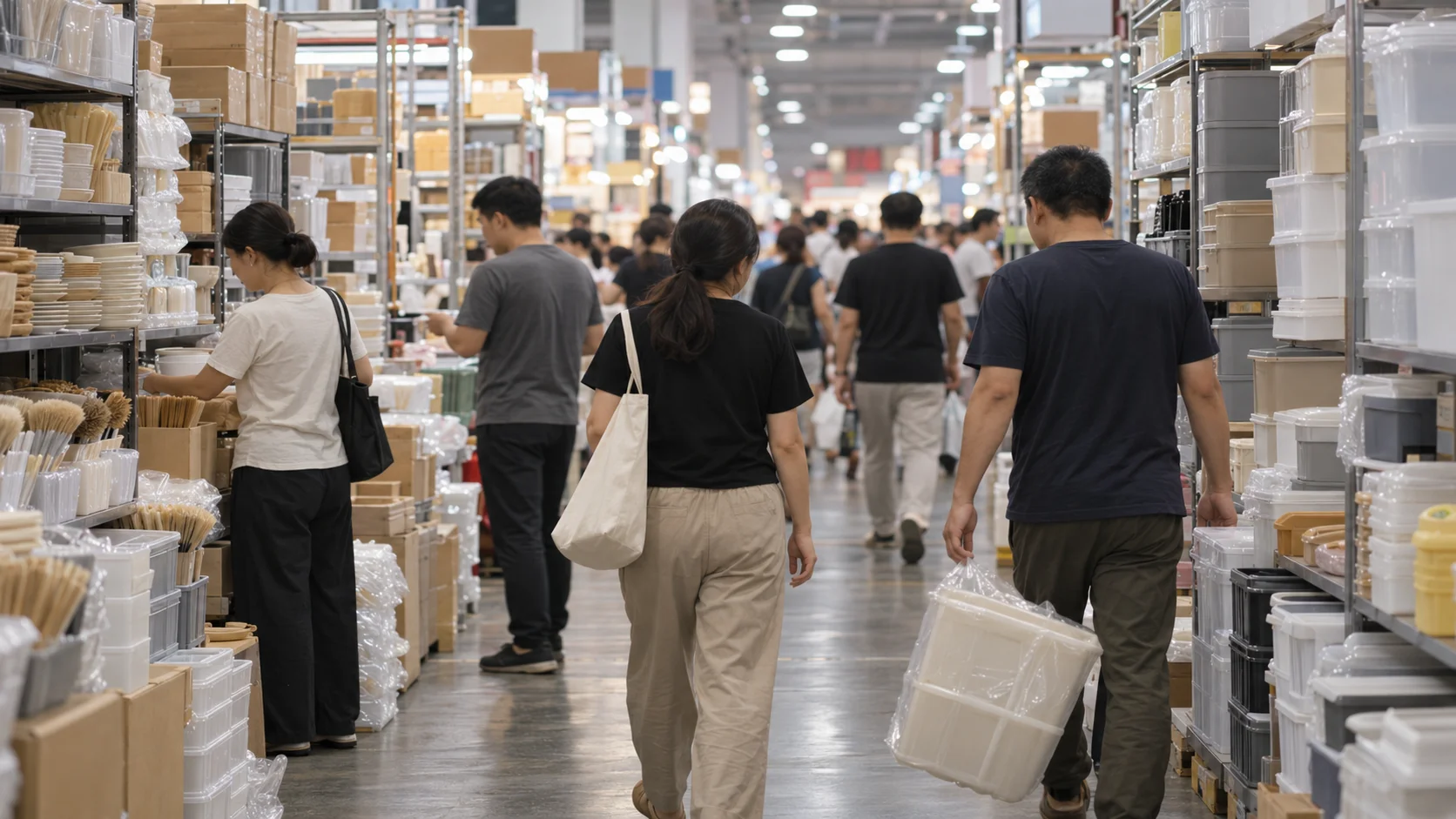
Each booth is a small showroom, typically ten to twenty square metres, stacked floor to ceiling with one narrow category: hair accessories, umbrellas, socks, photo frames, party supplies, phone cases, Christmas decorations (an entire district, trading year-round). The person behind the counter is usually a trader or a factory’s sales agent, not the manufacturer. Stock sits in warehouses around the city, and goods sell by the carton.
Around the market has grown a dense service ecosystem: buying agents who escort you booth to booth, consolidation warehouses that receive cartons from dozens of sellers, inspection services, and export agents who handle the customs paperwork for mixed shipments. Yiwu’s real competitive advantage is this ecosystem, not the market itself.
The Fundamental Difference: Factory-Direct vs Market-Stall Wholesale
Strip away the geography and the choice is between two supply-chain structures.
Guangzhou (factory-direct): fewer intermediaries, so fewer price layers. High minimums, because a factory has to justify a production run. Full customisation. Lead times of 30 to 60 days from deposit to ex-factory, because your goods don’t exist until they’re made. The ability to audit the actual production site.
Yiwu (market wholesale): one extra price layer (the booth’s margin, typically 5 to 15 per cent over factory price). Low minimums, often a single carton. Customisation limited to logo stickers, printed cards and packaging. Lead times of days to two weeks, because the goods already exist. A structural blind spot: the booth is not the factory, so you inspect stock, not production.
Decide between them by asking what job you’re hiring the hub to do. If the job is “manufacture my product to my specification at a per-unit cost that works at scale,” that’s a Guangzhou job. No Yiwu booth can be hired for it. If the job is “assemble a wide, shallow range of general merchandise quickly without committing serious capital to any single SKU,” that’s a Yiwu job. Hiring a Guangdong factory for it commits you to factory MOQs on twenty products you haven’t validated. That is how importers end up with a garage full of slow movers.
In practice: Guangzhou for hero products, OEM/ODM work, electronics, furniture, apparel programs, and anything where the product itself is your differentiation. Yiwu for accessories, promotional items, packaging inserts, seasonal merchandise, giftware, and range-fillers where speed and low commitment matter more than uniqueness.
MOQ Economics: Where the Crossover Sits
The numbers make the trade-off concrete. Take a stainless-steel insulated water bottle, a category available in both hubs.
A Yiwu booth might quote ¥14 per unit (about A$3.00) with a one-carton minimum of 50 units and a realistic working minimum of 200 units across colours. Total commitment for a 200-unit test: roughly A$600 in product. A Foshan factory making the equivalent bottle might quote ¥10.5 per unit (about A$2.25), but with a 3,000-unit MOQ. Total commitment: roughly A$6,750, plus a longer wait and more upfront work on specification.
The per-unit saving from going factory-direct is A$0.75, or 25 per cent. So when does the factory route win? Not simply “when you need 3,000 units.” The honest comparison includes the cost of being wrong. If there’s a meaningful chance the product doesn’t sell, the Yiwu route lets you spend A$600 to find out; the factory route makes that same lesson cost A$6,750. Run the expected-value maths: if you assign even a 30 per cent probability that a new SKU underperforms and has to be cleared at cost, the factory’s per-unit advantage evaporates on order one and only shows up on the reorders. That is why experienced importers describe the sequence as validate in Yiwu, scale in Guangdong: the first order is market research you happen to be able to sell; the third order is where factory pricing earns its keep.
The bottle example gives the price of validation directly. Buying the 200-unit test in Yiwu at A$3.00 instead of the factory’s A$2.25 costs A$150 more, against a factory commitment of A$6,750. That is about 2 per cent of the larger bet, paid for the right to learn whether the product sells before 3,000 units exist. It is also why the 25 per cent unit saving should not decide a first order: the saving is worth A$0.75 on every unit that sells and nothing on units that do not. If the test sells through, the next order carries the factory price and the A$150 is behind you.
As a rough rule across general-merchandise categories: below about 1,000 units per SKU, Yiwu almost always wins on total economics. Above 5,000 units of a proven seller, factory-direct almost always wins. Between those lines, the deciding factors are customisation need and your confidence in demand, not price alone.
Quality Control: Two Different Risk Profiles
The QC conversation differs between hubs, and importers who apply the wrong playbook get burned.
In the Guangzhou model, you can audit the factory before you order: walk the production line, check certifications, review their existing export clients, confirm the machinery matches the product they claim to make. During production you can commission an in-process inspection, and before shipment a final random inspection against an agreed AQL standard. The risk profile is front-loaded: pick the wrong factory and everything downstream suffers. But the tools to manage it are mature. Our guide on vetting Chinese suppliers covers the audit process in detail.
In the Yiwu model, you inspect what exists. The sample on the shelf looks fine; the question is whether the 40 cartons that arrive at the consolidation warehouse match it. Batch consistency is the specific weakness: market stock may come from different production runs, or even different factories supplying the same booth, so material weight, colour calibration and finish can drift between cartons. And because the booth owner is a trader, your recourse when a batch disappoints is weaker: there’s no production line to correct, only a negotiation over replacement stock.
Mitigating the risk is unglamorous but effective: a pre-shipment inspection at the consolidation warehouse, sampling cartons from every booth in the order, before anything is loaded. It costs a few hundred dollars for a day of inspection. The most expensive sentence in Yiwu sourcing is “it’s just cheap goods, inspection isn’t worth it”: on an A$15,000 mixed container, an uncaught 10 per cent defect rate is A$1,500 of landfill plus the freight you paid to ship it.
One more trap deserves its own flag: the booth is not the factory. Booth staff will happily say “we are the manufacturer” because it closes sales. Sometimes it’s true: many Zhejiang factories run booths as sales offices. Often it isn’t. If the answer matters to you (for customisation, for compliance documentation, for reorder stability), verify it the same way you’d verify any supplier claim: business licence, factory address, and ideally a visit.
Consolidation and Logistics: How Goods Actually Leave Each Hub
Here Yiwu plays its strongest card. Buying from twenty booths creates twenty small deliveries, a logistics nightmare anywhere else. In Yiwu it’s a solved problem. Your buying agent gives every booth the same consolidation warehouse address; cartons arrive over one to two weeks; the warehouse checks quantities against your purchase list, arranges inspection if you’ve booked it, and books the container. Twenty suppliers become one shipment. This is the machinery that makes mixed-SKU importing viable at all. It is the reason a Yiwu order of 25 different products can be less operational work than a single factory order elsewhere. If you’re combining suppliers into shared containers regularly, our piece on freight consolidation for Australian imports walks through the mechanics.
Geography helps too. Yiwu sits roughly two hours by truck from the port of Ningbo-Zhoushan, one of the world’s largest container ports. The established Yiwu–Ningbo corridor offers bonded trucking and even a customs-supervised rail link, and drayage is cheap, frequent and predictable.
Guangzhou-area cargo exits through Nansha (Guangzhou’s own deep-water port), Shenzhen’s Yantian or Shekou terminals, or Hong Kong, all well within two hours of most Pearl River Delta factories. For a single-factory FCL order this is as smooth as export logistics gets: the factory loads the container at their own dock and it trucks straight to the terminal.
The shipment profiles differ accordingly. Guangzhou sourcing tends to produce FCL shipments of one or few SKUs from one supplier. Yiwu sourcing tends to produce either LCL shipments (for smaller test orders) or a single mixed FCL assembled at the consolidation warehouse. Neither profile is better; they simply match the sourcing model that produced them.
Export Mechanics: Yiwu’s 1039 Regime
A quieter but real Yiwu advantage is regulatory. Standard Chinese exports require VAT invoices and export declarations tied to each supplier: manageable when you buy from one factory, painful when you buy from twenty booths, most of which are small traders not set up to issue export paperwork.
Yiwu’s answer is market procurement trade mode 1039, a simplified export regime created specifically for the small-commodities trade. Under 1039, an authorised export agent consolidates goods purchased from multiple market sellers onto a single customs declaration, without needing VAT invoices from each individual booth. The agent acts as exporter of record; you buy the goods, the agent handles the border. It’s the administrative twin of the physical consolidation warehouse, and together they make the twenty-booth container not just possible but routine.
From Guangzhou, exports run through the standard regime: the factory or a licensed export agent declares the goods, issues export documentation, and claims any VAT rebate. That means more paperwork per supplier, but with one or two suppliers per shipment it’s a non-issue. The documentation trail is also cleaner, which matters for products needing compliance certificates or detailed origin records.
Australian Importer Specifics
Transit times are nearly identical. Ningbo to Melbourne, Sydney or Brisbane runs about 14 to 18 days on direct services; South China ports to the same destinations sit in the same band. Port choice should not drive your sourcing decision.
ChAFTA applies equally. The China–Australia Free Trade Agreement‘s tariff preferences depend on the goods’ Chinese origin and correct documentation, not on the city of purchase. Your export agent (Yiwu) or factory (Guangzhou) arranges the Certificate of Origin either way. The broader compliance picture is identical from both hubs (GST, import declarations, ACCC product safety standards); our guide to importing from China to Australia covers it end to end.
Freight cost differences are noise; product cost differences are signal. A per-container ocean freight difference between Ningbo and Nansha departures might be one or two hundred dollars in a given month, and it flips direction with market conditions. The product-cost difference between the two sourcing models on a full container is measured in thousands. Optimise the sourcing, not the port: for Australian importers, the Guangzhou vs Yiwu sourcing decision should rest on product cost, customisation and MOQ.
Samples still travel the same way. Whichever hub you choose, get physical samples to Australia before committing: a courier satchel of samples is the cheapest insurance in the trade. See our guide on shipping samples from China for the practical options.
Trade Fair Strategy: Canton Fair vs Yiwu Fair
If you’re planning a sourcing trip, the fairs anchor the calendar. The Canton Fair (Guangzhou, April and October) runs in three phases over roughly three weeks: Phase 1 electronics, machinery and hardware; Phase 2 consumer goods, gifts and home décor; Phase 3 textiles, apparel, shoes and office supplies. Attend the phase matching your category, collect factory contacts, then use the following days to visit factories within the Delta. The fair-to-order workflow (meet at the fair, sample by courier, audit the shortlisted factory, place the order) typically spans six to ten weeks.
The Yiwu International Commodities Fair (October) is smaller and more trader-heavy, but Yiwu’s permanent market makes the fair semi-optional: the Futian Market is effectively a trade fair that never closes. Many importers structure a single trip around Canton Fair Phase 2, then take the high-speed rail up to Yiwu (about 6.5 hours, or a short flight) to fill out the accessory end of their range the same week. One trip, both models.
Worked Example: A 30-SKU Homewares Range Split Across Both Hubs
Consider an Australian homewares importer building a 30-SKU range: 6 hero products (a signature ceramic dinnerware set, glass storage jars, an acacia serving-board line) and 24 range-fillers (silicone utensils, napkin rings, placemats, candles, drawer organisers, and similar general merchandise).
The all-Guangzhou version: the 6 hero SKUs suit factory sourcing: say 3,000 units each at an average US$2.60, about US$46,800. But pushing all 24 fillers through factories commits US$22,800 to unvalidated SKUs, even at a lenient 1,000-unit MOQ and US$0.95 average, plus the coordination burden of a dozen-plus factory relationships. Total product spend: roughly US$69,600, with heavy inventory risk on the tail.
The all-Yiwu version: the 24 fillers suit Yiwu: 300 units each at US$1.10 average is US$7,920, consolidated by one agent into a part-container. But the hero SKUs suffer: market-stock dinnerware at US$3.40 equivalent with no custom glaze, no branding beyond a sticker, and batch-consistency risk on the product your brand stands on. The range loses its differentiation exactly where differentiation pays.
The hybrid: hero SKUs factory-direct from Foshan/Chaozhou factories: 3,000 units each at US$2.60, US$46,800, shipped FCL from Nansha with a production inspection. The 24 fillers from Yiwu: 300 units each at US$1.10, US$7,920 plus roughly US$650 agent fee and US$400 consolidation/inspection, shipped LCL or part-FCL from Ningbo under trade mode 1039. Total product spend about US$55,770: US$13,800 less cash committed than all-Guangzhou. The savings concentrate in the SKUs most likely to be replaced next season. Filler SKUs that prove themselves get promoted to factory orders in the next cycle; the crossover maths from earlier tells you when.
Two shipments instead of one is a modest freight penalty (typically under US$1,500 all-in) against a five-figure reduction in inventory risk. When reorder volumes grow, the same structure scales cleanly; our article on scaling imports for an Australian business picks up that thread. Before committing to either split, a corporate freight quote from Swift Cargo shows the real landed-cost gap between a single-factory FCL and a mixed Guangzhou–Yiwu shipment.
This comparison points toward something more structural. The trading-company layer in Yiwu has always sold two things: access to a fragmented supplier base, and the ability to consolidate small orders into one shipment. The second is a genuine logistics service and it is not going anywhere. The first is information: knowing which booth is the factory and which is a reseller. The cost of acquiring that information yourself has fallen steadily as supplier verification, video factory audits and cheap sample logistics have improved. That is a cost curve, not an opinion about middlemen. As it keeps falling, intermediaries lose the only advantage they had: a margin that depended on you being unable to check. The buyers who build their own verification habit capture that margin instead.
Common Mistakes
Using Yiwu for products that need customisation. If your product requires a structural change (different material, different dimensions, a moulded logo), the booth will quote it enthusiastically and then pass it back to a factory with factory MOQs and factory lead times. You’ve added a margin layer and lost direct communication for nothing. Go to the factory.
Committing to factory MOQs before validating demand. The 25 per cent per-unit saving is real, but it’s paid for with a 10x larger commitment. On unproven SKUs, the expected cost of dead stock usually exceeds the unit saving. Test small, then scale.
Skipping inspection because “it’s just Yiwu goods.” Cheap goods still cost full freight, full duty and full reputation when they arrive wrong. Batch consistency is Yiwu’s known weak point; a warehouse inspection is the cheap fix.
Assuming the booth owner is the manufacturer. Sometimes true, often not, always worth verifying if reorder stability or compliance documentation depends on it.
Treating the hubs as rivals instead of a system. The strongest importers we work with don’t choose Guangzhou or Yiwu. They route each SKU to the hub whose structure matches the job, and let the freight plan follow the sourcing plan, not the other way around.
A Rule of Thumb for Guangzhou vs Yiwu Sourcing
Below about 1,000 units per SKU, or when you need a wide range quickly, Yiwu usually wins on total cost; above about 5,000 units of a proven seller, or whenever the product needs structural customisation, go factory-direct in Guangdong. Validate new SKUs in Yiwu, then move the ones that sell to a factory when you reorder.
Related Reading
- How to Vet Chinese Suppliers Before You Order
- Shipping Samples from China: Options and Costs
- Importing from China to Australia: The Complete Guide
- Freight Consolidation for Australian Imports
- How to Scale Imports for Your Australian Business
Frequently Asked Questions
Is Guangzhou or Yiwu cheaper for sourcing products?
It depends on volume. Yiwu booths sell by the carton with working minimums of 100–500 units, so total cash outlay is lower for small orders. Guangdong factories require 1,000–5,000+ unit MOQs but per-unit prices typically run 15–30 per cent lower at volume. For most general-merchandise categories the crossover sits somewhere between 1,000 and 5,000 units per SKU: below that, Yiwu’s flexibility wins; above it, factory pricing does.
Can I get custom or private-label products in Yiwu?
Only lightly. Booths can usually add logo stickers, printed inserts or custom packaging to existing stock. Anything structural (materials, dimensions, moulded branding) goes back to a factory, with factory MOQs attached. Genuine OEM/ODM work belongs in the Guangzhou and wider Guangdong ecosystem.
What is Yiwu’s market procurement trade mode (1039)?
A simplified export regime built for small-commodity trade. An authorised export agent consolidates purchases from many booths onto one customs declaration without collecting VAT invoices from each seller. It’s the administrative machinery that makes a twenty-booth mixed container routine rather than a paperwork ordeal.
Which port do Yiwu goods ship from, and does it affect transit to Australia?
Yiwu cargo exits through Ningbo, about two hours away by truck. Guangzhou-area cargo ships via Nansha, Shenzhen or Hong Kong. Transit to Australian east-coast ports runs a similar 14–18 days from both regions, so the port question rarely decides the sourcing question.
Do ChAFTA tariff preferences apply equally to both hubs?
Yes. ChAFTA preferences depend on Chinese origin and correct documentation (a Certificate of Origin arranged by your factory or export agent), not on the city where you bought the goods.
Should I inspect goods bought in Yiwu?
Yes. Batch consistency is market sourcing’s specific weakness: shelf samples and warehouse cartons can differ in weight, colour and finish. A pre-shipment inspection at the consolidation warehouse costs a few hundred dollars and routinely pays for itself on the first container.