
Customs has cleared the container. The forwarder calls to say it’s ready for pickup. For many importers, this is where planning runs out. The focus has been on the shipment getting to Australia, not on what happens after it arrives. The transport is booked hastily. The warehouse is not ready. The receiving team does not have the packing list. The container sits an extra day while the organisation catches up, and the demurrage clock runs.
Post-import delivery and receiving is the part of the import process that most importers have never systematically designed. They have supplier relationships, freight programs, and customs processes, but their warehouse receiving is improvised every time. This guide covers the full post-customs sequence: container transport, warehouse receiving, inspection protocol, empty return, inventory integration, and what to do when the goods do not match what was ordered.

Container Transport: Booking Before Clearance
The critical error in container transport booking is waiting for the container to clear customs before arranging the truck. By the time customs clears (which in Australia typically takes 1–3 working days for a pre-arrival declaration or 3–7 days for goods selected for examination), the free time at the port is already running. Booking transport reactively after clearance adds 1–2 days of logistics coordination on top of the free time clock.
The correct sequence is to book container transport when the vessel arrives at the Australian port, not when the container is cleared. Book against the vessel’s berthing date and the expected clearance timeline your broker provides. Confirm the booking once clearance is received. If clearance is delayed by examination, update the transport booking, but maintain the slot, since transport providers in peak periods operate at capacity and released slots may not be available the next day.
Vehicle type selection: The type of container transport depends on your warehouse configuration and the container’s cargo type.
- Skel trailer: the standard for FCL container delivery. The container is transported on a skeletal trailer to your premises and unpacked in place (if you have a container dock) or tipped off if you have a container ramp. Requires adequate yard space and a vehicle of sufficient height clearance.
- Tilt-tray or crane truck: for warehouses that cannot accommodate a skel trailer. The container is tilted or craned off the vehicle. Less common for standard FCL imports but useful for smaller premises.
- Wharf cartage with CFS unpack: for LCL shipments, the goods are deconsolidated at the CFS (container freight station) and delivered as loose cargo. The delivery vehicle is a standard curtain-sider or box trailer. No container to return.
Cost benchmarks (Australian east coast, mid-2026): FCL skel delivery within 30 km of Port Botany or Webb Dock: AUD 300–550. FCL delivery 30–80 km: AUD 450–750. Empty container return from your premises to the container park: AUD 200–400 if booked as a separate run, or AUD 100–200 as a round trip with the delivery. LCL cartage from CFS to premises: AUD 150–350 depending on cubic metres and distance.
Out-of-hours delivery: If your warehouse has dock staff available after standard hours, an evening or early-morning delivery from the port (available from many transport providers) can avoid peak-period port gate queues and deliver the container to your warehouse ready for a full-day unpack. Port gate queues at Port Botany and Webb Dock during peak hours (7–11am) can add 45–90 minutes to a collection run; early-morning collections (5–7am) typically move in 10–15 minutes.
Scheduling the Warehouse Receiving Window
A container arriving at a warehouse without a prescheduled receiving window creates a cascade of internal inefficiencies: dock staff are not ready, forklifts are committed to other tasks, warehouse locations have not been cleared, and the receiving team does not have the documentation to process the inbound goods.
The receiving window should be booked in the warehouse management system (or on a whiteboard schedule for smaller operations) at the same time the container transport is booked, not when the container is on its way. The receiving window booking should trigger:
- Dock allocation (which dock the container will park at)
- Forklift scheduling (how many forklifts are needed for the unpack, for how long)
- Staff allocation (how many people are needed to unload the expected carton or pallet count)
- Receiving documentation preparation (purchase order, packing list, receiving checklist printed or loaded into the warehouse management system)
- Pre-clearance of warehouse locations (locations where the goods will be put away should be at or above required capacity before the delivery arrives, not cleared during the unpack)
Time estimation for container unloads: A standard 20ft container with cartons (averaging 20 kg per carton) unloaded by two operators with one counterbalance forklift: 2–4 hours for approximately 400–600 cartons depending on stacking pattern and palletisation. A 40ft container with similar cargo: 4–7 hours. Palletised 20ft: 1–2 hours. Bulk/heavy goods requiring repositioning: add 30–50% to standard estimates. Plan the receiving window to accommodate the unpack plus the inspection time, not just the unload time.
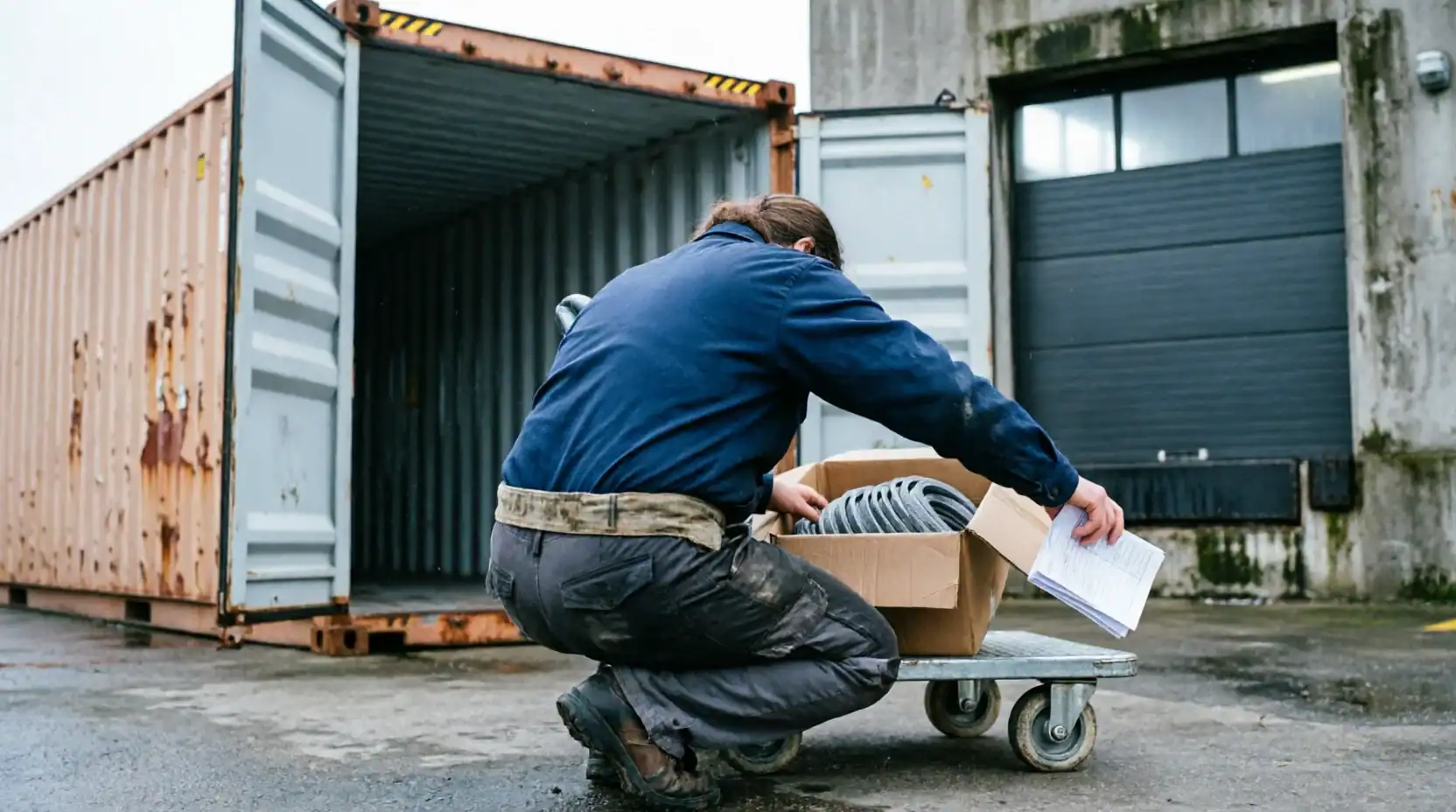
The Receiving Inspection Protocol
The receiving inspection is the quality and quantity gateway for every imported shipment. Its outputs (the inspection record) are the evidence base for any claim against the supplier, carrier, or insurance company. An inspection that is not documented is not an inspection.
Before the container is opened:
- Check the container seal number against the bill of lading. If the seal number on the physical container does not match the bill of lading, photograph it and notify your forwarder before breaking the seal. A broken or mismatched seal is evidence of a potential container breach and must be documented before you break into the container.
- Note the container’s external condition: dents, rust, evidence of moisture damage, any structural compromise.
- Note the delivery receipt condition before signing. If there is any external damage to the container (even if you do not yet know whether the cargo inside is affected), note it on the delivery receipt before the truck driver leaves your premises.
Opening and unloading:
- Photograph the interior of the container before any goods are moved. This documents the loading pattern, the stacking condition, and any immediately visible damage.
- Count every carton or pallet as it is unloaded and tally against the packing list. Do not do a bulk count at the end. Count each unit as it leaves the container.
- Separate damaged cartons from the main unload. Do not integrate damaged goods into the putaway flow; keep them in a designated quarantine area for inspection and documentation.
Inner goods inspection (sample-based): For most commercial imports, a 100% inspection of every item is not practical. Establish a sample rate appropriate to the goods value and supplier reliability:
- New supplier, first shipment: inspect 20–30% of cartons opened
- Established supplier with clean track record: inspect 5–10% of cartons
- High-value goods (electronics, jewellery): inspect 100% or a stratified sample weighted toward the highest-value SKUs
- Goods with compliance marking requirements (RCM, AS/NZS, TGA): inspect 100% for marking, as non-compliant goods cannot be sold
What to check in the inner inspection:
- SKU/model match: does the goods description on the carton match the purchase order? Is the correct size, colour, and specification inside?
- Unit count per carton: does the carton contain the quantity stated on the packing list?
- Compliance markings: for electrical goods (RCM mark, voltage rating), food products (ingredient and allergen labelling in English, country of origin), personal care products (ingredients, batch number, expiry), medical devices (TGA number)
- Expiry dates for perishable or time-sensitive goods
- Physical condition: no moisture damage, no crushing, no contamination
When we managed a team responsible for receiving, the hardest habit to build was not the checklist. It was getting people to flag a problem the moment they noticed it instead of hoping it would sort itself out by the time the pallet reached the shelf. A wrong SKU or a cracked carton does not get better with time; it gets more expensive to unwind the longer it sits unflagged in the warehouse. The generous read of a receiving team that misses things is not that they are careless. It is that no one gave them a clear, low-friction way to say “something is off here” before the goods moved on. Building that path (a five-minute photo-and-note habit at the point of discovery) does more for inventory accuracy than any downstream audit ever will.
Empty Container Return: The Deadline That Runs While You Unpack
Detention charges begin accumulating the day you collect the container from the port, regardless of how long the unpack takes. The free return period (typically 3–5 working days) is short enough that an unplanned delay in unpacking can push you into detention before you have finished receiving the goods.
The discipline required: on the day you collect the container, note the detention-free return deadline in your calendar and assign responsibility for arranging the empty return. This is not a task for “after the unpack is done”. It is a task to book in advance of the unpack.
Operationally: unpack the container as quickly as possible after delivery (ideally within the same or the next business day for a standard carton shipment). Once unpacked, arrange the empty return run promptly. An empty container sitting in your yard for 3 days past the free period at AUD 150/day is AUD 450 of avoidable cost.
Detention charges exist because the deadline is real and the shipping line has no reason to extend it for your convenience. That is a fair, disclosed arrangement. What is not fair, and what nobody at the shipping line will volunteer to explain, is that the same free-time clock that starts the moment you collect the container gives you no credit for delays that were the line’s own fault: a late vessel, a missed transhipment, congestion at the terminal they chose. The obligation runs one way unless you specifically ask it not to. Importers who assume the deadline is symmetrical, that a carrier-caused delay will be reflected fairly in their free time, find out otherwise only when the detention invoice arrives. Ask the question in writing before you collect the container, not after the charge lands.
Container inspection before return: Before returning the empty, check the interior for: any remaining goods that were missed during unloading; any pallets or dunnage that must be removed (returning a container with timber dunnage may breach ISPM 15 requirements); any damage to the container interior that was there on arrival but that you have not documented (the shipping line may attempt to charge you for pre-existing damage if it is discovered on return and you have no record of it from collection).
Photograph the empty container interior before it is collected by the transport provider for return. This closes the evidence chain if the shipping line subsequently raises a damage query.
HS Code to Internal SKU Mapping
The HS code on the customs entry and the internal SKU in your inventory management system are two different classification systems that rarely align automatically. Bridging this gap is a one-time setup task for each new product but it has ongoing operational consequences if not done properly.
The HS code determines: the import duty rate, the applicable FTA concession, any anti-dumping duty, any import permit requirement, and the reporting category for trade statistics. Your internal SKU determines: inventory location, reorder triggering, sales category, and COGS tracking.
A product that is imported under HS code 9403.20 (wooden furniture) and sold as a range with 12 individual SKUs needs a mapping table that associates the HS code to each SKU, so that when you run a landed cost report by SKU, the correct duty rate is applied to each product’s cost of goods. Without this mapping, landed cost calculations are wrong, and pricing built on those landed costs may be below breakeven without the importer realising it.
For businesses importing across multiple HS codes with multiple SKUs per code, the mapping table is maintained in the inventory management system (MYOB, Xero Inventory, NetSuite, or similar) and updated whenever new products are added to the import program. It should be reviewed by the customs broker annually to confirm HS code classifications remain accurate, since both the Australian tariff schedule and the goods’ specifications can change.
Putaway Planning: Organising the Warehouse Before Delivery
Putaway is more efficient when it is planned before the goods arrive than when it is improvised during the unpack. An import delivery is a predictable event: the quantities, dimensions, and weights are on the packing list days or weeks before arrival. Use that information to pre-plan location assignments.
Velocity-based location assignment: High-velocity SKUs (fast-moving goods that are picked frequently) should be assigned locations close to the dispatch dock, at a height that does not require a forklift to access (1–1.5 metres), and in quantities that reflect the expected pick frequency. Low-velocity goods (slow movers, seasonals, safety stock) go to the back of the warehouse, higher shelving, or off-site storage.
Seasonal import planning: If you are importing seasonal goods (for example, summer product for the October–December selling period), the delivery location should reflect the fact that these goods will be needed urgently in a specific time window. Do not store seasonal imports behind other stock that will need to be moved to access them. If the warehouse is full on arrival, assess whether lower-priority stock can be moved to an external storage facility temporarily to make room for the seasonal import in a prime location.
Pre-location clearance: Before the import delivery arrives, confirm that the nominated putaway locations are clear and at sufficient capacity to receive the new stock. A receiving team that arrives to find the nominated locations occupied by residual stock from a previous run must improvise location assignments on the spot, leading to stock being put in non-standard locations that are not recorded in the WMS, creating a picking accuracy problem downstream.
Inventory Integration: Receiving Into the System
Imported goods do not generate value until they are in the inventory management system as available stock. A receiving process that accurately counts, inspects, and puts away goods but delays the system receipt creates a gap in which goods exist in the warehouse but not in the sales system, leading to orders being declined for apparent stockouts that are not real, and losing sales from customers who were ready to buy.
The system receipt should be completed the same day as the physical receipt, or at the latest, within 24 hours. For operations with a warehouse management system (WMS), this is typically handled through the inbound delivery process: the advance shipping notice (ASN) is pre-loaded from the packing list, the receiving team scans each carton barcode as it is received, and the WMS automatically reconciles the receipt against the ASN and updates available inventory on confirmation.
For operations without a WMS (using a spreadsheet or simple accounting system), the receiving record should be entered into the system as a purchase receipt or goods received note (GRN) within 24 hours of the physical delivery.
Handling receiving discrepancies in the system:
- Quantity short: receive only what was physically received, not the packing list quantity. Record the shortfall as a purchase order variance and notify the supplier. Do not receive more than was physically delivered, as this overstates inventory and creates a negative quantity discrepancy when the short units are sold and cannot be picked.
- Quantity over: receive the actual quantity. Record the excess against the purchase order and notify the supplier. An overshipment may have duty implications if the customs entry was lodged for the expected quantity.
- Wrong goods received: do not receive into available inventory. Place the wrong goods on hold in a quarantine location in the WMS and initiate a supplier query.
- Damaged goods: receive the full quantity but mark damaged units as non-saleable in the WMS. This preserves the quantity record for insurance claim purposes while preventing the damaged goods from appearing as available stock.
Quality Inspection Beyond Receiving: When a Full QC Check is Required
For some goods categories, the receiving inspection is a first-pass check and a more thorough quality control inspection is required before the goods can be put into saleable stock. This is particularly relevant for:
Regulated goods: Medical devices, therapeutic goods, and food products subject to TGA or FSANZ compliance requirements may require batch release testing or certificate verification before stock can be sold. The goods should be held in a designated “quality hold” warehouse location until the compliance check is complete and the batch is released by the quality team.
OEM or private label goods: Goods manufactured to your specification (where you bear the compliance and quality responsibility as the importer and OEM) should undergo a specification conformance test on every shipment if the supplier is new or has had previous quality issues. Testing parameters depend on the product category: electrical goods need voltage and safety testing; textiles need fibre content testing; chemicals need composition verification.
High-value goods with resale warranties: Electronics, jewellery, and goods with significant after-sales warranty obligations benefit from a 100% functionality test before putaway. A product that fails in the field within the warranty period costs far more in customer service, return freight, and replacement cost than a factory test caught at receiving.
When Goods Don’t Match the Order
Every importer will eventually receive a shipment where something does not match: a quantity shortfall, a specification substitution, a wrong colour or model, a missing compliance mark, or goods that are damaged on arrival. Having a pre-defined response protocol for each scenario prevents the situation from escalating into a supplier dispute that consumes weeks of management time.
Quantity shortfall (goods not shipped): verify that the shortfall is not an unloading count error (recount before contacting the supplier). If confirmed short: document with photographic evidence of the carton count, notify the supplier in writing within 48 hours of delivery, request a credit note or replacement shipment. Under most purchase order terms, the supplier is responsible for shortfalls against the confirmed purchase order quantity.
Specification substitution (wrong goods): photograph the received goods and the specification discrepancy. Notify the supplier within 48 hours. Do not put the wrong goods into saleable stock. They may not comply with Australian regulations even if they are a higher-specification substitute. Request return or credit depending on the commercial relationship and the value.
Compliance marking failure: goods that fail the receiving inspection for compliance markings (missing RCM, wrong AS/NZS standard, missing ACCC-required labelling) must not be sold in Australia. The importer (not the supplier) is the responsible supplier under the Australian Consumer Law once the goods are imported. Selling non-compliant goods exposes the importer to ACCC enforcement action, product recalls, and fines. Remediation options: return to the supplier for remarking (expensive), arrange for Australian-based remarking (possible for some goods categories), or destroy and claim against the supplier for the full loss.
Landed Cost Reconciliation After Each Delivery
Every import delivery is a data point for improving the landed cost model that drives pricing and purchasing decisions. The week after delivery (once the receiving inspection is complete and the inventory receipt is in the system) is the right time to reconcile the actual landed cost against the estimate used when the purchase was committed.
The components to reconcile: ocean freight, local cartage, import duty and GST, customs brokerage fees, port charges and terminal handling, and any unplanned costs that arose on this shipment (demurrage, container examination fees, DAFF treatment costs, quarantine storage). Which of these actually land on your invoice rather than your supplier’s depends on the Incoterm the purchase order was written against. Compare actuals against the landed cost estimate by component, not just in total. A consistent overrun in demurrage indicates a process gap (too little free time in the booking, or too slow to collect after clearance) rather than bad luck, and warrants a process change. An overrun in duty may indicate an HS code that needs reclassification or an FTA concession that is not being claimed.
This reconciliation, done after each shipment, produces an accurate landed cost history that supports competitive pricing, informed freight rate negotiations, and identification of which import cost components are worth management attention. For guidance on managing shipment delays and their cost impacts, see What to Do When a Shipment Is Delayed and How to Handle Damaged Shipments.
Swift Cargo provides Australia-wide freight and cartage coordination as part of the import program (from port collection through to warehouse delivery) for commercial importers managing regular FCL and LCL programs. Visit swiftcargo.solutions/australia to discuss how delivery planning can be integrated into your freight arrangement.
Related reading: Inventory Planning Around Shipping Timelines for Australian Importers
Frequently Asked Questions
How far in advance should I book container transport from an Australian port?
Book container transport a minimum of 3–5 working days before the container’s estimated available date at the port. During Q3–Q4 peak season (September–December) or following port congestion events, availability of suitable container transport vehicles (skel trailers, tilt-trays) tightens. Book 7–10 days ahead during these periods. Do not wait for the container to show as ‘available’ before booking; the transport slot should be pre-booked against the vessel’s expected arrival date and confirmed once the container is released from customs. Late bookings during peak periods result in 1–3 day delays that accrue demurrage charges at AUD 80–250 per container per day.
What is a receiving inspection and what should it cover?
A receiving inspection is a systematic check of the imported goods against the purchase order, commercial invoice, and packing list at the point of delivery to your warehouse. It should cover: (1) carton count: verify the number of cartons or pallets matches the packing list exactly; (2) external condition check: note any damaged, wet, or deformed cartons before the delivery receipt is signed; (3) weight verification for high-value goods: weigh selected cartons and compare to the packing list; (4) inner goods inspection: open a sample of cartons to verify contents against the packing list (size, colour, model, specification); (5) compliance marking check: verify required Australian compliance marks (RCM, AS/NZS labels) are present on the goods; (6) expiry date check for consumables. The delivery receipt must be signed only after the external condition check. Any visible damage must be noted on the receipt before signing, not after.
When must I return the empty container after unpacking?
The empty container must be returned to the shipping line’s nominated container park within the free return period specified by the carrier, typically 3–5 working days from the date you collected the container from the port. After the free period, detention charges apply at the same daily rate as demurrage, typically AUD 80–250 per container per day depending on the carrier and container size. The return deadline runs from the day you picked up the container, not from the day you finish unpacking. Plan your unpack and empty return as a linked sequence: unpack within 1–2 days of collection, return empty within the free period. For 40ft containers, arranging a cartage provider for the empty return in the same booking as the delivery run saves time and typically gets a lower rate.
What should I do if the delivered quantity is short or the goods are wrong?
If the quantity delivered is less than the quantity on the bill of lading and packing list: note the shortfall on the delivery receipt before signing, photograph the container interior to document the loading pattern (which may show whether goods were left behind or never loaded), and notify your freight forwarder immediately. If the goods were short-shipped (not loaded at origin), this is a supplier responsibility under your purchase order terms. If goods were loaded but not delivered (a custody gap), the freight forwarder and carrier need to trace the missing cartons. For wrong goods (substituted products that do not match the purchase order specification), document the specification mismatch in writing with photographs and notify the supplier within 24 hours of discovering the error. For goods with compliance marking errors (missing RCM, wrong AS/NZS standard) discovered on receiving inspection, quarantine those goods immediately. They cannot legally be sold in Australia until the compliance status is resolved.