
Australia’s solar installation rate is among the highest per capita in the world, and the vast majority of panels, inverters, and battery storage systems installed here are manufactured in China. Chinese solar manufacturers have achieved a scale, cost structure, and product quality that no other country currently matches at volume. For Australian solar businesses, the supply chain runs through Jiangsu, Zhejiang, and Guangdong.
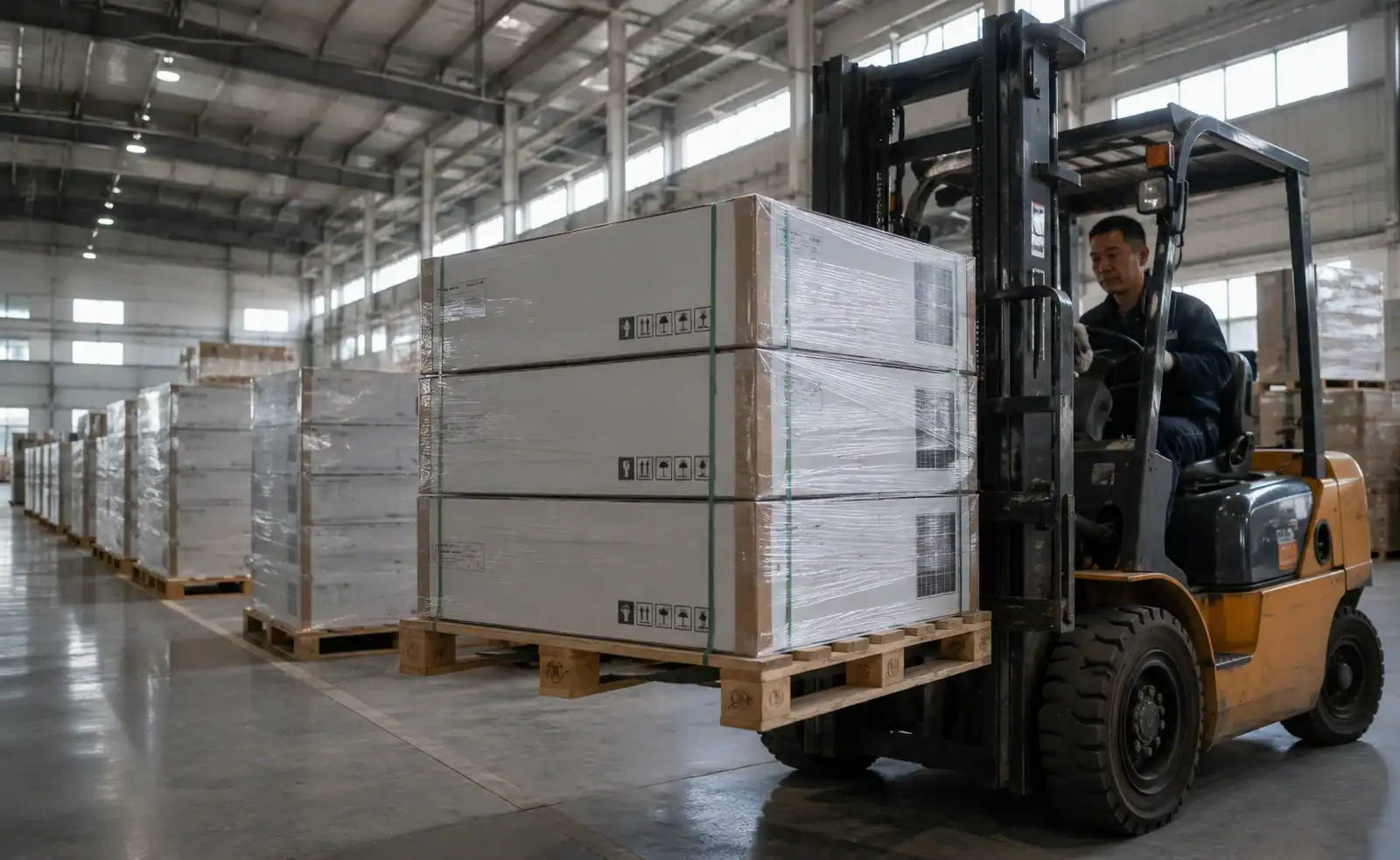
Solar equipment sits at the intersection of customs, electrical safety regulation, energy policy, and biosecurity. Each has its own requirements, its own authority, and its own consequences for getting it wrong. Once the framework is understood, it is entirely navigable. And unlike the US market, Australia imposes no anti-dumping duties on Chinese solar, which keeps the economics straightforward.
HS Codes: Get Classification Right Before Anything Else
Solar equipment spans multiple HS chapters. The classification determines your duty rate, your ChAFTA eligibility, and whether any special import conditions apply.
| Product | HS Code | MFN Duty | ChAFTA Rate |
|---|---|---|---|
| Solar PV panels (photovoltaic cells) | 8541.40 | 0% | 0% |
| Inverters (static converters) | 8504.40 | 0% | 0% |
| Lithium-ion battery storage | 8507.60 | 0% | 0% |
| Racking/mounting (steel) | 7308.90 | 5% | 0% with CoO |
| Racking/mounting (aluminium) | 8302.41 | 5% | 0% with CoO |
Solar panels are classified as semiconductor devices (HS 8541), not generators or electrical machinery, which is why they attract 0% MFN duty. This classification is settled and consistent. Misclassification into HS 8501 (electric motors and generators) would attract a duty rate. Confirm with your customs broker and use the ABF Tariff Classification tool for each product category you import.
For racking and mounting systems, the ChAFTA 0% rate requires a valid Certificate of Origin from an authorised Chinese issuing body (CCPIT or CIQ). The ChAFTA certificate process is the same mechanism used across electronics and other product categories. Request it before the vessel loads; it cannot be backdated.
Put a number on what that certificate is worth. A container of steel racking valued at AUD 60,000 pays 5% MFN duty (AUD 3,000) if the Certificate of Origin isn’t in hand at clearance. The same shipment with a valid CoO pays zero. Because the certificate can’t be backdated, that AUD 3,000 isn’t a rate you negotiate after the fact; it’s locked in the moment the container clears without the paperwork, and no amount of explaining to the broker afterward recovers it. On a program running several racking containers a year, that’s the difference between a rounding error and a real line item, for one document requested at the wrong time.
No Anti-Dumping Duties: A Genuine Australian Advantage
Australia currently has no anti-dumping or countervailing duties on solar panels, inverters, or battery storage from China. This is a structural advantage for Australian solar importers compared to their US counterparts, who face tariff rates of 14.25% to 250%+ on Chinese solar depending on the manufacturer and applicable measures.
The Clean Energy Regulator and Australian Border Force monitor solar import volumes and have mechanisms to initiate anti-dumping investigations if domestic manufacturing interests file a complaint, but no such measures are currently in force. Check the ABF anti-dumping register before any large volume contract. Conditions can change.
CEC Approved Products List: What It Means and When It Matters
The Clean Energy Council (CEC) Approved Products List is Australia’s industry-managed register of panels and inverters eligible for STC (Small-scale Technology Certificate) rebates under the Renewable Energy Target.
CEC listing is not a customs import requirement. It does not affect whether you can legally import the goods. But it directly affects whether your products are commercially viable in the Australian residential and small commercial solar market. Australian solar installers accredited under the CEC can only use listed products for STC-eligible installations. Installations using non-listed products do not generate STCs. The customer cannot claim the rebate, so you cannot sell the product at competitive prices.
How to get listed:
- The panel or inverter must hold current IEC certification (see below)
- The importer or manufacturer applies via the CEC Products Program, not the installer
- The CEC assesses the product and grants listing per model
- Listing must be renewed if the product specification changes materially
Plan the CEC application process before or immediately after your first import. New models not yet listed cannot be used for STC-eligible installations. If you have not started early, your first shipment may sit in your warehouse while the listing is processed.
IEC Certification: The Technical Compliance Layer
CEC listing requires that panels and inverters hold current IEC (International Electrotechnical Commission) certification from an accredited testing laboratory.
For solar panels:
- IEC 61215: design qualification and type approval for crystalline silicon modules. Tests performance durability and degradation.
- IEC 61730: safety qualification. From 1 May 2026, IEC 61730:2023 (the updated version) is mandatory for new CEC applications. Confirm with your Chinese supplier that their IEC 61730 certificates reference the 2023 standard. The CEC will not accept older editions for new listings.
For inverters:
- AS/NZS 4777.2: the Australian/NZ standard for grid connection of inverter energy systems. Updated version (2020) is the current requirement. Inverters must be tested and certified against this standard, not older versions.
- AS/NZS 61000: electromagnetic compatibility (EMC) requirements.
Request current, valid IEC and AS/NZS certificates from your Chinese supplier before placing an order. Certificates have expiry dates. A certificate that expired after the last production run creates a compliance problem for new batches.
EESS Registration: Mandatory for Inverter Importers
Australia’s Electrical Equipment Safety System (EESS) requires importers of prescribed electrical equipment to register as a Responsible Supplier before placing products on the Australian market. Grid-connected inverters are prescribed equipment.
Registration requirements:
- Register your business as a Responsible Supplier in the EESS database (eess.gov.au) with a valid ABN
- Register each inverter model separately, with supporting technical documentation and test reports
- The responsible supplier is legally accountable for compliance with the relevant Australian standard
- Model registration must be current, not a historical registration for a discontinued product
EESS registration is separate from CEC listing. A product can be EESS-registered without being CEC-listed (meaning it is safe to sell but not STC-eligible), and vice versa (though the latter scenario is unusual). Both are typically required for commercial viability in the Australian solar market.
ACMA (Australian Communications and Media Authority) also has jurisdiction over grid-connected inverters for electromagnetic compatibility and radiocommunications compliance. Your EESS registration will require ACMA-compliant test reports.
Shipping Solar Equipment: Handling, Container Choice, and Insurance
Solar panels are heavy, glass-faced, and fragile. How they are shipped matters as much as whether they are compliant.
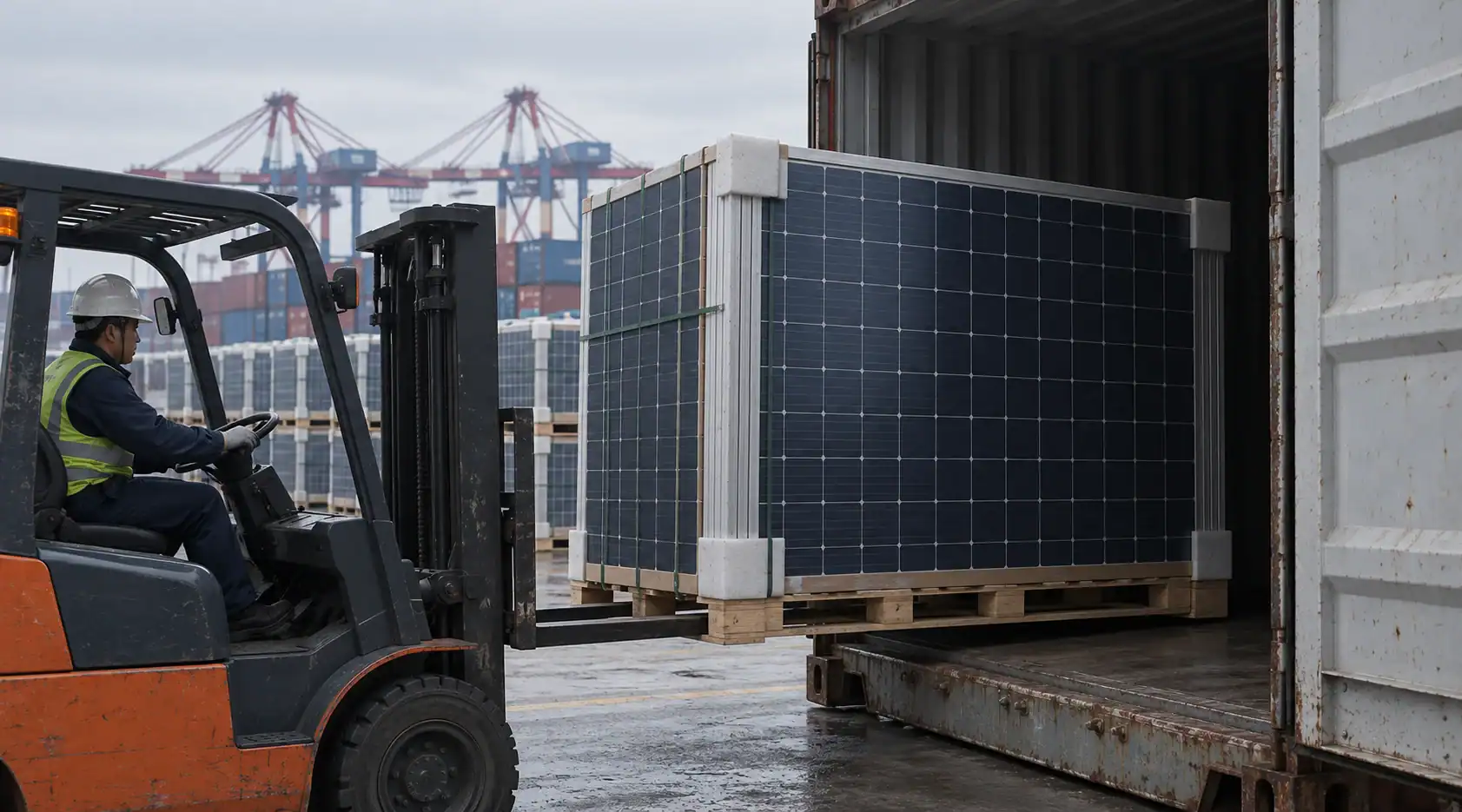
FCL is strongly preferred over LCL for panels. Co-loading in LCL means your panels are handled by forklift alongside other cargo, sometimes multiple times between Chinese port consolidation and Australian deconsolidation. Each handling event introduces breakage risk. A 40ft High Cube container holds approximately 1,500–2,000 residential panels (depending on wattage and manufacturer carton dimensions). For any order above 10–12 CBM, FCL is safer and typically cheaper on a per-panel basis.
Packing specifications: Panels should be palletised in manufacturer cartons, in portrait orientation, with adequate corner protection. Require packing photos and packing lists with carton-level serial numbers from your Chinese supplier. This matters for two reasons: customs clearance at the Australian end (the CER requires serial number reporting for STC claims), and insurance claims if breakage occurs.
Cargo insurance is essential. A marine all-risk policy covering breakage should be standard on panel shipments. Glass breakage is excluded from standard marine policies unless specifically endorsed. Confirm the policy wording with your insurer before the first shipment.
Wooden packaging and ISPM 15: Solar panels are typically palletised on treated timber pallets. All wooden packaging must comply with ISPM 15, the international standard for heat treatment or fumigation of wooden packaging material. A fumigation certificate must accompany the shipment. Non-compliant packaging is treated at the importer’s cost on arrival or destroyed. Australia’s biosecurity import conditions apply to the packaging of all imported goods, not just the goods themselves.
Chinese Manufacturing Hubs and Transit to Australia
Main manufacturing regions:
- Jiangsu and Zhejiang provinces: LONGi, JA Solar, Trina Solar, and Canadian Solar production facilities. Export primarily through Shanghai and Ningbo ports.
- Guangdong province: BYD (battery storage and panels) and other Shenzhen-area manufacturers. Export through Yantian (Shenzhen) and Guangzhou (Nansha).
Transit times to Australia:
- Shanghai / Ningbo to Sydney or Melbourne: approximately 16–22 days FCL
- Yantian (Shenzhen) to Sydney: approximately 14–18 days FCL
- Add 2–5 business days for ABF customs clearance after vessel arrival
Australian destination ports: Sydney (Port Botany) and Melbourne are the primary entry points for solar equipment. Brisbane, Adelaide, and Fremantle also handle significant volumes for state-level projects.
GST of 10% applies to the customs value plus duty plus international freight and insurance. For 0% duty solar equipment, the GST base is essentially customs value plus freight costs. Model this correctly in your landed cost calculation.
The Import Compliance Checklist
| Requirement | Authority | When Required |
|---|---|---|
| HS code confirmed | ABF | Before first import |
| ChAFTA Certificate of Origin | CCPIT / CIQ (China) | Each shipment; for racking at 5% MFN rate |
| IEC 61215 + IEC 61730:2023 (panels) | CEC / accredited lab | Before CEC listing application |
| AS/NZS 4777.2 (inverters) | CEC / EESS | Before EESS registration and CEC listing |
| CEC Approved Products listing | Clean Energy Council | Before STC-eligible sales |
| EESS Responsible Supplier registration | EESS | Before placing inverters on market |
| ISPM 15 fumigation certificate (packaging) | DAFF | Every shipment with timber pallets |
| Serial number reporting to CER | Clean Energy Regulator | For each STC-eligible panel batch |
| Marine cargo insurance (all-risk, breakage endorsed) | Insurer | Every shipment |
| Import Declaration | ABF (via customs broker) | Every shipment above AUD $1,000 |
Here is the contradiction worth sitting with. Australia runs anti-dumping cases against Chinese steel, aluminium and glass, yet waves Chinese solar panels in at zero duty. The obvious reading is inconsistency. The more useful reading is that trade policy here is not really about protecting local production. Australia barely makes panels. It is about a decarbonisation target that outranks the protectionist instinct. That tells you something about durability: a 0% duty defended by an emissions commitment is far harder to reverse than one defended by an industry lobby. Import on the assumption the policy holds, but understand exactly why it holds.
Ready to Import Solar Equipment from China?
Swift Cargo handles FCL and LCL freight from China to Australian ports, with customs brokerage, ISPM 15 compliance coordination, and cargo insurance guidance. For importers setting up or scaling a solar program, request a freight assessment from Swift Cargo.
Frequently Asked Questions
What is the import duty on solar panels from China to Australia?
Solar panels (HS 8541.40) are classified as semiconductor devices and attract 0% duty under both the general MFN rate and ChAFTA. Inverters (HS 8504.40) and lithium-ion battery storage (HS 8507.60) are also 0% under ChAFTA with a valid Certificate of Origin. GST of 10% applies regardless. Australia does not currently have anti-dumping measures on Chinese solar panels, unlike the United States.
Do solar panels need to be on the CEC Approved Products List before I can import them?
CEC listing is not required to import panels into Australia, but it is required for those panels to be eligible for STCs (Small-scale Technology Certificates) under Australia’s Renewable Energy Target. If your customers or installers rely on STC rebates, only CEC-listed panels qualify. Apply for listing via the Clean Energy Council before or immediately after your first import.
What is EESS and do I need to register as an importer of solar inverters?
EESS is the Electrical Equipment Safety System, Australia’s national framework for electrical equipment compliance. Importers of grid-connected inverters must register as a Responsible Supplier in the EESS database with a valid ABN and ensure each product model has current registration. Inverters must comply with AS/NZS 4777.2 (grid connection) and AS/NZS 61000 (EMC). Registration is required before the goods are placed on the market.
Is FCL or LCL better for shipping solar panels from China?
FCL (Full Container Load) is strongly preferred for solar panels. Panels are fragile: they are typically glass-faced and palletised in manufacturer cartons. Co-loading in LCL introduces additional handling by forklift and other cargo, which increases breakage risk. For any order above approximately 10–12 CBM, FCL is safer and often cheaper per panel. A 40ft HC container holds approximately 1,500–2,000 residential panels depending on wattage.
Are there anti-dumping duties on Chinese solar panels in Australia?
No. Australia currently has no anti-dumping or countervailing duties on solar panels from China. This is a meaningful difference from the United States, which applies tariff rates of 14.25–250%+ on Chinese solar imports depending on the manufacturer. Australian importers source Chinese solar equipment without the punitive tariff burden that affects US competitors.