
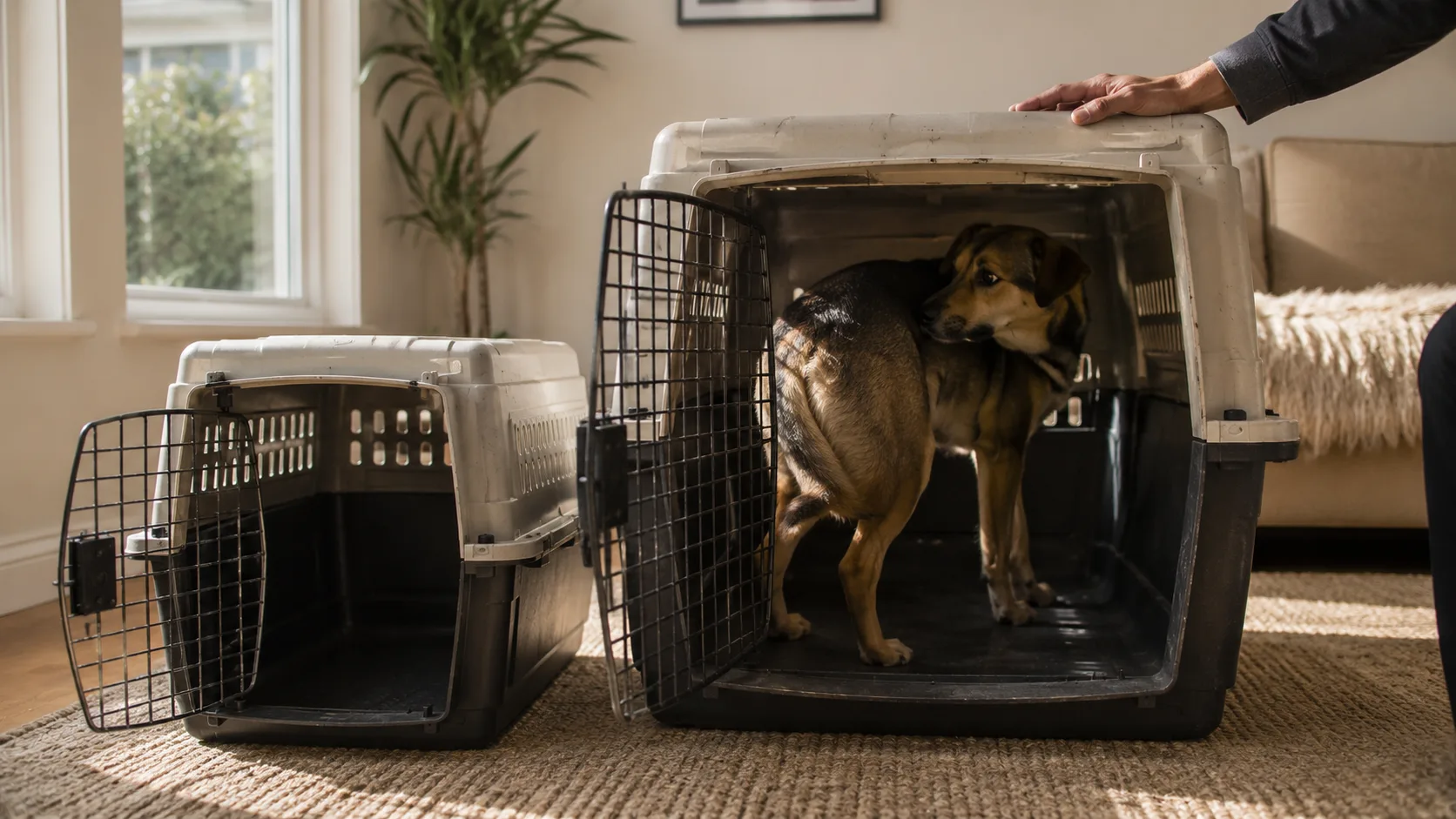
A crate that’s one size too small gets a pet turned away at check-in, sometimes with the flight already booked and the owner already at the airport. A crate that’s one size too large doesn’t just look generous. It lets an animal slide and be thrown around during turbulence or ground handling instead of bracing naturally against the sides. It also gets billed more, because airlines charge freight on the crate’s volume, not the animal’s weight. The right size comes from a formula, not a guess or a rounding-up-to-be-safe decision. The formula uses four measurements of your specific pet and produces one correct answer. Knowing how to measure dog for international flight crate requirements the right way, using the actual IATA method instead of a size chart, is what gets a booking through check-in on the first try.
Most rejected crates at check-in weren’t bought carelessly. They were sized off the dog’s weight, or a size chart for a “medium dog,” or the biggest crate that would fit in the back of the car. None of those methods are what an airline actually checks against.
Why Body Weight Is Not Enough
Weight tells you almost nothing about the shape a crate needs to accommodate. A 20kg dog with short legs and a long body needs a different crate footprint than a 20kg dog that’s tall and narrow. IATA’s container requirements are built entirely from the animal’s actual body measurements instead: length, height and width. Two pets of identical weight can need very different crates. If a size chart or an online calculator asks only for your pet’s weight and breed, treat its output as a rough starting point, not a number to check in with.
The Four Measurements, and the Formula That Uses Them
Take these four measurements with your dog standing naturally, not sitting or stretching:
- A. Body length: from the tip of the nose to the base of the tail (not the tip of the tail itself)
- B. Elbow height: from the floor straight up to the elbow joint of a front leg
- C. Width: across the widest part of the body, usually the shoulders or hips
- D. Standing height: from the floor to the top of the head, or to the tip of the ears for breeds with erect ears, whichever is taller
The minimum interior crate dimensions are then: Length = A + half of B, Width = C × 2, and Height = D (with a small additional allowance for bedding thickness). The formula guarantees the animal can stand upright, turn around, and lie down in a natural position, which is the actual welfare standard it exists to protect. Round every measurement up to the nearest whole centimetre or inch. Never round down to make a smaller, cheaper or more convenient crate work.
Here is the formula run on two illustrative dogs, using hypothetical measurements rather than any real animal. Both weigh 20kg. Dog one is long and low: A 70cm, B 15cm, C 24cm, D 35cm. Length is 70 plus 7.5, rounded up to 78cm; width is 24 doubled, 48cm; height is 35cm before the bedding allowance. Dog two is tall and narrow: A 60cm, B 33cm, C 20cm, D 60cm. Length is 60 plus 16.5, rounded up to 77cm; width is 40cm; height is 60cm. The lengths land one centimetre apart, but the crates do not: about 131,000 cubic centimetres for dog one and 185,000 for dog two. Divide each by 6,000, the volumetric divisor used for air freight, and that is roughly 22kg against 31kg of chargeable volume for two dogs of identical weight. The wrong turn is to pick a crate from the weight, which would likely point both dogs to the same box. Run the formula on your own dog’s four numbers first, write the result on the worksheet below, and only then compare crate listings.
Cat Sizing: The Same Formula, a Different Starting Point
Cats use the identical A/B/C/D formula, not a separate cat-specific method. The difference is practical, not mathematical. Cats are more likely to fit a manufacturer’s standard small or medium crate size without needing a custom build, but it’s still worth measuring rather than assuming a “cat-sized” label means your specific cat fits. A larger, more solidly built cat can need the next crate size up from what the breed’s general reputation suggests.
Head and Ear Clearance
Stand next to a German Shepherd or a Siamese cat and look closely at where the silhouette actually ends. It isn’t the skull. On an animal with upright, erect ears, the true highest point of the body is the tip of the ear, sometimes two or three centimetres above where a casual glance would stop. Standing height (measurement D) must be taken to whichever is taller, skull or ear tip, precisely because that gap is so easy to miss when you’re measuring quickly. Get it wrong and the crate is technically too short by a small, specific margin. That’s the kind of error that gets caught at check-in, not at home with a tape measure and a second look. This is exactly why learning how to measure dog for international flight crate compliance means measuring to the ear tip, not just the skull, on any animal with erect ears.
Door, Fastener and Ventilation Requirements
The crate halves need metal nuts and bolts, not plastic clips alone. These are among the most common reasons a crate gets rejected at the airport, even when the size is otherwise correct. Ventilation needs to run on all four sides, not just the door, so airflow continues even if the crate is positioned close to another shipment. The door itself needs to latch securely enough that it can’t be nudged open by the animal from the inside, but must still be operable quickly by ground staff in an emergency.
Water Bowls and Bedding
Attachable, spill-resistant water access is required and needs to be refillable from outside the crate without opening the door. Ground handling staff need to be able to top up water without a loose animal on the tarmac. Bedding should be absorbent and not so thick it works against the crate’s calculated interior height, since the formula’s height allowance already accounts for a normal bedding layer, not a thick padded one.
Plastic Versus Wooden Crates
Standard hard plastic kennels are the default choice for most dogs and cats and meet requirements unmodified when correctly sized. Larger and giant-breed dogs sometimes need wooden or timber-reinforced crates instead, partly because very large plastic crates aren’t always manufactured in the required dimensions, and partly because certain size and weight thresholds call for stronger materials under container specifications. If your dog’s calculated dimensions sit near or above the largest commercially available plastic option, ask your operator whether a wooden or reinforced build is the more realistic path before you buy a plastic crate that might still be rejected.
Giant Dogs: When the Formula Outgrows the Shop Shelf
Some giant breeds produce formula dimensions that exceed the largest standard manufactured crate sizes entirely. Large mastiffs, great danes and similarly proportioned dogs are common examples. When that happens, a custom-built crate to the exact required specification is often the only compliant option, and custom builds take real lead time to source or construct properly. A custom crate ordered too late can become the single reason a travel date has to move, so confirm this the moment you know your dog’s approximate adult size, not in the weeks before travel.
Snub-Nosed Animals: A Separate Set of Rules
Brachycephalic (snub-nosed) breeds carry an elevated risk of breathing difficulty under travel stress, and many airlines restrict or refuse them in the cargo hold entirely, independent of crate size or health status. Common examples include pugs, bulldogs, boxers and Persian cats. Where a brachycephalic animal is accepted, the crate typically needs to be larger than the standard formula produces, to improve airflow. Confirm your specific airline’s brachycephalic policy before you assume a larger crate is what solves the problem. For many carriers, no crate size changes the answer.
Why “IATA Approved” Is Not a Universal Product Certificate
IATA does not certify, approve, endorse or sell any specific pet container manufacturer, brand or model. IATA instead publishes the container requirements that any crate must meet: the dimensional formula and the construction standards described throughout this guide. When a listing advertises a product as “IATA approved,” that phrase means the manufacturer itself claims the product meets IATA’s published specifications, not that IATA issued a certificate for that specific item. In practice this means the brand name on the box matters far less than whether a crate correctly sized for your specific pet meets the construction requirements above. A well-built crate from a manufacturer you’ve never heard of that’s correctly sized beats a famous-brand crate that’s the wrong size for your dog.
A Legal Standard Built the Same Way
IATA isn’t the only standard that ties crate size to an animal’s actual body measurements rather than a fixed chart. Under United States federal animal welfare housing rules, 9 CFR 3.6 calculates minimum floor space for a dog as the square of its nose-to-base-of-tail length in inches plus six inches, divided by 144 for square feet. Interior height must be at least six inches taller than the tallest dog’s head in a normal standing position. It’s a different formula for a different context, kennel housing rather than international air freight, but the underlying logic is identical to IATA’s: crate size is calculated from the individual animal, not selected from a generic chart.
Metric or Imperial? Why the Number on the Box Can Mislead You
Australia measures in centimetres; a lot of the crates sold online are specified in inches, especially from US-based manufacturers. This sounds like a trivial conversion until you’re comparing your own tape-measure numbers in centimetres against a product listing in inches at eleven at night, tired. That is when it’s easy to misplace a decimal point or round the wrong direction. Convert once, write both numbers down on your worksheet, and compare the crate’s listed interior dimensions specifically. Exterior dimensions are usually a few centimetres larger on every side and are not the number that matters for compliance.
Multiple Pets in One Crate
IATA’s shared-container allowance permits up to two adult animals in a single crate, provided they are compatible in size, genuinely used to cohabiting, and each weighs no more than 14 kg. That’s a real option for two cats or two small dogs that already share a bed at home. Animals above that weight threshold must be crated individually regardless of how well they get along. Sharing a crate isn’t available as a cost-saving choice for animals that don’t already cohabit peacefully; it’s a welfare-scoped allowance, not a discount mechanism.
The Four-Week Crate Acclimation Plan
A correctly sized crate that a dog or cat has never spent real time in is still a stressful surprise on travel day. Start at least four weeks out:
- Week one: Leave the crate open and accessible in a normal living space, door propped open, with meals or treats placed just inside. Build purely positive association: no closed doors yet.
- Week two: Begin closing the door for short periods, a few minutes at a time, while you’re in the room, gradually extending as your pet stays calm. Add the exact bedding you’ll use for travel so the texture and smell are already familiar.
- Week three: Extend confinement periods to an hour or more, including some time with you out of the room, and introduce short car rides in the crate to help your pet tolerate motion and unfamiliar sound.
- Week four: Aim for calm tolerance of several hours in the crate, including at least one longer outing that mimics real travel conditions: noise, movement, time away from home. Do a final hardware check: fasteners secure, water bowl attached and working, identification and travel labels attached.
An anxious pet, or one that’s never been crated at all, may need longer than four weeks. Starting early is always the safer direction to be wrong in.
Printable Crate Measurement Checklist
Print this section, or take a screenshot, and fill it in by hand with a tape measure next to your pet.
Crate Measurement Worksheet
Pet name: _____________________ Date measured: _____________
Species / breed: _____________________ Weight: _____________
Step 1: Take the four measurements (standing naturally)
A. Nose to base of tail: __________ cm
B. Floor to elbow: __________ cm
C. Width at widest point: __________ cm
D. Floor to top of head or ear tips (taller of the two): __________ cm
Step 2: Calculate minimum crate dimensions
Minimum length (A + half of B): __________ cm
Minimum width (C × 2): __________ cm
Minimum height (D + bedding allowance): __________ cm
Step 3: Pre-travel hardware check
☐ Metal nuts and bolts joining the crate halves (not plastic clips alone)
☐ Ventilation openings on all four sides, unobstructed
☐ Water bowl attached and refillable from outside without opening the door
☐ Absorbent bedding fitted, not so thick it reduces usable height
☐ Door latches securely and cannot be nudged open from inside
☐ Live Animal labels and travel documentation pouch attached
☐ Crate acclimation started at least four weeks before travel
Common Rejection Reasons
The same handful of issues account for most check-in rejections. Undersizing, even just below the calculated minimum, is the single biggest cause. Plastic clips in place of metal nuts and bolts are the second most common cause. The list also includes missing or blocked ventilation, water access that requires opening the crate to refill, wheels left attached or not fully immobilised, and a crate with visible cracks or structural damage. Every one of these is preventable with the worksheet above and a hardware check the week before travel, not the morning of.
How to Measure Dog for International Flight Crate: Quick Recap
Take the four measurements (length, width at the widest point, height to the ear tip, and elbow-to-ground) with the animal standing naturally, then apply the formula rather than a breed chart or a weight estimate. Getting how to measure dog for international flight crate sizing right the first time avoids a rejected crate at check-in and the rebooking costs that follow it.
Frequently Asked Questions
How do I measure my dog for an international flight crate?
Take four measurements while your dog is standing naturally: nose to the base of the tail (not including the tail itself), floor to the elbow of a front leg, width across the widest part of the body, and floor to the top of the head or ear tips, whichever is taller. The minimum crate length is the nose-to-tail measurement plus half the elbow height, the minimum width is the body width doubled, and the minimum height is the standing height. Round up, never down.
Is a bigger crate always safer than the minimum size?
No. A crate that is too large lets an animal be thrown around during turbulence or ground handling instead of bracing naturally against the sides. It also increases the dimensional weight your freight is charged on. The goal is the correct size, enough room to stand, turn around and lie down naturally, not the largest crate that will fit through the door.
Does “IATA approved” mean a specific crate brand is certified?
No, and this is one of the most common misunderstandings in pet travel. IATA does not certify, approve or endorse any specific manufacturer, brand or model. It publishes container requirements that any crate must meet. When a product is marketed as “IATA approved,” that means the manufacturer claims their product meets IATA’s published specifications, not that IATA issued a certificate for that item.
What size crate does a giant dog breed need?
Whatever the formula produces from that specific dog’s actual measurements, even if that means an XL or custom-built crate. Some giant breeds exceed the largest commercially manufactured standard crate sizes entirely, which means a custom-built, IATA-specification crate may be the only compliant option; since custom builds take time to source or construct properly, confirm this well before travel.
Do snub-nosed dogs and cats need a different crate?
Where airlines accept brachycephalic (snub-nosed) breeds at all, the crate typically needs to be larger than the standard formula would produce, to improve airflow. Many airlines restrict or refuse brachycephalic breeds in the cargo hold entirely regardless of crate size, due to their elevated breathing-related risk, so confirm your specific airline’s breed policy before assuming a bigger crate solves the problem on its own.
How long does it take to crate train a dog for a flight?
Plan for at least four weeks of gradual acclimation before travel, longer for an anxious or previously uncrated dog. Rushing this step is one of the most common causes of a stressed animal on travel day, which is avoidable with early planning. Start the moment you know your travel date, not the week before.
Crate requirements are set by international standards but enforced airline by airline, so confirm your specific carrier’s current policy before you buy. Send us your pet’s measurements and travel route, and we’ll confirm the crate specification before you order one that might not fit.
