

The question most owners actually lie awake with is not “can my dog fly overseas.” It’s “will my dog still be entirely himself when he lands.” Nobody asks a vet that second version out loud, so they ask the first one instead, get a technically correct answer, and never quite address the fear underneath it.
Here is the honest version. Age alone disqualifies almost nothing. Airlines and IATA’s own Live Animals Regulations set a minimum age for flying (eight weeks, fully weaned) but neither sets a blanket maximum. A settled 14-year-old terrier with unremarkable bloodwork is not automatically a higher-risk passenger than a 6-year-old with a new, unstable heart murmur. What actually gates fitness to fly is the animal’s clinical picture this month, confirmed by a vet who has examined it recently, not the birthdate on the microchip record.
Age Versus Fitness: Two Different Questions
Treat “how old is my pet” and “is my pet fit to fly” as separate questions with separate answers, because conflating them causes mistakes in both directions. Some owners assume a healthy 12-year-old cat is automatically too fragile to travel and cancel a move that would have been fine. Others assume a young pet is automatically low-risk and miss a genuinely dangerous condition because nobody framed the question as a fitness assessment rather than a birthday check.
A proper fitness assessment looks at four things together: whether any diagnosed condition is currently stable, whether current medication doses have settled or are still being adjusted, whether recent bloodwork or imaging supports the vet’s impression rather than relying on how the animal seems in the exam room that day, and how the specific journey interacts with that condition, including crate time, altitude, time-zone shift and handling stops. Two pets with the same diagnosis can get two different, equally correct answers depending on how well-controlled each one currently is.
Respiratory and Cardiac Disease
Most commercial aircraft cabins and cargo holds are pressurised to the equivalent of roughly 6,000 to 8,000 feet of altitude, not sea level. A healthy heart and healthy lungs absorb that difference without the animal noticing. The actual mechanism that makes this risky for a compromised heart is not that altitude directly damages it. It’s that a heart or lung system already running with a reduced reserve has less spare capacity left to compensate for hypobaric stress layered on top of crate confinement, cooler cargo-hold air, and hours of restricted movement. The reserve, not the altitude alone, is what runs out.
This is why a vet needs to assess cardiac and respiratory disease specifically before clearing a pet to fly, rather than issuing a general health certificate from memory of a checkup months earlier. Pets with significant heart or lung disease are generally better suited to cabin travel than cargo, where a person can observe them directly. In more serious cases, a vet may recommend oxygen support planning or advise against flying to altitude at all. Pugs, French bulldogs, Persian cats and other flat-faced (brachycephalic) breeds carry elevated baseline respiratory risk regardless of age, which is why most cargo carriers restrict or decline them outright. That’s a real factor for owners of these breeds to weigh, though it’s a large enough topic to deserve its own dedicated guide rather than a few paragraphs here.
Kidney Disease and Dehydration
Dehydration is the specific mechanism that makes kidney disease and air travel a bad combination. According to the Merck Veterinary Manual’s clinical reference on renal dysfunction in dogs and cats, kidneys already operating with reduced function are compensating for lost capacity by working harder on whatever fluid and filtration reserve remains. Travel is exactly the kind of stress that reduces water intake, at the exact moment the kidneys can least afford it.
Practical management starts before departure, not at the airport. Offer water right up until crating rather than restricting it out of a mistaken worry about accidents in transit, and ask your vet whether a pre-travel subcutaneous fluid session makes sense as a buffer before a long journey. It’s a routine, well-tolerated procedure for pets with reduced kidney function. A bowl typically sloshes empty in the first hour of movement. A slow-melt ice cube in the crate’s water dish is a small detail that keeps water genuinely available for longer than most owners assume.
Diabetes and Insulin Timing
The problem with flying a diabetic pet is rarely the flight itself. It’s the clock. A dose that has been perfectly timed against breakfast and dinner for years suddenly has to survive a journey that crosses time zones, disrupts feeding, and puts hours between the pet and the person managing its care. Get a written plan from your vet, not a verbal one. It should specify exact dosing times keyed to your home time zone for the outbound leg, with a clear point at which you switch to destination-time dosing once settled.
Insulin belongs in temperature-controlled carry-on luggage, never in checked baggage or unattended cargo, where hold temperatures are not guaranteed to stay within the narrow range insulin needs. The single most dangerous combination for a diabetic pet in transit is a missed or delayed meal paired with an on-schedule insulin dose. Plan feeding around realistic handling windows, not the timetable you’d prefer, and build in a buffer of extra food and glucose-monitoring supplies in case a connection runs long.
Epilepsy and Medication
Well-controlled epilepsy on a stable regimen is usually compatible with flying. Phenobarbital, levetiracetam and potassium bromide are the medications with the strongest evidence behind them in veterinary neurology, according to guidance published in Today’s Veterinary Practice. The two things that are not negotiable are medication timing and dietary consistency: doses should stay on schedule through the journey, and if your pet is on a specific diet as part of seizure management, that diet needs to travel with it rather than being substituted at the last minute for whatever is convenient.
Travel anxiety itself can lower the seizure threshold in some epileptic dogs, which is a separate risk from the medication logistics and worth a specific conversation with your vet about anxiety management that avoids sedation. Pack noticeably more medication than the trip requires, and brief whoever is handling your pet, whether that’s a driver, kennel staff or a cargo agent, on what a seizure looks like for this specific animal and what they should do if one starts before you’re reunited.
Mobility, Arthritis, and Crate Fit
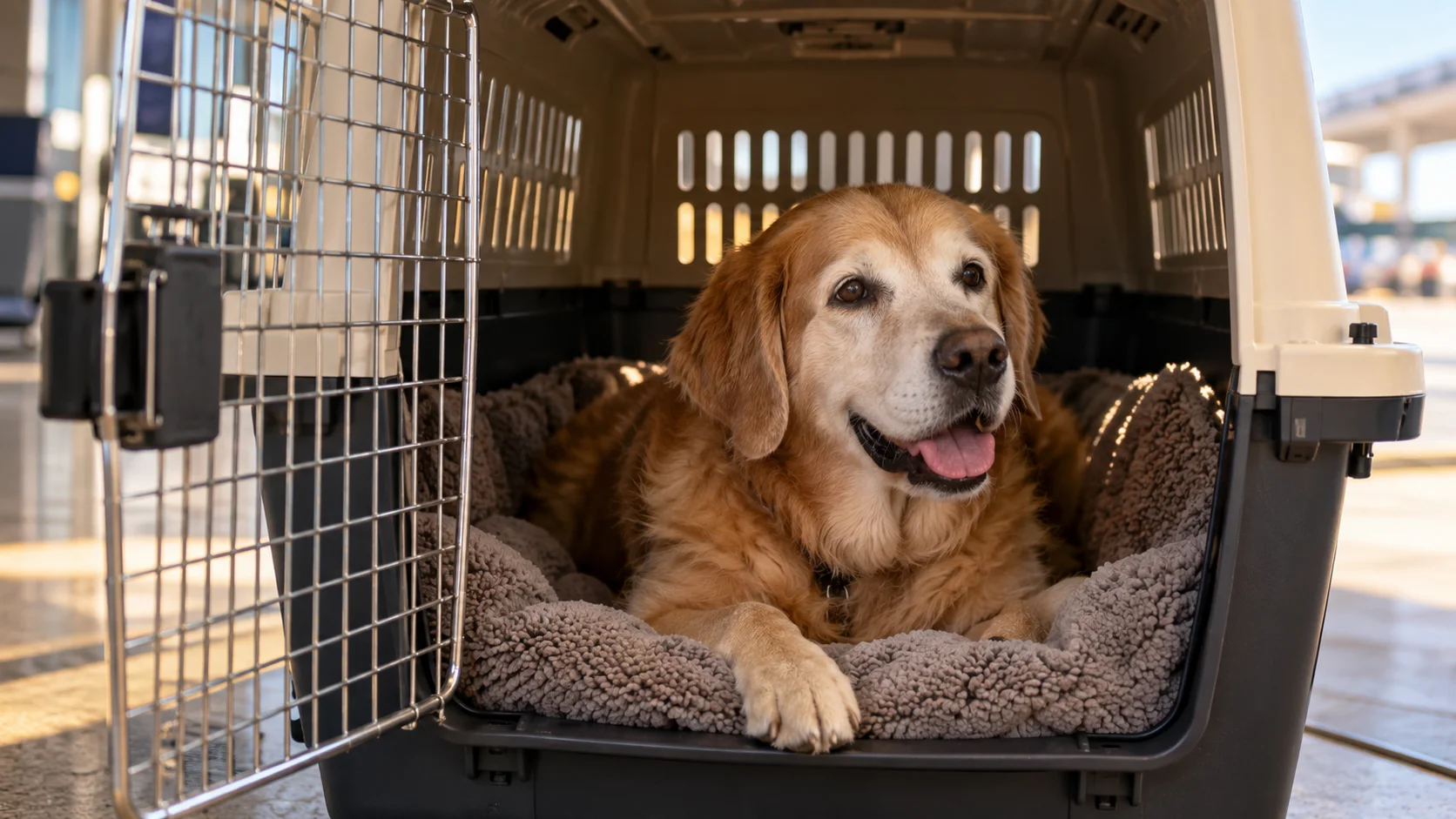
IATA’s minimum crate sizing is calculated for a healthy animal to stand, turn around and lie down. It is not calculated with an arthritic pet’s reduced range of motion in mind. A senior dog with hip or spinal arthritis often needs a crate genuinely larger than the size chart’s bare minimum to turn comfortably without jarring a stiff joint. Non-slip bedding matters too: a slick crate floor turns ordinary in-flight movement into a pet sliding and bracing against a joint that can’t absorb the strain well. Ask your vet about a short course of joint support or pain management timed around travel day specifically, not just the everyday maintenance dose.
One question comes up more than owners expect: can two senior pets from the same household share a single crate to keep each other calm? Airlines generally allow shared kenneling only for compatible animals of similar size where both can still turn and lie down without restricting the other. The rule is built around young, same-litter animals, not two arthritic seniors who each need their own turning space. Confirm this directly with your airline or handler rather than assuming it applies. For most medically complex senior pairs, two right-sized crates travelling together is the safer plan.
Appetite and Anxiety
An anxious pet that stops eating the day before travel is common enough that it shouldn’t be treated as an emergency on its own, but it is a reason to loop your vet in rather than push forward and hope. The Australian Veterinary Association’s own policy on medicating animals for air transport is unambiguous on one point: dogs and cats should not be sedated for air transport, because sedation blunts cardiovascular and respiratory function, impairs balance, and increases aspiration risk if a stressed animal drinks water while still groggy. That is the opposite of what a nervous flyer needs. Non-sedating anxiolytic medication is the appropriate tool, trialled at home under vet supervision well before the actual travel day so you know how your specific pet responds. Pheromone products in the crate can help at the margins, but they are a supplement to a real anxiety plan, not a substitute for one.
Long Flights Versus Multi-Stage Moves
A direct flight and a connecting itinerary are not the same trip with a different price tag when the passenger is medically complex. Every additional leg adds a handling transfer, a wait on the tarmac, and another window where nobody with direct knowledge of your pet’s condition is the one making decisions. For Australia-to-Thailand routes specifically, that argues for weighing departure city against total transit time and touchpoints, not just fare. A direct service from a capital with genuine cargo capacity to Bangkok is often the lower-risk option for a medically complex pet even when it isn’t the cheapest one on the board. Total time in the system, from the first crate door closing to the last one opening, is the number that matters for a fragile traveller, not the number of hours spent airborne alone. See our comparison of which Australian airport actually offers the best pet flight to Thailand for that trade-off worked out city by city, and our breakdown of Australia to Thailand pet transport costs for why the cheapest routing and the lowest-risk routing are not always the same booking.
Boarding and Quarantine Implications
If your pet’s journey includes an Australian import and a stay at the country’s post-entry quarantine facility, declare medical complexity formally in the import permit application’s special-needs section. Don’t mention it for the first time on arrival day. Some medication and monitoring arrangements have to be coordinated with an Australian veterinarian in advance and cannot be organised on short notice once your pet is already in the system.
Australia’s own biosecurity guidance on quarantine confirms that pets with serious or chronic medical conditions can be transferred from the quarantine facility to the University of Melbourne’s veterinary hospital in Werribee for treatment while remaining under biosecurity control, but that treatment is invoiced separately from the standard quarantine fee, not bundled into it. Owners of medically complex pets moving through Australia’s system should read our full walkthrough of what happens inside Mickleham quarantine day by day. Knowing the process in advance makes it much easier to plan around a pet’s specific medical needs rather than react to them once the clock has already started. Our broader guide to Australia’s biosecurity import requirements is worth reading if this move is a fixed-term posting rather than a one-way trip, since re-entry rules add a second layer of planning for a pet with an ongoing medical need.
Questions for the Veterinarian: A Decision Worksheet
Bring this list to the pre-travel vet appointment and leave with written answers, not a verbal impression you’re recalling three weeks later at the airport. A vet who is asked these questions directly, in this order, tends to answer far more usefully than one asked the general “is my pet OK to fly.”
| Question to ask | Why it matters for this trip |
|---|---|
| Has this condition changed in the last four weeks, in either direction? | Recent instability is the single strongest reason to delay, regardless of diagnosis |
| Does recent bloodwork, an ECG or imaging support flying, or are we relying on how they seem today? | A physical impression can miss what a test would catch |
| Exactly what time should each dose be given, keyed to departure time zone, for the outbound leg? | Verbal dosing plans get forgotten or misremembered mid-journey |
| Does the crate need to be larger than the standard size chart for this animal’s mobility? | Standard sizing assumes full range of motion |
| Is sedation appropriate here, or only a non-sedating anxiolytic? | The two are not interchangeable and carry different risks |
| What does an emergency look like for this specific pet, and what should a handler do if it happens in transit? | Generic advice is less useful than a plan written for your actual animal |
| How close to travel date can the health certificate be signed, and does that window fit the itinerary? | Certificates typically expire within days, not weeks, of the flight |
| In your professional opinion, should this specific animal fly on this specific timeline? | Ask directly. A hedge is an answer too. |
The worst moment to decide whether an older animal should fly is the week of the flight, once the relocation fee is paid and the lease at the other end has already started. A borderline result then competes with money already spent, and sunk cost quietly argues for going. Settle the stop conditions at the first vet appointment instead, while nothing is committed. Agree in writing which specific findings would postpone the trip, such as a new medication started within a set number of weeks of departure, or a kidney or heart marker past a level the vet names. Then ask your transport provider exactly what a postponement costs under their rebooking terms. A delay with a known price is far easier to choose on the day than one whose cost you would be guessing at.
When Delaying or Declining Travel Is Responsible
Nobody wants to hear that the trip they’ve planned around a job, a lease or a visa needs to move. But a two-to-four-week delay is a genuinely small cost, whether it’s spent restabilising a diabetic pet’s insulin dose or reassessing a heart condition after a medication change. A crisis in a cargo hold or in an unfamiliar airport with no vet nearby is not small, and it is not something the destination end of the journey can fix after the fact.
The clearest signal to delay is a vet who hedges instead of clearly endorsing travel. If the honest answer is “I’d feel better if we waited a few weeks,” that is not an obstacle to solve by asking a different vet until one signs the certificate. It’s the answer. The pets who travel best internationally are the ones whose owners treated a vet’s caution as useful information rather than as paperwork standing between them and a booked flight.
Frequently Asked Questions
Can an old dog fly internationally?
Age by itself does not disqualify a dog from flying. Airlines and IATA’s Live Animals Regulations set a minimum travel age of eight weeks but no blanket maximum age. What actually decides fitness to fly is the animal’s current clinical stability, confirmed by a veterinarian close to departure, not the number of birthdays on file. A well-managed 13-year-old with stable bloodwork can be a lower-risk traveller than an unstable 4-year-old with a new diagnosis.
Should I sedate my pet for a long international flight?
No. The Australian Veterinary Association’s own policy on medicating animals for air transport states that dogs and cats should not be sedated for air transport, because sedation can blunt cardiovascular and respiratory function at exactly the altitude where an animal has the least reserve to spare, impair balance and body-temperature control, and raise aspiration risk. Non-sedating anxiolytic medications are the appropriate alternative for an anxious flyer, trialled with your vet well before travel day.
Can a diabetic dog or cat fly on a long-haul flight?
Often yes, but only with a written insulin and feeding plan from your vet that accounts for the time-zone shift, not just the home-timezone dosing schedule. Insulin needs to travel in a temperature-controlled carry-on, never in checked cargo. Feeding needs to stay as close to on-schedule as the journey allows, since a missed meal paired with a normal insulin dose is the specific combination that causes a dangerous low.
Is it safe to fly a dog with epilepsy?
Usually yes if the epilepsy is well-controlled on a stable medication regimen. But the seizure medication and feeding schedule must not be interrupted by the journey, and travel stress itself can lower the seizure threshold in some dogs. Carry more medication than the trip requires, keep dosing times fixed against your home time zone until your vet advises otherwise, and brief your pet transport handler on what a seizure looks like for your specific dog and what to do if one happens in transit.
What questions should I ask my vet before flying an older or medically complex pet?
Ask whether the condition has been stable for at least four weeks, whether recent bloodwork or an ECG supports flying rather than a general impression, exactly how to time medication across the journey’s time zones, and whether the crate needs to be larger than the standard IATA minimum for comfortable turning given any mobility limitation. Then ask directly: in your professional opinion, should this specific animal fly on this specific timeline? This guide includes a vet decision worksheet covering these questions in full.
When should I delay or cancel a flight for an older or sick pet?
Delay or decline when a condition has changed in the last two to four weeks, when medication doses are still being adjusted rather than stable, when your vet hedges rather than clearly endorses travel, or when the only way to get a signed health certificate is to keep asking until someone says yes. A two-to-four-week delay to restabilise a pet is a minor cost. A medical crisis in a cargo hold or an unfamiliar airport is not.
Veterinary and airline guidance on medically complex pet travel is updated regularly, so confirm current crate standards, medication rules and certificate timing with your own vet and airline before you book. For a plan built around your pet’s specific medical needs, get a pet transport quote from SwiftCargo.