
Australia builds almost no bicycles. A handful of boutique frame builders aside, effectively every bike sold in the country (around 1.4 million units in a typical year) arrives in a container. That makes the bicycle trade one of the purest import businesses there is: no local manufacturing lobby, no anti-dumping duties, a flat 5% tariff that FTAs mostly erase, and a product the market never stops buying.
Then e-bikes happened. Electric bike sales in Australia have grown at rates the regulators never planned for, and the rulebook shows it. A pedal bike is governed by a consumer product safety standard written decades ago. An e-bike is simultaneously a consumer product, a road vehicle subject to state power limits, and a Class 9 dangerous good under international transport law because of its battery. Three regulatory regimes, one product, and an importer who often discovers the second and third regimes only after the container has sailed.
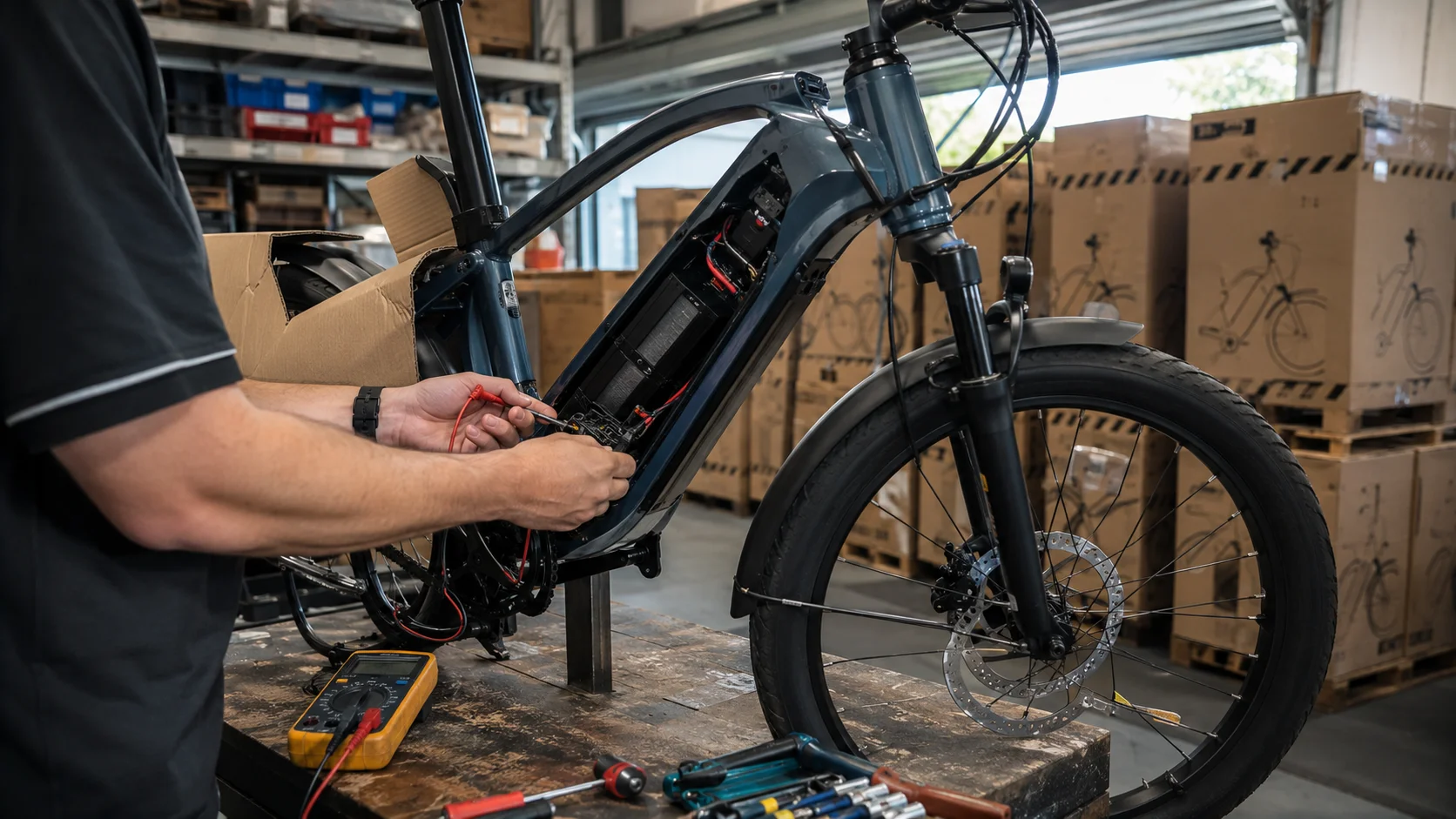
Layer one: the mandatory safety standard for pedal bicycles
Pedal bicycles are one of a small list of products with a mandatory safety standard under Australian Consumer Law, administered by the ACCC. The standard is based on parts of AS/NZS 1927, and it applies to bicycles as supplied to the consumer. That phrase is worth reading twice, because it determines who carries the obligation and in what state the bike must comply.
The core requirements cover:
- Braking. The bike must have compliant front and rear braking systems capable of meeting specified performance requirements. Fixed-wheel track bikes and some kids’ bikes have specific provisions, but a general-market adult bike needs two working brakes.
- Reflectors. Front, rear, wheel and pedal reflectors, fitted or supplied, meeting visibility requirements. This is the requirement factories most often get wrong for the Australian market, because reflector specs differ between destination markets and a factory running a European order alongside yours will happily fit the wrong set.
- Sharp edges and protrusions. No exposed sharp edges, protruding bolts beyond specified limits, and chain guard requirements on certain configurations.
- Assembly. If the bike is sold partially assembled (which almost every boxed direct-to-consumer bike is), it must come with adequate assembly instructions, and the bike as assembled per those instructions must comply. If your instructions are a photocopied generic sheet in mangled English, and a consumer assembles the brakes wrongly because of it, the compliance failure is yours.
Two boundary notes. First, the bicycle standard and the helmet standard are separate mandatory standards. If you bundle a helmet with a bike, the helmet needs its own compliance (AS/NZS 2063 basis) and its own certification trail. Do not assume a CE-marked helmet passes; European conformity does not automatically satisfy the Australian standard. Second, the standard applies at the point of supply to consumers. If you import semi-knocked-down bikes and your warehouse does final assembly, the compliant configuration is your responsibility end to end, including what your assemblers torque and fit.
The enforcement mechanism is Australian Consumer Law: the ACCC can compel recalls, and non-compliant supply attracts penalties per contravention, per bike, in the worst reading. For a 300-bike container, that is not a rounding error.
Layer two: e-bike power classes (the mistake that cannot be fixed after arrival)
Here is the number that governs the entire Australian e-bike market: 250 watts continuous rated power, pedal-assist, cutting out at 25 km/h. That is the EN 15194 framework (the European “pedelec” standard), which Australian states have adopted as the definition of a “power-assisted pedal cycle” that can be ridden without registration, licence or compulsory insurance. There is also an older 200W class that permits a throttle, but the EN 15194 pedal-assist framework is where the market lives.
The threshold logic is binary, and it is worth being precise because the consequences are asymmetric:
- ≤250W pedal-assist, 25 km/h cutout: a bicycle. Ride it anywhere a bike can go. No registration, no licence.
- Above that: a motor vehicle under state road law. And here is the trap: it is a motor vehicle that cannot be registered, because it was never designed or certified to Australian Design Rules for motor vehicles. It has no compliance pathway. It is legal to own, legal to ride on private property, and illegal to ride on any road or road-related area, which in most states includes footpaths and shared paths.
This is how importers destroy inventory without touching it. In Australia, the 500W and 750W “e-bikes” that dominate US marketplace listings are unregistrable motor vehicles. An importer who orders 200 of them from a Chinese factory lands a container of product that cannot lawfully be sold for road use, perhaps because the factory’s default export spec is built for the American market. There is no fine to pay and move on; there is no retrofit certificate. The realistic options are re-export, sale into a tiny off-road niche at a loss, or a very awkward conversation with a customs broker about what “recreational use only” labelling actually protects you from (approximately nothing, once the ACCC considers how the product is marketed and foreseeably used).
The throttle question deserves its own sentence: a throttle that propels the bike without pedalling pushes an EN 15194-class bike out of the pedelec definition in most state frameworks (the small 200W class and low-speed start-assist provisions aside). Factories fit throttles casually. Your purchase order should prohibit them explicitly, and your pre-shipment inspection should check for them, including “hidden” throttle connectors left in the loom for the dealer to activate, a genuine factory habit.
Practical rule: specify EN 15194 compliance in the purchase contract, require the test report from a recognised lab naming your model, and verify the motor’s rated power plate and controller firmware behaviour at inspection. Check with the state road authority in your primary market if your product sits anywhere near an edge case; the frameworks are aligned but not identical between states.
Layer three: the lithium battery (Class 9 dangerous goods)
Every e-bike battery worth selling is lithium-ion, typically 400–700 Wh. Anything above 100 Wh is fully regulated dangerous goods for transport, so every e-bike battery in commerce is a Class 9 dangerous good. This layer catches more first-time importers than the other two combined, because it is invisible on the product listing and unforgiving at the port.
UN 38.3: ask before you order, not before you ship
Before any lithium battery may be transported by any mode, the cell and battery design must have passed the UN 38.3 test series: altitude simulation, thermal cycling, vibration, shock, external short circuit, impact/crush, overcharge and forced discharge. The manufacturer must be able to produce a test summary, a standardised document identifying the battery, the testing body, and the tests passed.
The sequencing matters enormously. If you ask for the UN 38.3 test summary after production, and the supplier cannot produce one, you have a warehouse full of batteries in Shenzhen that no compliant carrier will load. Testing a battery design takes weeks and costs real money, which is precisely why the cheapest quotes skip it. So the question goes in the RFQ, before the deposit: provide the UN 38.3 test summary for this exact battery model, plus the MSDS/SDS. A supplier who responds with a certificate for a different capacity, a different cell brand, or a suspiciously generic document has answered your real question, which was “should I buy from you at all.”
Sea freight mechanics: UN 3480 vs UN 3481
Under the IMDG Code (the sea freight dangerous goods regime), the classification splits by how the battery travels:
- UN 3481: lithium-ion batteries contained in equipment or packed with equipment. A battery installed in the e-bike frame, or boxed alongside its bike, ships under this entry. Packing provisions are more forgiving because the equipment itself protects the battery.
- UN 3480: lithium-ion batteries shipped alone. Spare batteries, replacement stock, or batteries consolidated in their own cartons. Stricter packing (typically PI 965 equivalents under IMDG packing provisions), stricter state-of-charge expectations for some carriers, and higher DG surcharges.
Either way, the shipment needs a dangerous goods declaration, compliant UN-spec or provision-compliant packaging, Class 9 labels and lithium battery marks, and a carrier who has been told the truth on the booking. Air freight (IATA regime) is far more restrictive again: standalone lithium-ion batteries are effectively cargo-aircraft-only with tight state-of-charge limits, which is one reason e-bike logistics is a sea freight business.
The catastrophic version of getting this wrong is the undeclared shipment. A forwarder or carrier who discovers undeclared lithium batteries will at minimum refuse the cargo and at worst report it. Carriers do check, especially anything invoiced as “bicycle parts” from an e-bike factory. Fines for undeclared DG are severe, your marine insurance is void for the shipment (insurers do not cover cargo shipped in breach of the IMDG Code), and your name goes on a list at the shipping line. Ships have been lost to lithium battery fires. The industry’s patience for undeclared batteries is zero and falling.
The paper trail is a commercial asset, not just a compliance cost
Follow the documents downstream and the picture changes from burden to moat. The UN 38.3 test summary, the battery MSDS, the EN 15194 report, and the charger’s electrical safety approval make up that stack. RCM marking is part of that approval: the charger is regulated electrical equipment in its own right and needs certification to the relevant electrical safety standard, a whole parallel obligation. The stack is what your product liability insurer asks for when quoting you, what a marketplace demands before your listing goes live, and what your defence looks like if a battery ever does ignite in a customer’s apartment stairwell. The major Australian platforms have all tightened e-bike and battery listing requirements after well-publicised fires.
This is also the honest explanation of the price gap on Alibaba. The e-bike that costs US$180 less than its lookalike is usually cheaper because the battery uses uncertified cells, skips UN 38.3, and carries a BMS (battery management system) chosen by price alone. Battery fires are the e-bike industry’s reputational overhang, and nearly all of them trace to exactly this corner-cutting, plus incompatible aftermarket chargers. The certified paper trail is what separates your product from the fire statistics, and increasingly, it is what separates products that can be insured, listed and sold from products that cannot.
Duty, GST and FTA preference
The tariff picture is simple by Australian standards:
- Bicycles (including e-bikes): 5% general duty on customs value (FOB basis in practice).
- GST: 10% on the VoTI: customs value + duty + international freight and insurance. Recoverable as an input tax credit if you are GST-registered, so treat it as cash flow, not cost.
- China origin: 0% under ChAFTA with a valid Certificate of Origin or Declaration of Origin. Most volume e-bike production is Chinese; the CoO costs the supplier little and saves you the full 5%. Make it a documentary condition of payment.
- Vietnam origin: 0% under AANZFTA (or RCEP), same documentary discipline. Vietnam has absorbed significant bike assembly volume, partly as factories diversified out of China.
- Taiwan: no FTA with Australia. Taiwan builds much of the world’s best mid-to-high-end bike volume (the giants of the industry assemble there), and the 5% simply stands. Factor it into the comparison honestly: a Taiwanese bike at US$400 FOB carries US$20 of duty that its Chinese competitor does not. Sometimes the build quality is worth twenty dollars. Run the number rather than assuming.
Origin rules have teeth here: a bike assembled in Vietnam from a Chinese frame and Chinese groupset must still satisfy AANZFTA’s rules of origin (regional value content or tariff-shift tests) to claim preference. The Australian Border Force audits FTA claims, and the importer, not the supplier who issued the certificate, repays the duty if the claim fails. If your supplier’s origin story is complicated, get the CoO reviewed before you rely on it.
Freight mechanics: bikes are a volumetric cargo
Bikes are light and bulky, which makes them a cubic-metre business. The unit economics run off three numbers:
- Carton volume: ~0.25–0.35 CBM per boxed bike. A standard adult bike carton runs roughly 140 × 25 × 80 cm ≈ 0.28 CBM with the front wheel off, bars turned and pedals removed (the standard “85% assembled” export state). Kids’ bikes come in under 0.2; fat-tyre e-bikes with racks and fenders push 0.35+.
- Container loading: ~250–300 boxed bikes per 40ft high cube. A 40HC offers ~76 CBM nominal; bike cartons stack imperfectly, so plan on 68–72 usable. At 0.28 CBM per carton, that is ~250 bikes comfortably, ~280–300 with tight cartons and a good loading plan. Weight is never the constraint: 280 bikes at ~22 kg boxed is barely 6.2 tonnes against a 26+ tonne limit.
- Assembly state: CBU vs SKD. Completely built up (85% assembled) is the consumer-carton standard: worst density, simplest downstream, and factory-verified compliance in near-final configuration. Semi-knocked-down (frames, wheels and components packed densely for local assembly) can cut per-unit volume 30–40% and lift a 40HC toward 400+ units. The trade: you now run an assembly operation, and the mandatory standard’s “as supplied to the consumer” test lands entirely on your assembly bench. Brake setup, reflector fitment, torque specs, instruction sheets: all yours. SKD suits importers with genuine workshop capacity and volume to amortise it; for a first container, ship CBU and let the factory’s production line carry the compliance configuration.
One e-bike-specific freight note: because the shipment is declared dangerous goods, expect a DG surcharge per container (commonly US$300–800 on the ocean leg depending on carrier and lane), DG documentation fees from the forwarder, and a smaller pool of carriers willing to take the booking, which itself costs you negotiating leverage on the base rate.
Quality and spec control: the spec-sheet-versus-delivered problem
Bikes are assembled from dozens of components, and the export trade has a well-worn trick: quote the spec sheet, deliver the substitution. The sample bike arrives with the name-brand derailleur, the branded hydraulic brakes, the 6061 alloy frame. The production run arrives with an unbranded clone derailleur, cable-actuated brakes of the same lever shape, and a frame that weighs suspiciously more. Each substitution saves the factory two to eight dollars; across a 280-bike container they add up to a margin transfer from you to them, and on brakes, a compliance and liability problem.
Countermeasures, in order of leverage:
- Contract at component level. The PO annex lists every component with brand and model number: drivetrain, brakes, battery cells (cell brand matters more than pack brand), controller, charger, tyres. “Or equivalent” is deleted wherever it appears.
- Verify the frame claim. “Alloy” covers a wide spectrum; weigh the sample frame, and if frame material is central to your positioning, pay to verify the material on the sample.
- Sample bike, retained. The approved sample stays with you (or your inspection agency) as the golden reference. Production is compared against it, not against the spec sheet the factory wrote.
- Pre-shipment inspection with a bike-literate checklist. A generic inspection confirms carton counts and takes photos. You want an inspector who will pull five bikes, check component model numbers against the PO annex, test brake function, confirm reflector fitment for the Australian standard, verify the motor rating plate and absence of throttle hardware, and match battery labels against the UN 38.3 documentation. That is a half-day of a specialist’s time per container and it is the cheapest insurance in this entire guide.
Warranty logistics: the container after the container
A bike importer’s reputation is made in month seven, when the warranty claims arrive and the question becomes whether you stocked parts. The failure pattern is predictable, so provision for it in the first order:
- Derailleur hangers: the sacrificial part that bends in every shipping mishap and garage tip-over, and it is frame-specific. Order 5–10% of unit volume. They cost cents at the factory and a customer relationship each when you do not have them.
- Controllers and displays (e-bikes): the most common electronic failure. 3–5% of volume, plus wiring looms.
- Batteries: the expensive one, and the strategic one. A spare battery shipment is UN 3480 standalone DG freight: higher surcharge, stricter packing, minimum sensible order quantities. You cannot air-freight one replacement battery to a customer economically or, in many cases, legally. So the battery replacement channel must be designed upfront: a DG-rated domestic courier arrangement, batteries held in Australia from the original sea shipment (packed-with-equipment on the way in, which travelled under the friendlier UN 3481 entry), and a plan for taking failed batteries back that accounts for B-cycle, the national battery recycling scheme, and the state rules that increasingly constrain how end-of-life lithium is handled.
- Chargers: fail constantly, cheap to stock, and must be the certified original: an aftermarket charger on a warranty replacement is how you convert a goodwill gesture into a fire risk.
Rule of thumb: budget 2–3% of landed cost for spare parts provisioning on pedal bikes, 4–6% on e-bikes, shipped in the same container as the bikes.
Put a number on that before the first purchase order goes out. A frame-specific derailleur hanger costs about a dollar at the factory and thirty to forty dollars to courier to a customer in Perth eight months later, assuming the factory is still tooling that shape, which it frequently is not after a model-year change. Two per cent of landed cost buys the parts up front. Not having them costs a refund, a return leg and a review that outlives the model. The spare-parts line is the cheapest item in the entire landed cost and the first one a first-time importer strikes out to make the container fit the budget. Order the hangers.
Worked example: 200 e-bikes vs 200 pedal bikes from China
Same factory region, same sailing, Shenzhen/Yantian to Melbourne. E-bikes at US$620 FOB (EN 15194, UN 38.3-certified 500 Wh battery installed in frame; UN 3481). Pedal bikes at US$210 FOB. Exchange rate US$1 = A$1.52. Both orders fill one 40HC each (e-bike cartons ~0.34 CBM plus spares; pedal bikes at 200 units are under-utilising the box; noted below).
| Cost line | 200 e-bikes | 200 pedal bikes |
|---|---|---|
| FOB goods (200 units) | US$124,000 → A$188,480 | US$42,000 → A$63,840 |
| Spare parts (batteries, controllers, hangers / hangers, wheels) | A$9,400 (5%) | A$1,600 (2.5%) |
| Ocean freight 40HC | A$4,100 | A$4,100 |
| DG surcharge + DG docs | A$1,050 | n/a |
| Marine insurance (0.4% / 0.3% CIF basis) | A$810 | A$210 |
| Duty (ChAFTA CoO held) | A$0 | A$0 |
| Port, customs brokerage, delivery order, transport to 3PL | A$2,950 | A$2,750 |
| Compliance file (EN 15194 report verification, PSI with DG/throttle checks) | A$1,900 | A$850 (PSI + standard checks) |
| Landed cost ex-GST | A$208,690 | A$73,350 |
| Per unit | A$1,043 | A$367 |
| GST paid at border (recoverable) | A$20,240 | A$7,020 |
Three observations from the table. First, the DG layer costs surprisingly little in cash (roughly A$15 per e-bike in surcharges and paperwork) but only because everything was certified and declared; the uncertified version of this shipment costs somewhere between “cargo refused” and “insurance void plus fine.” The battery’s real cost is embedded in the FOB price of a certified pack, roughly US$60–90 above the uncertified lookalike, or about A$100–140 per bike landed. That is the number the cut-price competitor is “saving.” Second, freight per unit is trivial on both (A$20–26 a bike for the ocean leg), which is why bike importing rewards volume: the pedal-bike container at 200 units is wasting ~15 CBM; at 280 units the same fixed costs drop per-unit landed cost by ~4%. Third, if these bikes had been Taiwanese, add 5% duty: A$9,400 on the e-bike order. Real money, and still frequently worth paying for the build quality tier.
Retail context: that A$1,043 e-bike sells in the A$1,900–2,400 range through direct channels; the A$367 pedal bike at A$650–850. Margins are healthy precisely because the compliance stack deters casual entrants. For the full costing method, see our total landed cost guide. Get a corporate freight quote before you order to confirm DG surcharges and container costs for your specific lane and battery spec.
Common mistakes
- No UN 38.3 documentation. The single most expensive omission. Batteries without the test summary cannot legally ship, full stop. Ask in the RFQ, verify the document names your exact battery model, and keep it on file for insurers and marketplaces.
- Importing the wrong power class. 500W/750W US-market spec e-bikes are unregistrable motor vehicles in Australia. There is no retrofit fix. Specify EN 15194 (250W/25 km/h pedal-assist) in the contract and verify at inspection, including hidden throttle connectors.
- Batteries undeclared as dangerous goods. “Bicycle parts” on a commercial invoice covering battery packs is fraud against the carrier under the IMDG regime: cargo refusal, voided insurance, fines, and a blacklisted shipper profile.
- No spare parts provisioning. Derailleur hangers and controllers cost cents in the container and cost customers when they are back-ordered from China for eight weeks. Provision 2–6% of landed cost in the original shipment.
- Trusting the spec sheet over the delivered bike. Component substitution is endemic. Component-level PO annex, retained golden sample, and a bike-literate pre-shipment inspection.
- Assuming the CE mark or a European report covers Australia. The Australian pedal cycle standard, the helmet standard and electrical safety (RCM) for chargers are separate obligations with their own requirements.
Related Reading
- Importing Toys to Australia: Mandatory Standards and Compliance
- Importing Electronics from China to Australia
- The Complete Guide to Importing from China to Australia
- E-commerce Importing to Australia
- Total Landed Cost: What Importing to Australia Really Costs
- HS Codes Explained: How to Classify Your Imports to Australia Correctly
Related reading: Lire cet article en français
Frequently Asked Questions
What is the duty rate for importing bicycles to Australia?
5% general rate, plus 10% GST on the VoTI. ChAFTA (China) and AANZFTA/RCEP (Vietnam) reduce the duty to zero with valid origin documentation. Taiwan has no FTA with Australia, so Taiwanese-built bikes pay the full 5%. Factor it into any China-vs-Taiwan sourcing comparison.
Are e-bikes legal to import into Australia?
Yes, if they meet the road-legal class: 250W continuous rated pedal-assist with assistance ceasing at 25 km/h, per the EN 15194 framework adopted by the states. Higher-power models are motor vehicles that cannot be registered (legal to own, illegal to ride on roads and paths), so importing them commercially is importing unsaleable stock.
Do e-bike batteries count as dangerous goods for shipping?
Yes: lithium-ion batteries are Class 9 dangerous goods. Installed in or packed with the bike, they ship as UN 3481; shipped separately (spares, replacement stock), they are UN 3480 with stricter packing and higher surcharges. Both require a dangerous goods declaration and IMDG-compliant packing and marking for sea freight.
What is UN 38.3 certification and do I need it before ordering?
UN 38.3 is the mandatory transport test series every lithium battery design must pass: altitude, thermal, vibration, shock, short circuit, impact, overcharge and forced discharge. Request the test summary during the quoting stage, before paying a deposit. A supplier who cannot produce one for your exact battery model has batteries that cannot legally be transported.
How many bicycles fit in a 40ft container?
Plan on 250–300 boxed bikes per 40ft high cube at the standard ~0.28 CBM carton, with weight never the binding constraint. SKD packing can lift that past 400 units but transfers final assembly (and the compliance state of the bike as supplied) onto your own operation.
Do imported bicycles need to meet an Australian safety standard?
Yes. Pedal bicycles are subject to a mandatory consumer safety standard (AS/NZS 1927 basis) covering brakes, reflectors, sharp edges and assembly instructions, enforced by the ACCC under Australian Consumer Law. The importer is the supplier and carries the obligation; helmets, if bundled, need separate compliance to the helmet standard.