
A damaged shipment is a business problem the moment it reaches your warehouse in Australia, whether the goods came in by sea or air import. The decisions you make in the first 24 to 72 hours after discovering the damage determine how much of your loss you can recover: from the carrier, from your cargo insurer, or both. Miss the notification window and your options narrow. Accept the delivery without noting the damage and the burden of proof shifts to you. Open everything before photographing and you weaken the surveyor’s report. Handling a damaged shipment: Australia import businesses that treat the first day as a documentation exercise, not a cleanup job, recover a materially larger share of the loss.
Note: this guide focuses on what to do after damage has occurred. If you are looking at how damage happens and how to prevent it in the first place (packaging specifications, container condensation, CFS handling risk), that is covered in the companion guide at Why Shipments Get Damaged in Transit.
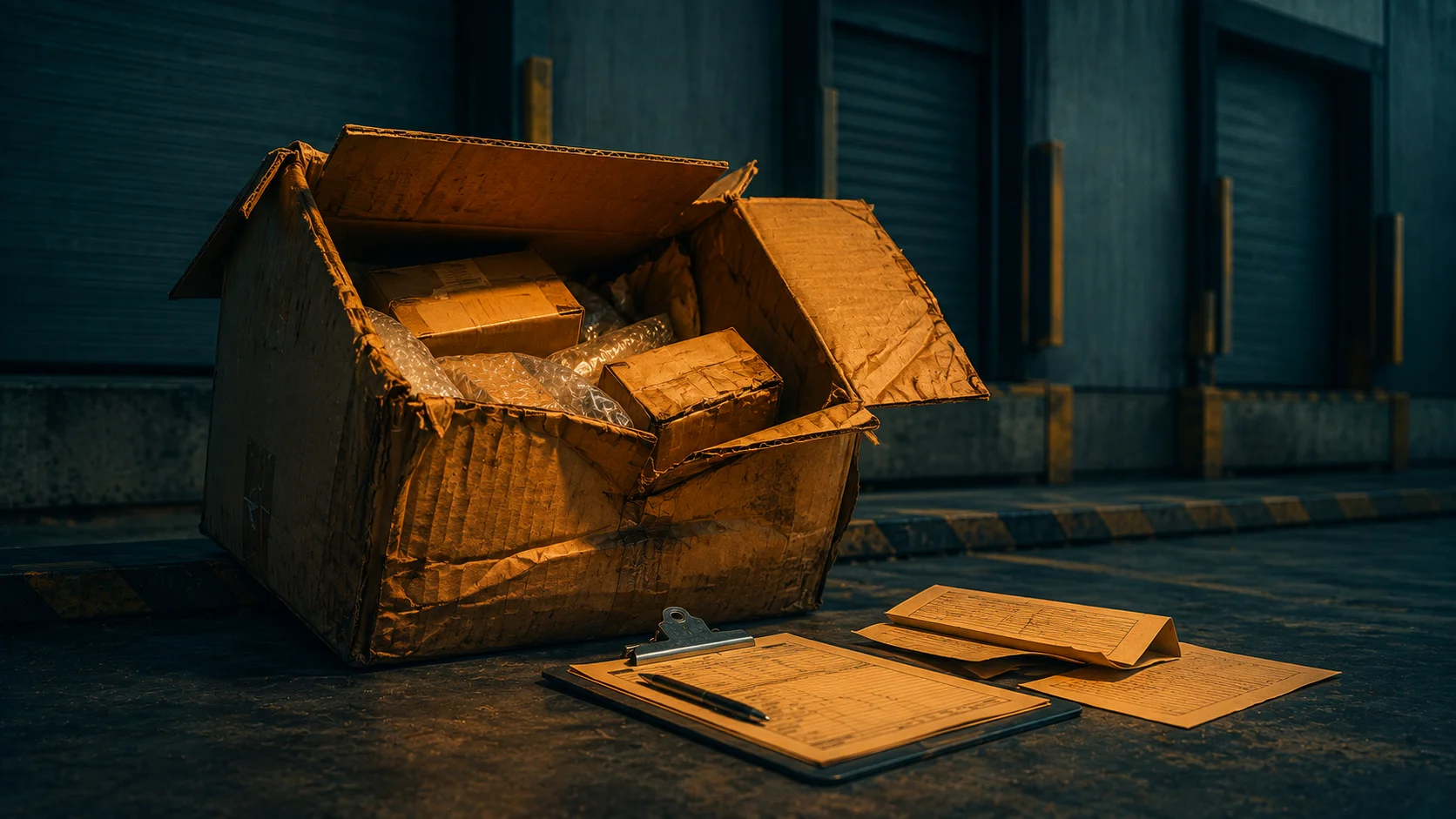
The First 24 Hours: What Happens at Delivery
The moment your goods arrive at the delivery point (warehouse, distribution centre, or store) is the most critical point in a cargo damage claim. What you do in the next few hours either locks in your evidence or surrenders it.
Step 1: Do not sign the delivery receipt without notation. The delivery receipt (sometimes called the Proof of Delivery, POD, or CMR note for road transport) is a legal document. Signing it without exception is evidence that you received the goods in the condition described, and the carrier will argue that means “good order and condition.” If external packaging shows signs of damage (crushed cartons, wet marks, forklift punctures, open seals), write the description of that damage on the delivery receipt before you sign. Use specific language: “3 cartons crushed, external damage to carton 7, wet discolouration on carton 12”, not “possible damage” or “subject to inspection.” Specific notation is evidence; vague language is hedging that carriers dismiss.
Step 2: Photograph everything before unpacking. Take photographs of the container or truck at the point of delivery: open doors, cargo in situ, stacking arrangement. Then photograph each damaged carton before it is moved. Then photograph the carton being opened. Then photograph the damaged goods inside. This sequence proves the damage was present on delivery, before your warehouse team touched anything. A photograph of a damaged item sitting on a warehouse shelf (without the carton, without the delivery context) is far weaker evidence than a photograph sequence that follows the goods from the transport unit to the damaged item.
Step 3: Preserve all packaging. Do not discard damaged cartons, packing materials, desiccants, or inner protective materials. These are physical evidence. Your marine surveyor will want to examine them to determine whether the packing was adequate (relevant to the carrier’s insufficiency defence) and to identify the mechanism of damage (crush damage vs. moisture damage vs. handling impact). Surveyor reports that lack packaging examination are weaker. Packaging that has been thrown in the skip before the surveyor arrives is gone.
Step 4: Do not use, modify, or repair the damaged goods before the claim is settled. Using damaged goods before the insurance or carrier claim is settled complicates the valuation: you cannot claim replacement cost on goods that have been put into service. In some cases, your insurer may agree to a partial repair assessment (agreeing to pay repair costs rather than replacement costs), but this should be discussed with the insurer before any repair work begins. Unauthorised repair before claim settlement can void the insurer’s liability for the repair cost.
Notifying the Carrier: Deadlines Under Australian Law
Under the Carriage of Goods by Sea Act 1991 (COGSA 1991), which incorporates the Hague-Visby Rules into Australian maritime law, the carrier’s notification requirements are:
- Apparent damage (visible at delivery): Written notice to the carrier must be given at the time of delivery. In practice, the damage notation on the delivery receipt serves this function, which is why correct notation at delivery is so important.
- Non-apparent damage (not visible at delivery): Written notice must be given within three days of delivery. If you receive a shipment with externally undamaged packaging but discover damaged contents when unpacking, you have three days to notify the carrier in writing.
Missing these notification windows does not automatically eliminate your claim, but COGSA 1991 states that failure to give timely notice creates a presumption of delivery in good order: the burden shifts to you to prove the damage occurred in transit. If you are within the deadline, the burden is on the carrier to prove the damage did not occur under their care.
Written notification to the carrier should be sent by email (with read receipt) or registered mail. The notification should include: bill of lading number, container number or truck reference, description of damage as observed, and the fact that you are reserving your right to claim. Keep the carrier correspondence as part of your claim file.
Note: carriers often have their own claim forms and submission windows in their terms and conditions, which may be shorter than the COGSA 1991 defaults. Check the bill of lading terms for any shorter contractual notification periods: terms that lessen carrier liability below the Rules are void under Article III rule 8, but follow the carrier’s process anyway.

How Much the Carrier Actually Owes: The Hague-Visby Liability Cap
The cap is set in Special Drawing Rights (SDR), the IMF’s unit of account:
- SDR 667 per package: the per-package limit, which applies when goods are shipped as individual cartons or packages
- 2 SDR per kilogram: the per-weight limit, which applies when it produces a higher figure than the per-package limit
At mid-2026 exchange rates, SDR 1 ≈ AUD 2.03 (IMF: SDR valuation). This means the per-package cap is approximately AUD 1,354 per carton, and the per-kilogram cap is approximately AUD 4.06/kg.
Worked example (electronics): You import 10 cartons of electronics. Each carton contains AUD 12,000 worth of goods and weighs 18 kg. The per-package cap is AUD 1,354 per carton. The per-kilogram cap is AUD 4.06 × 18 = AUD 73.08 per carton. The higher figure applies: AUD 1,354. For 10 damaged cartons, the carrier’s maximum liability is AUD 13,540, against a loss of AUD 120,000. The carrier owes approximately 11% of the actual loss.
Worked example (furniture): You import 1 FCL container of furniture, declared at AUD 80,000. The goods are in 24 pallets. If the bill of lading describes “24 pallets” as the package count, the per-package cap applies to pallets: AUD 1,354 × 24 = AUD 32,496. If the goods are also heavy (say, 18,000 kg total), the per-kilogram alternative is AUD 4.06 × 18,000 = AUD 73,080. The higher figure applies: AUD 73,080 for total loss of the container. Against an AUD 80,000 declared value, the carrier covers 91% of the loss, a relatively favourable outcome for the Hague-Visby cap. But partial damage (say, AUD 20,000 of damage to 5 pallets weighing 3,750 kg) is capped at the higher figure, AUD 4.06 × 3,750 = AUD 15,225.
Engaging Your Cargo Insurer: The Correct Sequence
If you have cargo insurance (ICC-A All Risk or ICC-B/C), the claim sequence is:
Notify the insurer promptly. Most ICC policies require notification within 3–7 days of discovering the damage. Check your policy’s specific wording: this is not a negotiable condition. Late notification that prejudices the insurer’s ability to investigate the claim (for example, by allowing you to alter or dispose of the damaged goods before a surveyor attends) can result in denial of the claim. Send the notification email and keep a copy of the send timestamp. This notification step is where most damaged shipment: Australia import claims are won or lost, since a late or vague notice gives the insurer grounds to dispute everything that follows.
Request the insurer’s survey instructions before appointing a surveyor. For claims above approximately AUD 5,000, the insurer will want an independent marine surveyor to inspect the goods. Most insurers have a panel of approved surveyors in major Australian cities. Do not appoint a surveyor independently without checking with the insurer first: non-panel surveyors may produce reports that the insurer disputes on methodology grounds. In smaller cities or regional locations without a local approved surveyor, the insurer may authorise you to appoint a local trade surveyor.
Submit the claim with complete documentation. A complete cargo insurance claim submission includes: (1) completed claim form; (2) original or copy bill of lading; (3) commercial invoice showing declared/insured value; (4) packing list; (5) delivery receipt with damage notation; (6) photograph sequence (delivery, unpacking, damaged goods); (7) surveyor’s report; (8) repair or replacement cost evidence; (9) any correspondence with the carrier about the damage; (10) a written narrative of what happened and when you discovered it.
Understand subrogation. Once your insurer pays your claim, they acquire the right to pursue the carrier for the portion of the loss within the carrier’s liability cap: this is called subrogation. Your insurer pursues the carrier in their own name; you do not need to manage that process. Cooperation with the insurer’s subrogation proceedings is a standard policy condition: if your insurer asks you for documents or witness statements to support their recovery from the carrier, you are required to provide them.

When to Engage a Marine Surveyor Directly
If you do not have cargo insurance, or if the insurer is disputing the claim, you may need to engage a marine surveyor independently to support a direct carrier claim.
A marine surveyor’s report for a cargo damage claim typically covers: the physical condition of the goods at the time of inspection; the packaging condition (relevant to the insufficiency defence); the apparent cause of damage (crush load, moisture, handling impact); an assessment of the pre-damage value and post-damage value; the repair cost or replacement cost estimate; and any opinion on carrier liability based on the facts observed.
The cost of a marine survey in Australia ranges from approximately AUD 800 (small desktop survey with photographs) to AUD 3,500+ (on-site inspection of a full container’s contents). For claims of AUD 10,000 or more, the survey cost is typically justified. For claims below AUD 3,000 against a carrier with an SDR cap well below the loss value, the economics of paying AUD 1,500 for a survey to recover a capped AUD 1,354 are questionable: in those cases, a written demand to the carrier with your own photographic evidence and replacement quotes is often more efficient.
Quantifying the Loss: Replacement Cost vs. Market Value
How you quantify the loss determines the maximum amount you can recover. There are three approaches, and they produce different figures:
Replacement cost: What does it cost to buy equivalent goods today to replace the damaged goods? This is the standard basis for cargo insurance claims under ICC policies and is the most favourable method for the claimant when goods have appreciated in value since purchase or when landed costs (duty, freight) add significantly to the replacement cost. For goods imported into Australia, the replacement cost includes the import cost: the freight, duty, and landed charges to replace the goods, not merely the ex-works supplier price.
Invoice value (CIF): The price stated on the commercial invoice, which on CIF terms includes cost, insurance and freight. Australian duty is assessed on the FOB customs value, not CIF. Many cargo insurance policies insure the CIF value plus 10% as a standard uplift (CIF × 1.10). If your goods have increased in market value since purchase, invoiced CIF value may understate the true loss.
Market value in Australia: The selling price of equivalent goods in the Australian market. For commercial importers selling into the retail or wholesale market, the market value typically exceeds the landed cost, but insurers pay the cost to the claimant (CIF + 10%), not the claimant’s profit margin on the goods. Loss of profit due to inability to fulfil orders because of damaged goods is generally not covered by standard cargo insurance and requires a separate business interruption or contingency policy.
Partial loss assessment: Where only part of the shipment is damaged, the loss is assessed proportionally. A shipment of 100 units where 15 are damaged to destruction is typically assessed at 15% of the insured value, assuming the undamaged 85 units are of full value. Where damage affects the whole shipment’s marketability (contamination, for example, that means the entire batch must be quarantined regardless of visible damage to individual units), the loss basis may be adjusted to total or near-total loss depending on the surveyor’s assessment.
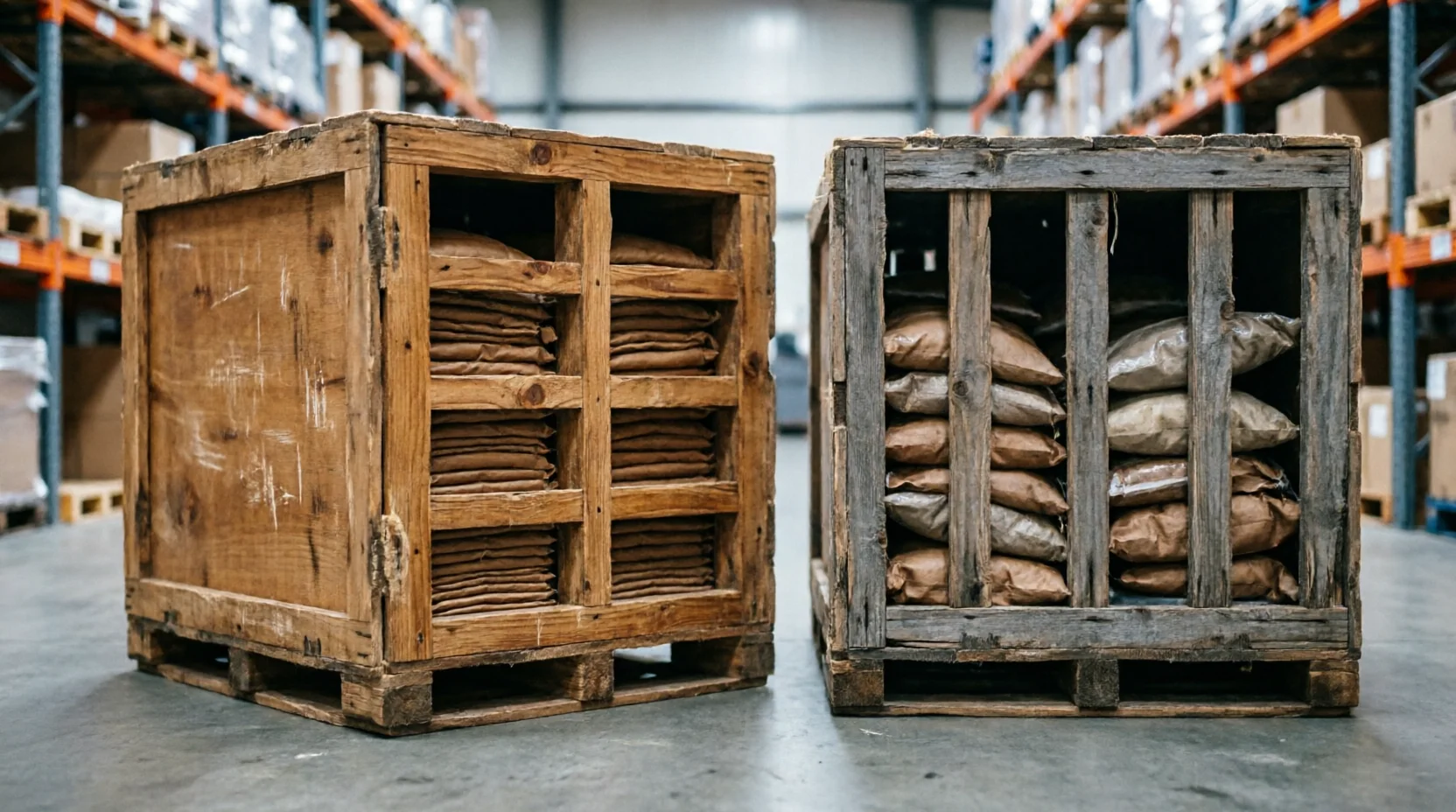
The Insufficient Packing Defence: How to Rebut It
The single most common carrier defence to a cargo damage claim is Article IV Rule 2(n) of the Hague-Visby Rules: insufficiency of packing. If the carrier successfully establishes this defence, their liability reduces to nil, not merely to the SDR cap.
The defence requires the carrier to prove that the packing was insufficient for the ordinary risks of sea carriage for that type of goods. Industry standards for packing are the key battleground. For most commercial goods in cartons, the relevant standards include:
- Carton stacking strength: minimum 400 kPa (approximately 7.2 kgf/cm² ECT) for standard goods. Heavier stacking requires higher ECT ratings.
- Inner cushioning: adequate void fill and cushioning to prevent goods moving within the carton under normal sea freight vibration and impact
- Moisture protection: PE wrap or moisture barrier for goods susceptible to humidity damage, especially for shipments with long ocean transit or transshipment at tropical ports
- Pallet specification: for palletised goods, pallet condition (no broken boards), stretch wrap securing cartons to the pallet, corner protectors where required
To rebut the carrier’s insufficiency defence, you need evidence that your packing met these standards. The best evidence is: a packing specification in the purchase order that your supplier was required to comply with; a pre-shipment inspection report confirming packing compliance; and a marine surveyor’s report that examines the packaging at your end and concludes the packing was adequate.
If your purchase order has no packing specification (if you simply ordered goods and accepted whatever packing the supplier chose), you are in a weaker position to rebut the insufficiency defence. The practical lesson: specify packing standards in every purchase order for goods you intend to ship by sea.
Everyone treats the insufficient packing defence as though the carrier has already won once they raise it. That is backwards. Article IV Rule 2(n) puts the burden of proof on the carrier, not on you, and most carriers who invoke it never actually produce evidence that your specific packing failed a specific standard. They assert the defence and wait to see if you concede. The contrarian move is to do nothing except ask, in writing, for the packing standard the carrier claims you violated and the survey report proving your cargo failed to meet it. A large share of insufficient packing defences are dropped at exactly that request, not because the carrier was wrong about your packing, but because building the actual proof costs them more than the claim is worth.
Realistic Timelines: How Long a Cargo Damage Claim Takes
Australian importers often underestimate how long a cargo damage claim takes to resolve. Planning the business response around realistic timelines prevents compounding the initial loss with stock shortages, delayed production schedules, or rushed reorders at premium cost.
Simple claim with cargo insurance (claim under AUD 20,000, clear documentation, cooperative insurer): Surveyor appointment within 5–10 business days of notification. Surveyor report issued 5–15 business days after inspection. Insurer assessment and settlement offer: 15–30 business days after receiving the complete claim file. Payment: 5–10 business days after settlement agreement. Total: 6–12 weeks from the date of discovery of damage to payment received, if your documentation is complete and the insurer does not dispute liability.
Complex claim with cargo insurance (claim over AUD 50,000, carrier liability dispute, counter-arguments about packing adequacy): Add 4–12 additional weeks for dispute resolution, legal correspondence between your insurer and the carrier’s P&I club, and potentially formal arbitration under the contract of carriage terms. For claims involving total loss of a full container, it is not unusual for the final settlement to take 6–9 months from date of damage to final payment.
Direct carrier claim without insurance: Carriers are motivated to minimise and delay direct claims. Initial liability denial is common. Expect 3–6 months for a simple claim and 12 months or more for a disputed claim. The one-year Hague-Visby time bar adds urgency: if the claim is not resolved within a year and you have not obtained a written time bar extension from the carrier, your claim extinguishes by operation of law regardless of its merits.
Business continuity during the claim period: Do not wait for the insurance settlement before reordering stock to replace damaged goods. The claim will reimburse the documented loss; it will not reimburse business losses from not having stock available during the claim period (unless you have a separate contingency policy). File the insurance claim, document the loss, and reorder stock on the basis that the insurance will ultimately reimburse the replacement cost. Coordinate the timing with your insurer so the replacement purchase is documented as part of the claim if needed.

Recovery Without Cargo Insurance
If you do not have cargo insurance and are pursuing the carrier directly, the process is: written notification to the carrier within the COGSA 1991 deadlines; compilation of your claim documentation; submission of a formal claim letter to the carrier’s P&I club or claims department; and negotiation of a settlement figure within the Hague-Visby cap.
Carriers rarely pay claims without negotiation. Common carrier positions: the claim is out of time; the damage was pre-existing; the packing was insufficient; the quantity is disputed. Each of these can be rebutted with the right documentation, which is why the delivery notation, the photograph sequence, and the surveyor’s report matter so much.
The Hague-Visby time bar is one year from the date of delivery (or the date the goods should have been delivered). Claims filed after one year are extinguished unless the carrier has agreed in writing to extend the time bar. Mark the one-year deadline in your records from the moment you discover the damage.
Swift Cargo can connect you with cargo insurance providers and marine surveyors as part of your import freight program. If you are shipping goods into Australia without cargo insurance, visit swiftcargo.solutions/australia to discuss your freight arrangement: the cost of a single uninsured damaged container typically exceeds the cost of two to three years of cargo insurance premiums.
Damaged Shipment: Australia Import Recovery Checklist
Note the damage on the delivery receipt before signing, photograph in sequence before unpacking, preserve every piece of packaging, and notify both the carrier and your insurer inside their respective deadlines. Handled this way, a damaged shipment: Australia import claim moves through survey and settlement in weeks rather than dragging on for months over a documentation gap that was avoidable on day one.
Frequently Asked Questions
How long do I have to notify the carrier of damaged goods in Australia?
Under the Carriage of Goods by Sea Act 1991 (COGSA 1991), which incorporates the Hague-Visby Rules into Australian law, the standard notification requirement for apparent damage is immediate written notice at the time of delivery. For damage not apparent at delivery, written notice must be given within three days. Failure to give notice within these timeframes does not extinguish your claim, but it shifts the burden of proof: the carrier is presumed to have delivered the goods in good order unless you can prove otherwise. In practice, most cargo insurance policies also require notification to the insurer within 3–7 days of discovery of damage. Check your policy’s specific notification requirement, as missing the insurer deadline can void the insurance claim entirely.
Should I claim against the carrier or my cargo insurance first?
For most practical purposes, claim against your cargo insurer first. The carrier’s liability under the Hague-Visby Rules is capped at SDR 667 per package or 2 SDR per kilogram (whichever is higher): at current exchange rates, approximately AUD 1,350 per package or AUD 4.05 per kilogram. For any commercial shipment with goods worth more than AUD 1,350 per package, the carrier’s liability cap means you can only recover a fraction of the loss from the carrier alone. Cargo insurance (especially ICC-A All Risk) covers the full declared value minus any applicable excess. Your insurer will then pursue subrogation against the carrier for the portion of the loss within the carrier’s liability limit. You keep the insurance payout; the insurer recovers from the carrier in its own name.
What documents do I need to make a cargo damage claim in Australia?
A complete cargo damage claim requires: (1) the original Bill of Lading or Sea Waybill; (2) the commercial invoice showing the insured value of the goods; (3) the packing list as loaded at origin; (4) the delivery receipt or Proof of Delivery (POD) showing the damage notation you made at the time of delivery: this is the most critical document; (5) photographs of damage taken before, during, and after unpacking; (6) a marine surveyor’s report if the claim value exceeds AUD 5,000; (7) any written correspondence with the carrier or freight forwarder about the damage; (8) repair or replacement cost quotes from qualified tradespeople or suppliers. Missing any of these documents does not automatically defeat a claim, but each gap weakens your negotiating position with both the carrier and the insurer.
The carrier says the damage was caused by insufficient packing. What does that mean for my claim?
The Hague-Visby Rules provide an exemption to the carrier’s liability for damage caused by insufficient packing. This is Article IV Rule 2(n): ‘insufficiency of packing.’ If the carrier successfully argues that the goods were inadequately packed for normal sea freight conditions, their liability reduces to zero, not merely to the SDR cap, but entirely. This is the carrier’s most commonly raised defence for cargo damage claims. To rebut it, you need evidence that the packing met industry standards: carton stacking strength (minimum 400 kPa / 7.2 kgf/cm ECT for standard goods), moisture barriers, inner cushioning, and pallet specifications. If the goods were packed by the supplier under your purchase order, your purchase order should specify packing standards, and the surveyor’s report should address whether the packing was adequate. A vague packing list with no specification gives the carrier room to argue insufficiency.