
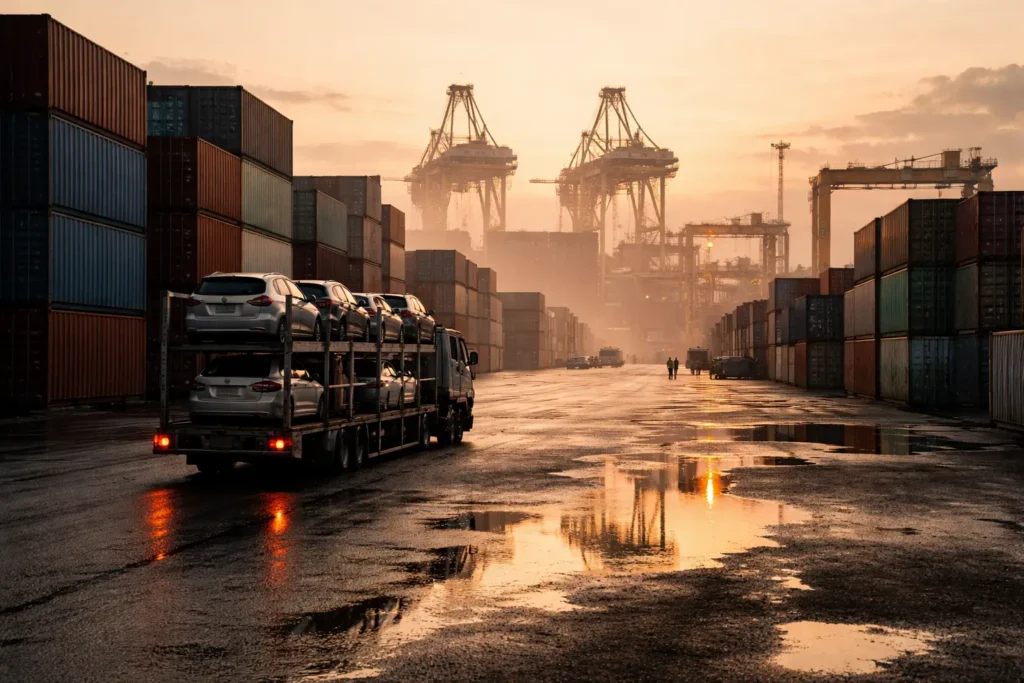
For Australians relocating to Thailand, shipping a personal vehicle can look like the rare part of a move that should be straightforward. Both countries drive on the left. Right‑hand drive is already the default. The maintenance history is known. But the corridor that feels simple on a map becomes complicated where freight meets regulation—especially for anyone who treats a vehicle as “just another item” in a household shipment.
The recurring search terms—shipping car Australia to Thailand, shipping motorbike Australia to Thailand, temporary import vehicle Thailand, Foreign Vehicle Permit Thailand (FVP), Thailand vehicle import tax calculation, import motorcycle Thailand ban—aren’t really about logistics. They’re about enforceability: whether the ownership story is consistent, whether the right permits exist before arrival, and whether the tax base is understood before it starts compounding. That question tends to surface alongside broader relocations such as household goods to Thailand and a wider move from Australia to Thailand, where a vehicle is easy to misclassify until the rules harden at the port.
Jump to a Section
- Quick Decision: Which lane are you actually in?
- TAFTA myth-busting: what it does (and doesn’t) change
- Australia-side prep: export reporting, deregistration, plates
- Shipping methods: container vs RoRo vs air (what changes for AU)
- Temporary import to Thailand: what Customs allows
- FVP: touring permits (what it is, what it isn’t)
- Permanent import: taxes, permits, and why the base compounds
- Motorbikes: the used-bike wall, and the routes that still work
- Classic cars: the 30-year pathway and weekend-use reality
- Documents checklist (AU → TH)
- Timeline: what’s predictable and what isn’t
- The failure points that cost the most
- FAQs (Australia → Thailand)
- Sources
Case Vignette: The Sydney Paperwork Loop
SYDNEY—The bike was clean, well-kept, and familiar in the way only a long-owned machine can be. The owner had done the sensible things: a fresh service, a battery check, photos for insurance, a crate arranged through a freight partner. The timeline looked tidy—ride for another week, drop it off, fly out, meet it in Thailand.
Then the export chain started asking questions in a language of forms. Which name is the “exporter” if the bike is in your name but the shipment is booked through a third party? Which address appears on the declaration if you’ve already handed back your lease? Which document is “proof of value” when you’re not selling anything?
Nothing was fraudulent. Nothing was even unusual. It was the most common relocation pattern: a move in motion, paperwork trying to catch up. The problem is that border systems don’t reward “close enough.” They reward clean, stable facts—names that match, values that are defensible, ownership that’s unambiguous.
The owner eventually solved it, but the lesson was expensive in time: if you wait until the shipment is rolling to assemble a coherent story, you end up negotiating with your own documents.
Quick Decision: Which Lane Are You Actually In?
Most Australia‑to‑Thailand vehicle plans unravel for a predictable reason: people mix regimes. Thailand runs distinct pathways for foreign vehicles—temporary entry, touring permissions, and permanent import/registration—and Australia’s export reporting adds its own documentary discipline. Confusing one lane for another is how a manageable shipment turns into a file that can’t clear.
| Your real goal | Thailand lane | What this means from Australia |
|---|---|---|
| You will leave Thailand again with the vehicle | Temporary import (Customs) | Export paperwork can be simpler, but Thailand will expect re-export discipline |
| You’re touring (overland-style) with a planned itinerary | FVP (DLT touring permit) | Plan early; this is not a backdoor to Thai plates |
| You want Thai plates for daily life | Permanent import (full regime) or buy local | Permits + tax compounding + DLT registration friction; budget time, not just money |
| You’re moving a collectible | Classic/vintage pathway (where applicable) + permanent steps | Potentially more “legible” economics, but strict usage restrictions apply |
| You want to ship a used motorbike and register it | Usually buy local | Used-bike imports hit restriction/prohibition risk; do not assume household move status helps |
If you’re treating the vehicle as part of a broader relocation, build the move like a project timeline. A practical structure for sequencing documents, inventory, and arrival buffers sits inside a broader moving preparation timeline, while the non-Australia-specific rules and cost mechanics are detailed in the main guide to moving a car or motorbike to Thailand. For Thailand specifically, a Thailand relocation checklist can help align what you ship with what you can actually clear. And if your timing is dictated by long-stay decisions, the limiting factor is often administrative rather than logistical—especially around retirement visa options (2026).
TAFTA Myth-Busting: What It Does (and Doesn’t) Change
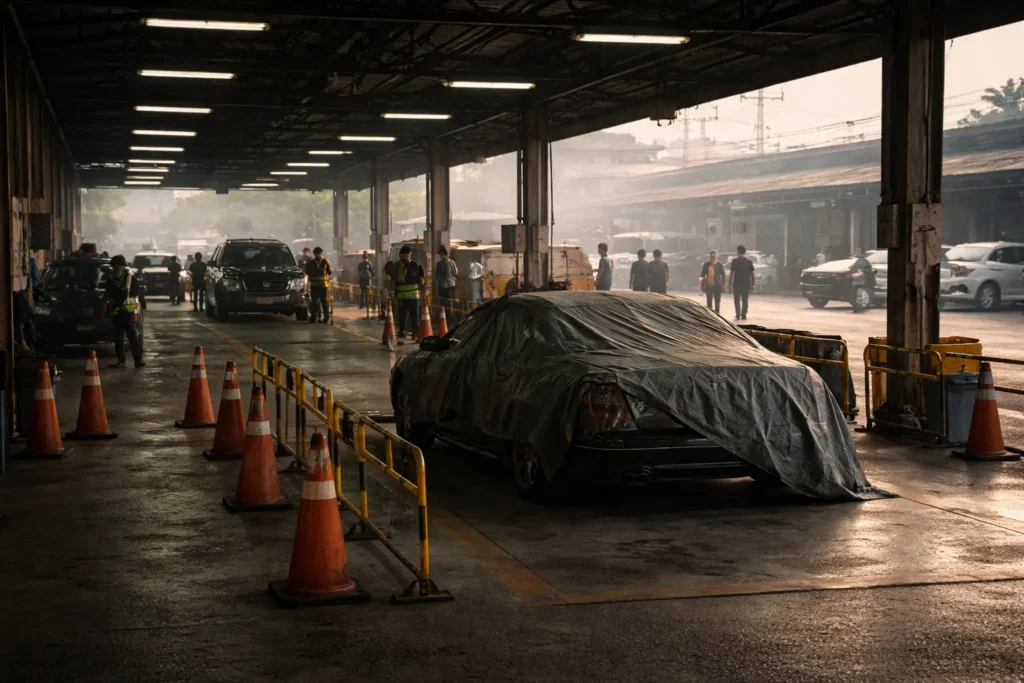
TAFTA is the detail that gets repeated in expat forums because it sounds like a shortcut: Australia equals cheaper import. In practice, it’s closer to a filter than a discount. Preferential duty treatment only exists where the shipment can prove it qualifies, and Thai Customs tends to treat assumptions as noise.
The hinge is rules of origin. State registration in Australia is not proof of origin, and many “Australian” vehicles are assembled elsewhere in the same way many “Thai” vehicles are built for export. On used vehicles in particular, the documentary trail can be thin—exactly where officials expect it to be thick.
The practical implication: don’t build your budget around a duty outcome you haven’t verified before the container is sealed. Even when preferential duty applies, it rarely changes the headline decision. Thailand’s excise, interior tax, VAT, and the post-clearance registration workflow are usually the bigger gravity wells. TAFTA can shift one layer; it doesn’t re-write the stack.
Australia-Side Prep: Export Reporting, Deregistration, and Plates
Australia doesn’t run a dramatic “export approval” gate for personal vehicles, but it does enforce export reporting. The Australian Border Force makes the point plainly: exports are reported through an Export Declaration (or an exemption), often via the Integrated Cargo System. Many people never log into the system themselves—brokers and forwarders do it—but the accuracy burden still lands on the owner.
The more mundane friction comes from state registration. If you cancel rego, you’re typically surrendering plates and timing refunds around a week when you’re also ending leases, closing utilities, and trying to board a flight. It’s not a legal hurdle so much as a sequencing problem—and it’s where otherwise tidy plans start to wobble.
The process rewards one thing above all: consistency. One spelling of your name, one ownership story, one defensible value, repeated across the export declaration, shipping paperwork, insurance documents, and Thailand-side permits. Most delays that look “mysterious” from the outside are simply inconsistencies that force an official to decide which document is the one to trust.
Shipping Methods: Container vs RoRo vs Air (What Changes for Australia)
On this corridor, the shipping choice isn’t a personality test. It’s a risk decision disguised as a freight quote. Australia-to-Thailand traffic is routine enough that sailings exist, but the exposure profile changes sharply depending on how many hands touch the vehicle, how much of the journey is sealed, and how tightly you can control what’s inside when it arrives.
Most private vehicles move one of two ways: sealed in a container or driven onto a roll-on/roll-off (RoRo) vessel. Motorbikes sit in the middle, where crating and consolidation are common, and air freight appears occasionally when the calendar is the true constraint.
- Container shipping: The default for motorbikes and the safer choice for higher-value cars. A sealed container reduces handling points and keeps the vehicle out of the “open system” until arrival. It also tends to produce a cleaner chain of custody when insurers and customs officers look for clarity.
- RoRo: The vehicle is driven onto the ship and parked on deck. It can price well when schedules align, but it is less forgiving: the vehicle must be operational, personal effects are typically restricted, and the handling footprint is larger. If you’re sensitive to scuffs, missing items, or ambiguous responsibility, RoRo is the option that forces you to be realistic.
- Air (mostly motorbikes): This is what people reach for when a tour, an event, or a fixed start date matters more than cost. It shortens transit time, but it doesn’t eliminate clearance time. The paperwork still has to clear the same gate once the bike lands.
Australia’s right-hand-drive alignment with Thailand is the quiet structural advantage here. It doesn’t soften the Thai tax stack, but it removes a common compliance friction that slows left-hand-drive imports later in the process.
Australian-only models: the parts-and-paperwork problem
The second Australia-specific factor is less visible than right-hand drive: what happens when the vehicle is Australian-market specific. The shipping leg is rarely the problem. The problem arrives later—when the vehicle needs parts, diagnostics, or documentation that was never designed to be read in Thailand.
If the model was never sold locally in meaningful volume, you can end up importing your own maintenance ecosystem: niche parts ordered from abroad, longer waits for sensors and control modules, and a mechanic network that learns your vehicle on the job. It’s manageable for enthusiasts. It’s miserable if you expected “normal servicing” to stay normal.
Paperwork can fail the same way. A vehicle can be perfectly lawful on Australian roads while still being difficult to make legible to the Thai compliance workflow—especially where safety or emissions documentation must translate into the categories Thailand uses. If you’re importing anything niche, treat the documentation pack as part of the asset. What you can produce, in a format the system accepts, matters as much as what the vehicle is.
Temporary Import Vehicle Thailand (Australia → Thailand): What Customs Actually Allows
Temporary import is the most misunderstood phrase in this entire category. In Thailand, Customs temporary import relief is conditional: the vehicle must be re-exported and the permitted time is capped. Thai Customs describes a temporary import relief window typically measured in one or two months, with an outer ceiling of six months, and only narrow extensions in exceptional circumstances.
For Australians doing a shorter assignment or a long “test period,” the mistake is assuming temporary import is a flexible trial. It isn’t. It’s a controlled re-export lane. If you can’t confidently describe how and when the vehicle leaves Thailand, you’re not in this lane—you’re just hoping you are.
Foreign Vehicle Permit Thailand (FVP): Touring, Not Relocation
The Foreign Vehicle Permit (FVP) is administered by Thailand’s Department of Land Transport (DLT). It exists to manage touring entry for foreign-registered vehicles—think planned trips, defined dates, and a paper trail that can be checked at borders.
What matters for Australians is not the acronym; it’s the boundary. The FVP is not a mechanism for “I’ve moved here, now let me keep my Australian plates indefinitely.” It does not convert a foreign registration into Thai registration. It does not solve the permanent-import permit and tax regime. It is a controlled, time-bound permission to operate a foreign-registered vehicle in Thailand under touring conditions.
- What it is: a DLT-managed touring permit workflow for foreign-registered vehicles, built around defined dates and a checkable paper trail.
- What it isn’t: a conversion to Thai registration, a substitute for permanent import permits, or a residency workaround.
- Operational rule: if your plan depends on staying indefinitely, you’re outside the intent of FVP. Treat it as time-bound permission and assume officials will test whether your story still looks like touring.
If your plan involves Thai plates for daily life, read the FVP section as a warning label: it can help riders and drivers who are passing through. It is not designed to help people who are settling in.
Permanent Import (Australia → Thailand): Taxes, Permits, and the Compounding Base
Permanent import is where “shipping a vehicle” becomes “importing a vehicle.” In Thailand, that distinction matters. Thai Customs explicitly states that importing used/secondhand motor vehicles and motorcycles requires an import permit from the Foreign Trade Department before the vehicle arrives. If you ship first and try to fix the permit after, Customs warns you may be fined 10% of the vehicle’s price, with the fine not less than 1,000 baht and not exceeding 20,000 baht. Thai Customs also states that vehicles under 3,500 kg require an additional import permit from the Industrial Standards Institute.
Who can realistically qualify for permanent import?
This is the part most people skip, then pay for later. Thailand does not treat permanent vehicle import as a general expat entitlement. The eligibility lane is narrow, document-driven, and designed to keep routine personal imports rare.
In practice, the cases that clear cleanly tend to look like one of these: a Thai national returning after an extended period overseas with a provable change of residence; a foreigner with a non-immigrant status tied to work and a valid work permit (not just a long-stay intention); or a special-status importer (for example, certain official or diplomatic categories) operating under a separate administrative framework.
Two rules that catch Australians off guard: the “one person, one vehicle” posture in personal-use contexts, and the fact that retirement plans do not automatically unlock a vehicle-import pathway. If you can’t state—on paper—why you qualify before the ship sails, you’re not planning a permanent import. You’re gambling on interpretation with storage fees running.
On cost: the hard part is not one rate; it’s the stacking. Thai Customs provides a sample duty assessment approach that illustrates the compounding nature of valuation and charges. In practice, this is why “headline duty” and “actual landed burden” can be worlds apart.
An illustrative cost example in AUD (why the base compounds)
This is not a quote—and it’s not a promise. It’s a simple illustration of why Thailand’s “stacking base” produces results that surprise first-time importers. The actual rates and assessed values depend on vehicle type, engine/CO₂ category, Customs valuation, and the permits you qualify for.
Assume a mid-range used vehicle leaving Australia with these illustrative inputs:
- Vehicle value: AUD 40,000
- Ocean freight + insurance: AUD 4,000
- CIF (cost + insurance + freight): AUD 44,000
Now assume (purely for illustration) that the combined duty/excise layers and later taxes act like this:
- Layer 1: Duty applied to CIF (adds to the base)
- Layer 2: Excise applied to (CIF + duty)
- Layer 3: Interior/local tax applied to excise
- Layer 4: VAT applied to the whole stack
If duty were 50% of CIF in this illustration, duty alone would be AUD 22,000. Your excise base is now AUD 66,000 (CIF + duty)—not AUD 44,000.
If excise were 30% of that new base, excise would be AUD 19,800. Add a 10% interior/local tax on the excise (AUD 1,980), and your VAT base becomes:
VAT base (illustrative) = CIF 44,000 + duty 22,000 + excise 19,800 + interior 1,980 = AUD 87,780
At 7% VAT (illustrative), VAT would be AUD 6,144. Total taxes and duties in this simplified scenario would be:
Total (illustrative) = duty 22,000 + excise 19,800 + interior 1,980 + VAT 6,144 = AUD 49,924
That is how a “AUD 40,000 car” becomes a vehicle with nearly AUD 50,000 in duties/taxes before port charges, broker fees, inland transport, and the registration steps that follow.
The point isn’t the exact number; it’s the mechanism. If you can’t model the stack on paper, you can’t budget the downside.
If you’re relocating for the long term, import economics tend to make sense in a narrow band: truly hard-to-replace vehicles, special-use builds, or collector vehicles where the value proposition survives the tax structure. Otherwise, buying locally is usually the lower-risk, lower-friction path.
Case Vignette: The Brisbane Clearance Clock
LAEM CHABANG—The container landed on a Tuesday. The owner had flown out weeks earlier, confident the hard part was done. Brisbane to Thailand was supposed to be the easy corridor: left-side traffic, right-hand drive, familiar Japanese hardware.
Then the broker called with a question that didn’t sound like a question. The permit had to be on file before arrival. Customs wanted one document to prove the vehicle’s value and another to prove the same number was defensible. A name on the export chain didn’t match the name on the registration chain—one had a middle initial, one didn’t. None of it looked dramatic. All of it was enough to slow the release.
That is when the clock becomes physical. Storage starts accruing. The port doesn’t care whether you’re in Chiang Mai on a new lease or back in Sydney packing the last of your life into boxes. “Just one more form” stops being paperwork and becomes a cost line.
The vehicle cleared in the end. What changed wasn’t the law; it was the mood. The owner stopped asking whether the process was fair and started asking what would make the file legible. In Thailand, that is often the difference between a plan and a lesson.
Motorbikes (Australia → Thailand): The Used-Bike Wall and the Routes That Still Work
Australians often assume a motorbike will be the easier shipment because it’s smaller, cheaper to crate, and simpler to handle at destination. Thailand tends to treat motorcycles more sharply than cars—not because the logistics are harder, but because the policy posture is different. In official trade guidance and import-notification summaries, used motorcycles repeatedly appear in prohibited or restricted contexts. That reality sits underneath a lot of the search traffic: people aren’t looking for a crate quote—they’re trying to work out whether their bike can be made registerable.
From Australia, the workable options depend on which lane you are actually in:
- Touring / time-bound entry: A foreign-registered bike may be able to operate in Thailand under touring permissions or temporary entry frameworks. It is date-driven, document-driven, and designed for a bike that leaves again.
- Permanent Thai registration: This is where most used-bike plans fail. The gap isn’t mechanical; it’s administrative. If the bike can’t be treated as a permissible import for permanent registration, you can end up with a shipment you own but can’t legally plate for daily use.
- Special cases: There are narrow exceptions in some regimes, but they are exceptions that must be confirmed on paper before you ship. “We’ll sort it out after arrival” is how storage fees get introduced to the budget.
The practical takeaway is unglamorous but protective: if your plan is “ship a used bike and register it,” assume it’s a hard no until proven otherwise by the category rules and a broker who can point to the specific pathway. For riders who want Thailand-road legality without an administrative fight, buying locally is usually the cleanest route.
Classic Cars (Australia → Thailand): The 30-Year Pathway and Weekend-Use Reality
Collectors face a different equation because Thailand has signalled a more structured lane for vintage imports. Reporting and legal summaries describe a classic-car framework that applies a 45% excise tax rate to imported classic vehicles from fiscal year 2026, paired with a usage posture that is intentionally non-commuter: weekend and public-holiday operation, with limited carve-outs for events.
From Australia, right-hand drive can make the compliance story easier than left-hand-drive markets, but it doesn’t change what the scheme is designed to do. The win is not “bring a classic as your daily driver.” The win is that the economics become legible for a collector vehicle, and the rules create a pathway that looks more like a policy category than an exception negotiated case-by-case.
If you’re considering this lane, treat the restrictions as part of the purchase price: the vehicle can be importable and still be operationally constrained. That’s not a flaw—it’s the design.
Documents Checklist (Australia → Thailand): What You’ll Be Asked For
Documents vary by lane, but the pattern of success is repetitive: identity that matches across every form, ownership that is unambiguous, and a value story that can be defended without improvisation. The most expensive delays rarely come from “missing paperwork” in the abstract—they come from small mismatches that force officials to stop and reconcile your file.
Australia-side (common requirements)
- Passport ID matching the shipment paperwork
- Proof of ownership (registration / title-equivalent documents)
- Proof of value (invoice, purchase record, or defensible valuation)
- Export reporting paperwork (Export Declaration via ICS if required)
- State registration actions (if cancelling rego): plate surrender and cancellation paperwork
Thailand-side (by lane)
- Temporary import: entry documents + ownership + shipping chain + coherent re-export plan
- FVP: touring permit workflow (typically via Thai travel agency) + registration documents
- Permanent import: import permits (where required) + Customs clearance docs + DLT registration steps after release
If you’re handling the first months in-country, even a small base of Thai phrases for bureaucracy can reduce missed requests at counters and banks—especially when you’re trying to fix a document problem quickly.
Timeline (Australia → Thailand): What’s Predictable and What Isn’t
Sea freight is the easy part to estimate. Clearance and registration are where plans lose their shape, because that’s where the process stops caring about your sailing date and starts caring about whether your documents are internally consistent.
- Week 0–2: Choose your lane. Stabilise documents (names, addresses, ownership proof). Decide whether you are cancelling registration in Australia.
- Week 2–6: Export reporting (as needed), booking, vehicle prep, and document pack finalisation.
- Arrival window: Customs processing, inspection, permit checks. This is the variable period that creates storage and handling cost risk.
- Post-clearance: If permanent import, DLT registration steps follow. Treat this as its own workflow, not an afterthought.
If you want a broader structure for sequencing the relocation as a project, treat the move as a preparation-driven timeline rather than a shipment-driven timeline. That’s the difference between “we shipped it” and “we cleared it.”
The Failure Points That Cost the Most
Most costly failures don’t look dramatic at the start. They look like minor assumptions that only become expensive once the vehicle is physically in the system.
Failure point 1: lane confusion. Temporary import is re-export discipline. FVP is touring permission. Permanent import is a permit-and-tax regime followed by a separate DLT registration workflow. When people blend lanes, they end up arguing with a system built for categorisation, not negotiation.
Failure point 1b: shipping before permits are issued. Thailand’s warning is unusually explicit for used/secondhand vehicles: the permit is expected before arrival. If you discover that requirement after the container lands, the project shifts from planning to triage—usually with storage accruing while paperwork catches up.
Failure point 2: unstable identity. New addresses, third-party bookings, middle initials, and small formatting differences are normal in a relocation. They are also exactly what causes export and import documents to stop matching. Officials don’t need to accuse you of anything to delay you—they only need a reason to doubt which document is authoritative.
Failure point 3: budgeting as if shipping is the main cost. The compounding tax base is the story. If you can’t explain how the duty-and-tax base grows through stacked components, you can’t budget the downside. That’s how a vehicle becomes “too expensive to release” after it has already arrived.
Failure point 4: treating a used motorbike as household goods. Used-bike restrictions appear in official contexts for a reason. The cheapest fix is often not a better broker; it’s avoiding the attempt and buying locally.
FAQs: Australia to Thailand (Cars & Motorbikes)
If this move is happening alongside a long-stay plan, the vehicle questions usually sit next to visa rules, insurance, and recurring reporting requirements. A consolidated reference list of Thailand retirement FAQs can help you keep the administrative timeline coherent while you plan the shipping timeline.
1) Do I need to lodge an export declaration to ship a car or motorbike from Australia?
Quick answer: Often, yes—especially if the goods value exceeds AUD 2,000 or other conditions apply.
More detailed: The Australian Border Force states that goods being exported must be reported using an Export Declaration or an exemption code, with goods over AUD 2,000 requiring an Export Declaration in many cases. In practice, freight forwarders or brokers often lodge this through the Integrated Cargo System (ICS), but the information still needs to match your ownership and shipping paperwork.
2) Do I have to cancel my Australian registration before exporting?
Quick answer: Not always, but if you do, plan plate surrender and timing.
More detailed: Registration is state-based. Some owners keep rego active until the vehicle departs; others cancel and seek refunds for unused periods. NSW and Queensland, for example, describe processes that involve returning/surrendering plates when cancelling registration. The right move depends on your timeline, insurer requirements, and whether you plan to bring the vehicle back.
3) Is Australia’s right-hand drive setup an advantage in Thailand?
Quick answer: Yes—Thailand drives on the left, so right-hand drive reduces compliance friction.
More detailed: It doesn’t reduce Thai import taxes, but it can remove a common registration complication faced by left-hand-drive vehicles. It’s an advantage in feasibility and inspection comfort, not a discount on the tax stack.
4) Can I temporarily import my Australian car into Thailand for six months?
Quick answer: Sometimes, but only if you’re truly in a re-export lane.
More detailed: Thai Customs describes temporary import relief as typically limited to one or two months, with an outer ceiling of six months, and only narrow extensions in exceptional circumstances. This pathway assumes the vehicle leaves again—temporary import is not a low-risk trial for permanent residency.
5) What is the Foreign Vehicle Permit (FVP) and does it help relocators?
Quick answer: It’s a touring permit for foreign-registered vehicles, not a path to Thai plates or a relocation workaround.
More detailed: The FVP is administered by Thailand’s Department of Land Transport and is built around managed touring entry: defined dates, a checkable document trail, and time-bound permission to operate a foreign-registered vehicle in Thailand. It does not convert an Australian registration into Thai registration, and it does not replace the permanent import system (permits + taxes + post-clearance registration). If you’re relocating, treat FVP as something that can help a short trip—then plan on switching to a Thailand-registered vehicle if you’re staying.
6) What permits can block a permanent import into Thailand?
Quick answer: Used/secondhand vehicles can require permits before arrival, and missing them can trigger fines.
More detailed: Thai Customs states that used/secondhand motor vehicles and motorcycles require an import permit from the Foreign Trade Department prior to importation, and warns of fines if missing. It also states that vehicles under 3,500 kg require an additional permit from the Industrial Standards Institute. Permit timing is a common “stuck at port” cause.
7) Why do Thailand import taxes feel higher than the headline duty rate?
Quick answer: Because the taxable base grows as each component is added.
More detailed: Thai Customs provides sample duty assessment guidance showing how CIF value, duty, and later taxes build an expanded base. By the time VAT is applied, you can be paying tax on a stack, not a single number.
8) Can I import a used Australian motorbike into Thailand and register it?
Quick answer: This is high risk; used motorcycles appear in prohibited/restricted import contexts.
More detailed: Official trade guidance and import-notification summaries list used motorcycles among prohibited/restricted imports. Temporary touring entry may still be possible, but permanent registration is where most used-bike plans fail.
9) If I ship the bike as “household goods,” does that avoid Thailand’s used-motorbike restrictions?
Quick answer: No—don’t assume household status overrides vehicle policy.
More detailed: Household moves can still be subject to vehicle classification rules. If a category is prohibited or restricted, packaging it inside household goods doesn’t magically change the category. Confirm your lane and eligibility before shipping.
10) Which is safer for Australia → Thailand: container or RoRo?
Quick answer: Container is typically safer for protection; RoRo can work but increases handling exposure.
More detailed: Containers reduce handling steps and protect the vehicle in a sealed environment. RoRo can be practical for some cars, but it usually restricts items inside the vehicle and depends on the vehicle being operable. The best choice depends on value, timing, and risk tolerance.
11) What’s the #1 paperwork mistake Australians make on this route?
Quick answer: Document mismatch—names, addresses, VIN formatting, and value proof drifting across forms.
More detailed: Relocation creates “moving facts”: changing addresses and third-party bookings. Border systems need stable facts. The fix is to stabilise your document pack before shipping, not after the container is in motion.
12) What happens after the vehicle clears Thai Customs?
Quick answer: Clearance is only half the story; Thai registration is a separate workflow.
More detailed: If you want Thai plates, plan DLT registration steps in advance. Many vehicles “clear” but then stall because the owner assumes plates are automatic. They aren’t—inspection and documentation steps follow.
13) How long does Australia → Thailand take end-to-end?
Quick answer: Shipping can be estimated; clearance and registration timelines vary widely.
More detailed: A vessel schedule is not your road-legal schedule. Build your plan around documentation readiness, inspection scheduling, and permit checks, because that’s what causes delays and cost escalation.
14) Does the classic 30-year pathway change the equation for Australians?
Quick answer: It can—if you’re a collector and you accept usage limits.
More detailed: Thai reporting and the Library of Congress summary describe a 45% excise rate from fiscal year 2026 for imported classic cars, paired with weekend/public holiday usage restrictions and event exceptions. It’s designed for collectors and exhibitions, not daily commuting.
15) When is buying locally in Thailand the smarter move?
Quick answer: For most daily drivers and most used motorcycles.
More detailed: If your vehicle is replaceable locally, the tax stack, permit complexity, and time risk often make importing a luxury decision. Local purchase usually wins on speed, compliance, and total cost—especially for motorcycles.
Sources (Verification)
- Australian Border Force – Export requirements (Export Declaration / ICS)
- business.gov.au – Documents for exporting (overview)
- NSW Government – Cancelling vehicle registration (plates/refunds)
- Thai Customs – Import of used/secondhand vehicles: permits + fines + 3,500kg note
- Thai Customs – Sample duty assessment (illustrates compounding base)
- Thailand DLT – Foreign Vehicle Permit (FVP) Manual
- Thailand Government Portal – Foreign vehicle entry (FVP summary)
- WTO Import Licensing – Thailand notification (used motorcycles prohibited imports context)
- International Trade Administration (U.S.) – Thailand prohibited/restricted imports (includes used motorcycles)
- The Nation Thailand – 45% tax on imported vintage cars from FY2026 + weekend restriction
- Library of Congress (Global Legal Monitor) – Thailand classic car import regulation summary