
Modern travel marketing likes to pretend it was born when ad platforms, dashboards, and loyalty apps became sophisticated enough to track users at scale.
Long before tourism boards had real-time ad attribution, Thailand had started moving toward a more intelligent version of destination marketing. The important shift was not that Thailand suddenly became creative. Thai tourism planners grasped something many destination marketers still miss: the most valuable travel marketing systems are built on distribution, behavioral proof, and economic timing, not on slogans alone.
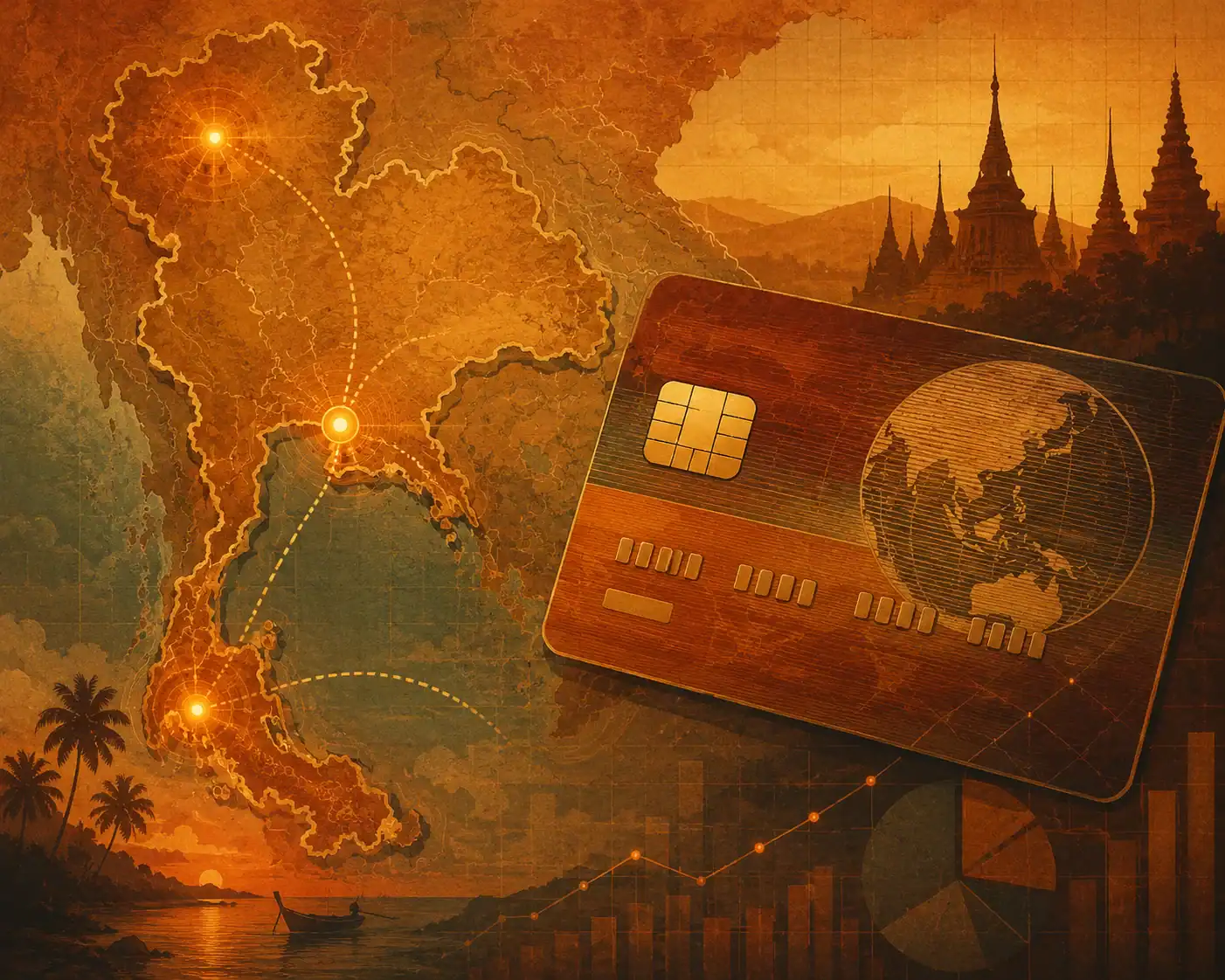
Thailand’s card-network partnerships in the late 1990s were not just sponsorships. They were an early bridge between audience access and spending intelligence. The Tourism Authority of Thailand was learning how to market a destination to travelers who were already more likely to spend. It was also getting better signals about whether those travelers created economic value once they arrived.
The result was not a modern CRM stack in the software sense. It was cruder than that. But the commercial logic was close enough that the campaign reads as a precursor to modern tourism analytics. Thailand’s tourism planners used cardmember publications, mailing-list access, transaction data, and distribution partnerships to reach high-value travelers during a moment when exchange-rate conditions made the country especially attractive.
This also explains why Thailand’s tourism statecraft kept working long after the 1997 crisis. The country learned to treat tourism less like generic promotion and more like a system. We looked at the macro side of that shift already in How “Amazing Thailand” Turned the 1997 Baht Crisis Into a Tourism Boom. We also traced the deeper infrastructure roots in U.S. Military Bases in Thailand Became the Backbone of a $50B Tourism Economy.

Thailand’s tourism strategy in the late 1990s anticipated many of the targeting and measurement ideas that later became standard in travel marketing.
Travel Marketing Before the Internet Was Mostly Blind
Before search engines, social media, and online booking funnels turned tourism into a measurable performance business, destination marketing was structurally blunt. Tourism boards could buy attention. They could influence travel agents. They could run campaigns in magazines, newspapers, airline channels, and trade publications. But they had limited visibility into what happened after the traveler arrived.
Arrival data told them people came. Hotel occupancy suggested demand was improving or weakening. Trade feedback from tour operators hinted at which markets were responding. But those signals were all downstream, delayed, and incomplete. They described volume better than value.
A destination can attract more visitors without materially improving the economic quality of demand. A country may fill rooms and still fail to maximize foreign-exchange inflows, retail spending, premium leisure spending, or the broader multiplier effects that policymakers actually care about. Counting arrivals is not the same thing as understanding economic performance.
Travel agencies sat at the center of this older system. They were distribution chokepoints. Airlines and wholesalers also mattered because they controlled routes, packaged inventory, and consumer attention. Tourism authorities therefore had to work through intermediaries. That made distribution power essential, but it still did not solve the measurement problem.

Before digital platforms reshaped travel demand, destinations depended on print, travel agents, airline partnerships, and slower feedback loops.
At the same time, other industries were already learning how customer databases could outperform pure mass advertising. Airline loyalty programs, direct-mail systems, and early database marketing had proved a basic idea: if you know something about past behavior, you can market more efficiently than if you shout at everyone equally. Research on database marketing in travel and tourism was formalizing this logic. Airline loyalty systems demonstrated how customer records could create better targeting and stronger retention. Bournemouth University: Database Marketing in Travel and Tourism AAAI case study: frequent-flyer customer database
Tourism boards, however, rarely owned that level of behavioral signal themselves. They needed a partner that could do two things at once: offer access to travelers likely to spend, and show how those travelers behaved economically inside the destination. Credit-card networks were well positioned to do both.
The Real Insight Was Not “Data.” It Was Economic Visibility.
People often reduce this story to the soft claim that Thailand “used data.” That is directionally true and still too lazy to be useful. More precisely: payment networks let tourism planners see economic behavior that ordinary tourism reporting could not show.
Every international card transaction captures more than a sale. In aggregate, it becomes a map of traveler value: where people are spending, how much they are spending, which segments appear stronger, and whether a campaign is bringing in visitors who matter economically rather than just statistically. For a tourism authority trying to recover from a regional financial crisis, that kind of visibility is strategically different from simply knowing headcount.
By the late 1990s, card companies had a structural advantage over tourism boards. They sat inside the payment layer of international travel. They could see activity in hotels, restaurants, retail, and experiences. Tourism boards could infer visitor significance. Card networks could observe spending behavior directly. UN Statistics presentation: Visa analytics and TAT
That meant Thailand’s tourism planners were not just buying exposure when they worked with payment companies. They were also learning which travelers generated the strongest return. Once that frame is in place, the campaign reads differently. It stops looking like a patriotic branding push wrapped around a crisis. It starts looking like a destination-level effort to align message, distribution, and value capture.
The campaign still feels modern in retrospect because it moved beyond demographics toward behavior. It cared not only about where a traveler came from, but about whether that traveler was part of a segment with observable spending power. Modern performance marketers would recognize the logic immediately.
Card Networks Were Also a Distribution Machine
Credit-card companies in the 1990s did not just process payments. They also published magazines, sent direct mail, maintained premium cardmember communications, and built trust-rich relationships with customers who were already affluent, internationally mobile, and comfortable transacting abroad. That is an unusually high-quality audience for a tourism campaign.
Partnerships with financial networks let Thailand reach consumers who were more likely to travel internationally and more likely to spend meaningfully once they arrived. Instead of relying solely on broad destination promotion, the campaign could piggyback on a channel that already filtered for valuable behavior.
Cardmember publications were not merely brand halo placements. They were highly targeted media environments before digital targeting made that commonplace. Premium travel offers, destination features, and curated editorial all sat inside a communication system designed for people with demonstrated purchasing power. Expression magazine for American Express cardmembers American Express publishing history

Cardmember publications gave destination campaigns access to an affluent audience long before modern ad platforms made similar targeting routine.
The Tourism Authority of Thailand was explicit that these relationships mattered. Card-network partnerships gave Thailand access to in-house publications and mailing-list channels that would otherwise have been difficult or expensive to replicate, according to contemporary campaign material and later archived reporting. Travel Impact Newswire archive: 1998 campaign materials and card data
Spending Data Turned a Branding Campaign Into a Feedback Loop
One of the hardest problems in destination marketing is proving whether a campaign changed anything economically meaningful. Branding campaigns are usually defended with soft proxies, selective anecdotes, or broad arrival growth that may have had multiple causes. Thailand’s card-network partnerships reduced that ambiguity.
Tourism officials cited early signals from major card issuers showing that international spending activity was rising during the campaign period. The frequently cited figures included sharp growth in American Express cardmember spending and a reported rise in international Visa transactions in Thailand during 1997. Travel Impact Newswire archive: 1998 campaign materials and card data
Those figures are not a modern attribution model. They do not prove that every dollar of spending came directly from one campaign message. But they narrow the gap between promotion and observed behavior. They show that tourism planners were at least trying to evaluate market response through spending signals instead of relying only on narrative.
Thailand’s real innovation was not simply partnering with card companies. It was combining a demand shock, a targeted distribution channel, and a partial performance signal into one coherent marketing structure. That structure makes the campaign look ahead of its time.
The Baht Crisis Created the Offer. The Data Helped Thailand Aim It.
No account of the campaign is complete without the exchange-rate context. The 1997 crisis made Thailand dramatically cheaper for foreign visitors holding stronger currencies. That was the offer, whether stated explicitly or not. But offers do not convert themselves. They have to reach the right people, through the right channels, with the right framing.
We already explored how Thailand turned crisis conditions into tourism opportunity in our analysis of the 1997 baht crisis and the Amazing Thailand response. The economic conditions made Thailand attractive, but the card-network partnerships put that message in front of consumers with demonstrated travel and spending power.
Lots of countries experience depreciating currencies without turning that into a durable tourism advantage. Thailand’s comparative strength was distribution, branding discipline, and enough intelligence to use the opening well.
You can see a similar logic in modern relocation and freight demand. Price dislocation attracts attention, but infrastructure, process clarity, and trusted channels turn attention into actual movement. That is part of why Thailand still matters for relocation today. It is also why pages like The Complete Thailand Relocation Guide 2026 and Air Freight vs. Sea Freight to Thailand sit naturally beside this historical analysis.

Why This Was an Early CRM Mindset, Not Just Clever Promotion
Customer relationship management is often discussed as software. That framing is too narrow. At its core, CRM is a commercial logic: identify the audience segments that matter most, understand their behavior, communicate with them more intelligently, and optimize toward long-term value rather than generic reach.
Thailand’s tourism planners were applying a version of that logic before modern marketing stacks became standard. They were implicitly prioritizing traveler segments with stronger spending potential, using partnerships that gave them direct access to those segments, and validating parts of the strategy through spending data rather than broad sentiment alone.
That does not mean the Tourism Authority of Thailand had a modern segmentation engine in the SaaS sense. But the campaign was directionally closer to CRM than to classic top-down brand advertising. It cared about high-value audience quality. It used behavior-adjacent data. It relied on channels that could reach known spenders, not just mass-market dreamers.
Traditional tourism promotion asks: how do we attract more tourists? A more advanced system asks: which visitors generate the most value, how do they behave, and how do we reach them efficiently? Thailand’s late-1990s strategy moved in that second direction.
Thailand identified the commercial logic that modern destination marketing would later formalize: audience quality beats broad visibility when your goal is economic return.
How the Model Evolved Into Modern Tourism Analytics
What Thailand did in the 1990s through card-network partnerships later became easier, broader, and more measurable with digital systems. Today destination marketers use booking data, search data, airline demand signals, payment analytics, social engagement, and ad-platform reporting to understand where demand is forming and which travelers are most valuable.
But the underlying logic did not change much. Modern tourism analytics still tries to answer the same questions:
Which audiences are likely to travel?
Which of those audiences spend the most?
Which channels reach them efficiently?
What evidence suggests the campaign is changing behavior?
That also explains why Thailand is still widely treated as one of the world’s more capable tourism marketers. Its institutional edge did not come only from branding creativity. It came from treating tourism as a system of infrastructure, channels, value capture, and feedback. The same systems thinking shows up in how Thailand built and reused infrastructure over time. That thinking made its broader logistics and commercial relevance so durable. U.S. Military Bases in Thailand Became the Backbone of a $50B Tourism Economy
Later presentations by Thai tourism intelligence teams explicitly referenced partnership-based analytics, including payment-network support, as part of a broader market-intelligence approach. UN Statistics presentation: Visa analytics and TAT That suggests the 1990s strategy was not a one-off gimmick. It was part of a longer evolution toward evidence-backed tourism management.

What the Card Data Could Not Do
Thailand’s use of card-network partnerships was strategically smart, but it was not omniscient. Payment data can show transactions. It cannot explain every motive behind a trip, every non-card purchase, or every future behavior that matters to a destination.
Tourism economics is always messier than a dashboard makes it look. Cash spending still mattered heavily in the 1990s. Package-tour economics could hide parts of value capture. A successful tourism campaign’s most important effects often sit outside a neat transaction report: later repeat trips, brand familiarity, word of mouth, or eventual long-stay conversion. Card data therefore improved visibility, but it did not complete the picture.
Even so, partial visibility can still be commercially decisive. Thailand did not need perfect information to outperform a blind campaign. It needed better information than most destination marketers had at the time, and better channels than a generic media buy could provide. Card networks offered both. They pointed toward where value lived, even if they could not explain every layer of why it lived there.
Why Distribution Beat Publicity
It is easy to underestimate distribution because modern marketers are trained to fetishize creative. Thailand’s advantage was not only a memorable campaign wrapper. That wrapper sat on top of channels with built-in commercial gravity.
A tourism board can buy magazine space and hope readers remember it. A payment network, airline, or loyalty channel starts from a stronger position. It already owns a relationship with people who travel, transact, or aspire to premium travel behavior. That makes the message more than publicity. It becomes distribution into a pre-qualified market.
That distinction carries over to relocation and logistics. Distribution into a high-intent audience usually beats generic awareness. A guide that reaches people already researching a Thailand move is more commercially useful than a broad lifestyle article shown to readers who will never act. Thailand’s late-1990s tourism partnerships show that serious operators understood this principle long before today’s content and performance-marketing language made it fashionable.

Why High-Value Travelers Mattered More Than Big Crowds
Tourism authorities often talk publicly as if every additional traveler is equally good news. That is politically convenient and analytically weak. The deeper question is about value density: which travelers stay longer, spend more broadly, and generate stronger economic effects once they arrive.
That is why the card-network layer matters so much in Thailand’s case. Premium traveler ecosystems are not just audience lists. They are proxies for spending power, travel frequency, and behavior that a destination can monetize more effectively than generic mass awareness. For a tourism authority operating in a recovery context, that quality difference outweighs another vague promise of bigger reach.
Research on travel database marketing keeps returning to the same principle: richer behavioral information improves audience quality, not just audience size. Thailand’s late-1990s strategy therefore reads as an early quality-of-demand play, not merely a visibility play. Bournemouth University: Database Marketing in Travel and Tourism
What Thailand Kept After the Campaign Moment
The late 1990s matter partly because the crisis created urgency, but more because Thailand did not discard what it learned once the urgency eased.
Many governments run one strong campaign under pressure and then slide back into generic promotion. Thailand’s record looks different. Over time, the country kept building tourism intelligence, kept investing in destination positioning, and kept working through channels that linked demand generation to practical market information. UN Statistics presentation: Visa analytics and TAT
That continuity shows the card-network phase was not an isolated curiosity. It was part of a longer pattern in which Thailand kept getting better at understanding who came, what they spent, and how a tourism system should be tuned around value rather than noise.
Why This Matters for Swift Cargo Readers
For people moving to Thailand, doing business with Thailand, or shipping goods into the country, this history explains why Thailand became unusually effective at absorbing international demand. Countries do not become relocation magnets only because they are cheap or beautiful. They become sticky because they build connective systems: transport, hospitality, administrative habits, service ecosystems, and a state or quasi-state ability to direct attention.
Tourism was one of the channels through which Thailand learned to do that. Once a country gets good at attracting international flows, it often becomes better at serving the wider needs that follow those flows. Some people arrive as tourists and return as long-stay residents. Some businesses first encounter a market through travel and later build trade routes, supply relationships, or relocation plans around it.
That is why Swift Cargo’s Thailand coverage goes beyond shipping paperwork. Pages such as The Complete Thailand Relocation Guide 2026, How Thai Customs Decides What’s “Used” vs. “New”, and The Forbidden Items List: 11 Things You Cannot Ship to Thailand make more sense as part of a larger Thailand demand system.
For anyone planning a shipment or relocation to Thailand, Swift Cargo explains how international shipping to Thailand works, from LCL booking to Thai customs clearance.

What the Thesis Does Not Claim
First, this was not modern programmatic advertising before programmatic advertising. The tools were much cruder. The targeting was narrower. The attribution was weaker. The point is not that Thailand had a hidden digital stack in 1998.
Second, payment data did not fully explain tourism demand. Exchange rates, air connectivity, hotel supply, geopolitical context, and national branding all mattered. Card-network information improved visibility; it did not replace the rest of the system.
Third, the available evidence often comes through campaign archives, official reporting, and secondary summaries rather than a modern measurement framework. The right standard is therefore defensible interpretation, not exaggerated certainty.
Thailand Understood That the Best Marketing Channels Already Know Who Spends
The best channels are not always the loudest. They are often the channels that already sit closest to behavior. Credit-card networks gave Thailand access to travelers with money, proof of spending, and communication systems built around trust-rich customer relationships. In the late 1990s, that combination was unusually powerful.
Related reading: Retiring in Thailand: Visa, Healthcare, Costs and What to Expect
Frequently Asked Questions
Did Thailand really use credit-card partnerships in tourism marketing during the 1990s?
Yes. Tourism Authority of Thailand campaign material and later archived reporting describe partnerships with card companies that provided access to publications, mailing channels, and spending-related intelligence.
The partnerships did more than put a logo on a campaign. They helped Thailand reach affluent international travelers through channels that were already trusted and behaviorally relevant. Travel Impact Newswire archive: 1998 campaign materials and card data
Was this early tourism CRM?
In logic, yes. In software terms, no.
Thailand was not using a modern CRM platform, but it was applying a CRM-like idea: focus on higher-value travelers, use behavior-adjacent signals, and improve marketing efficiency by reaching people already likely to spend.
Why did credit-card networks matter so much to destination marketing?
They combined audience access and economic visibility.
Most tourism boards could estimate arrivals but not easily observe how visitors spent money after arrival. Payment networks could supply a much better view into actual purchase behavior while also offering premium communication channels to cardholders. UN Statistics presentation: Visa analytics and TAT
Did the weak baht alone create Thailand’s tourism advantage?
No. The currency shock created an opening, but distribution and execution helped Thailand capitalize on it.
Many destinations benefit temporarily from exchange-rate moves. Thailand stood out because it had stronger tourism branding and distribution partnerships, and because it turned favorable economics into actual demand more effectively.
What is the difference between publicity and distribution in this case?
Publicity creates awareness. Distribution puts the message inside channels that already have trusted access to likely spenders.
That difference is why the card-network partnerships mattered. They were not only media placements. They gave Thailand access to traveler audiences that were already transaction-capable and easier to monetize than a generic mass audience.
Why is this relevant on a logistics and relocation site?
Tourism strength often sits upstream of broader international movement.
Countries that become better at attracting international visitors often build supporting infrastructure, service capacity, and market familiarity that later shape relocation, trade, and freight demand too. That is part of Thailand’s broader international advantage.
