
A packaging line lands at Port Botany. After twelve weeks of planning and a six-figure purchase, the machine sits in a container yard because nobody booked a crane for delivery day. Or worse: DAFF found soil in the conveyor chassis, and the whole unit is heading to a treatment facility at $180 an hour. Machinery imports fail at predictable points, and almost all of those points sit before the vessel ever sails.
This guide is written for the manufacturing, food processing, construction and agricultural businesses that make up the bulk of Australia’s machinery import trade.
New vs Used Machinery: Two Different Imports
The single most important fork in the road is whether the machinery is new or used. Not for duty (the tariff treatment is identical), but for biosecurity.
New machinery, crated ex-factory, is low risk. The Department of Agriculture, Fisheries and Forestry (DAFF) is mainly interested in the packaging: timber crates and dunnage must be ISPM 15 treated and stamped, and straw or raw plant-fibre packing is prohibited. Get the packaging declaration right and new machinery typically clears without physical inspection.
Used machinery is a different proposition entirely. A second-hand excavator, a used CNC mill, a decommissioned bottling line: these have lived in a working environment, and DAFF treats them as potential carriers of soil, seeds, plant material, insects, spiders, snails and animal residue. Australia’s biosecurity system exists to keep out pests like khapra beetle and brown marmorated stink bug (BMSB), and used machinery is one of the highest-risk vectors DAFF sees.
What DAFF expects of used machinery:
- Cleanliness to a “new condition” standard. No soil, no caked grease with embedded organic matter, no leaf litter in radiator fins, no grain dust in hoppers. Internal cavities count: inspectors open panels, check under guards, and look inside chassis rails.
- Pre-export cleaning documentation. A steam-cleaning or high-pressure wash certificate from a professional cleaning contractor, dated close to the export date, with photographs. This isn’t a mandatory document for most machinery lines, but it materially shifts the inspection outcome and is your evidence if condition is disputed.
- Inspection on arrival. Most used machinery is directed for physical inspection at an Approved Arrangement site or wharf. Budget for it in both money (inspection fees run in the hundreds of dollars, plus transport to the inspection point) and time (typically 3–10 working days added to the clearance timeline, longer in peak season).
- Seasonal BMSB measures. Machinery shipped from designated risk countries (much of Europe, including Germany and Italy, plus the US, Japan and others) between 1 September and 30 April (the shipped-on-board date on the bill of lading) must be treated (heat, methyl bromide or sulfuryl fluoride) either offshore by an approved provider or, in limited cases, onshore. Untreated BMSB-target cargo shipped in that window can be denied discharge or ordered for export.
The failure mode is expensive. If an inspector finds contamination, options are onshore cleaning (at your cost, at commercial wash rates, with re-inspection fees), fumigation, or in bad cases re-export or destruction. A contaminated 20-tonne machine that needs full onshore decontamination can absorb $5,000–$15,000 and three to six weeks. Compare that with $800–$2,000 for a proper pre-export steam clean and the maths makes itself.
Plant Safety: Your WHS Duties as an Importer
Here is the obligation most first-time machinery importers miss completely. Under Australia’s model Work Health and Safety Regulations (administered federally through guidance from Safe Work Australia and enforced by state regulators), a person who imports plant for supply or use in a workplace carries the duties of a manufacturer if the original manufacturer has no presence in Australia. You are a “person conducting a business or undertaking” (PCBU) supplying plant, and the law does not care that you didn’t build the machine.
Practically, that means before the machine is commissioned you must be able to demonstrate:
- Guarding. Rotating parts, nip points, cutting zones and crush hazards must be guarded to the standard of AS/NZS 4024 (Safety of machinery), the umbrella series Australian regulators and courts reference. European CE-marked machinery built to EN ISO standards is usually close, but not automatically compliant: interlock categories, guard opening distances and emergency stop provisions should be verified against the AS/NZS 4024 series, not assumed. Machinery from lower-cost manufacturing origins frequently arrives with guarding gaps that need rectification before use.
- Emergency stops and isolation. Accessible e-stops, lockable isolators for energy sources (electrical, pneumatic, hydraulic, stored mechanical energy).
- Documentation in English. Operating manuals, maintenance schedules, and safety information. If the machine comes with a German or Chinese manual only, commissioning it in an Australian workplace without translated documentation is a live compliance gap.
- A risk assessment before commissioning. A documented plant risk assessment (hazard identification, controls, residual risk) is the baseline expectation of every state regulator, and it is the first document requested after any incident.
- Registration where required. Certain plant items (pressure vessels above threshold hazard levels, some cranes, lift equipment) require plant design registration and/or item registration with the state regulator before use.
Treat this as a gate, not paperwork. The disciplined operator’s sequence is fixed: risk assessment scheduled before the vessel arrives, guarding review booked with a competent person for installation week, no production until both are signed off. Teams that improvise this step are the ones explaining themselves to an inspector after a hand injury on an unguarded infeed.
Electrical Compliance for Powered Machinery
Australia runs 230V single-phase / 400V three-phase at 50Hz. Machinery built for other markets (US 480V/60Hz plant is the classic trap) may need transformers, VSD reprogramming or motor changes, and 60Hz motors run roughly 17% slower on 50Hz supply, which matters for pumps, fans and anything speed-critical.
On regulatory compliance:
- In-scope electrical equipment supplied to the Australian market must meet the Electrical Equipment Safety System (EESS) requirements, and prescribed categories carry the Regulatory Compliance Mark (RCM). Household-type and plug-in equipment is heavily regulated; large fixed industrial three-phase machinery generally sits outside the Level 2/3 registration categories but must still be electrically safe and fit for Australian supply.
- Hard-wired connection must be performed by a licensed electrician, and the installation must comply with AS/NZS 3000 (the Wiring Rules). For a production line this includes supply capacity checks: a 75kW packaging line may need a distribution board upgrade the importer hasn’t budgeted.
- EMC requirements apply to equipment with electronics; reputable manufacturers supply a declaration of conformity that covers this.
Ask the supplier for the electrical schematic, the rated supply specification and conformity documentation before you pay a deposit. Retrofitting compliance after arrival is always dearer than specifying it in the purchase contract.
Freight: Matching Machinery to the Right Mode
Machinery freight decisions come down to three numbers: length × width × height, and the weight. Get accurate figures (from the manufacturer’s datasheet, not the sales brochure) including skid or crate dimensions, because the crate adds 100–300mm each way and can push borderline cargo into a different (more expensive) category.
The decision ladder by dimensions and weight
- Standard container (20’/40′ GP or 40′ HC). Internal working limits: about 2.35m wide, 2.28m high through the door (2.58m in a high cube), payload up to ~28 tonnes in a 20’GP but constrained in practice by road weight limits at destination: in most Australian states a standard container on a side-loader or skel trailer works best under 24–25 tonnes gross cargo. Cheapest option by a wide margin; always check whether the machine can be partially dismantled to fit.
- Open top container. For cargo within width limits but over door height, loaded by crane from above and shipped with a tarpaulin or as out-of-gauge (OOG) with the cargo protruding above roof line. OOG surcharges apply because the slot above becomes unusable.
- Flat rack. For over-width, over-height or very heavy units. A 20′ flat rack takes 30+ tonnes concentrated load; a 40′ flat rack suits long cargo up to ~40 tonnes depending on the unit. OOG cargo on flat racks pays for the “lost slots” beside and above it: an over-width machine can be charged as two or three container slots.
- Breakbulk / heavy-lift. Beyond flat rack envelopes (roughly >4m wide, >40 tonnes as a working rule of thumb, though it varies by trade lane), cargo ships on conventional breakbulk or project vessels, lifted by ship’s gear or shore crane. Sailings are less frequent (often monthly rather than weekly on secondary trade lanes), so breakbulk decisions push your whole project timeline.
- RoRo. Self-propelled or towable machinery (excavators, loaders, tractors) can ship roll-on/roll-off, often cheaper than flat rack for wheeled plant, but RoRo used machinery gets heavy biosecurity attention: track-type machines with soil in the undercarriage are the classic inspection failure.
Lashing, securing and deck position
Flat rack and breakbulk cargo must be professionally lashed: welded or bolted sea fastenings, chain and turnbuckle lashings rated for the cargo weight, timber cribbing to spread point loads. This is specialist work: lines can refuse cargo with inadequate securing, and marine insurers can deny claims where securing was below the applicable cargo securing standards. Budget $800–$3,000 for professional lashing of a mid-size machine, and get the lashing certificate into your document pack.
Deck position matters more than most importers realise. Under-deck stowage protects cargo from green water, spray and salt; on-deck stowage exposes it to all three plus greater motion. OOG flat racks frequently ride on deck. If your machine is sensitive (machined surfaces, electronics cabinets, anything not fully crated), specify under-deck stowage in the booking where the line offers it, request seaworthy export packing (VCI anti-corrosion wrapping, desiccants, fully sheathed crate), or accept that on-deck OOG cargo needs both robust packing and insurance priced for the exposure.
Arrival: Cranes, Forklifts and the Last 50 Metres
The last 50 metres kill more machinery delivery schedules than the previous 15,000 kilometres. Before the vessel sails (not after it berths) confirm:
- Offloading equipment at your site. A 12-tonne machine on a flat rack needs a crane (typically a 50–80 tonne mobile crane once radius is accounted for) or a very large forklift (a 16-tonne+ machine with extended tynes). Standard warehouse forklifts top out at 2.5–3 tonnes. Crane hire for a half-day lift runs $1,500–$4,000 in metro areas, more with traffic management.
- Site access. Door heights, floor loading capacity, turning circles for a semi-trailer or float, overhead power lines in the crane’s slew path.
- Transport permits. Over-dimension road movements (over 2.5m wide, 4.3m high or standard mass limits) need permits and possibly pilot vehicles, arranged days to weeks ahead depending on the state and route.
- Positioning and skating. Getting the machine off the truck is half the job; moving it to its footings inside the building may need machinery skates, an internal gantry, or a specialist machinery relocation crew.
Sequence it as doctrine: equipment booked against a confirmed delivery date, delivery date confirmed only after customs and biosecurity release, and a one-day buffer between planned release and the crane booking so an inspection delay doesn’t cost you a cancellation fee. Swift Cargo coordinates exactly this sequencing for machinery imports into Australia.
Insurance: Transit Damage vs Breakdown
Two distinct covers get conflated. Marine transit insurance covers loss or damage during carriage: the crate dropped at transhipment, salt water ingress on deck, the machine shifting in heavy weather. Insure at CIF value plus 10% as standard practice, declare OOG/on-deck stowage honestly (it affects both premium and validity), and note that many policies apply higher excesses or restricted conditions to used machinery and on-deck cargo. Premiums for machinery typically run 0.3%–0.8% of insured value depending on age, packing and route.
Machinery breakdown insurance is a separate, post-installation cover for mechanical and electrical failure in operation. It does not apply in transit, and conversely transit insurance ends when cover terminates at the destination named in the policy, often your premises, sometimes the port. The gap to watch is installation: the lift off the truck, the skate across the floor, the first energisation. Ask your broker for erection/installation cover or an extension of transit cover through to commissioning, because the uninsured window between “delivered” and “operational” is precisely when a $400,000 machine is dangling from a crane hook.
Duty, GST and the Deferral Scheme
Machinery classifies overwhelmingly under HS Chapter 84 (mechanical machinery) and Chapter 85 (electrical machinery). The Australian Border Force (ABF) working tariff puts most of these lines at 0% or 5% general duty, and free trade agreements take most of the remainder to zero:
- ChAFTA (China): virtually all machinery duty-free with a valid Certificate of Origin or Declaration of Origin.
- Machinery of EU origin (Germany, Italy): no comprehensive FTA in force, so 0–5% general rates apply by tariff line, but a large share of chapter 84 lines are already 0% general rate, and Tariff Concession Orders (TCOs) can eliminate the 5% where no Australian manufacturer makes a substitutable good. Check the TCO register by tariff classification before assuming duty is payable.
- Japan, Korea, US, UK, ASEAN: FTA rates of zero on almost all machinery lines with origin documentation.
Classification is worth doing properly: a packaging line, for instance, might classify as a single functional unit under one heading rather than as separate machines, changing both the rate and the paperwork. For anything ambiguous or high-value, a tariff advice ruling from the ABF gives certainty.
GST is 10% of the value of the taxable importation (customs value + duty + international transport and insurance). On a $500,000 machine that is roughly $52,000 of cash the ATO hands straight back as an input tax credit on your next BAS, unless you use the Deferred GST Scheme, in which case you never pay it at the border at all. Eligibility: GST-registered, lodging activity statements monthly (not quarterly) and electronically, with a clean compliance history. Approval is via the ATO, your customs broker flags deferral on the import declaration, and the GST amount appears on your BAS where the matching credit typically cancels it out. For machinery importers the scheme is close to a free lunch: on that $52,000, deferral is worth several hundred dollars in avoided funding cost per import, and more importantly it removes a five-figure cash bump from the week of arrival.
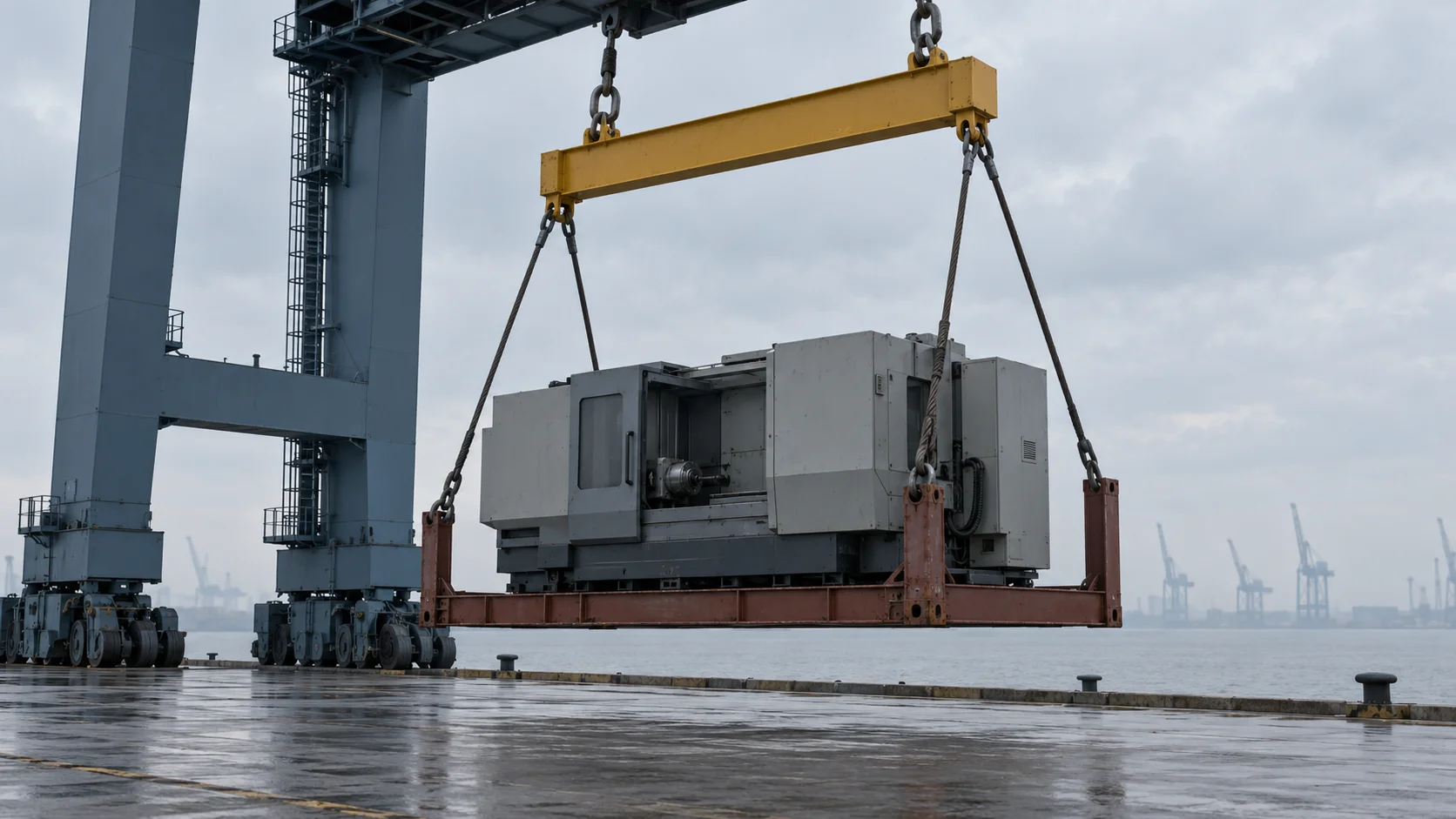
Worked Example: A Used CNC Machining Centre from Germany
A Melbourne precision engineering firm buys a 2019 five-axis CNC machining centre from a dealer in Stuttgart. Purchase price €220,000 (≈ AUD 365,000). Machine dimensions on skid: 3.4m long × 2.6m wide × 2.9m high, 14,200kg.
Freight decision. At 2.6m wide and 2.9m high it exceeds both the door and internal envelope of any standard box. Width kills the open top option. It goes on a 40′ flat rack as OOG cargo (over-width by ~150mm each side, over-height above the rack’s end walls) with professional lashing and a fully sheathed, VCI-lined export crate because it will likely stow on deck. Hamburg to Melbourne, roughly 38–42 days on water.
Biosecurity path. Used metalworking machinery: the dealer arranges a professional clean (coolant system drained and flushed, swarf trays removed, chip conveyor steam-cleaned, underside washed) with a cleanliness certificate and 40 photographs, cost €1,400. Shipping in October means it is inside the BMSB season window and Germany is a target risk country, so the crated unit is heat-treated by a DAFF-approved offshore provider before loading (€1,100). On arrival it is directed for inspection anyway (standard for used machinery); it passes on first inspection because the prep was done.
One caution about reading that result. A clean first inspection does not prove the €2,500 of cleaning and treatment was needed on this particular machine; it might have passed anyway. The spend was still the right call, because the decision had to be made before anyone knew how the inspection would go. Suppose an uncleaned machine of this age would pass three times in four. Skipping the prep then carries a one-in-four chance of a $5,000 to $15,000 decontamination bill and three to six weeks of lost production, which on expected cost alone lands close to the price of the clean, and only the clean protects the commissioning date. Judge the preparation by what was knowable before loading, not by the inspector’s verdict on arrival.
Compliance path. The machine is CE-marked to EN ISO 16090. Before commissioning, the buyer commissions a plant risk assessment against AS/NZS 4024 ($2,800 from a machinery safety consultant), which flags one gap: the swarf conveyor guard interlock doesn’t meet the required category and is upgraded for $1,900. Manuals are supplied in English. Electrically it is 400V/50Hz three-phase (native to both Germany and Australia, one of the quiet advantages of European used plant), connected by a licensed electrician with a new 125A supply ($3,600 including board work).
The numbers:
- Machine (FOB equivalent incl. cleaning/treatment/crating): AUD 375,500
- Ocean freight, 40′ flat rack OOG Hamburg–Melbourne incl. lashing: AUD 16,800
- Marine insurance @ 0.6% of CIF+10%: AUD 2,600
- Customs value ≈ AUD 375,500; duty: the tariff line carries 5% general rate, but an existing TCO covers the classification → duty $0
- GST: 10% × (375,500 + 0 + 16,800 + 2,600) = AUD 39,490 → deferred to BAS, fully credited
- Port charges, customs brokerage, biosecurity inspection fees: AUD 3,900
- OD road transport Melbourne wharf to Dandenong with permit: AUD 2,400
- 60-tonne mobile crane, half day, plus machinery skates crew: AUD 5,200
- Risk assessment, guarding rectification, electrical connection: AUD 8,300
All-in landed and commissioned: ≈ AUD 414,700 against a AUD 365,000 sticker price, a 13.6% on-cost, of which not one dollar of duty or (net) GST. Elapsed time from purchase to first chips cut: 11 weeks. The same machine bought new from Germany would cost roughly AUD 680,000 landed; the used import saved about $265,000 for two weeks of extra compliance work.
For a contrasting profile: a new packaging line from China (say AUD 240,000 FOB Shanghai, five modules each fitting a 40’HC) ships as three standard high cubes at ~AUD 4,500 each, enters duty-free under ChAFTA with a Certificate of Origin, faces packaging-only biosecurity scrutiny (ISPM 15 crates), but demands more WHS work at the destination end because guarding on the infeed and case erector needs upgrading to AS/NZS 4024 interlock standards, and its 380V rating needs verification against Australian 400V supply. New doesn’t mean compliant; it means clean.
The Pre-Shipment Checklist as Doctrine
Run this in order, every time. Discipline here is what separates an 11-week import from a 20-week one.
- Confirm exact crated dimensions and weight in writing from the supplier.
- Classify the goods (HS code), check duty rate, FTA eligibility and the TCO register.
- Used plant: contract the pre-export clean, cleanliness certificate and photo pack. Check the BMSB season window and book offshore treatment if required.
- Obtain electrical specs and conformity documents; verify against Australian supply before paying the balance.
- Select freight mode off the dimension ladder; book lashing/securing for flat rack or breakbulk; specify under-deck stowage or upgrade packing.
- Arrange marine transit insurance including the installation window.
- Apply for GST deferral (once, well before the first shipment).
- Book the plant risk assessment and any guarding review for installation week.
- Confirm destination logistics: OD permits, crane or heavy forklift, site access, positioning crew.
- Only then: confirm the delivery date, with a buffer day after expected biosecurity release.
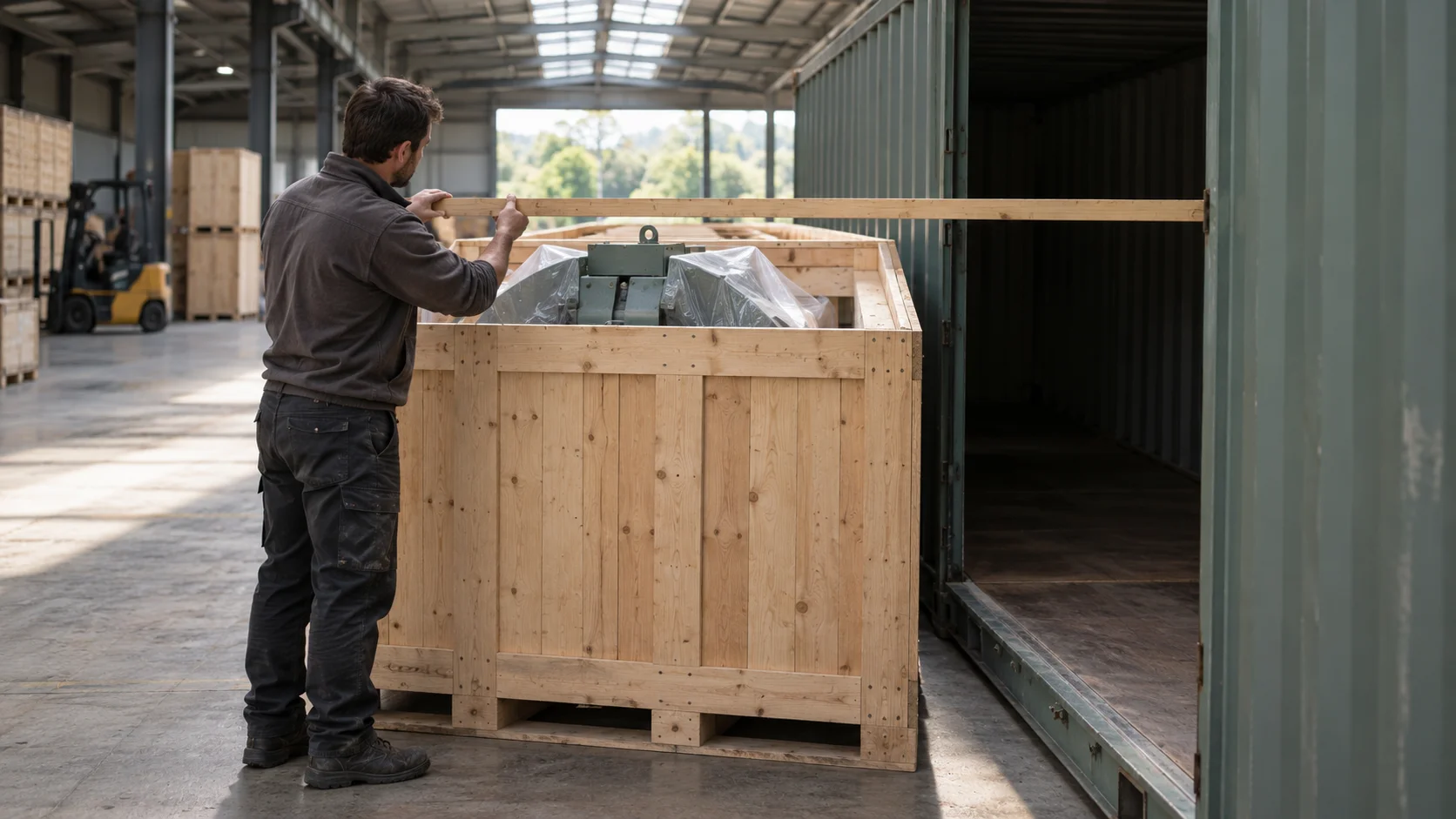
Common Mistakes
- Buying used plant sight-unseen with no cleanliness preparation. The auction bargain that arrives with soil in the chassis becomes the most expensive machine in its class after onshore decontamination, storage and re-inspection. If you can’t inspect it, pay for a third-party pre-purchase inspection that explicitly covers cleanliness.
- No WHS risk assessment before commissioning. Energising imported plant and putting operators on it without a documented risk assessment is the single most cited gap after machinery incidents. It costs a few thousand dollars and a week; skipping it can cost a prosecution.
- Booking the wrong container type. Discovering at the origin depot that the machine is 80mm too wide for the box means re-booking a flat rack at OOG rates on a later vessel, typically two to four weeks lost and thousands in re-handling.
- Ignoring the BMSB season. Target goods shipped from risk countries between 1 September and 30 April without approved treatment get held, treated onshore at premium rates, or refused discharge.
- No crane booked, or the wrong crane. A machine sitting on wharf accruing storage at $150–$400/day because site offloading wasn’t arranged is pure waste.
- Assuming CE marking equals Australian compliance. It’s a strong starting point, not a substitute for verification against AS/NZS 4024 and a local risk assessment.
- Insuring the transit but not the installation. The crane lift and floor positioning are statistically among the highest-risk moments in the machine’s journey.
Related Reading
- Biosecurity Requirements for Importing to Australia
- Total Landed Cost of Importing to Australia
- The Australian Import Process, Step by Step
- Customs Delays on Australian Imports: Causes and Fixes
- Warehouse Delivery Planning for Imports
- Tariff Concession Orders (TCOs): The Duty-Free List Most Importers Never Check
Frequently Asked Questions
What import duty applies to machinery imported into Australia?
Most machinery under HS chapters 84 and 85 carries a general rate of 0–5%, and FTAs (ChAFTA, JAEPA, KAFTA, AUKFTA and others) take nearly all of it to zero with valid origin documentation. For non-FTA origins such as Germany, check the Tariff Concession Order register: many machinery classifications are covered, eliminating the 5%. GST of 10% on the landed value applies regardless of duty outcome.
Does used machinery need to be cleaned before shipping to Australia?
Effectively yes. DAFF requires used machinery to arrive free of soil, plant material, seeds, insects and animal residue, and directs most used plant for physical inspection. A documented professional steam clean before export (certificate plus photographs) is the cheapest insurance in the entire import: it turns a likely failure-and-treatment scenario into a routine pass.
Do I need a flat rack or open top container for oversized machinery?
Work down the dimension ladder. Fits through a container door (≤2.28–2.58m high, ≤2.35m wide)? Standard box. Over-height only? Open top. Over-width or above roughly 25–28 tonnes? Flat rack, priced as out-of-gauge. Beyond flat rack limits, it’s breakbulk on a conventional vessel. Self-propelled plant can also go RoRo, often cheaper for wheeled machines.
What WHS obligations do machinery importers have?
An importer supplying plant for workplace use effectively steps into the manufacturer’s duties under the model WHS Regulations. That means guarding consistent with AS/NZS 4024, emergency stops and isolation, English documentation, registration for prescribed plant, and a documented risk assessment before the machine is commissioned. Safe Work Australia publishes the model codes of practice for managing plant risks.
Can I defer GST on imported machinery?
Yes, via the ATO’s Deferred GST Scheme, provided you are GST-registered, lodge monthly and electronically, and are approved before importing. GST that would be paid at the border is instead reported on your BAS and normally cancelled by the matching input tax credit: on a $500,000 machine that keeps around $52,000 out of the border transaction entirely.
Does imported electrical machinery need RCM marking?
Prescribed categories of electrical equipment must carry the Regulatory Compliance Mark. Large fixed industrial three-phase machinery usually falls outside the registration-heavy categories, but it must still be electrically safe, compatible with 400V/50Hz three-phase supply, connected by a licensed electrician to AS/NZS 3000, and supported by the supplier’s conformity documentation. US-spec 480V/60Hz plant almost always needs modification: confirm before purchase, not after arrival.