
The shipping time from China to Australia is not a single number. The tails of the range are where stockouts, missed deadlines, and emergency air freight decisions happen. Most freight forwarders quote the middle of the range: 18–22 days from Shanghai. Few are forthcoming about when the range extends to 35 days, and why. China to Australia shipping time for business cargo is best planned as an end-to-end lead time, from purchase order to warehouse.
Why Quoted Transit Times Are Not the Same as Actual Transit Times
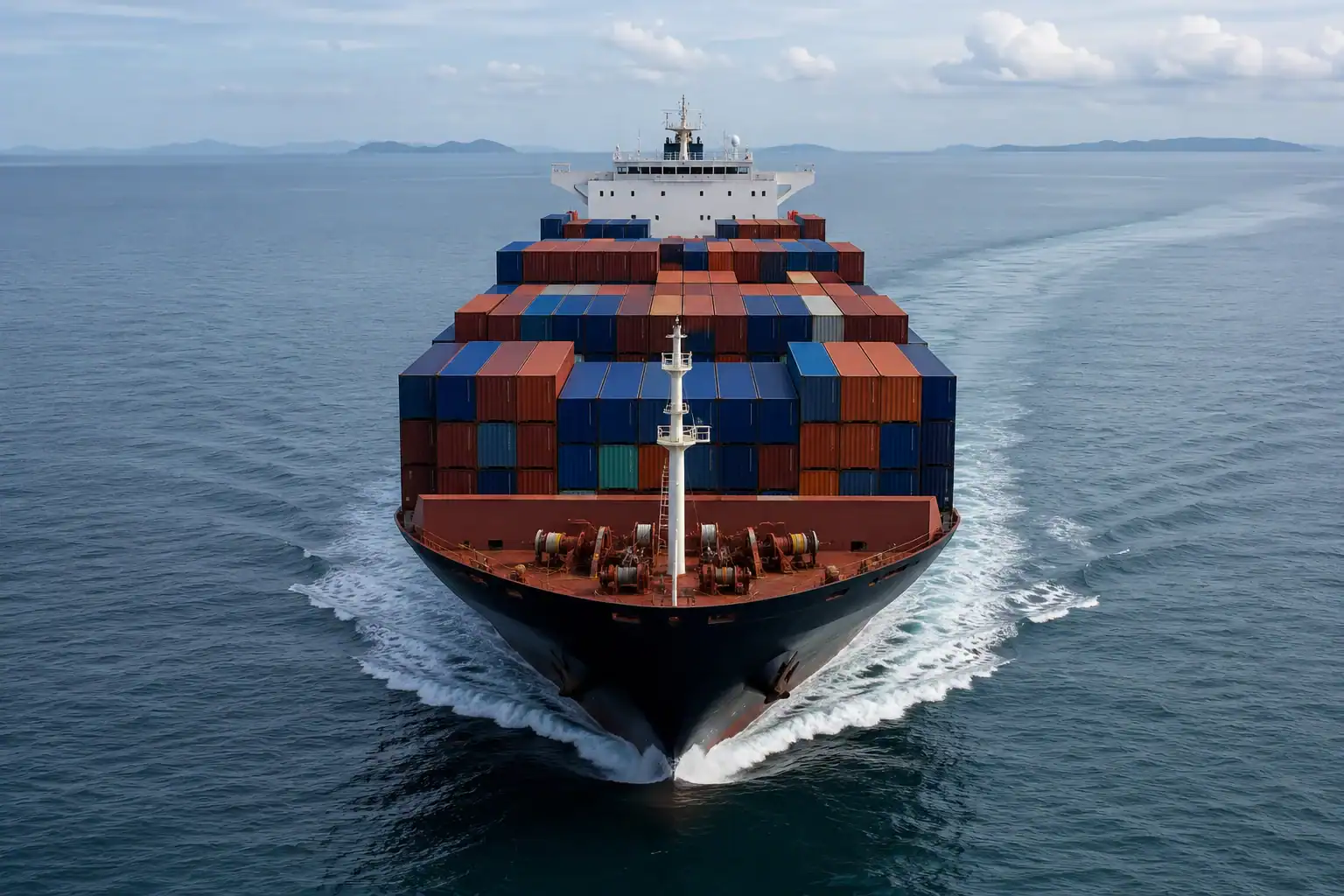
A freight forwarder’s quoted transit time is the vessel’s scheduled port-to-port sailing duration: the time from when the container loads at the Chinese port to when the vessel arrives at the Australian port. This number has two limitations:
First, it excludes the time before the vessel loads (export documentation, container stuffing, port cut-off) and after the vessel arrives (customs clearance, wharf release, delivery). The port-to-port number describes the vessel’s voyage, not the time your goods take to travel from your Chinese supplier’s door to your Australian warehouse.
Second, the port-to-port number is the scheduled time under normal conditions. Vessel delays, port congestion, transhipment connections, and weather events all extend actual transit times beyond the schedule. On the China-Australia trade lane, the difference between scheduled and actual port-to-port transit can be 3–10 days in normal conditions and significantly more during major disruption events.
The End-to-End Timeline: All Seven Stages
A China-to-Australia import cycle for sea freight moves through the following stages, each with its own duration and variability:
Stage 1: Supplier Production
Duration: 0–42 days, depending on whether goods are in stock or made-to-order.
For ex-stock goods (items already manufactured and available in the supplier’s warehouse), this stage may be zero: the goods can ship immediately once the order is confirmed. For standard make-to-order goods (clothing, custom products, furniture), production lead times of three to five weeks are typical. For complex or high-customisation goods, six weeks or more is common.
Many importers discover that a supplier’s stated “5–7 days” production time is optimistic during peak periods, particularly the weeks before Chinese New Year or Golden Week, when factories are working through a backlog of rush orders.
Stage 2: Export Documentation and Stuffing
Duration: 3–7 days.
Once goods are ready, the supplier arranges export documentation: the packing list, commercial invoice, and (if applicable) the Certificate of Origin for FTA duty preference claims. For ChAFTA (China-Australia Free Trade Agreement), the ChAFTA Certificate of Origin is issued by the China Council for the Promotion of International Trade (CCPIT) or China Customs. Obtaining it adds 2–5 days to the documentation stage if not pre-arranged.
The container is stuffed and transported to the port of loading. Port cut-off dates for container gate-in are typically 24–48 hours before the vessel departs. Missing the cut-off means waiting for the next sailing. On the China-Australia trade lane that next sailing may be 3–7 days later for a direct service, longer for a port-specific service.
Stage 3: Port-to-Port Ocean Transit
Duration: 12–28 days, depending on port pair and routing.
The table below shows scheduled port-to-port transit times for the main China-Australia port pairs under normal operating conditions:
| Origin Port | Destination Port | Service Type | Scheduled Days | Peak Season Range |
|---|---|---|---|---|
| Shanghai / Ningbo | Sydney (Port Botany) | Direct | 18–22 | 20–28 |
| Shanghai / Ningbo | Melbourne | Direct | 20–24 | 22–30 |
| Shanghai / Ningbo | Brisbane | Via transhipment | 22–28 | 25–35 |
| Shanghai / Ningbo | Perth (Fremantle) | Via transhipment | 20–26 | 23–32 |
| Guangzhou / Shenzhen | Sydney | Via transhipment (SG or PK) | 20–26 | 24–33 |
| Guangzhou / Shenzhen | Melbourne | Via transhipment | 22–28 | 25–35 |
| Guangzhou / Shenzhen | Perth | Via transhipment | 18–24 | 21–30 |
| Qingdao | Sydney | Direct or via SG | 20–26 | 23–32 |
| Tianjin | Sydney | Via transhipment | 22–30 | 26–38 |
Peak season range covers Q3–Q4 (July–December), when vessel space is tightest and port congestion at both ends tends to peak.
Stage 4: Arrival at Australian Port (Vessel Queue)
Duration: 0–5 days (vessel queue before berth).
When a vessel arrives at Port Botany, Port of Melbourne, or another Australian port, it may not berth immediately. If the berth is occupied by another vessel, the arriving vessel anchors in the bay or anchorage area and waits. During peak periods, berth queues at Port Botany and Port of Melbourne can add 2–5 days to arrival-to-berth time.
The port’s reported ETA is typically the vessel’s arrival at the anchorage or pilot station, not the berthing date. Goods are not discharged until the vessel is berthed. This distinction matters for customs pre-clearance timing.
Stage 5: Australian Customs Clearance
Duration: 1–10 days, depending on declaration status and examination.
Australian customs declarations are filed with the Australian Border Force (ABF) through the Integrated Cargo System (ICS). For commercial cargo, the import declaration must be lodged before the goods can be released. Customs duty, GST, and any applicable excise must be paid or deferred under a licensed broker’s deferral arrangement before the ABF issues a Release Advice.
For a standard commercial shipment with correct documentation and HS code classification, customs clearance typically takes 1–3 business days. Key delays at this stage:
- ABF “Hold”: a proportion of all shipments are held for examination, either directed examination (customs has a reason to examine) or random examination. A hold adds 3–7 business days while the examination is scheduled and completed.
- DAFF (Department of Agriculture) intervention: certain goods (food, plant products, animal products, timber) require biosecurity clearance from the Department of Agriculture, Fisheries and Forestry. Biosecurity clearance runs in parallel with customs clearance but adds 2–5 days if inspection is required.
- Documentation errors: incorrect HS code, mismatched invoice values, or missing permits delay the declaration and must be corrected before the ABF issues the Release Advice.
For a full breakdown of what the ABF checks on Chinese imports and what documentation is required, see the Australian customs import requirements guide.
Stage 6: Wharf Release and Container Collection
Duration: 1–3 business days.
After customs issues the Release Advice, the shipping line releases the container from the port. The importer or their broker pays the destination THC (Terminal Handling Charge) to the shipping line. The container is then collected by a road transport company and transported to the importer’s warehouse or a deconsolidation facility.
Port congestion affects this stage as well: during peak periods, transport slots at port terminals can be 2–4 days from the Release Advice, rather than next-day. Importers who manage their own transport should build this congestion into their peak season planning.
Stage 7: Delivery and Warehouse Receipt
Duration: 1–2 business days.
Once collected from the port, the container is transported to the importer’s warehouse. For metropolitan Sydney and Melbourne delivery, same-day or next-day delivery is typically available. For regional destinations, add 1–3 days for trunk transport.
Total End-to-End Lead Time Summary
Adding all seven stages:
| Stage | Normal Conditions | Peak Season / Delays |
|---|---|---|
| Supplier production (ex-stock) | 0–5 days | 0–7 days |
| Supplier production (made-to-order) | 14–35 days | 21–45 days |
| Export documentation and stuffing | 3–7 days | 5–10 days |
| Ocean transit (Shanghai → Sydney) | 18–22 days | 22–35 days |
| Vessel queue at Australian port | 0–1 day | 2–5 days |
| Customs clearance (no exam) | 1–3 days | 2–5 days |
| Customs clearance (ABF exam) | 4–8 days | 6–12 days |
| Wharf release and collection | 1–2 days | 2–4 days |
| Delivery to warehouse | 1–2 days | 1–3 days |
Total (ex-stock, no exam, normal conditions): approximately 24–40 days end-to-end.
Total (made-to-order, no exam, normal conditions): approximately 38–70 days end-to-end.
Total (made-to-order, ABF exam, peak season): approximately 60–105 days end-to-end.
The 60–105 day worst case is not hypothetical: it occurs regularly for importers who source made-to-order goods from slower-producing suppliers, ship during October-November peak, and encounter ABF examination. Any business where stockouts carry a meaningful cost should plan against that worst case. The China to Australia shipping time for business planning is that worst case, not the sailing time on the quote.

The Four Peak Season Periods That Extend China-Australia Lead Times
Chinese New Year (January–February)
Factory closures run from 1–3 weeks. Production rushes and port congestion fill the weeks before closure: vessels at Shanghai, Ningbo, and Shenzhen experience sailing delays of 3–7 days in the pre-CNY peak (typically late December to mid-January). Not all factory workers return immediately, so post-reopening production ramp-up takes 2–4 weeks.
Planning rule: Orders needed in February and March must be placed by late October–November at the latest (for made-to-order goods). Orders needed in January must ship before late November.
Golden Week in China (October 1–7)
A one-week factory closure combines with the northern hemisphere Q4 freight surge to make October the most congested month on the Asia-Pacific trade lane. Space on direct China-Australia services tightens and vessels roll bookings. Peak season surcharges apply from approximately August onward.
Planning rule: Orders needed for the Australian Christmas period (November–December) must be shipped by early September. Book space in July–August, before peak season surcharges rise.
Australian Christmas Season (November–December)
Australian port throughput reaches its highest level of the year in November–December. Port of Melbourne and Port Botany operate at near-capacity; berth queues add 2–4 days compared to the annual average. Road transport capacity also tightens, particularly in the December fortnight.
Planning rule: Target vessel arrival at Australian ports by late October or early November for Christmas season goods. Buffer an additional week for port congestion.
Australian Long Weekends and Public Holidays
Each state has specific additional holidays (Melbourne Cup Day in Victoria, Show Day in Queensland). Customs clearance, wharf operations, and transport services all operate at reduced capacity on public holidays. A shipment that arrives on the Friday before a long weekend may not clear customs until Wednesday of the following week.
Planning rule: Check the public holiday calendar for the destination state when scheduling vessel arrival. Arriving on the Thursday before a long weekend saves 3–4 days compared with arriving on the Monday after it.
ChAFTA and Certificate of Origin: Impact on Customs Clearance Speed
Under ChAFTA, most Chinese goods attract a duty rate of 0% when accompanied by a valid ChAFTA Certificate of Origin. Without it, general MFN (Most Favoured Nation) duty rates apply: typically 0–5% for most consumer goods categories, but up to 10% for some. Check the ChAFTA tariff schedule on DFAT for the specific HS code covering your goods.
A declaration claiming ChAFTA preference without the certificate in hand may be held pending verification.
Issuance takes 2–5 business days from application. Obtain the certificate for every shipment and instruct your Chinese supplier to include it in the standard export documentation pack, not on request.
Air Freight: When Does the Speed Premium Pay?
Air freight from China to Australia takes 3–5 days door-to-door (including customs clearance), compared to sea freight’s 24–70+ days. The cost premium is significant: approximately AUD 8–18 per kg for air freight vs AUD 2–6 per kg for sea freight (inclusive of port charges and local delivery). For a typical 500 kg commercial consignment, air freight might cost AUD 5,000–9,000 vs AUD 1,200–2,500 for sea freight.
Air freight makes commercial sense when:
- The stockout cost (lost margin × stockout duration) exceeds the air freight premium
- The goods are high-value and time-sensitive (fashion, electronics, pharmaceutical components)
- The shipment weight is under 150–200 kg (the crossover where air becomes disproportionately expensive relative to sea)
- The shipment is an emergency replenishment and sea freight cannot arrive in time to prevent stockout
For the air vs sea freight decision framework in detail, see our article on air vs sea freight for Australian importers. For how to calculate stockout cost and decide when air freight is justified, see how to avoid stockouts when importing goods.
How to Get Reliable Transit Time Information From Your Forwarder
Standard questions (“how long does it take?”) produce the scheduled port-to-port time, not the full picture.
These questions produce more useful answers:
- “What is the typical range for this trade lane, not the average but the 20th percentile and 80th percentile of actual arrival times?”
- “For the vessel I’m booked on, what is the current ETA at Port Botany/Melbourne and has it changed since the original booking?”
- “Is this a direct service or does it tranship at Singapore or Port Klang? If transhipping, what is the connection schedule and what happens if the feeder misses the connection?”
- “What is the current ABF examination rate for this commodity from China? Has it changed recently?”
- “What is the current berth situation at my destination port? Are vessels queuing?”
A specific answer cites the current vessel schedule, the current port conditions, and the current examination rates.
For a practical way to integrate this transit time intelligence into your inventory planning, see our article on how to plan inventory around shipping timelines. For the full guide to importing from China to Australia, see importing from China to Australia: the complete business guide. It covers compliance, documentation, and supplier management.
To get door-to-door transit estimates and current space availability for your specific route and volume, request a corporate freight quote.
Planning China to Australia Shipping Time for Business
Plan against end-to-end lead time: about 24 to 40 days for ex-stock goods and 38 to 70 days for made-to-order goods in normal conditions. Get the ChAFTA certificate with the export documents, avoid Golden Week and pre-Chinese New Year sailings where you can, and target Australian arrival by late October for Christmas stock.
Frequently Asked Questions
How long does sea freight from China to Sydney take?
Port-to-port transit from Shanghai or Ningbo to Port Botany (Sydney) on a direct service is 18–22 days under normal conditions, and 22–28 days during peak season (Q3–Q4). The total end-to-end time from goods leaving the Chinese factory to delivery at your Sydney warehouse is typically 24–40 days under normal conditions, and can extend to 50–70 days during peak season or when an ABF examination occurs.
Is the China-Australia route affected by the Suez Canal or Red Sea disruptions?
The China-Australia trade lane does not typically route via the Suez Canal or Red Sea. It transits directly across the Pacific or via Singapore/Port Klang. Red Sea disruptions on Europe-Asia trade lanes barely affect China-Australia freight directly. However, shipping lines repositioning vessels away from disrupted routes (vessel cascading) can indirectly affect space availability and rates on the China-Australia lane during major global shipping disruptions.
Does ChAFTA eliminate import duty on goods from China?
For most goods, yes: under ChAFTA, the tariff rate for most goods originating from China is 0% when accompanied by a valid ChAFTA Certificate of Origin. However, not all goods are covered. Some agricultural products, sensitive goods, and goods where origin cannot be clearly established as Chinese may still attract duty. Check the specific HS code for your goods against the ChAFTA tariff schedule before assuming duty-free status.
What is the difference between a direct service and a transhipment service?
A direct service means the vessel travels from the Chinese loading port to the Australian destination port without calling at an intermediate transhipment hub. A transhipment service means the container is transferred from a mainline vessel to a feeder vessel at an intermediate hub (typically Singapore or Port Klang) for the final leg to Australia. Direct services are faster but less frequent. Transhipment services are more frequent but add 3–7 days to transit time and introduce the risk of missing the feeder connection. A missed connection can add another 7–14 days if the next feeder is a week away.
How should I plan my orders to avoid Chinese New Year delays?
Work backward from your Required In-Stock Date (RISD). If you need goods in February or March, your Must-Ship Date (MSD) from China is early to mid-January, before the pre-Chinese New Year rush. Confirm your purchase order with the supplier by November at the latest (for made-to-order goods with 4–6 week production lead time). For ex-stock goods, orders by mid-December may still make a January ship date. Confirm with your supplier and forwarder based on the specific year’s Chinese New Year date.