
Most customs delays in Thailand are not caused by bad luck. They are caused by documentation that was close enough to pass a quick read but not close enough to pass a customs officer’s scrutiny: a packing list that says “household goods” instead of naming items, a duty-free application filed after goods arrived instead of before, a prohibited item buried in a container because the shipper didn’t know it was restricted.
To understand why Thai customs holds happen at the system level (the classification decisions, document failures, and valuation disputes that trigger holds), read our companion article before working through the prevention steps here.
The Thai Customs Department processes over 20 million import declarations per year. Risk profiling is automated and systematic. Shipments flagged for physical examination are rarely flagged by chance. Understanding what triggers scrutiny and what eliminates it is the difference between goods cleared in three to five working days and goods sitting in a bonded warehouse while paperwork is gathered under time pressure.
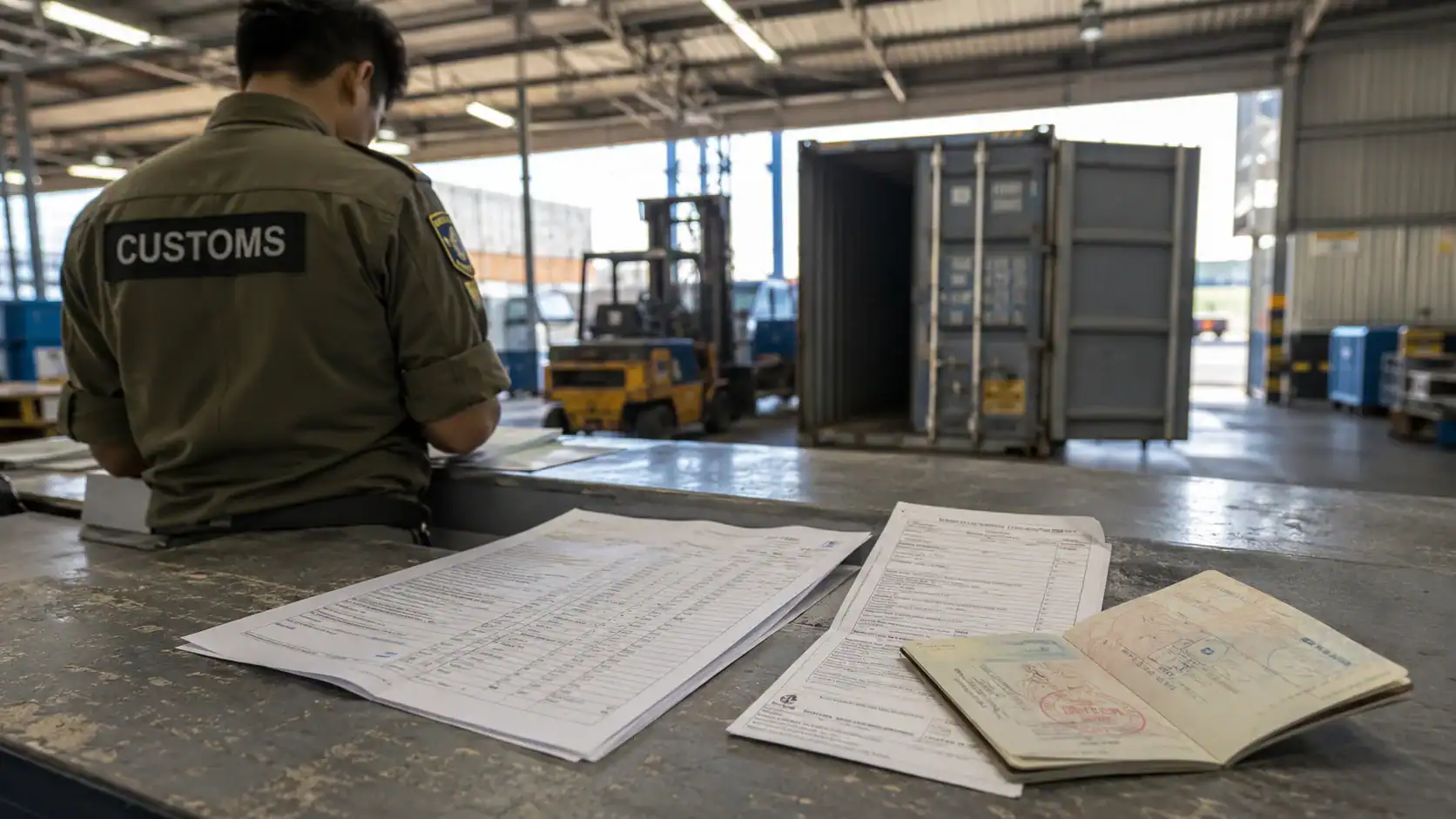
Why Thailand Customs Delays Happen: The Five Causes
Thailand operates under the Customs Act B.E. 2560 (2017). The Act modernised the framework but kept the core requirement: goods must be declared accurately and completely before clearance is granted. The five causes below account for the majority of delays experienced by international relocators.
Current clearance requirements and personal-effects conditions are published by the Thai Customs Department.
1. A Packing List That Doesn’t Meet Thai Standards
The single most common cause of examination and delay is a packing list that uses category labels instead of itemised descriptions. “Household goods,” “personal effects,” “miscellaneous items,” or “furniture and clothing” are not acceptable descriptions under Thai customs practice for personal effects shipments claiming duty-free status.
What Thai customs expects is an itemised list that includes, for each item: a specific description (e.g., “Sony 65-inch television, LED, model KD-65X80J”), a declared value in the currency of origin, a statement that the item is used and personally owned, and the approximate year of purchase. A customs officer reviewing a packing list labelled “electronics x 12” has no basis to approve a duty-free claim, and every reason to refer the shipment for physical examination to verify what “electronics” means.
The practical standard: write the packing list as if you are writing it for someone who has never seen your house. Every item named. Every item with a condition note (used, personal use, approximately X years old). Every item with a conservative estimated value. Box-level or room-level organisation is acceptable, but each box’s contents must be itemised, not summarised.
2. The Duty-Free Window Is Missed or Misunderstood
Thailand’s personal effects duty-free concession exempts household goods from the standard 5–30% import duty and 7% VAT, but it is not unconditional. It applies when three requirements are met: the importer holds a qualifying immigration status, the importer is relocating their principal residence to Thailand, and the goods arrive within six months of the importer’s first entry on the visa under which they are relocating. Status is the requirement that disqualifies most people, and it is the one no amount of better timing can fix.
The six-month window is measured from visa entry, not from the date goods are shipped. Some relocators ship goods early (before securing a visa, or under a tourist visa) and then return to collect a long-stay visa on a separate trip. They can find that their goods arrived outside the window, or that the visa class doesn’t qualify them for the concession at all.
Thai Customs grants the concession against documented status, not against the fact of relocating. The qualifying routes are: a Department of Labour work permit valid for one year or more, in practice held alongside a Non-Immigrant B visa; a non-immigrant visa with a confirmed working period of not less than one year; Thai permanent residence; a full one-year Smart Visa; or returning-Thai-national status after 12 or more consecutive months abroad. An LTR holder qualifies only where the LTR carries a work permit or a confirmed one-year working period, and then via that route rather than via the LTR itself.
Retirement visas do not qualify. The FIDI Global Alliance Thailand customs guide records that holders of visa type O and O-A will not be considered for duty-free entry and are subject to duties and taxes. The guide excludes Thailand Elite and education visas on the same basis. Tourist visas and visa exemption entries do not support a claim either. A retiree shipping on a Non-Immigrant O, O-A or O-X should budget 5–30% duty on CIF value plus 7% VAT rather than plan around a window they cannot use. Verifying eligibility with a Thai customs broker before shipping is not optional. It is the step that determines whether the financial case for sea freight holds. Swift Cargo’s Thailand customs documentation checklist sets out what each qualifying status requires.

3. Prohibited and Restricted Items That Were Not Declared
Thailand maintains a list of prohibited and restricted goods under the Customs Act and associated sector legislation. Items that are commonly included in household shipments but that generate customs examination or seizure risk include:
- Firearms and ammunition: prohibited without a Thai firearms import licence issued in advance; this includes replica and deactivated firearms
- Certain medications: narcotics and psychotropic substances under the Narcotics Act require pre-approval from the Thai Food and Drug Administration; bringing more than a 30-day personal supply of any controlled substance requires advance documentation
- Certain animal products: ivory, shagreen (stingray leather), items containing protected species under CITES require export and import permits
- Religious and cultural images: images of Buddha and other Thai religious figures are restricted for export from Thailand, but there is no import prohibition on images brought from overseas for personal use; however, antique religious images require cultural property clearance from the Fine Arts Department if they are antiques (over 100 years old)
- Electronic gambling equipment: prohibited
- Tobacco exceeding the duty-free limit: 200 cigarettes or 250g of tobacco; quantities above this are dutiable regardless of personal effects status
- Alcohol exceeding the duty-free limit: 1 litre; quantities above this are dutiable regardless of personal effects status
The issue is not always deliberate concealment. Relocators with collections (wine cellars, antique firearms, taxidermy, or extensive medication supplies) often don’t realise these items have specific import requirements. A shipment that triggers examination for one item holds all other goods in the container while the issue is resolved.
4. Valuation Disputes
Thai customs has the authority to challenge declared values that appear understated. For commercial goods, this is a common source of delay. For personal effects, it is less common but still occurs. The typical trigger is high-value electronics, jewellery, watches, artwork, or luxury goods declared significantly below the Thai Revenue Department’s reference values for those categories.
The risk is not that you need to overvalue your goods. It is that goods with visible and verifiable market values should be declared at values that reflect their actual market worth, not a nominal “used and depreciated” figure that ignores current resale value. Declaring a three-year-old MacBook at USD 50 will raise questions. Declaring it at a realistic used-market price will not.
5. The Broker Receives Documents Too Late
Thai customs clearance requires a customs broker to file an import declaration before goods can be released. The broker cannot file without a complete document set: the Bill of Lading or Air Waybill, the commercial invoice or packing list, the importer’s passport copy, the visa documentation, and the duty-free application (if applicable).
If the broker receives documents after the vessel arrives, goods begin accumulating port storage charges from day one of arrival. Storage at Laem Chabang runs approximately THB 300–900 per day per container depending on container size and dwell time. A seven-day documentation delay on a 20ft container costs THB 2,100–6,300 in storage, before any broker or customs fees. On a 40ft container, the storage charge is proportionally higher. Documentation delays are also among the easiest to prevent entirely.
The Documentation Set: What Thailand Customs Requires for Personal Effects
The following documents are required for a standard personal effects import cleared by a licensed Thai customs broker. “Standard” means sea freight of used household goods by someone relocating their primary residence to Thailand under a qualifying visa.
Primary Documents
- Bill of Lading (OBL or Telex): the original or a telex-released copy issued by the shipping line. Must match the vessel, voyage, container number, and declared contents
- Itemised packing list, to the standard described above: named items, values, condition, quantity per box, total declared value
- Importer’s passport: copy of the data page and the page showing the entry stamp in Thailand on the qualifying visa
- Status documentation, meaning proof of a qualifying status: a Non-Immigrant B visa with its one-year work permit, a non-immigrant visa with a confirmed one-year working period, a permanent residence certificate, or a full one-year Smart Visa. A retirement O/OA/O-X, a Thailand Elite card and an education visa do not support a personal effects claim
- Personal effects duty-free declaration. This is the Customs Department’s form for claiming the personal effects exemption; it must be completed by the importer (not just the broker) and declares that goods are used, personally owned, and not for commercial resale
Supporting Documents (Required in Many Cases)
- Origin packing list / shipper’s export declaration: from the origin country, confirming what was loaded
- Proof of residence in origin country: lease termination, utility bills, or sale of property in the origin country confirming that the relocation is genuine (i.e., the importer is not simply importing goods while maintaining their primary home abroad)
- Valuation support for high-value items: purchase receipts, insurance valuations, or current market value references for electronics, jewellery, or artwork above approximately THB 50,000 per item
- CITES permits: for any items made from protected species, including some leather goods, fur items, ivory, or timber products from restricted species

Submission Timing: The Document Window That Matters
The Thai customs broker requires a complete document set ideally two weeks before the vessel arrives at Laem Chabang. The practical minimum is five working days before arrival. “Arrival” means the date the vessel is scheduled to berth, not the date goods are loaded at origin.
Transit times on major routes to Thailand:
- UK (Felixstowe/Southampton) → Laem Chabang: 26–33 days sea freight
- Australia (Sydney/Melbourne) → Laem Chabang: 12–20 days sea freight
- USA (Los Angeles/Long Beach) → Laem Chabang: 18–24 days sea freight
- Germany (Hamburg) → Laem Chabang: 24–30 days sea freight
Working backward: if you load a container in Sydney, documents should be at your Thai broker within five to seven days of loading. For a UK shipment, the same applies, but the longer transit time means you have more days before vessel arrival, not more days before you need to act. The earlier documents are submitted, the more time there is to resolve any discrepancy before the clock starts ticking on port storage.
Choosing and Briefing a Thai Customs Broker
A Thai customs broker is a licensed intermediary who files the import declaration with the Thai Customs Department on the importer’s behalf. Brokers are also known as customs agents or freight forwarders with customs clearance services. For personal effects shipments, choose a broker who regularly handles household goods relocation clearances: the duty-free process has specific documentation requirements that not all brokers handle routinely.
Questions to ask a Thai customs broker before appointing them:
- How many personal effects relocation clearances do you handle per month?
- What is your standard timeline from document receipt to customs release?
- Do you provide a document checklist before the shipment departs origin?
- What is your process if customs requests additional documentation during examination?
- What are your fees for a standard clearance, and what are the situations that would generate additional charges?
A broker who cannot answer these questions with specific process detail is not the right broker for a household goods shipment. The clearance of a container of personal effects, particularly one claiming duty-free status, requires actively managing the documentation relationship between the importer, the origin freight forwarder, and the Thai customs officer. A broker who treats it as a standard commercial import transaction will produce standard commercial delays.
Items That Almost Always Trigger Physical Examination
The Thai Customs Department’s risk profiling system assigns examination probability to shipments based on declared contents, origin country, shipper history, and declared value relative to category norms. The following categories of goods reliably increase examination probability:
- Electronics above a certain quantity threshold: a packing list that includes more than three or four items in the “television / monitor” category, or more than five or six items in the “laptop / computer” category, will often trigger questions about whether goods are for personal use or commercial resale
- New or near-new goods: a shipment of household goods where many items appear to be recent purchases (based on declared values) may be examined to verify that goods are genuinely “used household effects” rather than commercial stock
- Luxury goods: watches, jewellery, handbags, and high-end audio equipment above certain value thresholds are routinely flagged for valuation verification
- Any declared weight that appears low for the declared volume: a 20ft container declared as carrying 10 CBM of “household goods” at 800 kg will raise questions, since normal household goods density runs approximately 200–250 kg per CBM
- Any item listed as “misc” or “assorted”: these items force the examining officer to open the box and record contents manually, which takes time and increases examination scope
The solution to all of the above is the same: specific descriptions, realistic values, and a packing list that reads as though it was written by someone who has nothing to hide, because it was.
The Role of Marine Insurance in a Customs Delay
Customs delays create a secondary risk that relocators often don’t consider until it materialises: goods held in a bonded warehouse or port CFS (Container Freight Station) for more than a few days may accrue storage and demurrage charges that the shipper is responsible for. Most marine insurance policies cover the transit period plus a defined number of days at the destination, typically 30–60 days from arrival. A protracted customs dispute that runs beyond the policy’s arrival window can leave goods in a warehouse without insurance coverage.
Verifying the policy’s “extended cover” provisions for customs-related delays before shipping is part of the document preparation process, not an afterthought. A marine insurance policy that includes a customs delay rider, or that explicitly extends cover during any period of government-ordered delay, provides a safety net that standard transit policies do not.
Air Freight vs Sea Freight: The Customs Delay Calculus
Air freight shipments to Thailand are cleared through the Suvarnabhumi or Don Mueang cargo terminals rather than Laem Chabang port. The customs process is structurally similar (itemised packing list, customs broker, duty-free declaration) but the timeline is compressed: air freight can be cleared in 24–72 hours if documentation is complete. The same documentation gaps that delay a sea freight shipment by seven days may cause the same seven-day delay in air freight, but the starting storage costs are much higher at an airport cargo terminal than at a sea port.
Air freight makes sense for: high-value items that need to arrive quickly, items where the replacement cost of a delay exceeds the cost premium of air freight, and small volumes (under 300 kg) where the sea freight cost differential is small. For a full household goods move (sofas, beds, kitchen equipment), sea freight remains the only commercially viable option, and the customs documentation process needs to be treated accordingly.
What Happens During a Physical Examination
When a shipment is flagged for physical examination, the process unfolds as follows:
- The customs officer issues an examination notice to the broker. The broker notifies the importer.
- A date is set for examination. The container (if FCL) or the specific boxes (if LCL) are moved to the examination bay.
- A customs officer opens designated boxes or the container and physically inspects contents against the declared packing list.
- If contents match the declaration, the examination is completed and a clearance recommendation is issued, typically within one to three working days of the examination date.
- If discrepancies are found (items not on the list, items with values that don’t match, or prohibited items), the officer will either: request a revised declaration and supporting documentation, issue a penalty for misdeclaration, or refer the goods for further review by a senior officer.
During a physical examination, the most useful thing an importer can do is keep their Thai broker’s contact information at hand and respond to any document requests within the same working day. Every day of delay in responding to a customs information request is another day of port storage charges and potentially another day before goods are released.

Pre-Shipment Checklist: What to Complete Before Your Container Loads
One caution before you work through it. The checklist moves your odds; it does not settle them. A relocator who itemised every box and filed the concession on time can still draw a physical examination, because a share of inspections are selected on profiling factors no shipper controls. Another who wrote “household goods” across three lines can clear in four days on a quiet week at Laem Chabang. Neither result tells you much on its own. The first person made the right call and lost the toss; the second made a poor one and happened to win it, and will very likely repeat it on a shipment where the stakes are higher. Judge the preparation on what was knowable before the container sealed, not on how the clearance happened to land, or you will learn precisely the wrong lesson from a good outcome.
Working backward from vessel loading, the following sequence gives a Thailand-bound household goods shipment the highest probability of clearing customs without delay:
Eight to twelve weeks before departure:
- Confirm visa class and entry date eligibility for personal effects duty-free concession with a Thai customs broker or immigration lawyer
- Appoint a Thai customs broker and obtain their document checklist
- Begin the itemised packing list. Start with the highest-value items: electronics, jewellery, artwork, musical instruments, sporting equipment
Four to six weeks before departure:
- Book the removals survey. Volume determines container size and LCL vs FCL decision
- Review goods against the prohibited/restricted items list. Remove anything that requires an import licence that you have not obtained
- Obtain any required permits for restricted items (CITES certificates, medication import approvals), which have lead times of two to six weeks
Two to three weeks before loading:
- Finalise the packing list to itemised standard: every box, every item
- Send the packing list draft to your Thai customs broker for pre-clearance review. A good broker will flag potential issues before the container is sealed, not after it arrives
- Prepare the personal effects duty-free declaration and ensure you have copies of your qualifying visa and passport entry stamp ready to transmit
At loading / sealing:
- Confirm the final packing list matches what was actually loaded (not what was planned to be loaded, but actual contents after removalists packed)
- Ensure Bill of Lading draft is reviewed and any errors corrected before the shipping line issues the final OBL
Immediately after loading, before vessel departure:
- Transmit the complete document set to your Thai customs broker: B/L, packing list, passport copy, visa documentation, duty-free declaration
- Confirm broker has received and reviewed the documents. Resolve any outstanding questions before the vessel sails
The sequence matters because some of these steps have hard dependencies. The duty-free concession application requires both the visa documentation and the itemised packing list. The broker cannot pre-check the packing list until it is itemised. The B/L cannot be reviewed until loading is complete. Doing these steps in the wrong order doesn’t save time. It creates gaps that delay clearance.
None of this is complicated. It is just discipline. Every delay in this article traces back to a step someone skipped, rushed, or assumed the broker would handle. The mover who itemises the packing list down to the box, completes the duty-free declaration personally, and gets the full document set to the broker before the vessel sails is not smarter than the one whose container sits in a Bangkok examination yard for three weeks, just more disciplined about the boring parts. You own this outcome, not the customs officer and not the broker. Do the checklist. Do it early. Do it completely.
Related reading: Shipping Delays When Moving to Thailand Cluster at Predictable Points
Frequently Asked Questions
How long does customs clearance typically take for household goods shipped to Thailand?
When documentation is complete and correct, customs clearance for a personal effects shipment in Thailand typically takes three to five working days from the vessel’s arrival at Laem Chabang. If a physical examination is ordered, add two to four working days for the examination itself. If a discrepancy is found during examination, the timeline depends on how quickly supporting documentation can be provided. One to two additional weeks is common for minor discrepancies; longer for valuation disputes or prohibited items.
Do I need a customs broker for personal effects in Thailand?
Yes. Personal effects may not be self-cleared in Thailand. A licensed customs broker must file the import declaration on your behalf. The broker relationship should be established and the document checklist obtained before your goods are shipped, not after they arrive.
What is the personal effects duty-free limit in Thailand?
There is no single monetary limit on the personal effects duty-free concession. The concession applies to used household goods that are personally owned, brought to Thailand as part of a genuine relocation of primary residence, and imported within six months of the importer’s first entry on a qualifying status. The key eligibility criteria are: a qualifying status (a one-year Thai work permit, a non-immigrant visa with a confirmed one-year working period, Thai permanent residence, or a full one-year Smart Visa), used (not new), personal (not commercial), and timed within the six-month window. Retirement visas, Thailand Elite and education visas are excluded outright, so for those holders there is no concession to place a limit on. Alcohol, tobacco, and vehicles are treated separately. They have quantity/value limits regardless of personal effects status.
What happens if I miss the six-month duty-free window?
Goods that arrive after the six-month personal effects window closes are subject to standard import duty and VAT. Duty rates vary by goods category: furniture typically attracts 10–20%, electronics 5–10%, clothing 10–30%. VAT is 7% on CIF value plus duty. The importer must decide whether to pay the duty to release the goods or explore storage options. There is no appeal process for a missed window. It is a hard deadline.
Can I ship a car to Thailand under personal effects?
No. Vehicles, including motorcycles, caravans, and boats, are excluded from the personal effects duty-free concession. Vehicle imports are subject to import duty of 80% or more on the CIF value, plus excise duty (varies by engine size) and VAT. Most relocators either sell their vehicle before departure or investigate Thailand’s Temporary Import Permit (TIP) as an alternative to permanent import. See our guide to the Thailand Temporary Import Vehicle Permit for the full TIP pathway.
What should I do if my shipment is held for examination?
First, do not panic. Examination is a normal part of the customs process and does not automatically indicate a problem. Contact your Thai customs broker immediately and confirm: what triggered the examination, what documentation has been requested, and what the estimated timeline is. Respond to any document requests within the same working day. If the issue involves a prohibited or restricted item, seek advice from a Thai customs lawyer before responding, since a voluntary disclosure before formal seizure is treated significantly more favourably than a contested examination result.