
The Dutch approach to moving tends to be pragmatic. You assess what you have, work out what follows you, and plan the logistics without too much sentimentality about the rest. The move from the Netherlands to Thailand rewards that approach — because the most consequential decisions in a Dutch-to-Thailand relocation aren’t about what to pack, but about which visa you arrive on and when you book your freight relative to that visa date.
These two factors — visa type and freight timing — determine whether your goods clear Thai customs duty-free or attract duties of up to 30% plus 7% VAT. Everything else in the relocation is logistically manageable. Getting the visa and timing wrong generates a tax bill that’s difficult to undo after the container is already sailing.
Visa Type: The Eligibility Decision That Precedes Everything Else
Thai customs grants the duty-free personal effects exemption based on visa status, not nationality. The rules apply identically to Dutch nationals and to all other nationalities.
| Visa / Status | Duty-Free Eligible? | Notes |
|---|---|---|
| Non-Immigrant B (work permit) | Yes | One-year work permit required; 6-month shipment window applies |
| Retirement (O-A / O-X) | No | Does not qualify — full import duties and 7% VAT apply |
| Thai Elite / Privilege Card | No | No exemption |
| Long-Term Resident (LTR) | Seek ruling | Conditions vary by LTR sub-category |
| Education (ED) | No | No exemption |
| Tourist / visa-exempt | No | No qualifying status |
| Returning Thai national | Yes | Must prove 12+ consecutive months abroad |
The retirement visa O-A is straightforward to obtain as a Dutch national over 50 and is a common route to Thailand. It does not, however, qualify for the household goods duty-free exemption. If you are moving to Thailand on an O-A and you want to bring significant household contents, the economics change: import duties of 10–30% plus 7% VAT on the declared CIF value of everything in the shipment. For a 15 CBM shipment with CIF value of €20,000, that could generate €3,000–6,000+ in Thai import costs. This may still be worth it for specific items, but it changes what belongs in the container and what doesn’t.
For those arriving on a Non-Immigrant B visa with a work permit, the exemption conditions:
- Valid one-year Thai work permit issued before the shipment arrives at Laem Chabang
- 12+ consecutive months of prior residence in the Netherlands (or origin country)
- Shipment arriving between one month before your initial Thailand entry and six months after your work permit issue date
- One sea and one air shipment — not multiple sea consignments
- All goods demonstrably used and personally owned; one of each appliance type
Dutch Departure: Rotterdam’s Advantage
Rotterdam (Port of Rotterdam) is Europe’s largest container port by throughput and one of the best-connected ports for Asia-bound cargo. For Dutch movers, this is a genuine logistical advantage — more frequent vessel departures to Asian ports, shorter time waiting for the next available sailing, and a well-developed LCL consolidation infrastructure serving Dutch removal companies.
From Rotterdam, the route to Laem Chabang:
Via Suez Canal: English Channel, Strait of Gibraltar, Mediterranean, Suez Canal, Red Sea, Indian Ocean, transshipment at Singapore or Port Klang, onward to Laem Chabang. Ocean leg approximately 32–40 days from Rotterdam — slightly shorter than Hamburg because Rotterdam’s North Sea position allows a more direct westward entry into the Channel routing.
Via Cape of Good Hope (current routing for many carriers since early 2024): Around southern Africa, Indian Ocean, transshipment, Laem Chabang. Ocean leg approximately 43–52 days. Ask your removal company or freight forwarder which routing is current before committing to a timeline.
Realistic door-to-door from the Netherlands:
- Collection and packing: 1–3 days
- Rotterdam port handling and loading: 5–10 days
- Ocean transit (Suez routing): 32–40 days
- Ocean transit (Cape routing): 43–52 days
- Thai customs clearance at Laem Chabang: 5–10 working days
- Last-mile delivery in Thailand: 1–3 days
Total: 7–9 weeks (Suez) or 9–11 weeks (Cape). Rotterdam’s efficiency advantage tends to show up in shorter port handling times and more frequent sailing options — it rarely changes the ocean leg duration meaningfully, but it can reduce the wait between booking and vessel departure.
Dutch Deregistration: The BRP and Thai Customs Documentation
Dutch nationals leaving the Netherlands permanently should file an aangifte van emigratie (emigration notification) with their local municipality. This deregisters you from the Basisregistratie Personen (BRP — the Dutch population register) and changes your status to non-resident for Dutch tax and social security purposes.
For Thai customs documentation purposes, the deregistration process generates useful evidence of prior Dutch residence:
- Uittreksel BRP (BRP extract) — an official document showing your registered address history in the Netherlands, available from your municipality or via MijnOverheid.nl. Useful as proof of 12+ months’ Dutch residence.
- Verhuisbericht (change of address notification) — confirms the deregistration event
- Alternatively: recent utility bills, rental contracts, or bank statements showing a Dutch address over the qualifying 12-month period
Thai customs may request proof of prior residence when processing a duty-free personal effects claim. Having a BRP extract in your document pack — alongside your passport, work permit, and packing inventory — is cleaner than assembling utility bills after the fact.
LCL or FCL: Sizing a Dutch Household Move
Dutch homes vary considerably. Amsterdam apartments and Rotterdam flats tend to be smaller than German or Italian equivalents. A typical 2-bedroom Amsterdam apartment is dense but compact — books, quality furniture, personal items, and clothing often fill 10–20 CBM when curated for the move.
| Property Type / Volume | Estimated CBM | Recommended Mode | Approximate Cost (EUR) |
|---|---|---|---|
| Studio / 1-bedroom flat | 5–12 CBM | LCL groupage | €600–€1,800 |
| 2–3 bedroom apartment | 12–28 CBM | LCL or 20ft FCL | €1,800–€4,000 |
| Family home / larger property | 28–55 CBM | 20ft or 40ft FCL | €3,000–€7,000+ |
Costs are freight-only estimates and exclude Thai import duty, VAT, and local delivery. Your removal company (verhuisbedrijf) will provide a more accurate survey estimate.
What to Ship and What to Leave Behind
Generally worth shipping from the Netherlands:
- Quality clothing — particularly cold-weather and business attire; Dutch fashion is not easily replicated in Thailand
- Books and personal libraries
- Artwork, antiques, and objects of sentimental or monetary value
- Professional and specialist equipment
- Children’s belongings and comfort items
- Quality Dutch-made or European furniture with significant replacement cost
Typically not worth shipping:
- Bicycles — the Netherlands’ bicycle culture doesn’t translate to Thailand’s roads, traffic, or terrain. City bikes are bulky to ship, and comparable or better bicycles for Thai conditions are readily available locally. High-performance road or mountain bikes may be an exception if they’re high-value and not easily replaced.
- Standard flatpack or mid-market furniture — available in Thailand at comparable prices
- Large white goods — washing machines, dishwashers, large fridges. Thai apartments are smaller and local replacements are affordable
- Bulky items (heavy sofas, large wardrobes) where shipping approaches replacement cost
- Dutch-voltage electrical appliances not usable on Thailand’s 220V/50Hz grid (most modern appliances are dual-voltage, but older Dutch-purchased items may not be)
Prohibited and Restricted Items
Prohibited — remove before packing:
- Lithium batteries of any kind — power banks, e-bike batteries, laptop batteries, power tool batteries. Prohibited from sea freight under IMDG regulations. Remove all batteries from devices before packing; carry them in your cabin luggage. This is especially relevant for Dutch movers who commonly own e-bike batteries.
- Flammable substances, aerosols, gas canisters, paint
- Narcotics and controlled substances
- Pornographic material
- Counterfeit goods
- Weapons and firearms (without Thai police permit)
- CITES-protected wildlife and derivatives
Restricted — documentation required:
- Alcohol — not covered by the personal effects duty-free exemption; Thai excise duty applies. Small personal quantities may be accepted; consult your removal company.
- Buddha images and religious antiques — Fine Arts Department permit required
- Plants and plant material — phytosanitary certificate from NVWA (Nederlandse Voedsel- en Warenautoriteit) required; easier to leave behind
- Prescription medication in excess of personal use — carry documentation
Required Documents for Thai Customs
- Passport copy — all pages including current valid Thai visa
- Work permit copy — valid one-year Thai work permit (if claiming duty-free exemption)
- Detailed packing inventory in English — every item listed with description, quantity, and estimated value
- Bill of Lading — issued by the shipping line
- Proof of Dutch residence for 12+ months — BRP uittreksel, utility bills, rental contracts, or bank statements covering the qualifying period
The complete Thai customs document checklist covers every required item including the electronic import declaration your customs broker files via the National Single Window system.
All household goods at Laem Chabang enter the Red Line — physical inspection against the packing inventory. Complete, accurate documents mean clearance in 5–10 working days. Incomplete documents mean bonded storage at daily cost. Documentation gaps are the primary cause of clearance delays.
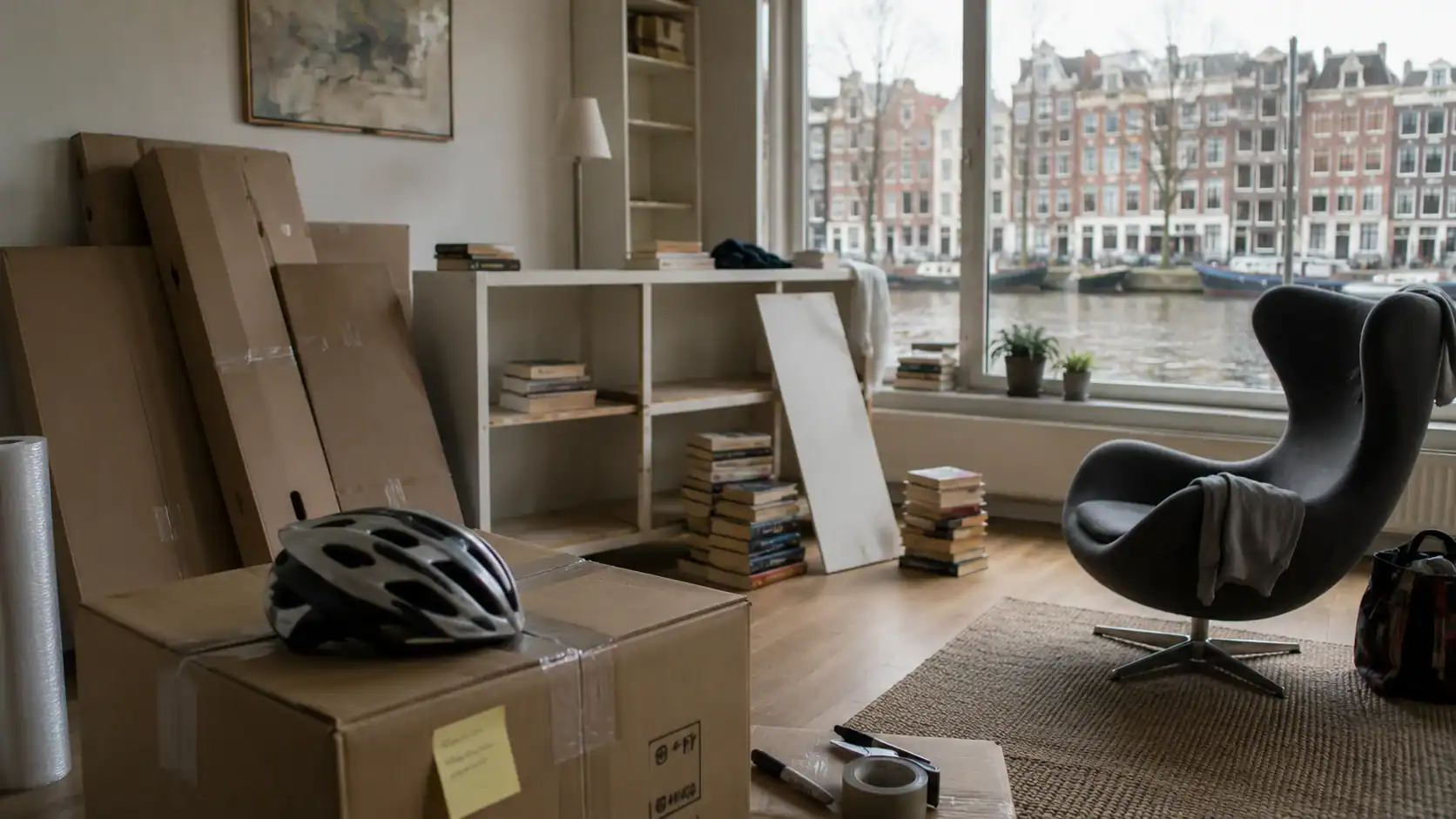
The first thing nobody mentions about moving from the Netherlands to Thailand is the bicycle. Not the bike itself — that gets sold in Amsterdam two weeks before the flight. It is the absence of the cycling life that catches Dutch relocators by surprise. The morning commute, the school run, the Friday-evening ride along a canal — those are not just transport in the Netherlands; they are the rhythm of the day. Bangkok does not have that rhythm. The traffic does not allow it, the heat does not allow it, the road culture does not allow it. The relocator arrives expecting “warmer weather and lower cost of living” and discovers that one of the small architectures of their daily life has been removed without a replacement. The Dutch relocators who land well are the ones who name this in advance and figure out what fills the gap before they arrive. Some take up early-morning walks in Lumphini Park. Some find a Dutch expat cycling group that rides outside the city. Some accept that this part of life is gone and rebuild around something else. The freight side of the move is the easy part. The harder part is the rhythm-shaped hole the bicycle leaves behind, and what the relocator chooses to put in its place.
Frequently Asked Questions
Can Dutch nationals import household goods duty-free when moving to Thailand?
Yes — if arriving on a qualifying visa. A Non-Immigrant B visa with a one-year work permit qualifies. Retirement visa (O-A, O-X) holders do not. Import duties of 10–30% plus 7% VAT apply without qualifying visa status. The rule is visa-based, not nationality-based.
How long does sea freight from the Netherlands to Thailand take?
Door-to-door: 7–9 weeks via Suez Canal, or 9–11 weeks via Cape of Good Hope (current for many carriers since 2024). Rotterdam’s high-frequency Asia services reduce waiting time between booking and departure. Add Rotterdam port handling and Thai customs clearance at each end.
Do I need to deregister from the Dutch BRP before moving?
If leaving permanently, yes — file an aangifte van emigratie with your municipality. This changes your Dutch tax and social security residency status. The resulting BRP uittreksel serves as clean proof of Dutch residence for Thai customs documentation.
Is Rotterdam a good port for shipping to Thailand?
Yes. Europe’s largest container port with frequent direct Asia services. For Dutch movers, fewer feeder steps to the deep-sea vessel and more departure options than most European alternatives.
Should I ship my bicycle from the Netherlands to Thailand?
For most people, no. Standard Dutch city bikes don’t suit Thai roads, and good bicycles are available locally. High-performance road or mountain bikes may be worth shipping if high-value and not easily replaced. Remove the battery from e-bikes before packing — lithium batteries cannot travel as sea freight cargo.
Planning Your Move from the Netherlands with Swift Cargo
The complete step-by-step guide to shipping household goods to Thailand covers eligibility verification, volume planning, document preparation, and Laem Chabang clearance. Swift Cargo manages European-origin household goods shipments to Thailand, including Dutch-origin removal coordination, customs brokerage, and delivery to your Thai address.
Contact Swift Cargo for a Netherlands-to-Thailand freight assessment →

