
Hi there! We’re the editorial team behind MCS Sdn Bhd, an MM2H agent in Kuala Lumpur.
We obviously help expats relocate to Malaysia under the programme, and besides human dependents, many applicants also want to bring their four-legged family members!
While not covered directly by MM2H, it is possible to import a pet via the Malaysian Quarantine and Inspection Services Department (MAQIS), the body responsible for pet imports, and while deferring to Swift Cargo on the international relocation logistics, our guide covers:
- general requirements to bring a cat or dog into Malaysia
- what to expect once your pet arrives in Malaysia
- how to time it around your visa application, and crucially
- how a pet can impact your MM2H property purchase
Note: We only cover cats and dogs, and other pets, such as birds and rodents, are subject to different requirements!
Let’s begin.
The MM2H application timeline
First, a quick look at a typical MM2H process from initial discussion to final endorsement.
| Stage | Timeframe |
|---|---|
| Consultation with an MM2H agent, then signing an agreement and paying a deposit | at the start |
| Preparing, certifying, and notarising documents | 1 to 2 months |
| The agent submits your application to the Ministry of Tourism, Arts and Culture (MOTAC) for review | 2 to 3 months |
| Conditional approval, after which you pay the outstanding balance | within 7 days of approval |
| Entering Malaysia | within 3 months of approval |
| Opening a local bank account for your fixed deposit, completing a medical check-up, and buying insurance | 3 to 4 working days |
| Visa endorsement | once the above is complete |
That’s around 8 months in total, and if you haven’t bought a home yet, you’ll then have 3 to 12 months from endorsement to do so, depending on your MM2H tier.
Ideally, your pet relocation prep work should start at Stage 2 together with your MM2H document compiling. Although they go through separate agencies, you’ll want all the requirements sorted at the same time so you can align the relocations as closely as possible.
General requirements
All cats and dogs coming into Malaysia need an import permit from MAQIS.
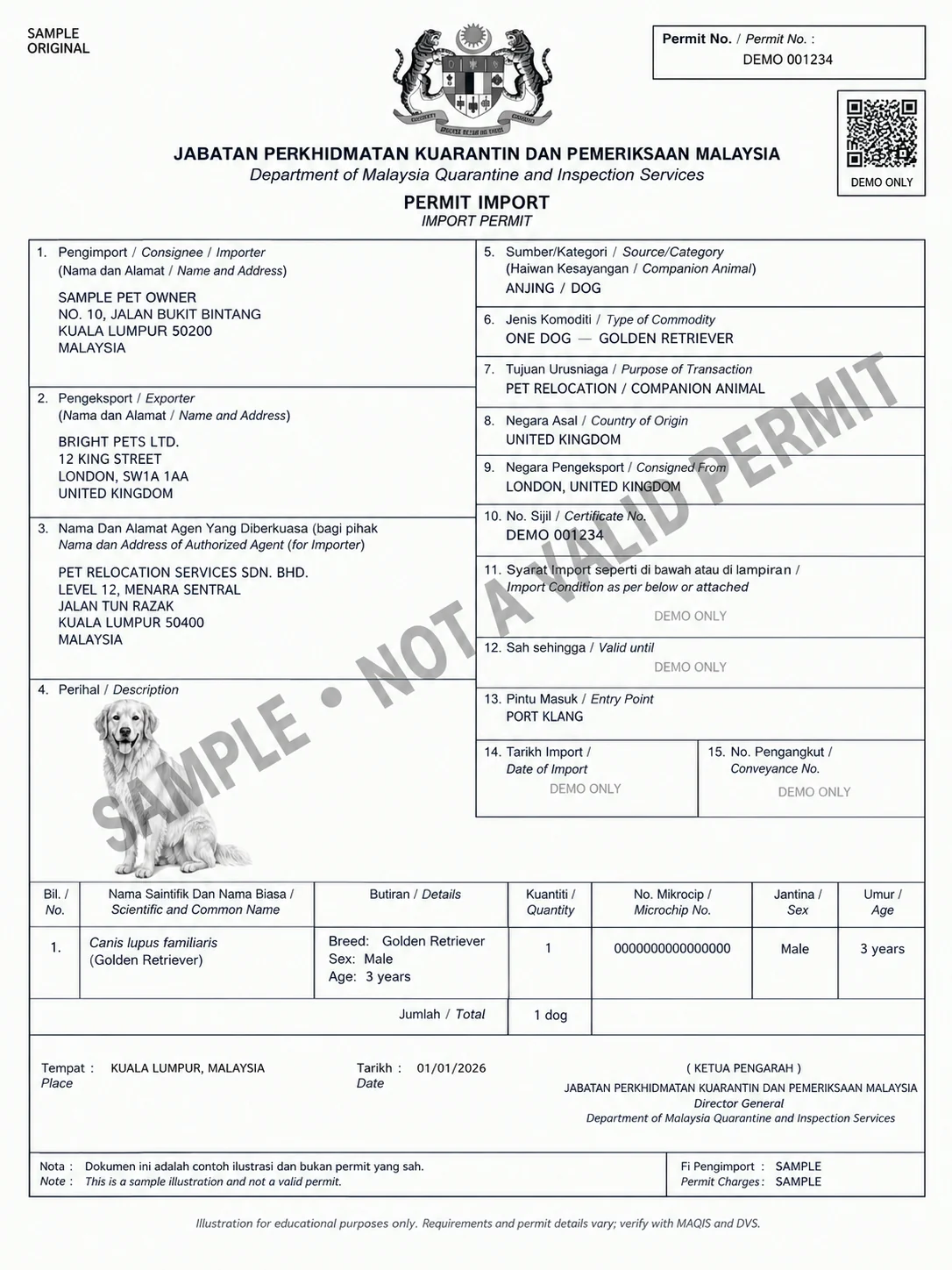
This should be obtained before your pet leaves the country you’re coming from, and MM2H or not, MAQIS treats every pet the same.
To secure this permit, your pet must be:
- at least 3 months old
- fitted with a microchip that meets ISO standards 11784 and 11785
- vaccinated against rabies and other core vaccines, with its vaccination history, treatments and current health recorded in a vaccination book or pet passport
- certified fit to travel, and exported within 7 days of its Veterinary Health Certificate being issued
- a breed that’s allowed into Malaysia (more below)
You will also need to prepare the following supporting documents:
- your pet’s vaccination book, vaccination certificate or pet passport
- a quarantine booking, if your pet is coming from a country that isn’t exempt from quarantine (more on this below)
- your boarding pass and passport, or an airway bill if your pet is flying as cargo
- an approval letter from the Director General of MAQIS, if bringing a restricted breed, and
- a Veterinary Health Certificate by the veterinary authority of the country you’re exporting from
As the application is tied to your import date, you can only apply once your travel date is set, and if your pet needs quarantine, you’ll have to book a quarantine space at least 7 days before arrival, as the booking number is part of your permit application.
On arrival, MAQIS officers will check the original permit, Veterinary Health Certificate and vaccination records along with your pet.
If it feels like a lot of work, now you know why professional pet relocation services are a thing.
Swift Cargo’s guide to pet relocation to Malaysia covers the same rules, plus typical costs.
And depending on where you are relocating from, there could be more!
Quarantine-exempt countries
Cats and dogs from the following countries don’t need to be quarantined, as long as they’re healthy and all documents are complete:
- the United Kingdom, Ireland and Northern Ireland
- Sweden and New Zealand
- Japan, Brunei and Singapore
This also means you won’t need a quarantine booking for your permit application, though your pet will still be inspected at the point of entry.
A December 2025 notice from Malaysia’s Department of Veterinary Services also added Austria, Bahrain, Belgium, Bulgaria, the Czech Republic, Estonia, Germany, Greece, Lithuania, Luxembourg, Malta, Montenegro, Portugal and Slovenia to its list of scheduled countries. Quarantine terms can differ by country (Australia has its own), so if you’re coming from one of them, ask MAQIS whether quarantine applies before you book.
Requirements for Australia
In addition to the import permit and Veterinary Health Certificate, your pet will need lab test results as set out in your import permit conditions, including a negative Hendra virus blood test taken within 14 days before it leaves Australia, and you’ll need to bring the originals with you.
Australian pets also aren’t exempt from quarantine, and must stay at least 14 days so they can be confirmed free of Hendra virus. The MAQIS pet guide still says 10 days, but Malaysia’s current rules for Australia, revised in December 2024, say at least 14.
Restricted and banned dog breeds
Cats are generally fine, but unfortunately, certain dog breeds may not be viable for relocation.
This can be a situational restriction due to your MM2H property purchase, or in some cases, a blanket ban.
Restricted dog breeds
Malaysia heavily restricts the import of the following dog breeds:
- Bull Mastiff
- Bull Terrier
- Dobermann
- German Shepherd or Alsatian, including Belgian Shepherd and East European Shepherd
- Belgian Malinois
- Perro de Presa Canario, also known as Canary Dog (banned if your dog is coming from Australia)
- Rottweiler
While not impossible to bring in, the government imposes additional requirements and requires written approval from the Director General of MAQIS before you can even apply for an import permit.
A MAQIS officer will also inspect your home to check the dog’s enclosure size, safety and how it will be kept under control, and you’ll need to declare that the dog is a personal pet and not for sale, and will be kept within an enclosed area at all times.
Banned dog breeds
These can’t be brought into Malaysia, full stop.
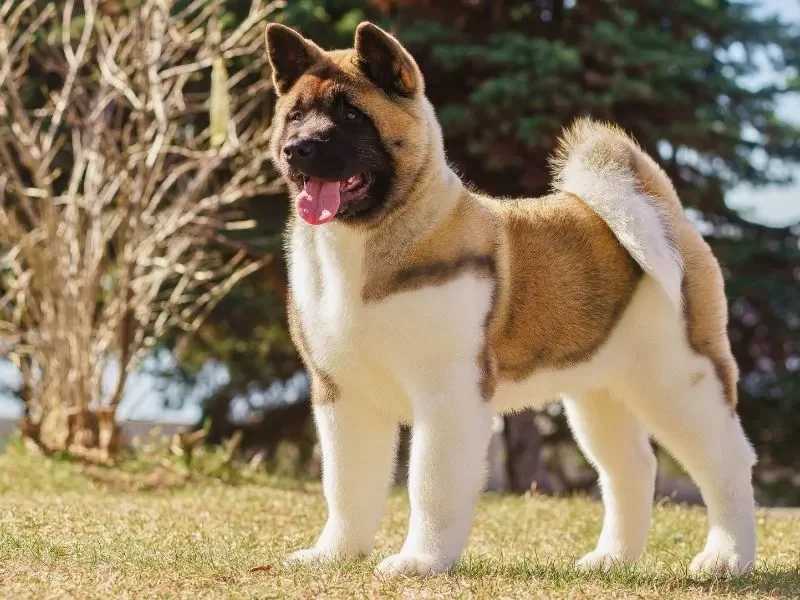
- Akita
- American Bulldog
- Dogo Argentino
- Fila Brasileiro
- Japanese Tosa
- Neapolitan Mastiff
- Pit Bull Terrier or Pit Bull, also known as American Pit Bull, American Pit Bull Terrier, American Staffordshire Terrier, and Staffordshire Bull Terrier
Extra rules for pets from Australia
Malaysia’s Australia-specific rules are stricter than the lists above:
- the Boerboel and the Perro de Presa Canario are banned
- the Cane Corso is added to the restricted breeds
- a restricted breed must be at least 9 months old and neutered, and come with a pedigree certificate from an approved organisation in Australia
- first to fourth generation Bengal and Savannah cats are banned, and a Bengal or Savannah can only come in with documents proving it is at least five generations from its wild ancestor
Quarantine on arrival
Unless your pet is coming from a quarantine-exempt country, it will be taken straight to a quarantine station when it arrives, accompanied by a MAQIS officer.
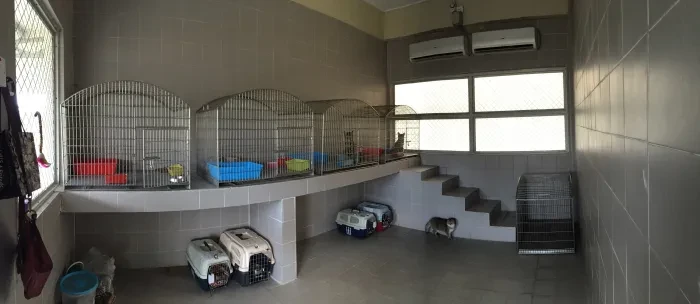
MAQIS has four quarantine stations at KLIA, Batu Maung in Penang, Padang Besar and Rantau Panjang, and which one your pet goes to generally depends on your point of entry.
From what we can tell, they are all well maintained, and you can visit your pet during set visiting hours too 🙂
How long depends on where your pet is coming from:
- Quarantine-exempt countries: no quarantine
- Australia: at least 14 days
- all other countries: at least 7 days
These are minimum periods. MAQIS can extend quarantine after a risk assessment, and country rules do change, so confirm the current requirements for your origin before you book.
Quarantine isn’t a boarding service, though, as you’ll need to bring your pet’s food and equipment, and feed it and clean its room every day. Once the quarantine period ends and the charges are paid, your pet is released to you with a quarantine certificate.
When to start your pet’s relocation prep
Swift Cargo will be able to advise you best since they’ll have the fullest picture of your pet’s situation and the requirements from your country of origin.
That said, based on the MAQIS process and MM2H, here are some general recommendations.
| Stage | What to do for your pet |
|---|---|
| While your application is being processed |
|
| After conditional approval |
|
This brings us to our last section, which is a friendly word of caution about where you buy your forever home in Malaysia.
Purchasing a pet-friendly MM2H property
MM2H requires you to buy a home in Malaysia, which you can’t sell unless you upgrade to a more expensive property.

Without factoring in a pet, the typical MM2H home purchase needs to fulfil two things:
- the minimum purchase price of the MM2H tier, and
- the minimum purchase price of the state for foreigners (which is often higher)
Now you’re bringing in a cat or dog, you also need to ensure your home and surrounding neighbourhood can accommodate it. We wouldn’t be able to do this topic justice here, but here are some key points to consider:
- many condos here restrict pets, either banning them outright or limiting size and number
- not all landed homes will pass the MAQIS inspection needed to house a restricted dog breed
- not all landed homes that can house a restricted dog breed are in a dog-friendly neighbourhood!
While Malaysia is home to multiple religions, it is an officially Muslim country, and not all residents would be equally thrilled that their next door neighbours have twenty German Shepherds gambolling about!