
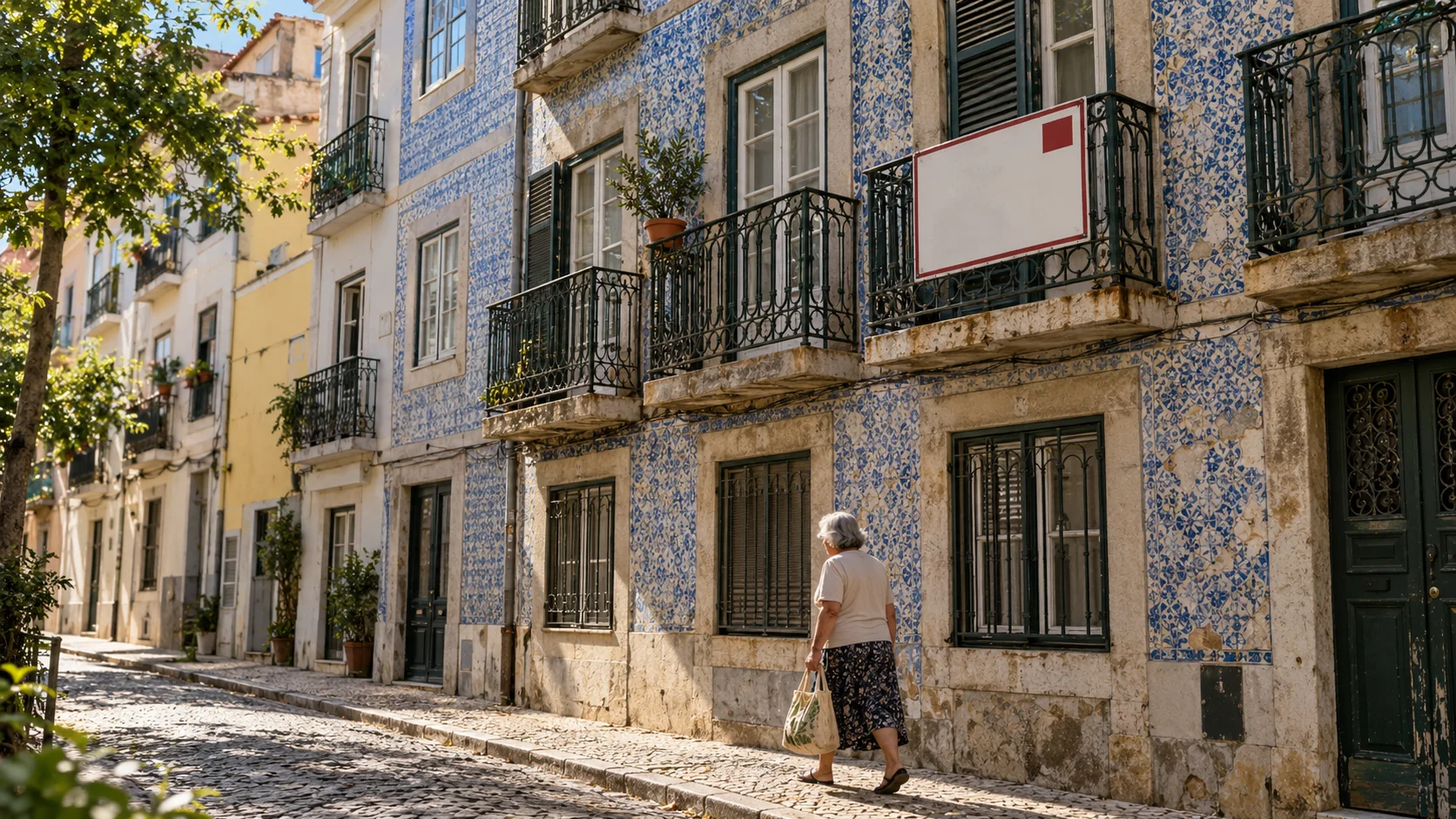
The Short Answer: No, Not Since October 2023
Search “property investment in Portugal” or “Portugal Golden Visa properties” today and a meaningful share of what comes back still assumes the old rules. It is an understandable mix-up. For over a decade, buying a home in Portugal was the fastest, simplest way into the Golden Visa, the residence permit officially called the Autorizacao de Residencia para Investimento, or ARI. That changed on 7 October 2023. Direct real estate purchase, property renovation, and capital transfer into property all stopped qualifying on that date, under a law known as Lei n.o 56/2023, de 6 de outubro, Portugal’s “Mais Habitacao” housing package.
Nothing about that fact is new. Most guides state the closure and move on. What is worth walking through carefully is what the change actually removed, what happened to the people whose applications were already moving, and whether any of the routes that survived still touch property in a way that is easy to mistake for a workaround.
It is also worth being honest about who lands on a search like this one. Some readers here are specifically Golden Visa researchers, working out whether real estate is still a route to residency. Others typed “property investment in Portugal” with no residency angle at all, weighing an ordinary buy-to-let purchase or a holiday home. Both questions get a real answer below, but they are not the same question, and conflating them is exactly how the outdated “buy a house, get a visa” idea keeps circulating.
What Lei n.o 56/2023 Actually Removed
Before October 2023, three property-linked paths qualified for the Golden Visa. A direct purchase of residential real estate worth 500,000 euros or more was the best known. A renovation route existed too, for properties over 30 years old or sitting in an urban rehabilitation area, at a lower combined threshold of around 350,000 euros. A third route let an investor qualify through a capital transfer of 1.5 million euros or more, which in practice was frequently structured around property as well. Mais Habitacao removed all three at once, and it did so for a stated reason: the government itself framed it this way. Golden Visa property purchases were adding pressure to a housing market Portuguese residents were already struggling to afford. Redirecting the program toward funds, research, culture and job creation served the country better than continuing to subsidize demand for the same homes ordinary buyers were competing for.
Low-density areas do not bring the property route back either. Before 2023, a reduced threshold applied there too, and reporting on the reform is consistent that this was removed along with everything else. Where a low-density discount survives today, it applies to one of the routes below, the cultural donation, not to any form of real estate purchase.
What Still Qualifies for the Golden Visa
Portugal’s immigration authority, AIMA, lists the routes that remain, and our full breakdown of Golden Visa routes and costs covers each one in more depth than this article needs to. Job creation is the most direct: create at least 10 permanent jobs in Portugal and no separate capital minimum applies. A related route lets you incorporate or expand a company with a minimum share capital of 500,000 euros, provided it creates or maintains at least 5 permanent jobs for a minimum of three years. Donations qualify too: 500,000 euros to a public or private scientific research institution, or 250,000 euros toward artistic production or cultural heritage preservation, with that figure commonly reported as reduced to around 200,000 euros for projects in designated low-density areas.
The route doing most of the volume today is the fifth one: a 500,000 euro investment into a qualifying investment fund. The specialist advisory firms that dominate this search space now recommend it by default, largely because it asks the least of an investor in terms of active management. The next section covers why that fund route is not a quiet path back into real estate, despite how often it gets framed this way.
One more difference is worth naming, since it is a large part of why the fund route appeals to people who never actually planned to live in Portugal. AIMA’s own physical-presence rule for Golden Visa holders is light: roughly 7 days in the country in the first year and 14 days in each year after that, far short of the 183-day threshold that would make you a tax resident. A property purchase used to fit that same low-commitment profile, buy a home, spend a couple of weeks a year in it, keep the visa active. The routes that replaced it do not ask for more physical presence, but they do ask for real, ongoing capital at work in a fund, a company or a research institution rather than a static asset sitting empty. Source current thresholds directly with AIMA before acting on any of these figures. Investment-migration program terms change, and a number that is accurate today is not a guarantee for next year.
If You Already Had an Application Moving
The reform is widely reported as non-retroactive. Applications already submitted before 7 October 2023 are reported to continue processing under the rules that existed when they were filed, real estate route included. That includes ones still sitting at an early stage, such as awaiting a municipal pre-approval. Existing Golden Visa holders kept their status and renewal rights regardless of which route they originally used.
This is also where a common piece of secondhand evidence gets misread. If you have heard a specific story about someone who used property to get their Golden Visa in 2024 or 2025, that is not proof the route quietly reopened. It almost certainly describes a grandfathered application that was already in the pipeline before the cutoff, working its way through a genuinely large backlog. That backlog was reported at roughly 50,000 pending ARI requests with AIMA as of early 2025. AIMA launched a dedicated digital renewal portal in February 2026 aimed at that backlog specifically, which tells you the queue was still substantial well over two years after the law changed. A real outcome from an old application says nothing about whether a new one filed today could use the same route. Confirm your own case directly with AIMA or a licensed Portuguese immigration lawyer rather than reasoning from someone else’s result, since individual filing dates and stages genuinely change the answer.
If you are holding one of these grandfathered cases, it is worth knowing that renewal changes the permit’s label too. On renewal, a real-estate-route Golden Visa is reported to convert into a different permit category, one built for immigrant entrepreneurs. That category carries its own updated in-person renewal process and minimum-stay rules. It does not lapse, but it stops being the same product it started as.
Swift Cargo ships households once a Portugal move is real.
Whichever route actually gets you there, a Golden Visa fund, a D7, or a D8, moving your household is a separate, practical question, and it is one we handle every day.
The Workaround People Keep Looking For: Funds With Property Inside
Given how central real estate used to be, it is a reasonable question: can a fund simply hold real estate and let an investor qualify that way regardless? The answer is no. A qualifying fund has to be regulated by Portugal’s securities market regulator, the CMVM, carry a minimum remaining maturity of five years at the time of investment, and commit at least 60 percent of its capital to Portuguese companies rather than property. Direct or indirect real estate exposure disqualifies a fund outright, which rules out property-linked funds, REIT-style vehicles and development funds specifically, not just a straightforward apartment purchase dressed up differently.
The same logic applies to the company-incorporation route. Qualifying there rests on the 500,000 euros in share capital and the jobs the company creates or maintains, not on anything the company happens to own. A Portuguese company formed under this route could, in principle, hold real estate as a genuine operating asset, run as an actual business, a small hotel, for instance. But the property itself carries no special immigration status and does nothing to reduce the capital or job-creation thresholds. It is an ordinary business asset inside an ordinary company, taxed and regulated the same way any other commercial property in Portugal would be. If the pitch behind a fund or a company structure amounts to “your money still ends up in property,” that structure almost certainly does not qualify, and is worth having independently checked by a licensed advisor before any capital moves.
Buying Property Still Works. It Does Something Different Now.
None of this means buying property in Portugal stopped being possible or sensible. Foreigners can still buy Portuguese real estate freely, the same as before 2023. What changed is narrower and more specific than most headlines suggest: that purchase no longer functions as an investment-migration route on its own. It buys you a home, not a residence permit.
The more relevant visas are the D7 and the D8 for someone whose actual goal is living in Portugal rather than qualifying through a large, largely passive investment. The D7 and D8 comparison we have written covers both in detail, but the short version matters here: both are qualified through income, passive income for the D7, remote employment or freelance income for the D8, not through owning property. A property purchase can support either application, since demonstrating accommodation is part of the paperwork, but it does not substitute for the income test, and it does not shorten the process. The Golden Visa and the D7/D8 routes solve genuinely different problems: the Golden Visa asks for capital and, for most applicants, very little physical presence, while the D7 and D8 ask for income and, in practice, an actual move.
One More Change That Landed Alongside This: The Citizenship Timeline
A second, unrelated change is worth flagging here because people researching the Golden Visa often run into both at once and blur them together. Portugal’s nationality law changed under Lei Organica n.o 1/2026, in force since 19 May 2026. It extended the standard path from legal residence to citizenship eligibility from 5 years to 7 years for EU and CPLP nationals, or 10 years for everyone else. This is a citizenship-timeline change, not an investment-rules change. It applies on top of whichever route got you your residence permit in the first place, Golden Visa included, and it has nothing to do with which investment routes currently qualify.
Where This Leaves Someone Weighing the Golden Visa Today
Treat any Golden Visa pitch built around real estate as a signal to look closer rather than a reason to move faster, however it is framed. The routes that survived the 2023 reform ask for something genuinely different from a property purchase: a fund investment with no property exposure allowed, job creation, company capital tied to jobs, or a donation to research or culture. None of them is a relabeled version of buying a house.
None of this is investment, tax or immigration advice, and Swift Cargo is not a licensed advisor in any of those areas. The routes and thresholds above change, individual applications vary, and a decision this size deserves a real conversation with a licensed Portuguese immigration lawyer and, separately, a tax advisor who understands your home country’s rules, before any capital moves or any application gets filed.
Related Reading
- Portugal Golden Visa: Investment Routes, Costs and the Path to Citizenship
- Portugal Digital Nomad Visa: D7 vs D8
- Portuguese Citizenship, Passport and Residence Permit
- Retiring to Portugal from Australia: Visa, Pension and Tax Guide
- Moving to Portugal from the UK: Complete Relocation Guide
- Moving to Portugal from the US: Complete Relocation Guide
- Cost of Living in Portugal: A City-by-City Breakdown
Frequently Asked Questions
Can I still buy property in Portugal to get a Golden Visa?
No. Direct real estate purchase, property renovation and capital transfer all stopped qualifying for the Golden Visa on 7 October 2023, under Lei n.o 56/2023. You can still buy property in Portugal as a foreigner, but the purchase itself no longer earns you a residence permit.
What investment routes still qualify for Portugal’s Golden Visa?
Five main routes remain: a 500,000 euro investment in a qualifying, non-real-estate investment fund; creating at least 10 jobs; incorporating or expanding a company with 500,000 euros in capital that creates or maintains at least 5 jobs for 3 years; a 500,000 euro donation to scientific research; or a 250,000 euro donation to arts, culture or heritage preservation, reduced to 200,000 euros in designated low-density areas.
What happens if I already had a property-route Golden Visa application in progress before October 2023?
The change is widely reported as non-retroactive. Applications submitted, or already at an early stage such as awaiting municipal pre-approval, before the law took effect are reported to continue processing under the old rules, including the real estate route. Confirm your own application’s status directly with AIMA or a licensed Portuguese immigration lawyer, since individual cases vary.
Can a Golden Visa investment fund get around the property ban by holding real estate indirectly?
No. A qualifying fund cannot hold real estate directly or indirectly. It must be regulated by Portugal’s securities regulator, the CMVM, run for a minimum of five years, and put at least 60 percent of its capital into Portuguese companies rather than property. Property-linked funds and real estate investment vehicles do not qualify.
Does buying property in Portugal help with a D7 or D8 visa instead?
It can support an application, since owning or renting a home is part of showing you have accommodation, but it is not an investment route and does not reduce the income or documentation requirements. The D7 and D8 are qualified through passive income or remote work income, not through a property purchase.
Has anything else about the Golden Visa changed recently?
Yes, separately from the investment rules. Portugal’s nationality law changed under Lei Organica n.o 1/2026, in force since 19 May 2026. It extended the standard path from legal residence to citizenship eligibility from 5 years to 7 years for EU and CPLP nationals, or 10 years for everyone else. This affects the citizenship timeline, not the Golden Visa’s residency rules themselves.